
Small website SEO: why does a ten-page site stay invisible in AI answers? 6 gaps
Let’s say you run a physiotherapy clinic in Avcılar, Istanbul, and your website has ten pages: home, about, five services, team, contact and an empty blog. From a small website SEO point of view it looks fine: fast, correct address, one-tap phone. Yet when someone asks ChatGPT or Google “how many physio sessions does a herniated disc need”, your name never comes up.
AI does not build an answer from a website but from the passages that answer the question most clearly. A ten-page site answers ten questions at most, while your customer asks dozens before walking through the door. The difference shows up as six gaps in the question map: price, duration, comparison, location, suitability and worry. Until those gaps are filled, the site sits in the shop window but never makes it into the answer.
What does AI look at when it builds an answer?
BU BÖLÜMÜN ÖZETİ
- One question, six sub-questions
- No extra requirement, but you need the page
- The technical side is a separate topic
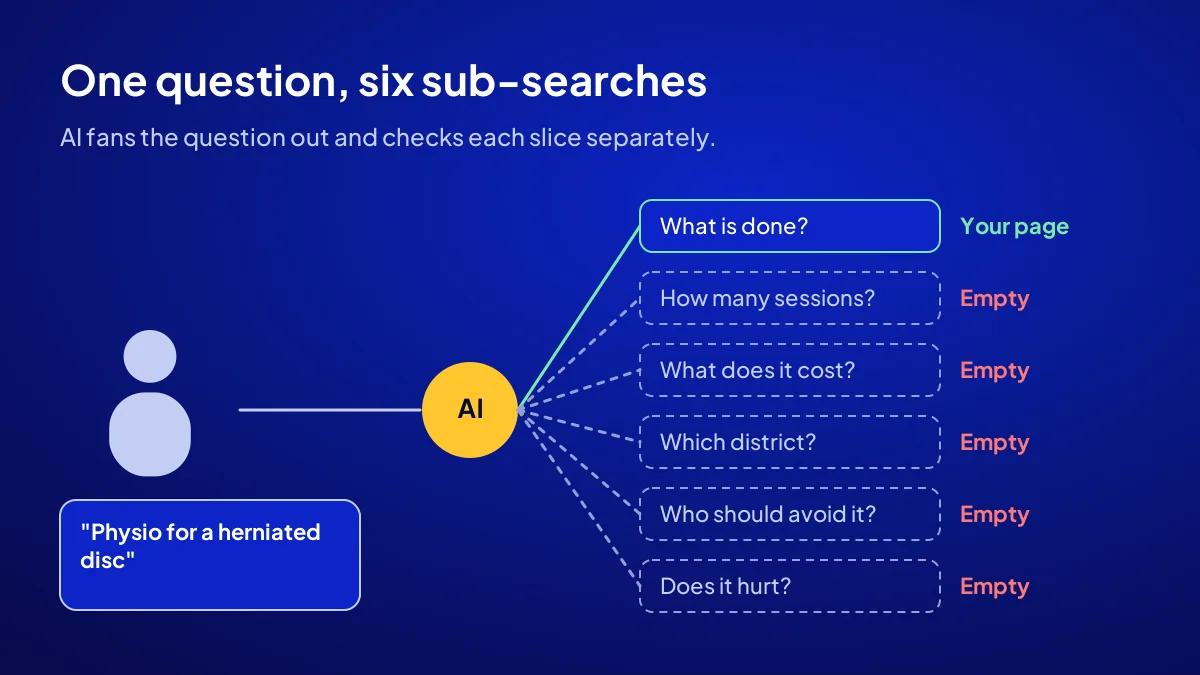
Google’s documentation says its AI features can split a question into subtopics and search each one separately. This is called query fan-out: the question opens like a fan. Each sub-search looks for the page that answers that sub-question most clearly. If your site has no page for that sub-question, you are missing from that slice of the fan.
One question, six sub-questions
“Physiotherapy for a herniated disc” is one line, but six questions wait behind it. How many sessions, what does a session cost, does insurance cover it, does it hurt, which district has a good clinic, who should avoid it. Your service page may answer one of them.
No extra requirement, but you need the page
Google says no additional requirement or special optimisation is needed to appear in its AI overviews. The page must be indexed and eligible to show as a snippet. So settings are ready on most sites; what is missing is the page written for the question.
The technical side is a separate topic
Crawler blocks, slow loading or indexing problems can also drop you; we cover those in why isn’t my website recommended by AI. Here the subject is the content gap.
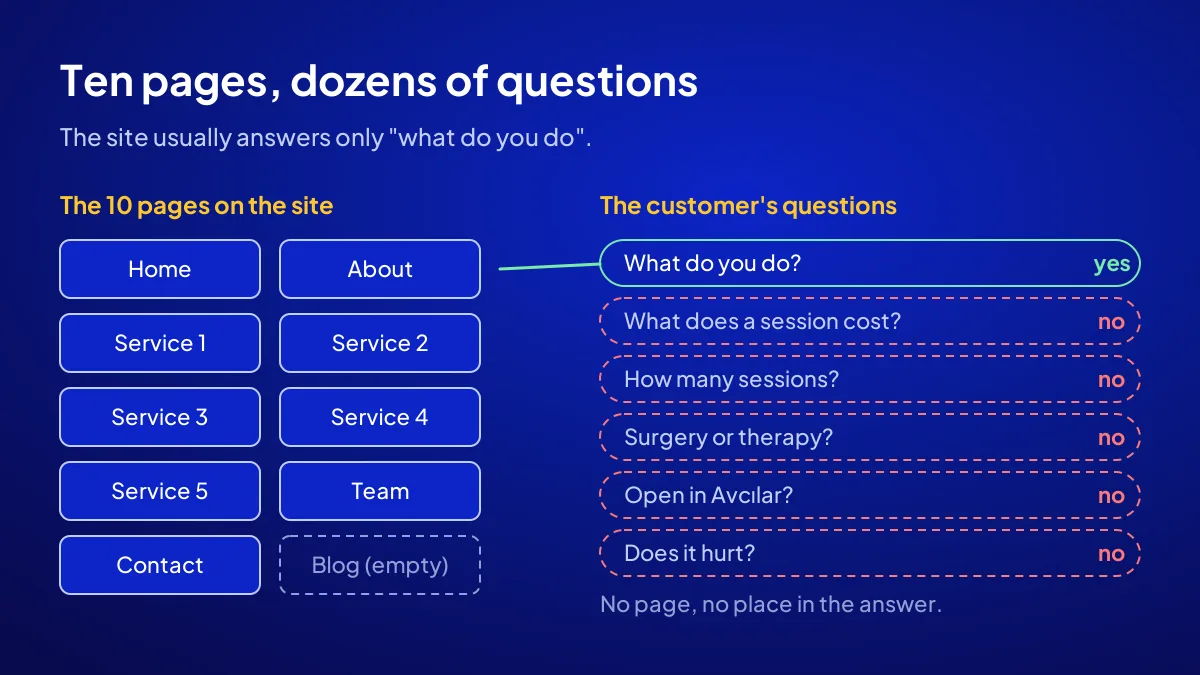
Why can ten pages give no more than ten answers?
Every page has one main question. A service page says “what we do”; it does not say “how long it takes” or “is it right for me”. AI reads the paragraph that meets a sub-question, not the whole page. Squeeze five topics into one page and none gets a clear paragraph, so the page comes second on every question.
A service page introduces, it does not answer
“We offer manual therapy, kinesio taping and dry needling” is an introduction. The customer’s question is narrower: “how many sessions does dry needling take to work”. The introduction names the topic but leaves the question open.
An empty blog is a shop with the shutters down
Most small sites have a blog tab that is empty or holds one old announcement. To AI it is a shuttered window, yet that tab is exactly where question-answering pages belong.
What are the 6 gaps in the question map?
BU BÖLÜMÜN ÖZETİ
- The price and duration gaps cost the most
- The comparison and location gaps go to competitors
- The suitability and worry gaps break trust
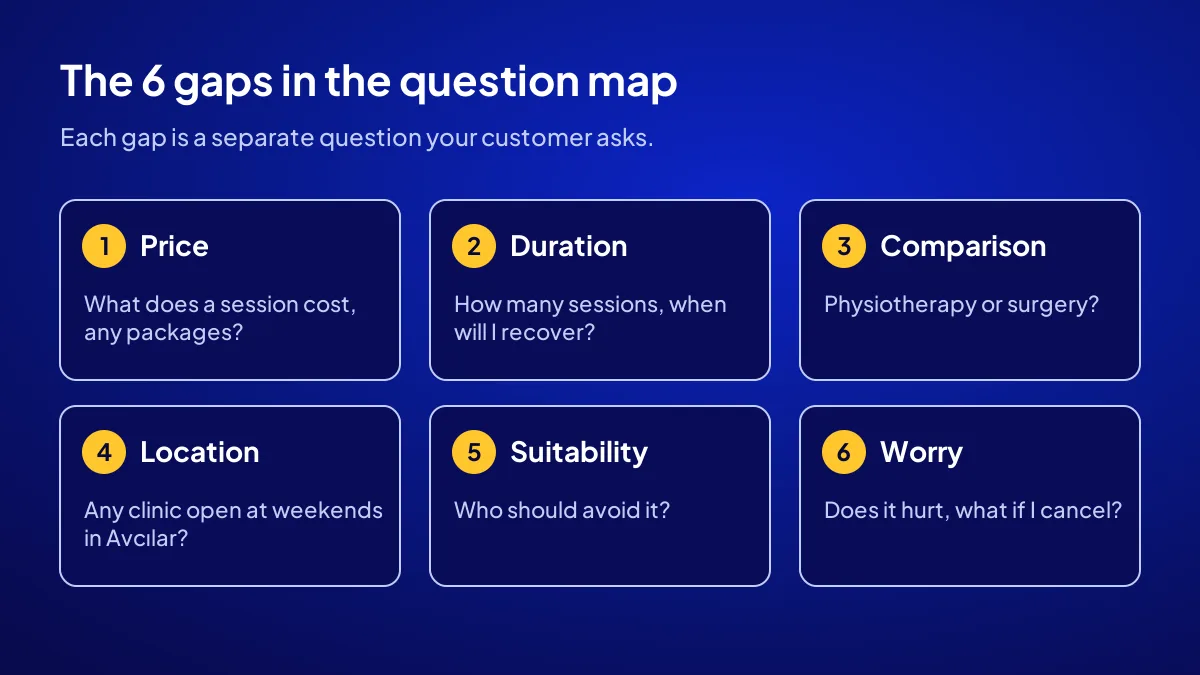
Customer questions fall into six groups, and a ten-page site usually covers only one of them: “what do you do”. The other five, often all six, stay uncovered. The table shows each gap with the customer’s own words and the typical state on a small site.
| Gap | Customer’s question | On a ten-page site |
|---|---|---|
| Price | What does a session cost, is there a package? | Usually missing, “call us” instead |
| Duration | How many sessions, when will I recover? | Missing |
| Comparison | Physiotherapy or surgery? | Missing |
| Location | Is there a clinic open at weekends in Avcılar? | Only an address line |
| Suitability | Is it safe in pregnancy, who should avoid it? | Missing |
| Worry | Does it hurt, what if I cancel a session? | Missing |
The price and duration gaps cost the most
These two questions make the decision. Stay silent on them and the customer goes to the competitor who answers. “Call for prices” means saying nothing online.
The comparison and location gaps go to competitors
“Which one” and “where” are the questions in which AI lines several businesses up side by side. If your name is not in those answers, the list is built without you.
The suitability and worry gaps break trust
If people cannot find an answer to “is this right for me”, they do not come in. One paragraph that settles a worry often does more than your best sales line.
The problem is not page count but unanswered questions
BU BÖLÜMÜN ÖZETİ
- Writing the same question twice closes nothing
- One gap, one page, one clear answer
- Six pages are only the start
Here is the unexpected finding: a hundred-page site can be stuck in the same place. If those pages repeat one question in different words, the map is still empty. The measure is the number of distinct questions answered, not pages. More pages only matter when each closes a new question.
Writing the same question twice closes nothing
Two pages written for the same question block each other. In SEO this is called cannibalisation. The search engine cannot decide which one to show, so both stay weak.
One gap, one page, one clear answer
Take the clinic in Avcılar. Each gap gets its own page, and each page opens with a clear two-sentence answer to the question. We explain how to write that answer, rule by rule, in writing FAQ blocks that AI quotes.
Six pages are only the start
Each gap holds several questions. Under “price”, the session fee, the package fee, insurance and payment options are separate questions. As the map grows, your name sits in more slices of the fan.
What are the three ways to fill the gaps, and who suits each?
BU BÖLÜMÜN ÖZETİ
- If you write them yourself
- A few posts a month
- Building the map in one period
Three routes: write the pages yourself, buy a monthly blog service, or have the whole map built in one go. The difference is speed and completeness. Your own page is the most personal, but leaving the counter while the till is busy is hard. Monthly posts move slowly; a one-off build closes the map in one period.
If you write them yourself
Take the question you hear most on the phone and write one page for it. Even one page a week covers a good part of the map within a year. The hard part is keeping it up, because writing is the first thing dropped in a busy week.
A few posts a month
A monthly blog service moves steadily but takes a long time to complete the map. You will find a 12-month comparison of both routes on the same budget in monthly blog plan or AI SEO package.
Building the map in one period
Adapte’s AI SEO Campaign fills these gaps with 108 articles across 6 question groups, delivered in 30 days. The price is a fixed TRY 36,000 + VAT; with 20% VAT that is TRY 43,200, so check the current rate on your invoice. Only 12 businesses are taken per period, and there is no guarantee of being recommended; the readability and recognisability groundwork is built and measured at the start and end. Details are on the AI SEO Campaign page.
How can you spot your own site’s gaps in 15 minutes?
You need a pen and paper, not a tool. Write down the questions customers ask on the phone or at the counter, and check whether each has an address on your site. Every question without one is a gap. The six steps below take fifteen minutes.
- Write down six questions customers asked in the last week, word for word.
- Place each question in one of the six gaps above.
- Point to a single page that answers each question; if you cannot, mark the gap.
- On the pages you found, check whether the answer sits in the first two sentences.
- Type each question into Google and an AI assistant, and note whose name appears.
- Rank the marked gaps, starting with the most frequently asked.
How to read the result
If three or more are marked, your site works like a business card. People searching your name find you; people searching with a question do not. Word-of-mouth customers keep coming; new ones knock on another door.
If you want the full picture
We explain how the question map joins up with diagnosis, entity setup and measurement in AI SEO with 108 articles. Keep one principle in mind: every question your customer asks deserves an address on your site.
Quick Summary
- AI builds an answer from the passages that answer each sub-question most clearly.
- A ten-page site usually covers only the “what do you do” question.
- Six gaps: price, duration, comparison, location, suitability and worry.
- The measure is distinct questions answered, not page count.
- Google says AI overviews need no extra technical requirement; the page must be indexed.
- The campaign builds the map with 108 articles in 6 question groups in 30 days, with no guarantee.
Short Glossary
Query fan-out: Query fan-out is the technique AI uses to split a question into subtopics and run a separate search for each.
Question map: A question map is the plan used to group the questions a business’s customers ask and give each one its own page.
Snippet: A snippet is the name used for the short text extract shown under a page in search results.
Next Step
If more than three gaps are marked on your paper, it is time to build the map in one period. Apply for the AI SEO Campaign, share your site and target questions, and we will start with your diagnosis card.
Frequently Asked Questions
Source: Google Search Central — AI features and your website
Sık Sorulan Sorular
It can appear, but only for the questions the site answers. A ten-page site mostly shows up when people search the business name and leaves gaps when they search with a question.
In the campaign every article is written for a specific question and intent. The number comes from the questions in the map; articles that repeat the same question are not produced.
No. There is no guarantee of being recommended. The campaign builds readability and recognisability groundwork and measures it with start and end diagnosis cards.
Updated: October 2026