
Domain value: how it forms and the 6 sources behind a keyword domain’s worth
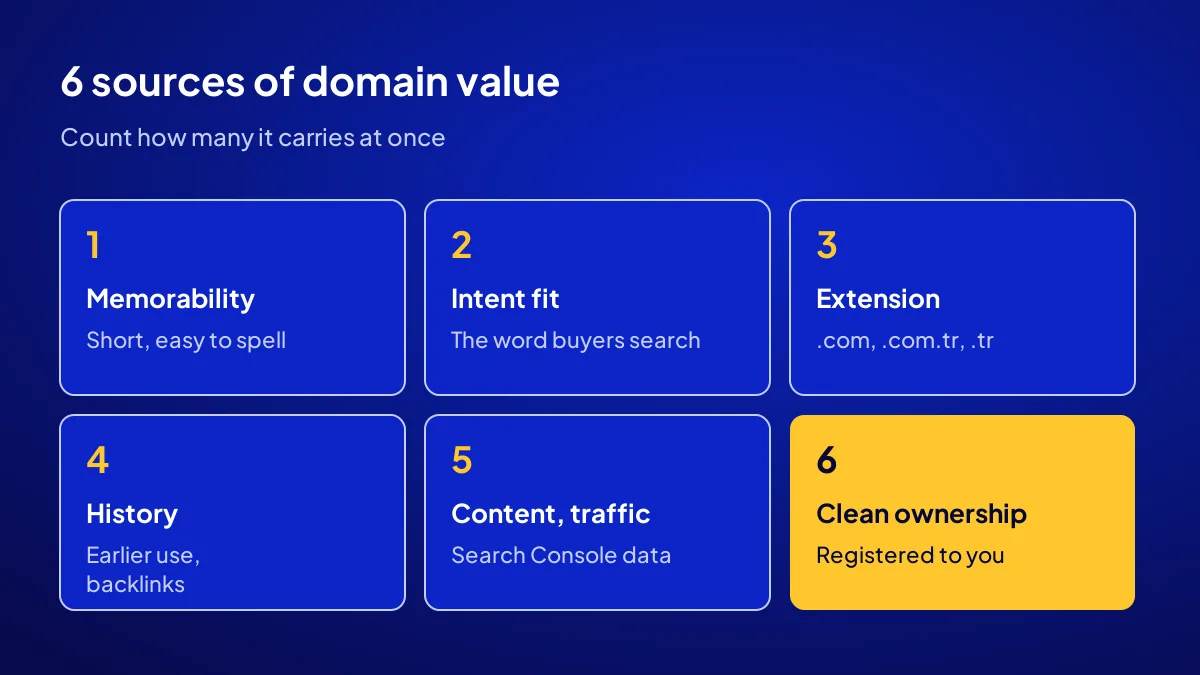
Domain value forms from six sources: memorability, fit with search intent, the extension, history and links, the content and traffic on it, and finally clean ownership. The keyword is only one piece of this.
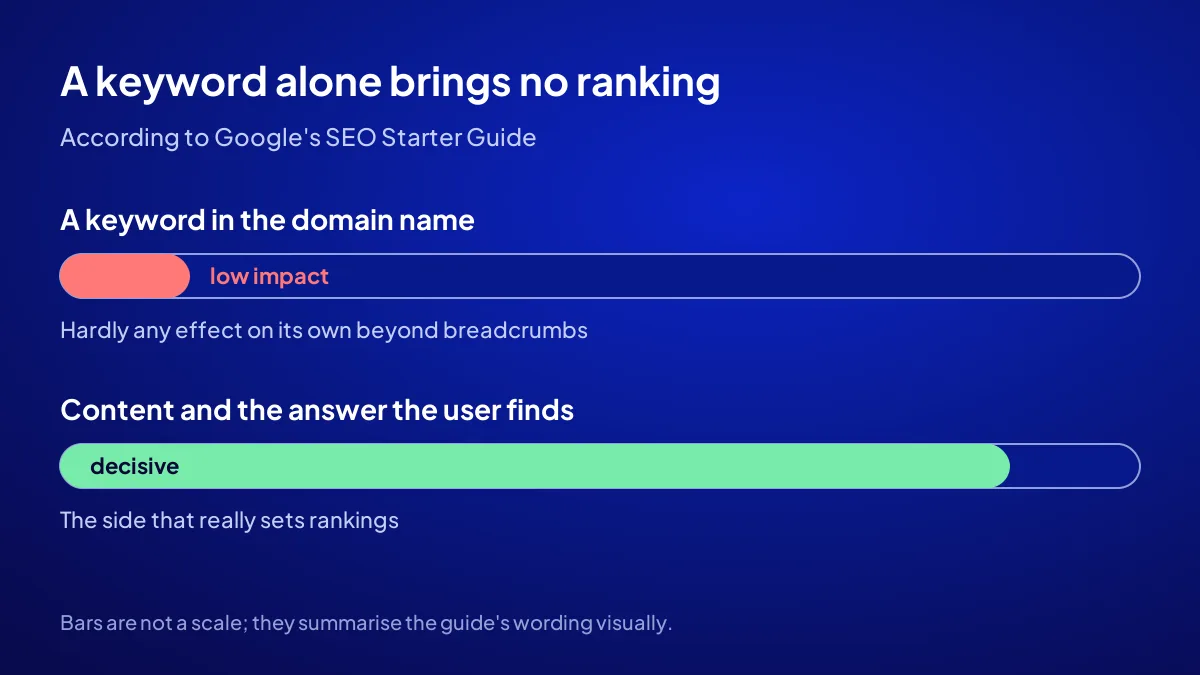
Most people do not know this: Google’s own SEO Starter Guide says that keywords in a domain name have hardly any effect on rankings on their own. So an address carrying the word will not lift you to first place by itself. The value is set by the content built on top of the address and by whose name the address stands in.
Why can’t domain value be measured with a single number?
Because a domain is a sign, a title deed and a memory all at once. A short, memorable name is valuable as a sign. Being cleanly registered in your name is its deed value. The links and traffic it gathers over the years are its memory. That is why two similar domains can carry very different prices.
An empty address and a full one
A domain that has never been used is like a plot of land with no building on it. The location may be good, but nobody lives there. The building, meaning the site and its content, lifts the value to another floor.
The seller’s price, the buyer’s price
Everyone holding a domain thinks their address is worth a fortune. But the value of goods is measured by what the buyer will earn from them. The shopkeeper’s saying “the owner sees one price, the customer sees another” holds here too.
Does a keyword in the domain lift you to the top?
Not on its own. According to Google’s SEO Starter Guide, keywords in a domain name or URL have hardly any effect by themselves beyond appearing in breadcrumbs. The guide also says the top-level domain matters only when you target users in a specific country, and even then it is usually a low-impact signal. Rankings are set by the content and by the answer the user finds.
When the word meets the content
A keyword domain gains meaning when it is combined with content focused on that word. The address makes a promise and the content keeps it.
Which 6 sources make a domain valuable?
There are six sources and each can be checked separately. Memorability and fit with search intent come from the name itself. The extension shows which market the address speaks to. History and links build up over the years. Content and traffic are added later. Clean ownership is the ground all of them stand on. The table below shows each source and how to check it.
| Source of value | What it means | How to check it |
|---|---|---|
| 1. Memorability | A short name, easy to spell, understood when spoken | Say it once on the phone: can the other person type it correctly? |
| 2. Fit with search intent | Carrying the word the sector searches for | Compare it with the questions the sector asks most |
| 3. Extension | An ending such as .com, .com.tr or .tr | Is your target market Türkiye or the world? |
| 4. History and links | The address’s earlier use and the backlinks pointing to it | Look at archive records and the link profile |
| 5. Content and traffic | The site on the address and its visitors | Search Console impression and click data |
| 6. Clean ownership | The record being in your name and free of problems | The WHOIS record and the renewal period |
History, the unknown side
The links of a previously used domain can add value. But it can also carry a bad past. That is why the history of a second-hand domain is always examined before buying.
Whose name should the domain be registered in, and why?
BU BÖLÜMÜN ÖZETİ
- A domain is not bought, it is rented
- The risk of an agency registration
- Check the renewal period
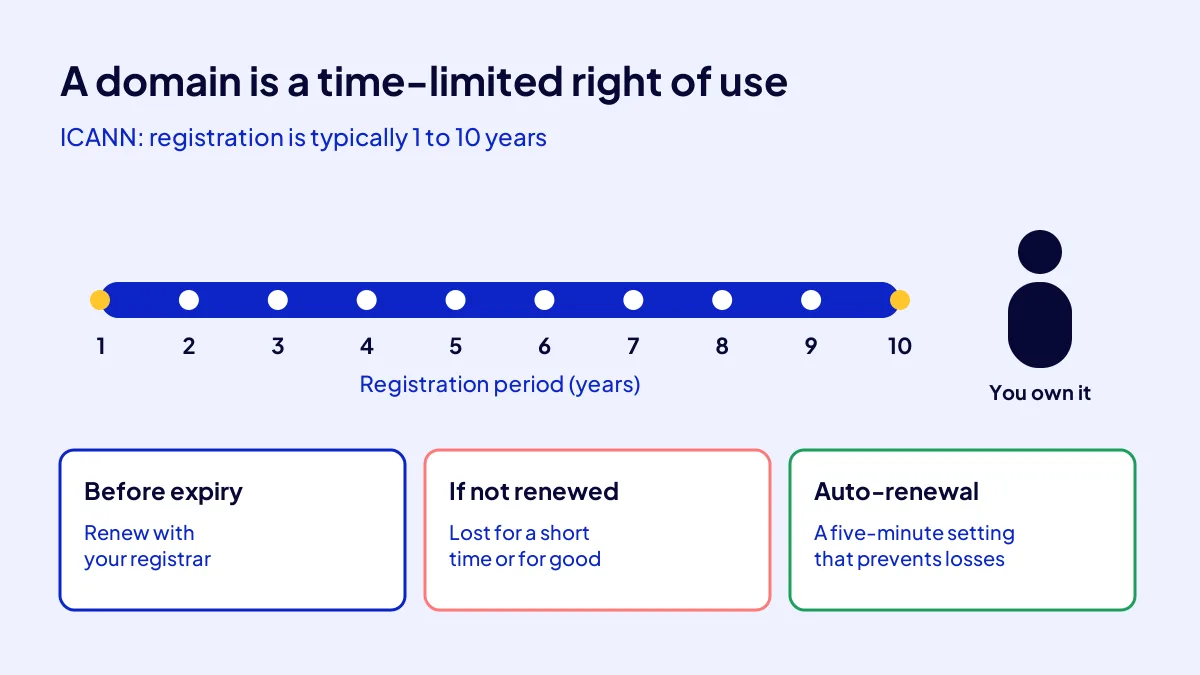
The domain should be registered in your name, because all of its value depends on ownership. According to ICANN’s page on renewing domain names, a domain is yours for the period you registered it, typically between one and 10 years. To keep using it, you have to renew it before it expires. If you do not, you risk losing it for a short time or possibly for good.
A domain is not bought, it is rented
It sounds odd, but a domain is really a time-limited right of use. The fee you pay the registrar extends that period. If the renewal day slips by, someone else may open your shutters.
The risk of an agency registration
Some businesses have their domain registered to the person or agency that built the site. When the parting comes, the address stays with the other side. In Adapte’s campaign, the domain is registered in your name from day one. We cover the rules for addresses ending in .tr in .tr domains: the latest.
Check the renewal period
You can see your domain’s expiry day in your registrar’s panel or through a WHOIS lookup. Turning on auto-renewal takes five minutes and is the setting that prevents the most losses.
What is the value gap between an empty domain and a full one?
The gap is the traffic and the content themselves. An empty domain carries only a possibility. A full domain with regular visitors is a measurable asset. A buyer, a tenant or your own business prices it by looking at that traffic. You will find the whole asset idea in owning a digital asset.
What can be measured can be sold
A site with Search Console data can tell a buyer “this address brings this many people a month”. An empty address can only say “it might one day”.
The return on value
We explain separately when and how a digital investment pays you back in digital transformation ROI.
How is the domain chosen in the START package?
BU BÖLÜMÜN ÖZETİ
- The domain does not come alone
- Slots and coupon
- Now you know
Choosing the domain is part of the project planning step in the START package. First a sector and opportunity analysis is done, then a domain that fits that sector’s questions is chosen. The domain is bought in your name and 1 year of hosting is included. The package is TRY 36,000 + VAT, upfront and fixed; with 20 percent VAT it comes to TRY 43,200, so check the current rate on the invoice.
The domain does not come alone
On the chosen address, a site with 6 main and 12 sub pages and 108 posts across 6 keyword groups is built. So the address does not stay an empty plot. If you want to search for a keyword address yourself, follow the steps in how to find a keyword domain.
Slots and coupon
The campaign has 12 project slots, and the last day is 1 November 2026. If you have a 10 percent coupon, just mention the code when you apply or during the call. To apply, go to the Own a Digital Asset campaign page.
Now you know
The word in a domain does not bring rankings on its own. Value comes from six sources, and the strongest is an address registered in your name with content standing on it.
Quick Summary
- Domain value forms from six sources; the keyword is only one of them.
- According to Google, a domain keyword has a low ranking effect on its own.
- A domain is a time-limited right of use, typically registered for 1 to 10 years.
- If ownership is not in your name, all of the value is at risk.
- A full domain with traffic carries more than an empty one.
- In the START package the domain is bought in your name, with 1 year of hosting.
Short Glossary
Registrar: A registrar is the term used for a company authorised to register and renew domain names.
WHOIS: WHOIS is the registration database used to look up whom a domain is registered to and until when.
Backlink: A backlink is a link from another site to your page that search engines treat as a sign of trust.
Next Step
To start with a domain that fits your sector and is registered in your name, apply for the Own a Digital Asset campaign. The domain is chosen together in the project planning step.
Sık Sorulan Sorular
A keyword name builds trust and a sense of fit in the searcher’s eyes. Someone searching for “Beylikdüzü hairdresser” may click more readily on a result whose address contains those words. That is not a ranking signal; it is human behaviour.
Customers hear your address by word of mouth and keep it in mind. A long, hyphenated or confusing name gets lost on that journey. A short name is like a sign that is easy to read.
In Adapte’s Own a Digital Asset campaign, the domain is registered in your name. The asset belongs to you, and the right to rent or sell it later is yours too.
No. According to Google’s SEO Starter Guide, a keyword in the domain has hardly any effect on its own. Rankings are set by the content and the answer given to the user.
If it is not renewed before it expires, the domain can be lost for a short time or for good. Turning on auto-renewal and tracking the expiry day reduce this risk.
Updated: October 2026