
Website rental: why a site that collects traffic can be rented out to a business
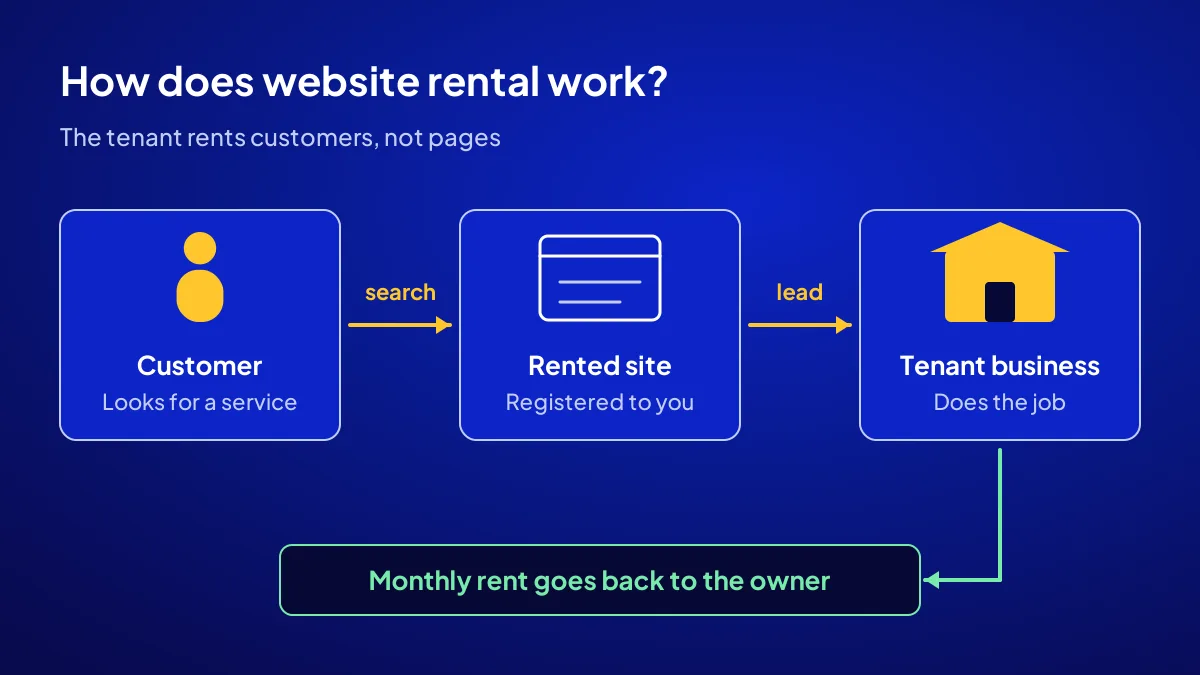
Website rental means handing the calls and enquiries a traffic-collecting site brings to another business for a monthly fee, for a set period. The tenant rents the calls and forms, not the pages, so a site can be rented only while it brings customers.
It works like renting out a shop. The domain stays in your name, the tenant pays for use, and the site returns to you when the lease ends. In the Own a Digital Asset campaign the asset is yours too, and renting or selling it later is possible. There is no earnings guarantee, though.
What is the tenant actually renting?
The tenant rents the leads the site brings every month. For a plumber or an air conditioning service, what matters is not how pretty the page is but whether the phone rings. The rent is set by the number of calls and forms the site produces.
What is rented: calls, forms and visits
The tenant wants the site’s number and form working for it. The real question is how many jobs reach its door each month.
What is not rented: ownership
The domain stays in your name, and the content stays yours. You give the tenant a right of use, not the property. You keep the deeds, the tenant gets the keys.
Say people looking for air conditioning repair in Beylikdüzü land on your site
Say you have a site that shows up for searches like “Beylikdüzü air conditioning service”, and a steady number of people call through it each month. You run no repair service. A local technician worries customers are not coming through the door as summer arrives. The two sides meet here: you bring the traffic, they bring the workmanship.
Why would a tenant rent instead of buying?
Because renting lets it start with little cash and leave if it is not happy. Buying takes a large upfront payment, and building its own site means waiting months for traffic. The tenant hands that waiting time and risk over to your build-up.
| Option | Upfront cash | When enquiries arrive | Who it suits |
|---|---|---|---|
| Buying a ready site | High, upfront | Right away, if traffic exists | Those staying in the area long term |
| Building its own site | Medium | Within months, as content builds | Those with time and patience |
| Renting a site | Low, monthly | Right away, if traffic exists | Those who want to test first |
Tenant versus owner
A tenant starts fast, but the build-up never becomes theirs. It is like selling on a marketplace versus your own store. We cover that in why build my own store.
How is the rent agreed?
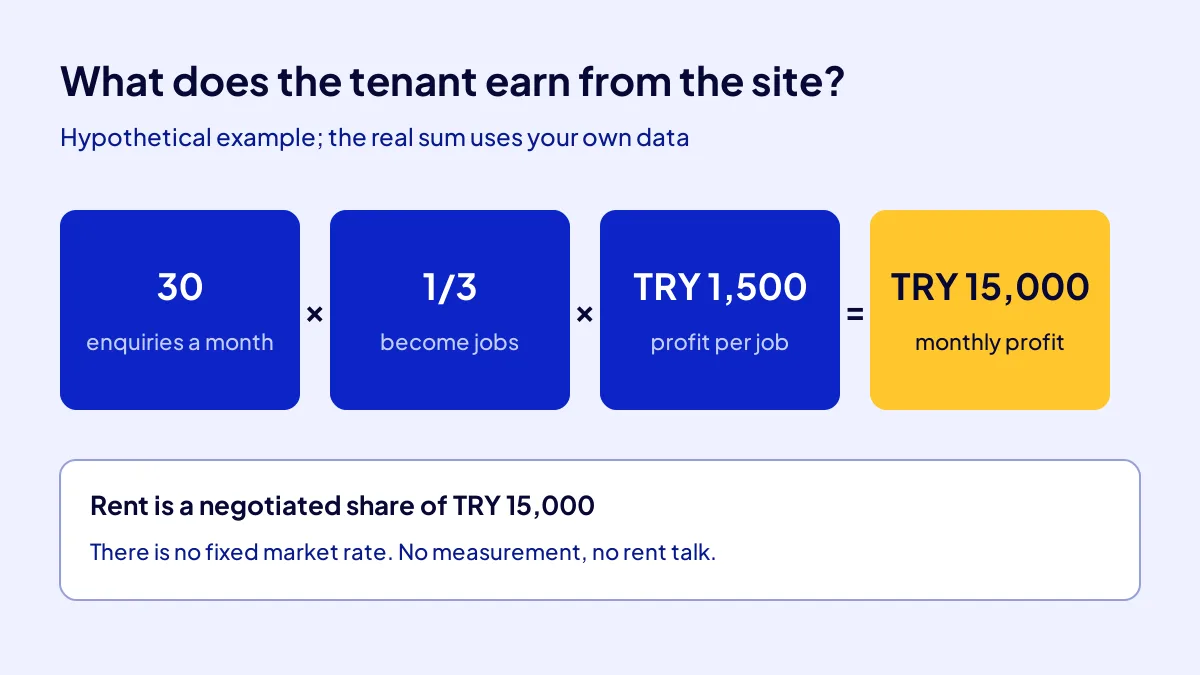
Rent is agreed as a share of the gross profit the tenant earns from the site. The sum uses three numbers: monthly enquiries, the share that turns into jobs, and gross profit per job. If the tenant keeps a meaningful profit after paying rent, the deal works.
| Item (hypothetical example) | Value |
|---|---|
| Monthly enquiries (calls and forms) | 30 |
| Enquiries that become jobs (one third) | 10 |
| Gross profit per job | TRY 1,500 |
| Tenant’s monthly gross profit from the site | TRY 15,000 |
The numbers are an example, the share is a negotiation
The figures are illustrative. Rent is a negotiation over how much of that TRY 15,000 you share, and there is no fixed market rate. Say you settle on a third: rent is TRY 5,000 a month and the tenant keeps TRY 10,000.
No measurement, no rent talk
If you cannot show how many calls and forms arrive each month, the tenant will rightly haggle. Measurement starts on day one. We work out a site’s total value step by step in how to value a website.
Which 6 clauses go into a rental agreement?
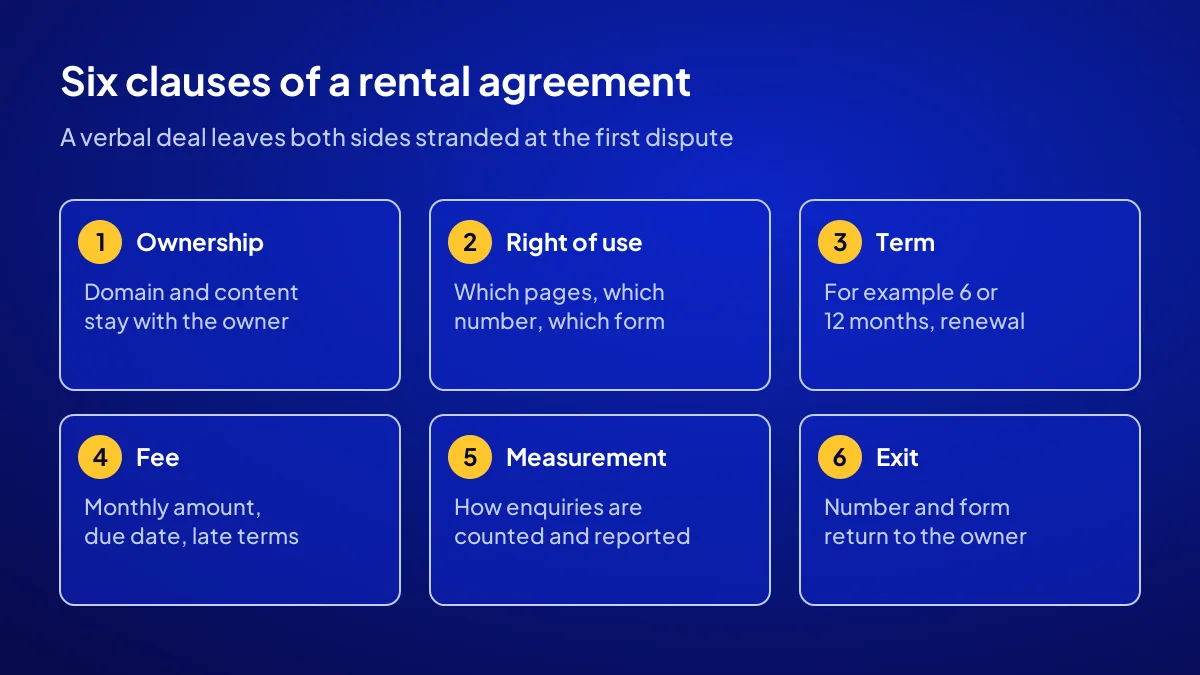
The agreement should be short but clear: who owns what, what the tenant uses, how long it runs and how it ends. The six clauses below are a starting list. Ask a lawyer for your own contract.
- Ownership of the domain and content stays with the site owner.
- The right given to the tenant: which pages, which number, which form.
- Term and renewal, for example 6 or 12 months.
- Monthly fee, payment day and late payment terms.
- How enquiries are counted and reported each month.
- Number, form and forwarding returning to the owner at the end.
Where do Google’s rules limit renting?
BU BÖLÜMÜN ÖZETİ
- The profile must be the tenant’s, and real
- The site must say clearly who provides the service
- Regulated professions check the rules first
Google Business Profile guidelines draw the clearest line. A profile belongs to a real business with an address that receives customers during opening hours, or a service area. Numbers and URLs that send people to pages not belonging to the actual business are not allowed. So no fake profile is opened for the site; the profile belongs to the tenant that delivers the service.
The profile must be the tenant’s, and real
The tenant manages its own profile under its own name. The rented site works as an extra channel, not a replacement.
The site must say clearly who provides the service
Visitors should know who they are calling. If the site openly presents the business delivering the service during the lease, nobody is misled. Google’s spam policies also flag third-party content published only to ride on another site’s ranking signals.
Regulated professions check the rules first
In professions where advertising is limited by regulation, such as law, dentistry and health, renting carries extra risk. Check bar association or ministry regulations first.
How does a rentable asset get started?
A site has to collect traffic before it can be rented, and that takes content and time. The Own a Digital Asset campaign sets up that start: sector and opportunity analysis, a domain in your name, a site with 6 main and 12 sub pages, 108 pieces of content, GA4 and Search Console. The START package is TRY 36,000 + VAT, upfront and fixed.
Places, deadline and payment
The campaign has 12 project places, and the last day is 1 November 2026. With 20 percent VAT the total is TRY 43,200; check the current rate on the invoice. For the 10 percent coupon, simply mention the code when you apply or during the call.
Quick Summary
- The tenant rents the calls and forms the site brings, not the pages.
- Domain and content stay with the owner; the tenant gets a right of use.
- Rent is a negotiated share of the tenant’s gross profit from the site.
- The most forgotten clause is the number returning at the end.
- The Google Business Profile belongs to the real business, the tenant.
Short Glossary
Lead: A lead is a term used for a person who calls or leaves a form about a service but has not bought yet.
Rental site model: The rental site model is a business model used to pass a traffic site’s enquiries to a business for a monthly fee.
Call forwarding: Call forwarding is a phone setting used to connect a caller to the number on the site through to another line.
Next Step
A rentable asset needs traffic first. Apply to the Own a Digital Asset campaign and we plan a site that collects enquiries in your sector together.
Frequently Asked Questions
Source: Google Business Profile Help — Guidelines for representing your business on Google
Sık Sorulan Sorular
The number on the site is forwarded to the tenant’s line, or the tenant’s own number is shown. The visitor calls, and the job goes to the tenant.
What tenants like most is not traffic but predictability. Rent is not a cost that moves every day like pay-per-click ads. It is a fixed figure known at the start of the month. For a tradesperson short on cash, that makes it easier to cut the coat according to the cloth.
When the lease ends, the traffic returns to the owner. If the tenant does not grow its own customer list and name meanwhile, it starts from zero again.
The exit clause. If the tenant’s number stays on the site, customers keep going to them after the lease ends. Write down on day one who keeps what at the end.
A monthly enquiry report shows what the rent buys and ties renewal talks to numbers.
Local projects also include Google Business Profile setup. Sites carrying a city and a service name come closest to the rental model, as we explain in city plus sector domains.
Read why domain, site and content gain value like property in owning a digital asset. To build a rentable asset in your sector, go to the Own a Digital Asset campaign page. One principle: tenants rent customers, not pages, so collect the customers first.
Yes. In the Own a Digital Asset campaign the domain is registered in your name and the asset belongs to you. Renting it out or selling it later is possible.
No. The campaign gives no earnings guarantee. Finding a tenant depends on the enquiries the site collects; the potential is shown with data.
The owner does. Write into the agreement that the number, form and forwarding return to you at the end.
Updated: October 2026