
Who should buy an online business? Six profiles, from side income seekers to growers
Who should buy an online business? Someone who does not want to wait a year building from zero, but can give the business a few steady hours every week. Taking over a site that already collects demand, with its domain, content and enquiries, shortens the first stretch of the road. It does not remove the work of running a business.
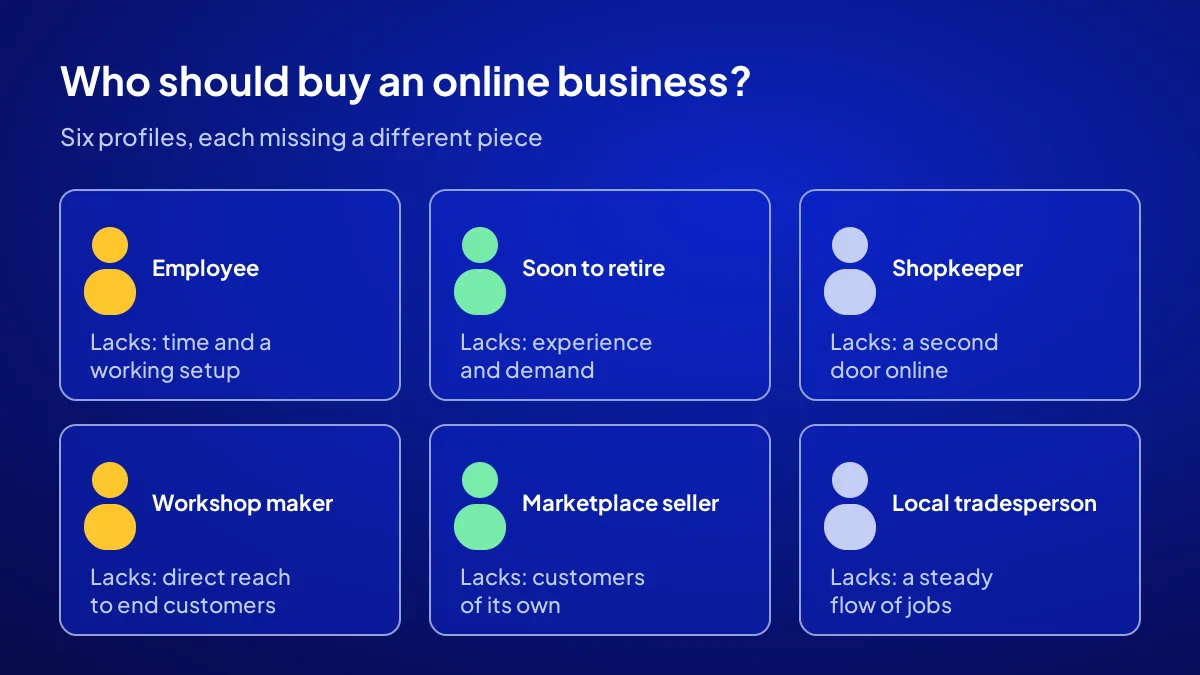
Six types of people in Türkiye fit that description: the salaried employee, the person preparing for retirement, the shopkeeper with an open shutter, the workshop producer, the marketplace seller and the local tradesperson. Each gets a hypothetical scene below; see which one feels like you.
What do these six profiles have in common?
Each has time, capital or customers, but never all three. A ready-made online business fills the missing piece: a working setup for the person short on time, a new door for the one with customers, a running start for the one with savings. It guarantees earnings to none of them.
They cannot afford to wait
A new site can take months to show up in search, and these profiles pay for those months. We work out the time cost of starting from zero in why building from scratch loses year one.
They can spare a few hours a week
Someone has to answer enquiries, follow orders and keep content fresh. Without those hours, even the best asset gathers dust.
The evening workers: the employee and the soon-to-retire
BU BÖLÜMÜN ÖZETİ
- The salaried employee: the salary runs short, there is no capital for a shop
- The soon-to-retire: savings in hand, a first-time founder
- A note on official support for first-time founders
These two have full days, or days about to change. They run the business in the evenings, at weekends or after retirement. What matters is that it does not need attention every hour and that questions can be handled in batches. Assets with a calm flow of orders suit them better.
The salaried employee: the salary runs short, there is no capital for a shop
Say you are a planner at a logistics firm in Esenyurt, İstanbul. You get home at seven and the salary is gone by the twentieth. With an online store you take over, you pack orders in the evening and drop them at the courier on your way to work.
The soon-to-retire: savings in hand, a first-time founder
Say you retire in two years and have some savings put aside. You want a business where you have skin in the game. This is not investment advice; it is a decision to run a business. You learn to operate the asset you take over, and the call is yours.
A note on official support for first-time founders
KOSGEB’s Entrepreneur Support Programme Directive, updated in July 2026, targets newly founded businesses. For the business start-up grant it requires an application within one year of founding and completion of the basic entrepreneurship training. Ask KOSGEB directly whether a digital asset you take over falls within that scope.
The open shutters: the shopkeeper and the workshop producer
These two already have customers and products. What they lack is the shop’s second door on the internet. If customers are not walking in, a ready-made asset that collects demand hands over that door already open, as long as the product matches the asset’s topic.
The shopkeeper: the shop is open, the till is quiet
Say you run a home textiles shop in Beylikdüzü. The shutter goes up in the morning, three people walk in by the afternoon. When you take over a site that sells the same products and gets search traffic, your window reaches past the district. Same stock, same shelves, two doors.
The workshop producer: making goods, selling to a middleman
Say you have a small shoe workshop in Bayrampaşa. Most of what you make goes to a wholesaler, and the wholesaler sets the price. A ready-made online store where you sell your own product directly cuts a link out of the chain to the end customer.
The growers: the marketplace seller and the local tradesperson
These two know digital. One sells on a marketplace, the other takes jobs by phone. Their shared problem is that the customer belongs to an intermediary. A ready-made asset collects demand in their own name and hands back some bargaining power.
The marketplace seller: turnover comes in, profit goes to commission
Say you sell kitchenware on a marketplace. Turnover arrives, but after commission, shipping and ads, little stays in hand. Taking over your own site does not mean leaving the marketplace; it means a second leg to stand on. First check whether your store really makes a profit with our guide is my store profitable.
The local tradesperson: work comes by word of mouth
Say you service boilers in Avcılar. Jobs come by recommendation, and a busy week is followed by an empty one. A service site that gets district search traffic smooths that wave. We cover the details of local assets in buying a local service site.
Profiles side by side: who takes over what?
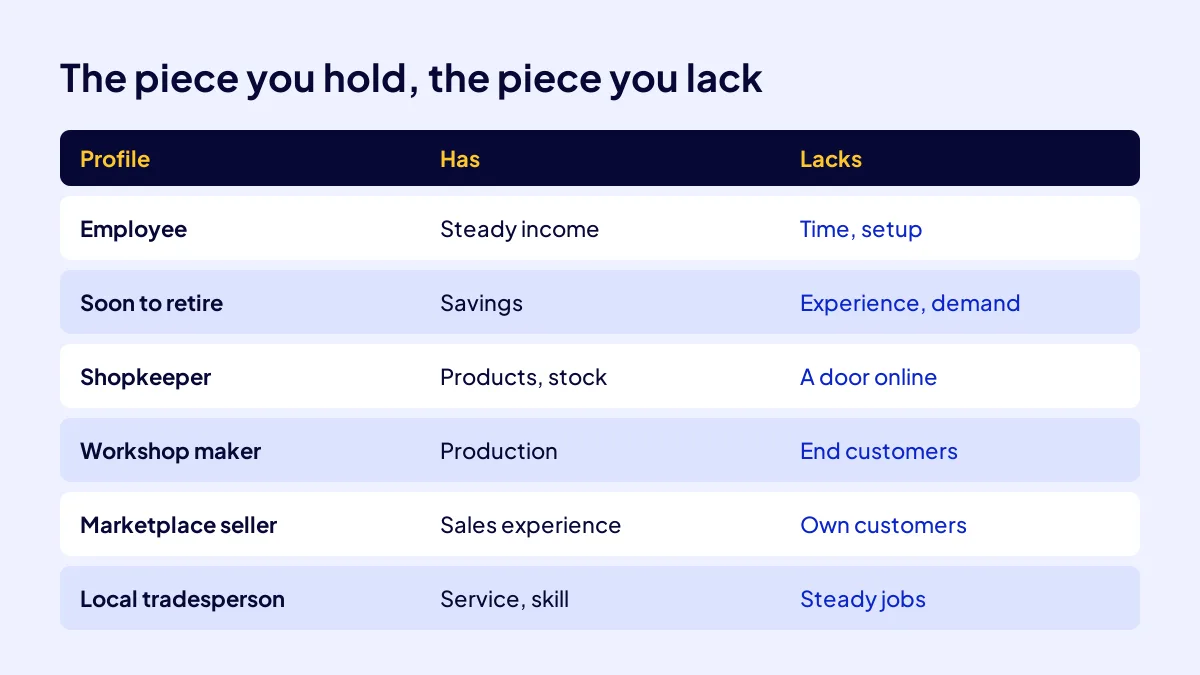
The table puts each profile’s two pieces side by side, with the first question to ask before any handover. Find your row and put that question to the asset’s owner. If the answer is vague, it is too early to take it over.
| Profile | Has | Lacks | First question |
|---|---|---|---|
| Salaried employee | Steady income | Time, a working setup | How many hours a week does it need? |
| Soon-to-retire | Savings | Experience, existing demand | What must I learn in the first month? |
| Shopkeeper | Products, stock | A door on the internet | Does the site’s topic match my products? |
| Workshop producer | Production | Reach to end customers | Which searches bring the traffic? |
| Marketplace seller | Sales experience | Customers of its own | Which channel does demand come from? |
| Local tradesperson | Service, skill | A steady flow of jobs | Which districts does traffic come from? |
The table does not tell you which tier fits
Assets on ASSETOR sit in three tiers: Platinum, Gold and Silver. Choose the tier by your budget and the topic by your trade.
Who is a ready-made online business not for?
BU BÖLÜMÜN ÖZETİ
- The “set it and forget it” buyer
- The all-in buyer
- The stranger to the topic
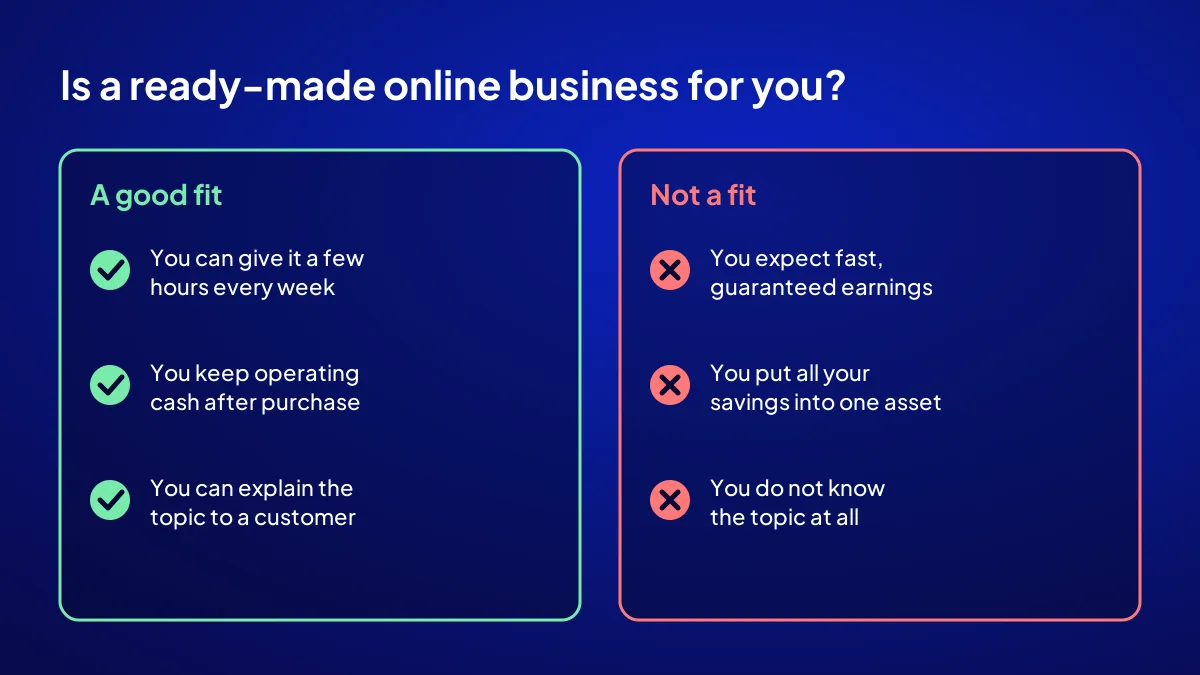
It is not for someone expecting fast, guaranteed earnings, someone with no time for the business, or someone choosing an unknown field on price alone. It is a shortcut, not a cash machine. If that is you, adjust your expectations first.
The “set it and forget it” buyer
If nobody answers orders and questions, demand drains away.
The all-in buyer
Cut your coat according to your cloth. After the purchase price you also need cash for stock, shipping and promotion.
The stranger to the topic
A jeweller who buys a dental supplies site gets stuck on the first customer question. A field you know makes the first months far easier.
Which profile are you? Six questions to find out
Answer these six questions on paper; they lead you to a row in the table. If you answer “I don’t know” to three or more, get your own numbers straight first.
- How many hours a week can I give this business?
- After the purchase price, how many months of operating cash will I have left?
- Do I already have a product, stock or service?
- Which topic do I know well enough to explain to a customer?
- Where are my customers: in my district or across Türkiye?
- Can I make this decision without any earnings guarantee?
If your answers are ready
To see the assets for sale by tier and topic, visit the ASSETOR digital assets for sale page. We build the full calculation from start to finish in our guide to buying a ready-made online business.
Quick Summary
- A ready-made online business gives the missing piece to someone short on time, capital or customers.
- Six profiles stand out: employee, soon-to-retire, shopkeeper, workshop producer, marketplace seller, local tradesperson.
- A business you take over needs steady weekly time; it does not run itself.
- ASSETOR gives no earnings guarantee; budget decides the tier, your trade decides the topic.
- If you are a first-time founder, ask KOSGEB itself about the scope of its support.
- Once you can answer the six questions, move on to inspecting assets.
Short Glossary
Digital asset: A digital asset is the term used for a domain, site, content and incoming demand sold together as a business that can be handed over.
Organic traffic: Organic traffic is the term used for visitors who reach a site from search results without paid ads.
Commission rate: Commission rate is the percentage used to show the share a marketplace takes from each sale.
Next Step
If you see yourself in one of the profiles, the next move is to look at an asset that fits it. Browse the digital assets for sale on ASSETOR and send your questions through the buyer form.
Frequently Asked Questions
Source: KOSGEB — Entrepreneur Support Programme Directive (in Turkish)
Sık Sorulan Sorular
You take over a digital asset that is already set up, running and collecting demand. The assets on ASSETOR are online stores, production businesses and service platforms.
It can be, if you can give it a few steady hours every week. A business you take over does not run itself; it needs enquiries, orders and content looked after.
No. ASSETOR does not guarantee earnings. Results depend on how you run the asset and on your market, so decide according to your own situation.
Updated: October 2026