
Perfumery Licence: Sealed Bottle Sales or Open Refill?
One question decides the document list when opening a perfumery: will you sell the bottle sealed, or will you refill it? Sealed bottle sales are straightforward retail and run on a non-hazardous premises licence. Refilling counts as intervening in the product; at that point the chain of responsibility and the document list change entirely.
Let’s put the two models side by side and work out which suits you. The difference is not only in paperwork; it is also in capital, inspection burden and margin.
What separates the two models?
In sealed bottle sales you are the seller; notification, labelling and safety of the product are the manufacturer’s or importer’s responsibility. In open refill you package the product yourself, which moves you towards the position of the party placing it on the market. These two positions carry different obligations under the same framework.
Comparison table
| Criterion | Sealed bottle sales | Open refill |
|---|---|---|
| Licence class | Non-hazardous premises | Depends on activity, may be hazardous |
| Product responsibility | With manufacturer or importer | Weighs on the packager |
| Labelling obligation | The supplier’s | Yours |
| Fire and storage | Standard | Extra conditions for alcohol-based products |
| Start-up capital | Higher stock cost | Lower, essence-based |
| Margin | Narrow | Wide |
| Inspection burden | Light | Heavy |
| Suits whom | Those selling known brands | Those building their own blends |
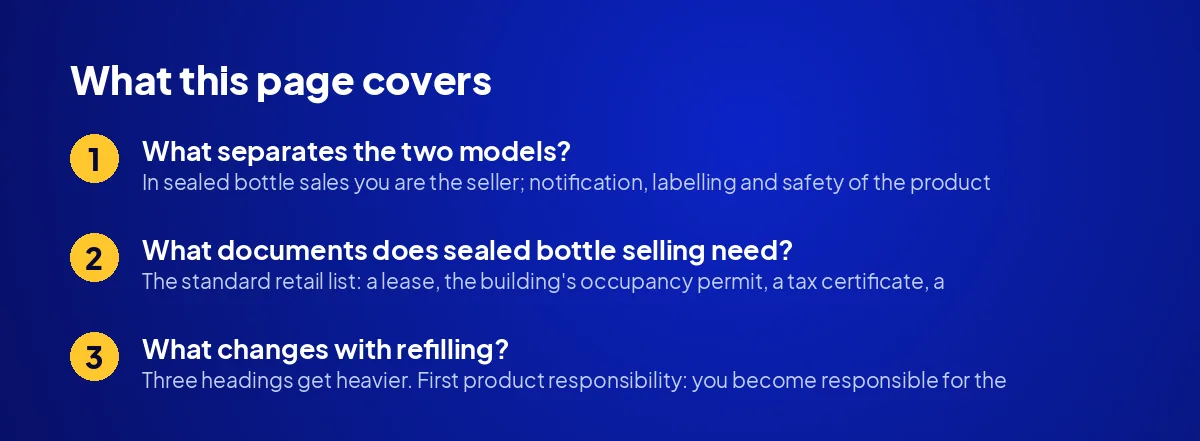
What documents does sealed bottle selling need?
The standard retail list: a lease, the building’s occupancy permit, a tax certificate, a chamber registration, the workplace opening and operating licence, and a social security declaration if you will employ staff. Condominium consent is added in a residential building.
In addition, ask your supplier for written confirmation that the products you sell are notified. This is not a licence condition but a file that should be in your hands when inspection asks.
What changes with refilling?
Three headings get heavier. First product responsibility: you become responsible for the content and labelling of what you package. Second storage: perfume essences are alcohol-based, meaning they are flammable liquids, and storage conditions are assessed separately in the fire report. Third the licence class: depending on volume and method, the business may be treated as hazardous premises.
Three questions if you will refill
- Does your work count as “sales” or “packaging”? Describe it to the municipality’s licensing unit and ask for a written opinion
- What threshold does the quantity of alcohol-based product you store fall under for fire purposes?
- Will you print your own label? If so, verify label content rules against the regulation, not against your supplier
Which suits whom?
Sealed bottle sales suit an entrepreneur who wants to sell known brands and build a steady retail business. The process runs quickly and the inspection burden is light. In return the margin is narrow, because customers can compare the price online.
Open refill suits an entrepreneur who wants to build their own blends and raise the margin. The product becomes incomparable and the margin widens. In return responsibility and inspection burden increase; entrepreneurs who think of this as “an easy way to sell perfume” usually struggle at the first inspection.
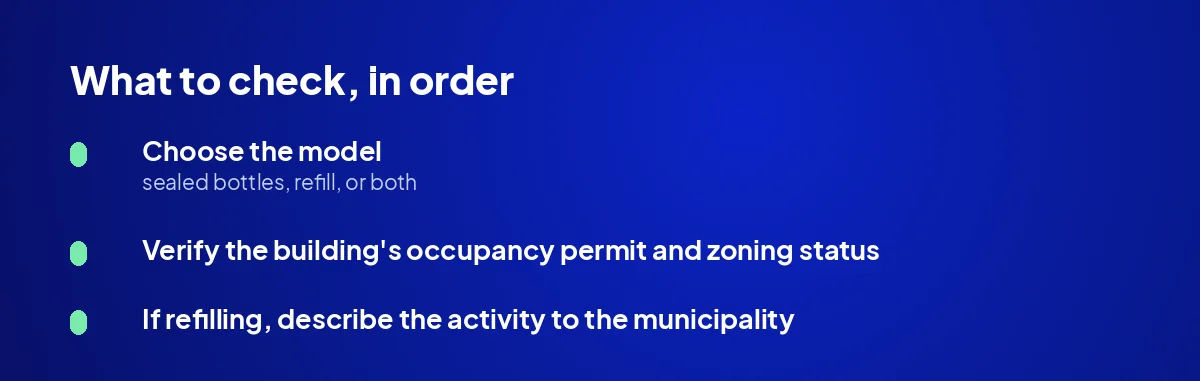
Common steps and order
- Choose the model: sealed bottles, refill, or both
- Verify the building’s occupancy permit and zoning status
- If refilling, describe the activity to the municipality and learn the licence class
- Sign the lease and pay the stamp duty
- Complete the commencement notice and chamber registration
- If refilling, start the fire report at this stage; it is the longest item
- Apply to the municipality for the licence
- Prepare the supplier notification file and keep it in the shop
For authority-by-authority detail see the business licence roadmap, and for capital and cost bands the cosmetics and beauty sector page.
What changes on the stock and supply side?
Capital structure differs between the two models as much as the paperwork. In sealed bottle sales your money is tied to the shelf; every brand and every size is a separate line, and a full-looking window needs broad stock from the start.
Where capital goes in refilling
In the refill model stock is essence-based; because you can sell different volumes from the same essence, less capital is tied up. In return you need an upfront investment in the refill unit, bottles, labels and storage layout.
Questions when choosing a supplier
- Have the products been notified, and will they give written confirmation?
- Are labels in Turkish and compliant, or does labelling fall to you?
- Is batch tracking possible in essence supply?
- Does the minimum order value match your capacity to tie up stock?
The deciding sentence
If this is your first business and you want to open quickly, start with sealed bottle sales and add refilling to the licence later. If you want a wide margin from the start, begin with refilling but settle the fire and labelling headings before taking premises. If you are in between, look at this question: do you want to be responsible for what is inside the product? If the answer is no, sealed bottles is your model.
For the equivalent distinction on the equivalent-perfume side see our equivalent perfume article.
Changing model after the licence
Starting with sealed bottles and moving to refilling later is a common path. That transition requires the licence to be updated; the activity is added to the existing licence or a new application is made.
The order in a transition
- Describe the refill activity to the municipality’s licensing unit and get a written opinion
- Set up the storage layout and start the fire assessment
- Prepare your label design in line with the regulation
- File the licence update application
- Do not start refill sales before the update is complete
The fifth item is the one most often skipped. Refilling carried out before the licence is updated is treated at inspection as unlicensed activity.
The same boundary question appears in is a pharmacy required and barber shop licences, permits.
In Short
- The question deciding the list: sealed bottles or open refill
- Sealed bottle sales are non-hazardous premises with a standard retail list
- In refilling, product responsibility, labelling and storage obligations pass to you
- Alcohol-based storage is assessed separately in the fire report
- Depending on volume the business may be treated as hazardous premises
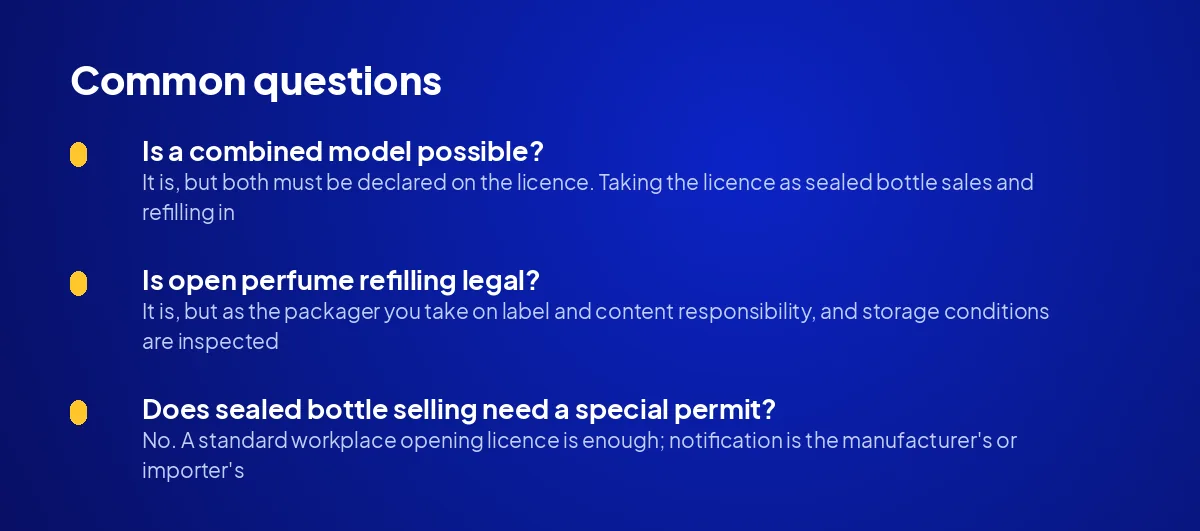
- A combined model is possible but both must be declared on the licence
- Sealed bottles are fast and light with a narrow margin; refilling is heavy with a wide margin
- Refilling before the licence update counts as unlicensed activity
Quick Glossary
Open refill: selling essence by filling bottles in the shop. Placing on the market: offering a product for sale for the first time; responsibility sits with this party. Flammable liquid: alcohol-based and similar materials carrying ignition risk and requiring special storage. Activity description: the work written on the licence as permitted at that address.
Next Step
Let’s settle which model fits you: quote form.
Frequently Asked Questions
Updated: September 2026
Sık Sorulan Sorular
It is, but both must be declared on the licence. Taking the licence as sealed bottle sales and refilling in the back renders the licence useless at inspection. The activity description and the work done must match.
It is, but as the packager you take on label and content responsibility, and storage conditions are inspected separately.
No. A standard workplace opening licence is enough; notification is the manufacturer’s or importer’s responsibility.
It depends on volume and method. Describing the activity to the licensing unit and getting a written opinion is the safest route.
A standard assessment applies to sealed bottle sales. In refilling the conditions tighten because of alcohol-based storage.
You can, but the licence must be updated. Refilling without the update renders the licence useless.
Refilling carries a clearly wider margin because the product cannot be compared. In return responsibility and inspection burden are heavier.
An annual advertising tax to the municipality, calculated on size. Register it at opening.
Notification confirmation, Turkish labels, batch tracking and whether minimum order values match your stock capacity.
Refilling ties up less capital in stock but requires upfront investment in the unit, bottles and storage layout.
Source: Cosmetics Regulation