
Which Documents Do You Need to Sell Equivalent Perfume?
The documents needed to sell equivalent perfume are the same as for any cosmetics shop: a lease, a tax certificate, a chamber registration and a workplace opening and operating licence. There is no such thing as a separate “equivalent sales permit”. What draws the boundary of this business is not paperwork, though. It is how the product presents itself.
You may not have known this: equivalent perfume and counterfeit perfume are two entirely different things in regulatory terms. One is sold freely, the other is a criminal matter. The line between them is not a fine one, but most people do not know where it sits, so they either worry needlessly or cross it without noticing.
What is equivalent perfume, and how does it differ from counterfeit?
An equivalent perfume resembles a well-known scent but is sold under its own name, in its own packaging, with its own brand. A counterfeit uses another brand’s name, bottle, logo or packaging design.
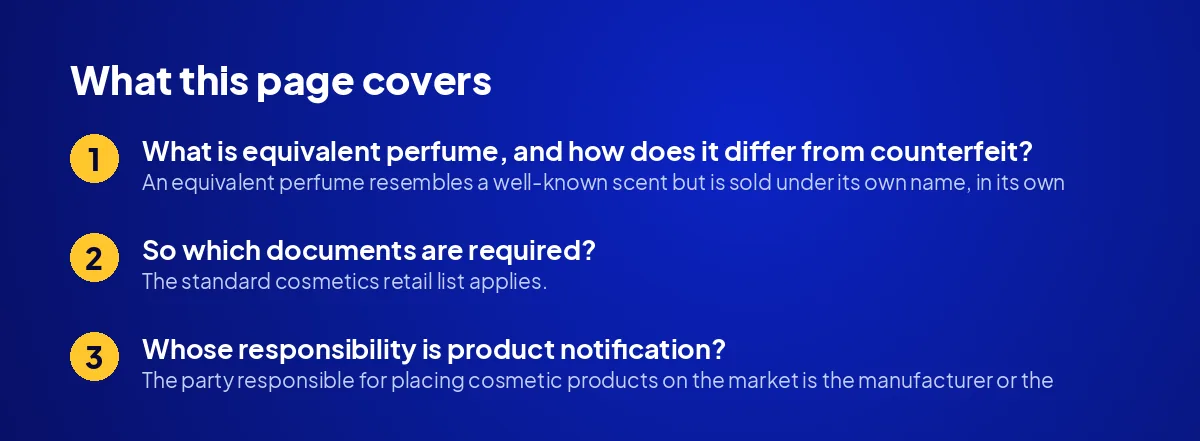
So which documents are required?
The standard cosmetics retail list applies.
| Document | Where from | Note |
|---|---|---|
| Lease | Landlord, with stamp duty | The basis of the address |
| Occupancy permit | Municipal planning office | Must be held by the landlord |
| Tax certificate | Tax office | With the commencement notice |
| Chamber registration | Tradesmen’s or trade chamber | Depends on the structure |
| Workplace opening and operating licence | District municipality | Non-hazardous premises |
| Product notification confirmation | From the supplier | Not a licence condition, an inspection file |
Whose responsibility is product notification?
The party responsible for placing cosmetic products on the market is the manufacturer or the importer. If you are the seller, the notification obligation is not yours. Checking that the product you sell has been notified is.
What to ask your supplier for
For every product group, ask for written confirmation that notification has been made, along with product safety information. Collect it in one file. The first question an inspection asks is where these products come from, and having the answer ready closes the matter within an hour.
If you have your own brand produced
Then the table changes. Producing under your own brand means you are the party placing the product on the market, and notification, safety assessment and labelling responsibility pass to you. This is a different business from running a shop, and it is usually carried out under contract with a manufacturer or a contract facility.
What must the label carry?
The product name in Turkish, the list of ingredients, the net quantity, manufacturer or importer details, the batch number, and either an expiry date or a period-after-opening. Do not shelve a product that has no label, carries information only in a foreign language, or comes from an unclear source.
Let me add this: missing label information is the item most often fined at inspection, and also the easiest to put right. Checking once before shelving costs far less than collecting products back later.
Refilling changes the business
If you fill the bottle yourself in the shop, you are no longer a seller; you move into the position of the packager. Label and content responsibility comes to you, storage of alcohol-based products is assessed separately for fire purposes, and even your licence class may change.
For a comparison of the two models, see our perfumery licence article, where sealed bottles and refilling sit side by side, criterion by criterion.
Where does the line sit on social media?
Adjusting the language inside the shop is easy. The boundary is usually crossed on social media instead. Naming a brand in a post, or showing the product next to a well-known bottle, means doing online what you would not do in the shop.
A practical rule
Use this test: could someone seeing your post mistake the product for another brand’s? If the answer leans towards yes, that post carries risk. Build a language that describes your own brand name, your own bottle and the character of your scent. Leave the resemblance for the customer to infer.
On marketplace listings
Putting another brand’s name in a product title is the most common reason listings get removed. Decisions here come quickly, too; a notice from the brand owner is enough. Build the title around your own product name and describe the fragrance family in the description.
Now you know this
You do not need a special permit to sell equivalent perfume; a standard cosmetics shop licence is enough. What needs your attention is not the paperwork but how the product introduces itself. A scent sold under its own name, its own packaging and its own label is free to sell. A product carrying another brand’s name is not protected by any licence.
For the order of documents authority by authority, see the business licence roadmap, and for the sector’s capital and cost bands, our cosmetics and beauty page.
Protecting your own brand
In the equivalent perfume business most people watch out for someone else’s brand and never think about protecting their own. Yet as the business grows, this becomes the real issue.
In Short
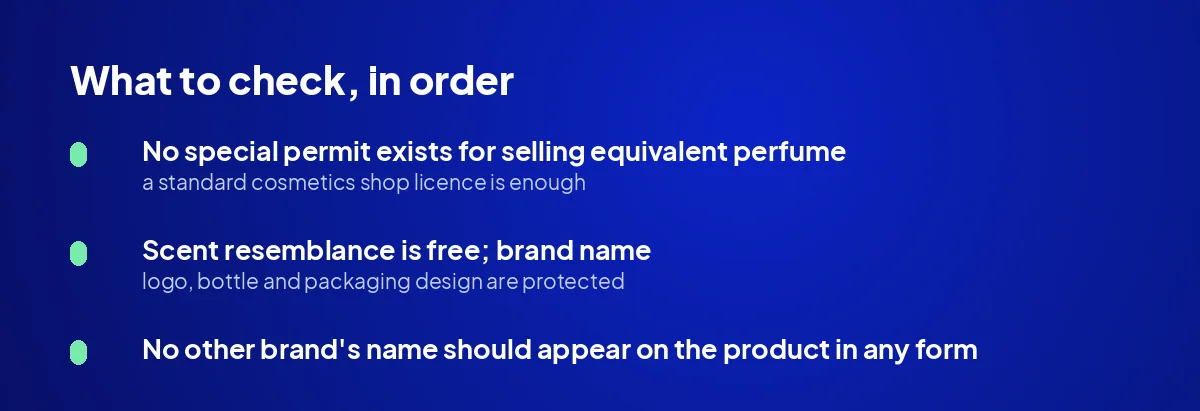
- No special permit exists for selling equivalent perfume; a standard cosmetics shop licence is enough
- Scent resemblance is free; brand name, logo, bottle and packaging design are protected
- No other brand’s name should appear on the product in any form
- Notification sits with the manufacturer or importer; the seller is responsible for checking
- Missing label information is the item most often fined and the easiest to correct
- Producing under your own brand makes you the party placing it on the market
- Refilling in the shop moves you into the position of the packager
Quick Glossary
Equivalent perfume: a product resembling a known scent, sold under its own brand and packaging. Placing on the market: offering a product for sale for the first time; responsibility sits with this party. Batch number: a code used to trace a group of products made under the same conditions. Contract manufacturing: production carried out at another facility under your brand.
Next Step
Let’s set up your product file and your labelling together: quote form.
Frequently Asked Questions
Updated: September 2026
Sık Sorulan Sorular
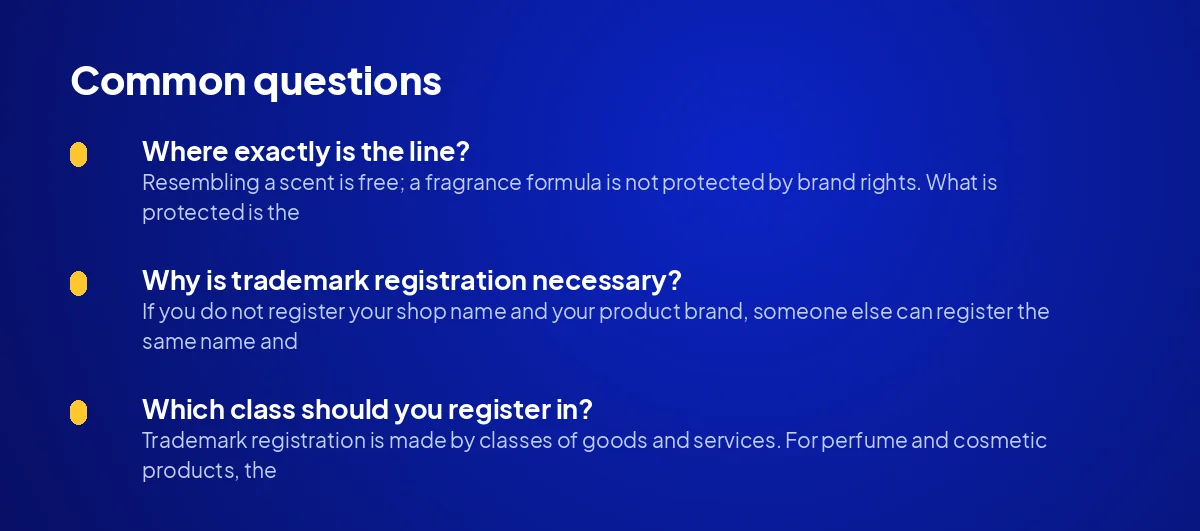
Resembling a scent is free; a fragrance formula is not protected by brand rights. What is protected is the brand name, the logo, the bottle design and the packaging. Saying “this scent recalls a certain brand” is one thing. Using that brand’s bottle and label is another.
In practice, set the distinction this way. No other brand’s name should appear on your product in any form. If you use a reference list, keep those names on an in-shop guidance tool, separate from the label. Being cautious here beats explaining yourself later.
If you do not register your shop name and your product brand, someone else can register the same name and stop you using what you have been calling yourself. That means losing a name you have put work into, overnight.
Registration passes through application, examination and publication stages, and takes months. Starting it while you open the shop beats remembering it two years later.
Trademark registration is made by classes of goods and services. For perfume and cosmetic products, the relevant goods class should be considered together with the retail services class. Settle which classes fit you with a trademark attorney; registration in the wrong class provides no protection.
Two more branches running a similar process: notification rules in natural and why are skin care.
Yes. Products sold under their own brand and packaging, using no other brand’s name or design, are free to sell.
Putting another brand’s name on the product itself is risky. Every use naming a brand carries the chance of running into a registered right.
Not if you are the seller; notification is the manufacturer’s or importer’s obligation. If you have your own brand produced, the responsibility passes to you.
The product name in Turkish, ingredients, net quantity, manufacturer or importer details, batch number and shelf life.
You can, but then you become the packager; label responsibility passes to you and storage conditions are assessed separately.
The source of the products and their label information. If your supplier confirmation file is ready, the process closes quickly.
Yes. An unregistered name can be registered by someone else, leaving you unable to use your own name.
It passes through application, examination and publication stages; the process spreads over months. Start it as you open the shop.
The goods class should be considered together with the retail services class; settle it with a trademark attorney.
Source: TİTCK — Cosmetics Activity Area