
Record Keeping and Documents in Hairdressing Supply Sales

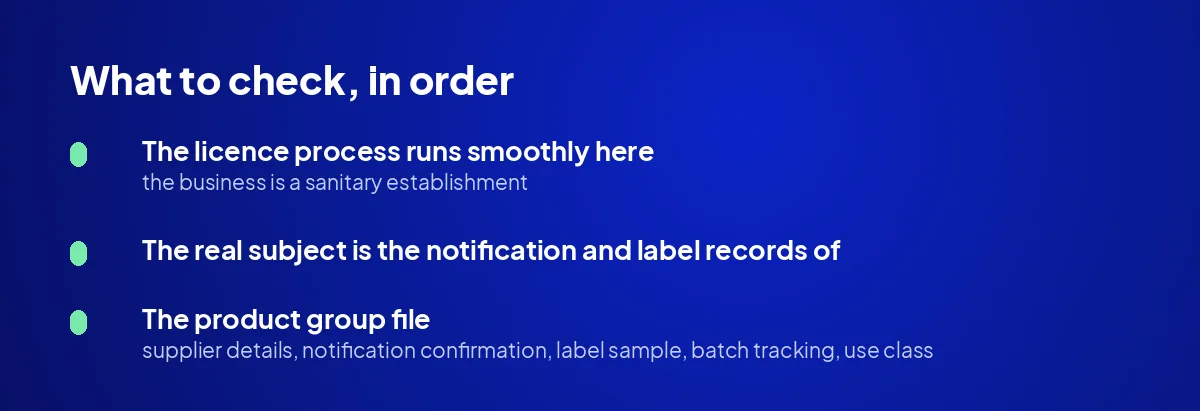
In a business selling hairdressing supplies the document list is the standard retail list: a lease, the occupancy permit, a tax certificate, a chamber registration and the workplace opening licence. What makes this branch different is not the licence but the record keeping behind the products you sell.
The method we set up for businesses in this branch is one file per product group. Below we explain how that routine is built and why it works.
Why records rather than licences?
Because the licence process runs smoothly here. The business falls in the sanitary establishment class, no treatment is carried out, and no hygiene training is required. The licence comes through in three weeks.
The real difficulty arrives afterwards: the notification, labelling and traceability of products intended for professional use. That is where inspection looks, and a business without a file struggles.
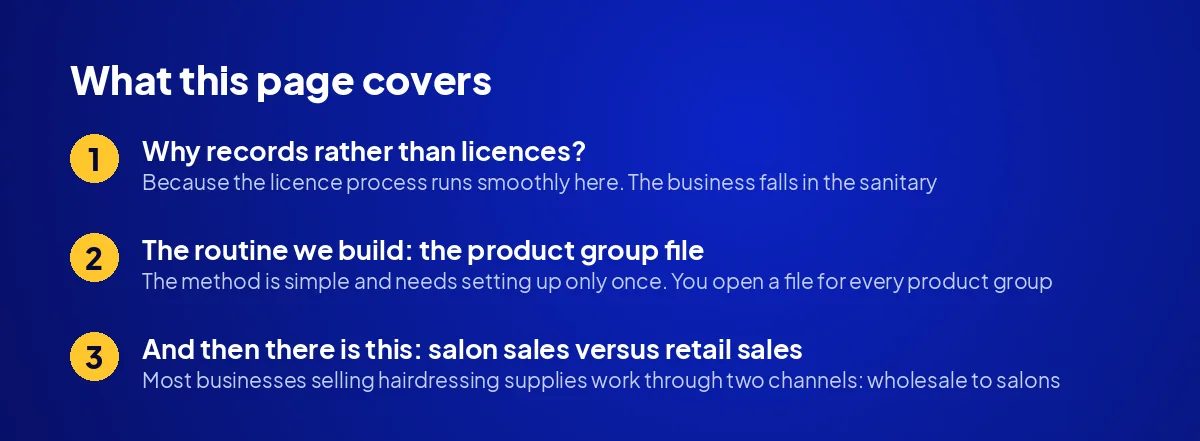
The routine we build: the product group file
The method is simple and needs setting up only once. You open a file for every product group you sell, and into it go the following.
- Supplier details: company name, tax number, contact
- Notification confirmation: a written statement that the products are notified
- Label sample: a photograph or sample of the Turkish label
- Batch tracking: which batch was taken, when, and how much
- Use class: professional, or intended for the general consumer
And then there is this: salon sales versus retail sales
Most businesses selling hairdressing supplies work through two channels: wholesale to salons and retail to end consumers. The tax and invoicing routine differs between the two.
| Channel | Document | Watch for |
|---|---|---|
| Sale to a salon | Invoice | The buyer’s tax registration is asked for |
| Sale to an end consumer | Retail sales receipt or invoice | Mind the professional product distinction |
| Online sale | Invoice plus distance sales | Electronic commerce registration required |
An extra heading for devices and tools
Electrical items such as clippers, hairdryers and tongs are not cosmetics; they fall under electrical product legislation. For these, a conformity marking, a Turkish user manual and a warranty certificate are looked for.
Those three items are asked about separately at inspection and should be kept apart from your cosmetics file. Ask your device supplier for the warranty certificate and the Turkish manual; a device sold without them causes trouble later.
The method in a sentence
The licence is the easy part in this branch. The hard part is keeping the record behind what you sell. Setting up a product group file is a day’s work; left undone, it becomes a gap you pay for at every inspection.
For the document list on the retail side see our cosmetics shop article, for the wholesale side our cosmetics wholesaler article, and for the order authority by authority the business licence roadmap.
Stock rotation and expiry tracking
A large share of hairdressing supplies are chemical products and all of them carry an expiry date. This is the second leg of the filing routine.
The routine that works
- Record the expiry date of every batch that comes in
- Arrange the shelf by date: first in, first out
- Mark products with three months left and move them to the front
- Take expired stock out of the sales area entirely and gather it separately
- Keep a disposal record
The fifth point is usually skipped but it matters: the record of what you disposed of is the evidence of that loss, for your accounts and for inspection alike.
Two more branches running a similar process: opening a cosmetics wholesale and notification rules in natural.
In Short
- The licence process runs smoothly here; the business is a sanitary establishment
- The real subject is the notification and label records of the products you sell
- The product group file: supplier details, notification confirmation, label sample, batch tracking, use class
- Selling professional-use products to end consumers is raised at inspection
- Invoicing differs between salon sales and retail sales
- Electrical devices fall under separate legislation: conformity marking, Turkish manual, warranty certificate
- Setting the file up is a day’s work; the benefit shows at every inspection
Quick Glossary
Professional product: a product manufactured for use by trade practitioners, whose label may carry that statement. Batch tracking: the record of which production batch was taken, when and in what quantity. Conformity marking: the marking showing an electrical product meets the relevant standards. Notification confirmation: the supplier’s written statement that a product is notified.
Next Step
Let’s set up your product group file together: quote form.
Frequently Asked Questions
Updated: September 2026
Sık Sorulan Sorular
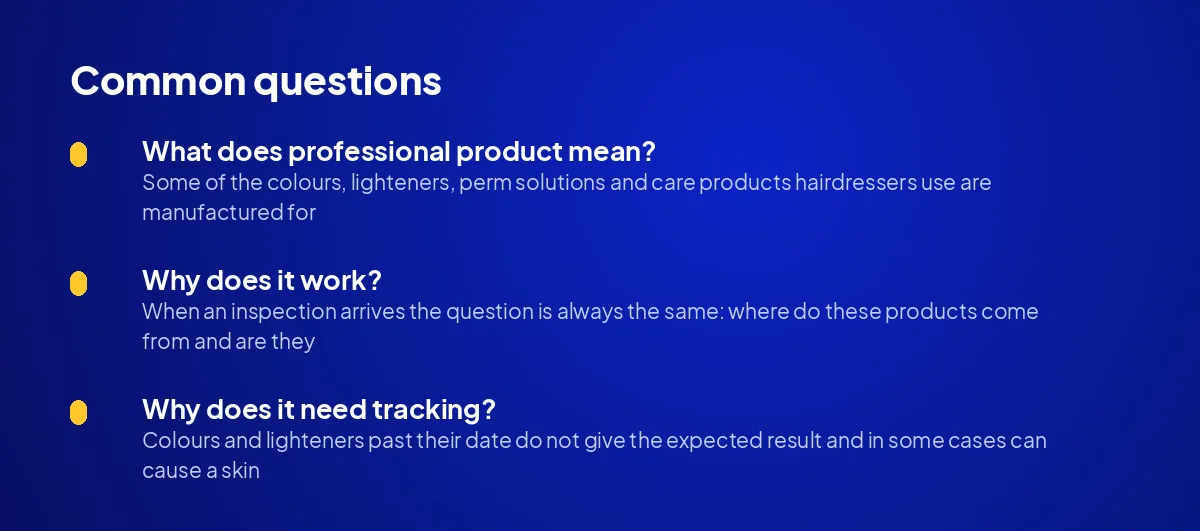
Some of the colours, lighteners, perm solutions and care products hairdressers use are manufactured for professional use. These products fall under cosmetics legislation and carry notification obligations; their labels may also state that they are for professional use.
Selling those products to an end consumer is not the same as selling them to a salon. Putting a product whose label says professional use in the window and selling it to anyone is a subject raised at inspection.
When an inspection arrives the question is always the same: where do these products come from and are they notified. With the file ready, the answer takes a minute and the inspection closes. Without it, you have to call the supplier, request documents and wait, and the business sits under pressure throughout.
The set-up cost is close to zero and the benefit shows itself at the first inspection.
Colours and lighteners past their date do not give the expected result and in some cases can cause a skin reaction. The hairdresser who used the product will say they bought it from you, and the problem comes back to you.
Beyond that, expired products found on the shelves at inspection are a finding recorded directly.
No. A standard workplace opening licence is enough; the business is in the sanitary establishment class.
Selling products whose label states professional use to end consumers is a subject raised at inspection; keep the use class recorded in your file.
The source of the products and whether they are notified. With your product group file ready, the inspection closes quickly.
A conformity marking, a Turkish user manual and a warranty certificate; these are kept apart from the cosmetics file.
No. The invoicing and tax routine differs; on a sale to a salon the buyer’s tax registration is asked for.
Electronic commerce registration, a distance sales contract and published return conditions.
Expired chemical products do not give the expected result and can cause a reaction; the problem comes back to you.
First in, first out; mark products with three months left and bring them forward.
Yes. It is the evidence of that loss, for your accounts and for inspection alike.
Source: TITCK — Cosmetics Activity Area