
Herbalist Shop Licences and Permits: How the Process Runs
The place where most time is lost in opening a herbalist shop is not the document list but the shelf plan. What a herbalist sells does not sit under one set of rules; spices, herbal teas, food supplements and cosmetic-class goods each create their own obligations.
This article follows the order of decisions rather than the order of authorities. Decide first what you will sell, then you will know which door to knock on. Files that travel in the reverse order come back at the application stage.
First decision: what goes on the shelves?
A very wide range of products can be sold under a herbalist’s sign, and each end of that range looks towards a different area of inspection. Your document table follows from your product decision.
A practical approach: write down the products you will sell at opening and note beside each which category it belongs to. That single page shapes both your application file and your choice of supplier later.

The three categories that separate your products
Products in a herbalist shop gather into three groups, and moving between them changes your obligations noticeably.
| Category | Typical products | What changes |
|---|---|---|
| Products within the scope of food | Spices, dried herbs, herbal teas, nuts | Food rules and the business registration side apply |
| Food supplement class | Capsules, powder blends, extracts | The product’s own notification and labelling regime is expected |
| Cosmetic-class products | Soaps, oils, care blends | Cosmetic rules bring a separate set of duties |
Keeping all three on the same shelf is possible. But at inspection each category is assessed against its own rules; no single document covers them all.
A fourth area: medical claims
The riskiest thing in this trade is not a product but a sentence. Saying a product heals, treats or cures a complaint moves it into an entirely different scope. Describe the product; do not build a health claim.
The premises decision: three checks before you take the place
Three headings must be looked at before signing the lease, and all three are expensive to put right afterwards.
- Whether the building has an occupancy permit and whether it covers commercial use
- Whether the zoning status of the address allows this activity
- Whether condominium consent can be obtained if the building is residential
Add one heading specific to this trade: whether an area can be built where dry goods are stored, protected from damp and sunlight. The shelf life of spices and dried herbs depends on it.
The tax office and chamber registration stage
Once the premises are settled, the commencement notice is filed, the tax office visits and the tax certificate is issued. A sole trader then registers with the tradesmen’s chamber, a company with the trade chamber.
This stage runs mechanically and rarely causes trouble. But it feeds the applications that follow; a day lost here pushes the timetable back a day.
The food business registration side
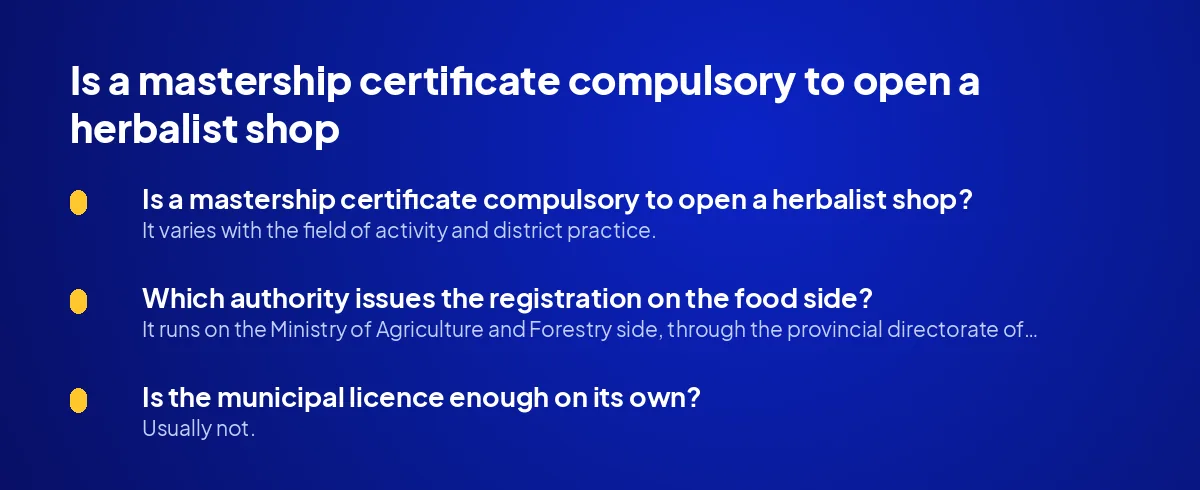
For businesses selling food, a registration regime runs on the Ministry of Agriculture and Forestry side. This food business registration certificate is typically handled through the provincial directorate of agriculture and forestry and assessed according to the business’s field of activity.
Which type of registration is expected for which product group can differ from province to province and from activity to activity. For your own file, obtain written confirmation from the district municipality and the provincial directorate of agriculture and forestry; do not carry out alterations on the strength of spoken information.
The municipal licence and the establishment class
The workplace opening and operating licence comes from the district municipality. What decides matters here is whether the shop counts as a sanitary establishment or a non-sanitary establishment.
A shop selling only packaged goods and one that grinds, blends or roasts on the premises are not assessed in the same class. When the class changes, so do the documents requested and the inspection carried out.
Documents typically requested
- Application form and declaration
- Lease or title deed
- Occupancy permit
- Tax certificate and chamber registration document
- Hygiene training certificate for staff
- The food business registration certificate
- Fire brigade report, depending on the activity
This list is not a promise but a framework for preparation. Municipalities may request additional documents according to their own practice.
Hygiene training and the staff side
In work involving contact with food, staff are expected to have completed hygiene training, and that covers everyone in the shop. At inspection the position of whoever is behind the counter that day is asked about.
Ask for this certificate when you recruit; if it is missing, plan the training around the start date. A gap filled later still goes down as a gap if it coincides with inspection day.
The one certain thing about fees and charges
The licence fee, the signboard tax and similar items vary according to the municipality’s own tariff and are updated annually. So do not write the figures you see online into your budget.
The right move is this: before you open the file, ask the revenue department of the district municipality for the current tariff. Your budget then rests on a document rather than a guess. For capital and monthly cost bands see our herbalist and food sector page.
Scales, labels and packaging
For goods sold loose, the weighing instrument is expected to have been inspected and label information to be visible to the customer; on packaged goods the label is expected to be complete.
These three look small but they are the first things an inspection checks. The habit of checking labels as goods come in prevents a report later.
Timetable: how long each stage takes
| Stage | Typical duration |
|---|---|
| Premises checks and the lease | A few days |
| Commencement notice and tax certificate | Up to a week |
| Chamber registration | A few days |
| Registration on the food side | Weeks, depending on the activity |
| Municipal licence | Weeks if the file is complete |
The behaviour that shortens the total is running the steps in parallel rather than in sequence. Preparing the hygiene training and the registration paperwork while the premises negotiation continues wins back the lost weeks.
For the general order authority by authority see the business licence roadmap, for how roasting and packing change the class see our nuts and dried fruit shop article, and if you are thinking of making your own products look at our home production article.
The supplier file is the trade’s insurance
The history of everything sold in a herbalist shop has to be visible in your own hands. When a question arrives, the answer is who you bought it from and which document came with it.
Keep a separate file for each supplier: invoice, a sample of the product label and, where there is one, the analysis certificate. Without that order the chain of responsibility stays with you, because you are the one who handed the product to the customer.
Items worth holding in the file
- The supplier’s registration details on the food side
- Invoice and delivery note by product
- A label sample for packaged goods
- A record of batch numbers and expiry dates
These four make up the most useful paperwork you will keep after opening. Setting it up takes an afternoon; not setting it up costs dearly months later.
In Short
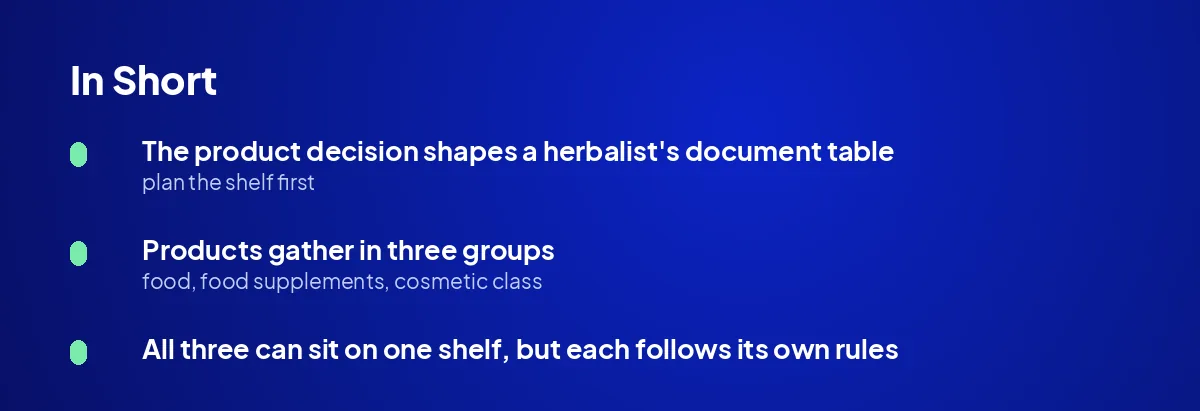
- The product decision shapes a herbalist’s document table; plan the shelf first
- Products gather in three groups: food, food supplements, cosmetic class
- All three can sit on one shelf, but each follows its own rules
- Building a health claim moves a product into an entirely different scope
- Before taking the premises, check the occupancy permit, zoning and consent
- Registration on the food side runs through the provincial directorate of agriculture and forestry
- The class changes according to whether processing happens on the premises
- Hygiene training covers everyone working in the shop
- Fee figures vary with the municipal tariff and are updated annually
- Scale inspection and labelling are the first headings an inspection looks at
- Running the steps in parallel pulls the opening forward by weeks
Quick Glossary
Food business registration certificate: the document recording a food business’s activity officially, handled on the provincial directorate of agriculture and forestry side. Sanitary establishment: the class of workplace accepted as carrying no heavy health effect on its surroundings. Food supplement: a class of product offered to support a normal diet, with its own notification regime. Health claim: promoting a product by linking it to an illness or complaint.
Next Step
Let’s draw up your shelf plan and document timetable together: consultation request form.
Frequently Asked Questions
Updated: September 2026
Sık Sorulan Sorular
It varies with the field of activity and district practice. Obtain written confirmation from the district municipality before you open your file.
It runs on the Ministry of Agriculture and Forestry side, through the provincial directorate of agriculture and forestry.
Usually not. In businesses selling food the registration side applies separately; further duties arise according to your product group.
It varies with the municipality’s own tariff and is updated annually. Ask the district municipality’s revenue department for the current figure.
You can, but cosmetics follow their own rules; notification and labelling duties apply separately.
You can describe the product, but saying that it heals an illness changes the scope and creates risk.
In loose sales, scale inspection, storage arrangements and the information given to the customer come to the fore. Confirm the conditions with the directorate.
It is expected of everyone working in jobs involving contact with food; at inspection everyone working that day is assessed.
A few weeks to eight weeks if the paperwork is complete and the premises suitable. If a premises problem arises the timing becomes unpredictable.
Source: Ministry of Agriculture and Forestry — Corporate Page