
Nuts and Dried Fruit Shop Licences: Why Does Roasting Change the Class?
Picture two nut shops on the same street. One got its licence and opened in three weeks; the other spent four months and had to carry out building work. Both sell the same products and their windows look alike.
The difference is the roaster in the back. In this trade what settles the establishment class is not the product but the process applied to it. This article places three realistic cases side by side and shows why that distinction decides so much.
Three cases, three different outcomes
The three sketches below represent the models most often seen in practice. The distance between them opens up less in the document table than in the conditions placed on the premises.
| Case | Work carried out | Typical outcome |
|---|---|---|
| Case 1 | Packaged goods only | The lightest scope, quick set-up |
| Case 2 | Roasting on site and loose sales | A business carrying out a process, extra premises conditions |
| Case 3 | Packing under its own brand | Production and packing scope |
None of the three is better or worse. The difference lies in the capital and the timetable you want to start with.
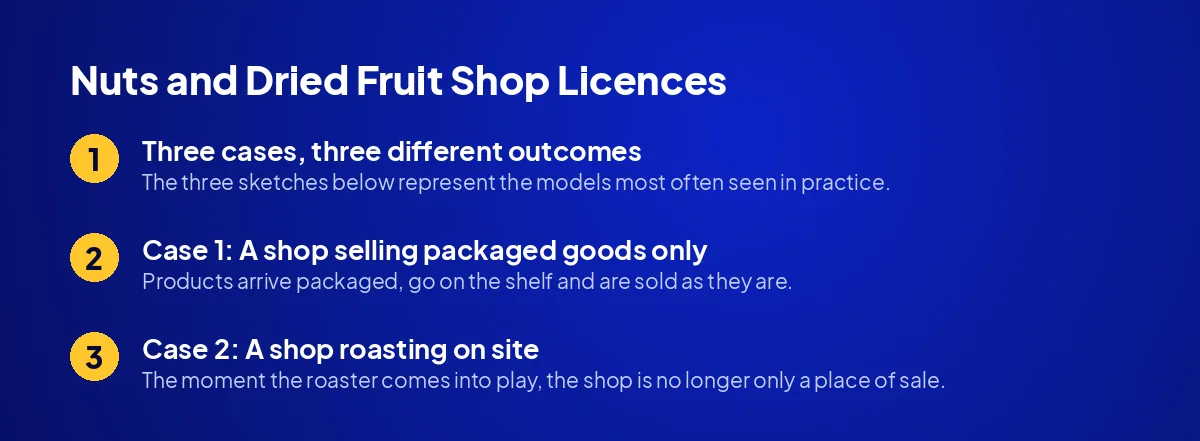
Case 1: A shop selling packaged goods only
Products arrive packaged, go on the shelf and are sold as they are. The business sits within food retail and its table looks like other food shops’.
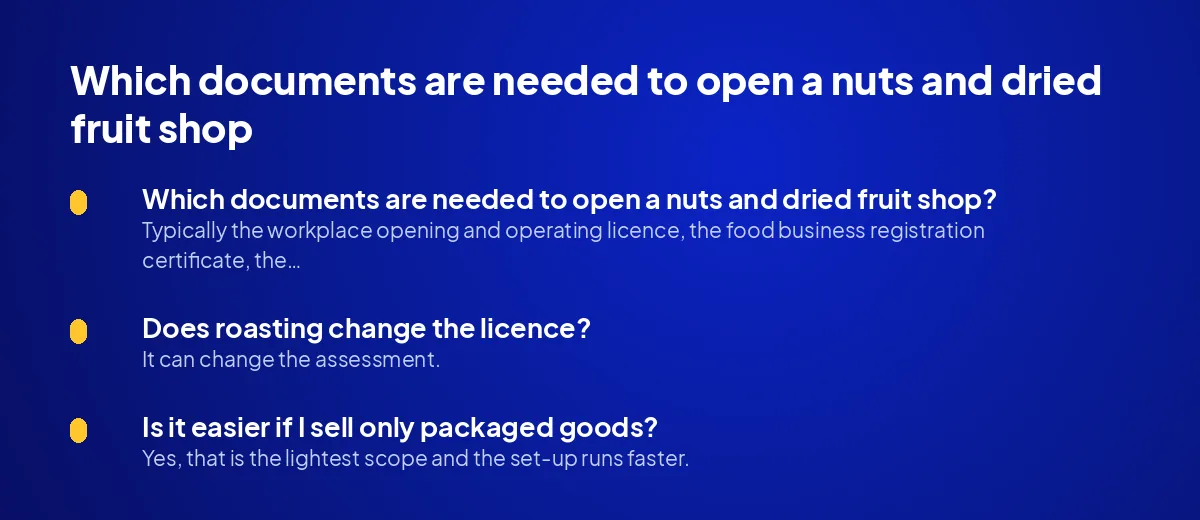
Typically the workplace opening and operating licence, the food business registration certificate (issued by the provincial directorate of agriculture and forestry), the tax certificate, chamber registration and hygiene training certificates for staff are requested. What is expected of the premises is dry, cool storage protected from damp.
This model’s one weak point is the margin. Because the product is comparable, price competition is hard.
Case 2: A shop roasting on site
The moment the roaster comes into play, the shop is no longer only a place of sale. A process is being carried out that produces heat, smoke, smell and oil vapour.
Three conditions follow from that: an extraction and flue arrangement, the ability to separate the processing area from the sales area, and the building management’s permission for a flue line. The third is where the surprise turns up in most files.
In this case the assessment of the establishment class can also change. The distinction between a sanitary establishment and a non-sanitary establishment is drawn according to the effect of the process on its surroundings, and roasting is a process that weighs on that assessment.
Case 3: A shop packing under its own brand
If you buy the product, bag it yourself and sell it under your own label, your place in the chain changes. You are now the party presenting it to the customer, and every line on that label becomes your declaration.
This model falls within packing scope, and registration on the food side is assessed accordingly. Obtain written confirmation from the district municipality and the provincial directorate of agriculture and forestry as to which scope applies in your own file.
Why this case is the one most often confused
Because from the outside nothing changes. The same product, the same shop, just a name on the bag. Yet that name carries responsibility from the producer to you.
Why does roasting change the class?
The rules classify workplaces by the effect of their work on their surroundings and on those who work there. Roasting produces three separate effects, each assessed under its own heading.
- Heat and combustion: fire safety and the fire brigade assessment come into play
- Smoke and smell: because neighbouring units are affected, a flue solution is expected
- Oil vapour: an extraction line and a cleaning regime are expected
When those three effects come together, the shop can no longer be assessed as a simple shelf business. A heavier class is not a penalty; it is the true measure of the work being done.
The duties that packing brings
Once you begin selling under your own label, the content of that label becomes the first thing an inspection looks at. The following are the items typically expected.
- Product name and net quantity
- Ingredients and allergen information where relevant
- Details of the place of production or packing
- Batch number and expiry date
- Storage conditions
Setting an optimistic expiry date is this model’s most common mistake. In nuts, rancidity arrives with time, and the complaint reaches you from the customer before the inspector.
Why this distinction decides so much at inspection
An inspection looks not at the signboard but at the work actually being done. If a roaster is running in a shop licensed only within sales scope, that is assessed as activity outside scope.
The same holds for packing. If you are carrying out work outside your scope, doing it well does not change the position. Setting the scope correctly at the start is both quicker and cheaper than widening it later.
Which case is the less risky start?
For a founder with limited capital the sensible order is usually this: open with Case 1, learn which products turn over, then move to the roasting or packing side.
The reasoning is simple. A roaster and a flue line are capital tied up while there is still no volume. Once volume builds, the same investment starts to finance itself. For capital and earnings bands see our herbalist and food sector page.
The price of going in the reverse order
Those who begin with roasting take on the premises conditions, the building work and a heavier licence process from day one. The opening slips by months, and rent runs throughout.
What to do when you want to change class
You opened within sales scope and now you want to add roasting. What has to be done is not buying the machine and switching it on.
- Apply to the district municipality for a change of activity and get in writing which documents are needed
- Ask the provincial directorate of agriculture and forestry to update the scope of your registration
- Obtain written permission from the building management for the flue and extraction
- Have the building work planned only after those three answers arrive
Breaking that order and buying the machine first means taking apart an arrangement already built. In this trade the most expensive building work is the work done twice.
Why the flue should be asked about when choosing premises
When viewing premises for this trade, two things are asked before floor area: whether a flue line can be built, and whether the electrical capacity will carry a roaster.
If those two answers are no, the place is not suitable for the roasting model however well priced it is. If you plan to open with Case 1 there is no problem; but if you are thinking of growing later, today’s decision draws tomorrow’s boundary.
For the general order authority by authority see the business licence roadmap, if you are considering adding the spice and herbal side see our herbalist shop article, and for a model that prepares on site see our çiğ köfte shop article.
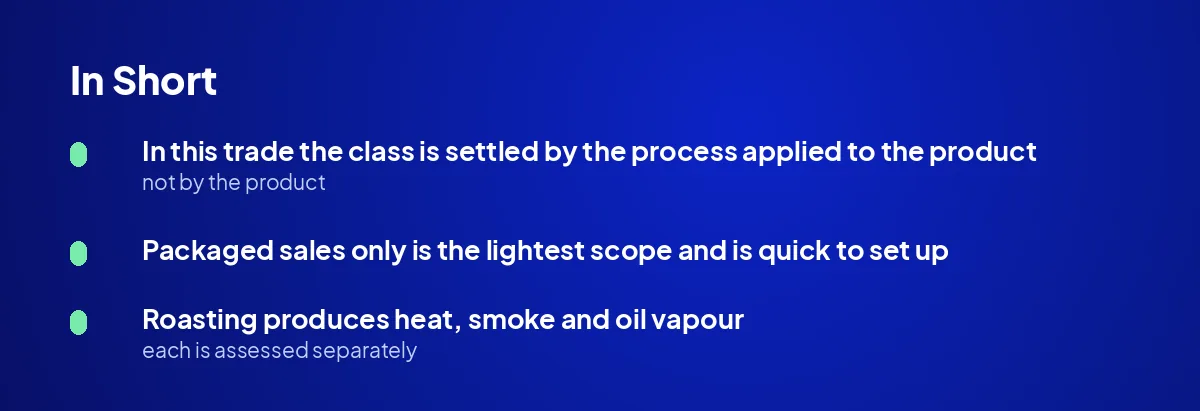
In Short
- In this trade the class is settled by the process applied to the product, not by the product
- Packaged sales only is the lightest scope and is quick to set up
- Roasting produces heat, smoke and oil vapour; each is assessed separately
- The building management’s permission for a flue line is where most files meet a surprise
- Selling under your own label carries responsibility from the producer to you
- Batch, expiry date and storage conditions are expected on the label
- An inspection looks at the work actually done, not at the signboard
- Activity outside scope is not put right by doing that work well
- The sensible order is to start with sales and move to processing as volume arrives
- In a change of class: written answers first, then building work, the machine last
- When viewing premises, the flue and the electrical capacity come before floor area
Quick Glossary
Non-sanitary establishment: the class of workplace subject to a heavier assessment because of its work’s effect on its surroundings. Packing: the operation of placing a product in a container and labelling it for presentation to the customer. Extraction line: the system drawing smoke and vapour away from the point where a process creates them. Batch number: the code identifying a group of products made or packed under the same conditions.
Next Step
Let’s settle which case you will start with and what your premises must allow: consultation request form.
Frequently Asked Questions
Updated: September 2026
Sık Sorulan Sorular
Typically the workplace opening and operating licence, the food business registration certificate, the tax certificate, chamber registration and hygiene training certificates. If there is roasting or packing the scope widens.
It can change the assessment. Because of heat, smoke and oil vapour, an extraction arrangement and a class assessment come into play.
Yes, that is the lightest scope and the set-up runs faster. The margin, though, is more limited.
You can, but that falls within packing scope and the information on the label becomes your declaration.
Written permission is needed from the building management; an assessment is also made on the municipal side according to the activity.
You can, but obtain the written answers for a change of activity first and have the building work done afterwards.
It varies with the municipality’s own tariff and is updated annually. Ask the revenue department for the current figure.
Product name, net quantity, ingredients, batch number, expiry date and storage conditions are typically expected.
With limited capital, starting with packaged sales and moving to roasting or packing once volume has built.
Source: Ministry of Agriculture and Forestry — Food Businesses