
Car Detailing Licences and Permits: Where Is Your Service List Heading?

Ten years ago car grooming meant a wash and a wax. Under the same sign today you will find ceramic coating, paint protection film, deep interior cleaning and paint correction. As the service list grows, so does the shop’s paperwork.
This article does not hand over a document list on its own. It first shows the direction your service list is expanding in, then explains what that expansion touches on the licensing side. In this trade the file is decided not by the sign outside but by the work carried out in the bay.
Detailing is no longer a single trade
The sector has split into three separate service layers in recent years. Customers walk through the same door for all three, yet from a business point of view they do not sit in the same place.
The dividing line runs here: work done with water and shampoo and work that involves applying chemicals and curing them indoors are not counted as the same activity by an inspector. Write your service list with that in mind.
Three service layers, three weights of file
| Layer | Typical services | What changes in the file |
|---|---|---|
| Basic washing and care | Exterior wash, interior vacuum, wax | The water and waste water side comes forward |
| Advanced detailing | Paint correction, compounding, deep interior cleaning | Chemical storage and ventilation are added |
| Protection applications | Ceramic coating, paint protection film | Enclosed application bay and waste arrangements grow heavier |
Offering all three layers in one shop is perfectly possible. But the moment you move into the third layer the expectation for the premises shifts: you need a dust-free bay with controlled temperature and planned ventilation.
Where do ceramic coating and PPF take you?
These two services lift a detailing shop out of the simple wash-point category and move it closer to a workshop that works with chemicals. Three things change.
- The products used fall into the chemical class; storage, labelling and safety data sheet arrangements come into play
- Application happens indoors over a set period; ventilation and the fire side are assessed separately
- The waste produced is not ordinary rubbish; cloths, sponges and container residues are collected apart
Those three items are the headings that can affect how the business is assessed within the non-sanitary establishment (second or third class) framework. Do not assume that a shop which only washes cars and one which applies coatings will be placed in the same class. Set the service list you are planning down on paper and have the district municipality confirm it in writing.
What the municipal file typically contains
The workplace opening and operating licence comes from the district municipality. The file usually calls for the following items.
- Application form and declaration
- Lease or title deed
- Occupancy permit
- Tax certificate and chamber registration document
- Fire brigade report, depending on the activity and floor area
- Waste water connection document, where washing is carried out
- Mastership certificate or vocational qualification certificate (MYK), according to district practice
This is not a closed list. Municipalities may ask for further papers according to their own practice, so read the list as a framework for getting ready rather than a final inventory.
The water, waste water and chemical side
In any business that washes vehicles, the drainage line is the first thing examined. An oil and silt interceptor arrangement is expected to be in place, and waste water is not expected to go straight into the mains.
Once you move into coating and paint correction, chemical residues join the picture. Put your product list in front of the relevant authority and ask in writing whether those residues will be treated as hazardous waste.
Three checks when choosing premises
Settle three headings before you sign the lease. All three are expensive to put right afterwards.
- Whether the zoning status of the address permits this activity
- Whether the building’s occupancy permit covers commercial use
- Whether the drainage line suits a washing load and an interceptor can be fitted
Add a fourth: if the building is residential, whether noise and smell are likely to cause trouble with the other owners. This work is loud and it smells; the neighbour question turns out to be as decisive as the file.
Staff and competence
Detailing has become a craft trade. A mistake by whoever does the paint correction shows up directly on the customer’s car, and putting it right is costly.
When you recruit, run a practical test alongside the paperwork. Check your district’s approach to the mastership certificate and the vocational qualification certificate (MYK) before opening as well; this heading differs from province to province.
Why the booking system matters as much as the file
In a shop that applies protection products, a car stays inside for hours. Curing time has to pass, and the next vehicle cannot come in until the bay is clear. Capacity is therefore set not by the number of lifts but by how many hours of the day the enclosed bay is occupied.
A shop working without appointments cannot see its own capacity in this trade. Keep a simple booking record from the day you open: the car that came in, the work done, how many hours it held the bay. Three months later that record will tell you which service is genuinely earning for you.
What is certain about fees and charges
The licence fee, the signboard tax and similar items are set by each municipality’s own schedule of charges and revised every year. Figures quoted on forums do not belong in your budget.
Before you open the file, request the schedule in force from the revenue department of the district municipality. Our automotive sector page sets out the capital and monthly cost bands.
Where is demand shifting in the period ahead?
Two trends stand out. The first is the rising amount car owners will pay for protection work; the customer is looking less at a one-off wash and more at an annual protection package. The second is corporate fleets coming into the market.
Both point the same way: businesses that work by appointment, indoors and under contract are pulling ahead. Planning an enclosed application bay while you build the shop is a decision about the period ahead, not about today.
Confirmation list before opening
- The establishment class that follows from the service list you plan
- The scope under which coating and paint correction waste is assessed
- The waste water connection document and the interceptor expected of you
- District practice on the mastership certificate or the vocational qualification certificate
- Whether a fire brigade report is called for
Put these five headings to the district municipality and the relevant authority and keep their answers on paper. For the general order authority by authority see the business licence roadmap; if you are thinking of starting with washing alone look at our car wash article, and if refinishing is on your mind see our paint and bodyshop article.
In Short
- Car grooming has split into three service layers: washing, advanced care, protection work
- The file is decided by the work done in the bay, not by the sign outside
- Ceramic coating and paint protection film open up the chemical application side
- An enclosed, dust-free bay with planned ventilation is expected
- Used cloths, sponges and container residues are not ordinary rubbish
- Ask for your establishment class in writing, together with your service list
- In a washing business the waste water connection document and interceptor come first
- Practice on mastership and vocational qualification differs between provinces
- Fee items follow the municipal schedule of charges and change annually
- Demand is moving towards annual protection packages and corporate fleets
- Planning an enclosed bay is a decision about the period ahead
Quick Glossary
Detailing: a service covering the care of a car’s paint, trim and details by advanced methods. Ceramic coating: a protective chemical layer applied to the paint surface that needs curing time. Paint protection film: a clear protective film bonded to the paint surface. Waste water connection document: the paper setting out the terms on which a business may discharge its waste water to the sewer.
Next Step
Let’s set out your service list and a licensing timetable to match: consultation request form.
Frequently Asked Questions
Updated: September 2026
Sık Sorulan Sorular
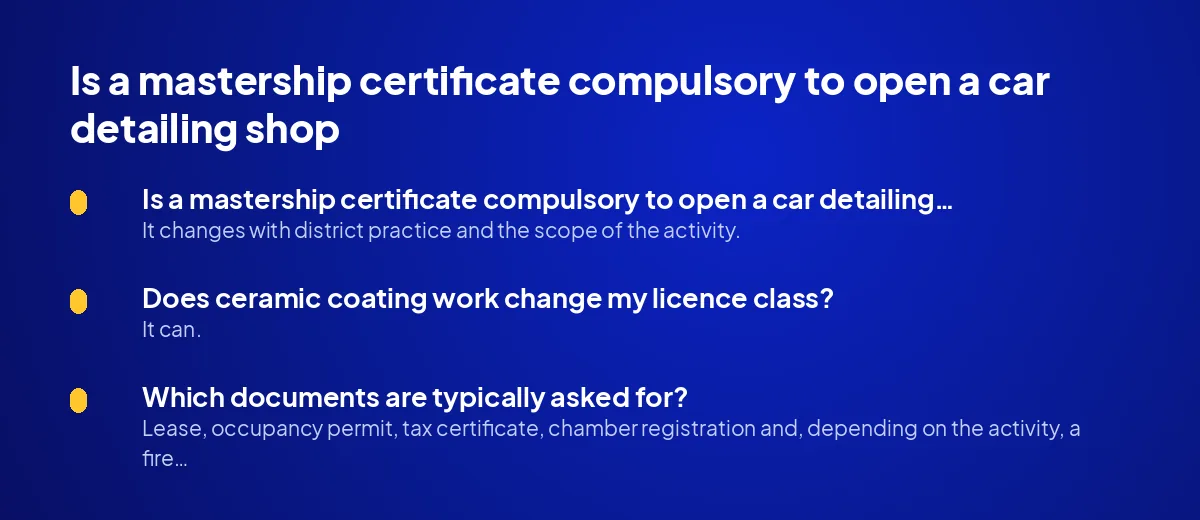
It changes with district practice and the scope of the activity. Have the district municipality confirm it in writing before you open your file.
It can. Chemical application and enclosed-bay conditions are headings that bear on classification; ask the municipality for a written answer with your service list attached.
Lease, occupancy permit, tax certificate, chamber registration and, depending on the activity, a fire brigade report and waste water connection document.
It typically arises where washing is carried out. Get confirmation for your own address from the relevant administration.
It is assessed against the products you use. Ask the relevant authority in writing whether it falls within the hazardous waste scope.
There is not. It follows the municipality’s own schedule of charges and is revised annually; the revenue department will give you the figure applying this year.
Zoning status and the position of the other owners decide it. Because noise and smell do cause friction, confirmation address by address is essential.
It may be asked for according to the scope of the activity and the size of the floor area. If you keep chemicals on site this heading carries more weight.
A few weeks to two months if the premises suit and the paperwork is complete. Any alteration work is added on top.
Source: Ministry of Environment, Urbanisation and Climate Change — Corporate Page