
Stationery and Gift Shop Licences: The Three Tables of Location

In a stationery and gift shop the shelves look much the same wherever you stand. The document file, though, runs along a different line depending on whether the shop opens beside a school, inside a shopping centre, or halfway down a residential street.
Those three locations do not share the same authority, the same premises condition or the same opening timetable. Below we set out a separate table for each of them; placing your decision into one of the three before you sign a lease makes the rest of the work considerably lighter.
The same shelf, three different customer hours
A stationer’s revenue moves with the clock and with the season. Beside a school the morning rush and the going-home hour carry the day; in a shopping centre it is the evening and the weekend; on a residential street the middle of the day and the early evening come forward.
That rhythm shapes more than your sales. It also shapes the trading pattern the municipality expects of you, along with headings such as signage, pavement display and the use of the frontage. This is why a decision about location is, in the end, a decision about licensing.
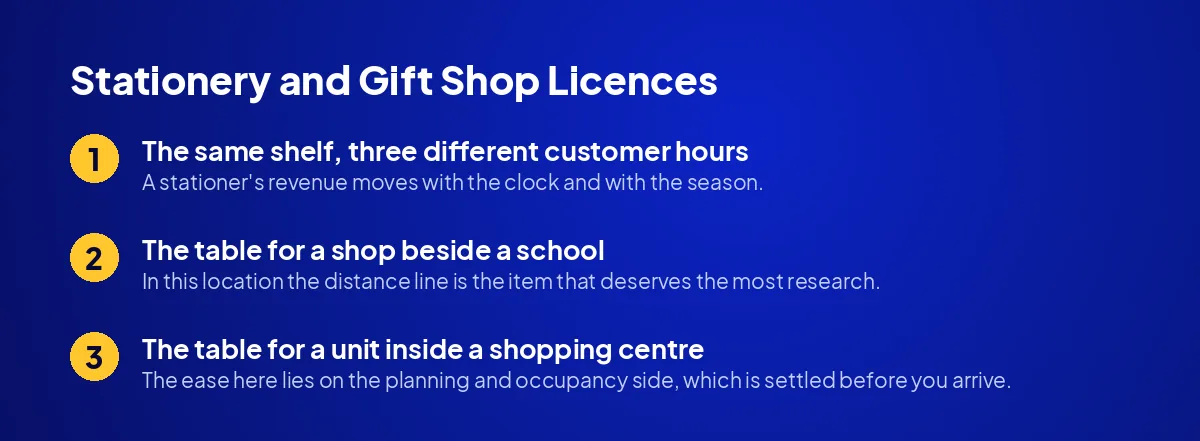
The table for a shop beside a school
| Heading | Position beside a school |
|---|---|
| Principal permission | Workplace opening and operating licence |
| Authority | The licensing unit of the district municipality |
| The distance question | For certain product groups a distance rule from the school arises |
| Building status | Usually residential; condominium consent will be expected |
| Seasonal shape | A sharp peak in August and September, a trough in midsummer |
| Additional service | Demand for photocopying and printing runs high |
In this location the distance line is the item that deserves the most research. Asking in advance whether a given product may be sold within reach of a school is far better than clearing the shelf of it afterwards.
The table for a unit inside a shopping centre
| Heading | Position inside a shopping centre |
|---|---|
| Principal permission | Workplace opening and operating licence |
| Authority | The municipality together with the centre’s management |
| The building side | The occupancy permit already covers commercial use |
| Premises condition | The management’s own shopfront and signage standard |
| The fire side | Connection to the building system plus management approval |
| Trading hours | Fixed to the centre’s own hours |
The ease here lies on the planning and occupancy side, which is settled before you arrive. In exchange, every alteration inside the unit requires the management’s written approval, and that approval process imposes a timetable of its own.

The table for a neighbourhood shop
| Heading | Position on a residential street |
|---|---|
| Principal permission | Workplace opening and operating licence |
| Authority | The district municipality and the building management |
| Building status | Consent is the heading that stalls most often |
| Product mix | Stationery and gift lines sit comfortably side by side |
| Seasonal shape | Flatter overall, with peaks on special occasions |
| Rent burden | The lowest of the three locations |
The core papers asked for in all three locations
Wherever you open, the body of the file looks similar. The following headings are typically requested, and the final list appears on the form of the municipality you apply to.
- Application form and business declaration
- Lease agreement or a copy of the title deed
- Occupancy permit and the zoning status of the address
- Tax certificate and commencement of business notice
- Tradesmen’s chamber or trade chamber registration
- Identity document and a passport photograph
- Condominium consent where the building is residential
- A fire safety measures report, according to the activity and the floor area
- Social security workplace notification if staff will be employed
What changes when photocopying and printing are added?
Most stationers offer photocopying, printing and binding. That offer adds a service line to the shop’s principal activity and brings with it headings such as machine noise, toner waste and the electrical load on the premises.
A small copying corner is generally assessed alongside the retail activity. As the number of machines grows, the municipality’s reading of the premises may shift, so write the machine arrangement you intend to run plainly onto the application form.
The labelling side of toys and gift lines
Gift shelves hold toys, decorative pieces and small electrical items together. Each of those groups falls under its own product safety regime, and items such as CE marking, a Turkish-language information label and details of the manufacturer and importer are looked for.
What is expected of you as the retailer is simple: do not put an unlabelled or undocumented item on the shelf. Ask your supplier for this information with every consignment and keep it on file.
The question of establishment class in a stationer’s
In most districts the sale of stationery and gift lines is treated as a sanitary establishment. Adding a printing press, a cutting machine or a small production corner can nevertheless move that assessment.
The class decision determines your documents and your premises conditions directly. Write out the activities you plan one by one and have the district municipality confirm the position in writing.
Five questions to ask before taking premises
- Whether the zoning status at this address permits the sale of stationery and gift lines
- What majority of owners’ consent is required if the building is residential
- How photocopying and printing should be worded in the activity description
- Whether any product group is restricted because of proximity to a school
- Above what threshold a fire safety measures report is requested
Fees and charges are read off each municipality’s own tariff, and that tariff is refreshed once a year. For that reason write a ceiling into your budget rather than a single figure.
How the location decision builds your cash flow
A shop beside a school carries its turnover on two months of the year and stays fragile through the rest. A shopping centre delivers steady footfall, but the rent and the service charge sit heavily on every month.
A neighbourhood shop runs on the lowest fixed costs of the three. It grows slowly, yet it survives easily, and if your capital is limited that third model is the least risky place to begin.
Which location suits whom?
- Beside a school, for the founder who can manage seasonal peaks and carry stock risk
- In a shopping centre, for anyone chasing brand visibility and a gift-led product mix
- On a residential street, for those who want to grow through relationships and low fixed costs
- Near a school or a public office, for anyone making copying and printing the main earner
To see the order in which the authorities line up, look over the business licence roadmap; capital and margin bands we have gathered onto the home and building sector page. If widening the product mix is on your mind, our homeware shop article reads well beside this one, and if you plan to sell the same lines online, so does our online sales article.
In Short
- In stationery and gifts the document route runs along three separate lines according to location
- All three share one core permission: the workplace opening and operating licence
- Beside a school a distance rule comes up for certain product groups
- In a shopping centre the centre’s management joins the municipality as an authority
- On a residential street the condominium consent is the heading that stalls most often
- Photocopying and printing should be written into the activity description from the start
- For toys and small electricals the labelling duty begins on the shelf
- A printing press or a cutting machine can move the establishment class assessment
- A school-gate shop earns in two months; a neighbourhood shop stays level across twelve
- Charges follow the municipal tariff and are renewed every year
Quick Glossary
Sanitary establishment: a class of workplace held to carry no likelihood of physical or chemical harm into its surroundings. Condominium consent: the written approval showing that commercial activity is permitted in a residential building. Zoning status: the official information recording which use a plot of land has been set aside for. Information label: the label showing a product’s manufacturer, importer and usage details in Turkish.
Next Step
Let us weigh up your location and your product mix together and draw out your document timetable: consultation request form.
Frequently Asked Questions
Updated: September 2026
Sık Sorulan Sorular
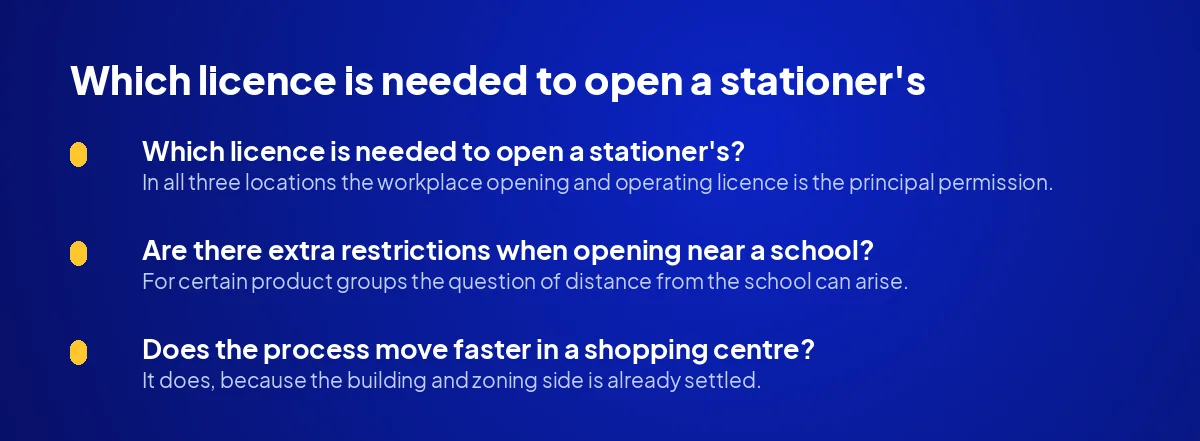
In all three locations the workplace opening and operating licence is the principal permission. The class you are placed in is set by your activity description.
For certain product groups the question of distance from the school can arise. Put your shelf plan to the district municipality in writing.
It does, because the building and zoning side is already settled. Against that, the management’s design and signage approval demands a timetable of its own.
Condominium consent. In a residential building the file does not advance until that approval is in hand.
On a small scale it is usually read alongside the retail activity. As the number of machines rises the assessment may change, so state the arrangement plainly in your application.
Keep the product safety documents supplied to you, the CE marking information and records of the Turkish-language information label on file.
A social security workplace notification is filed before the first employee. A vocational document is not usually looked for in this trade, but confirm the point with your district.
It depends on the floor area and on what is stored. If you intend to hold heavy paper stock, raise this heading at the outset.
There is no single figure. Fees and charges are read from the municipality’s own tariff and are refreshed each year.