
Homeware Shop Licences and Permits: The Seven-Step Set-Up Order

In a homeware shop the weight of the document file is settled not by the size of the premises but by what you put on the shelf. A shop selling vases, figurines and ornaments does not hear the same questions as one selling plates, cutlery, pans and storage containers.
The seven steps below are arranged in the order of decisions, not of the authorities. Walk them in this sequence. Files begun from the wrong end wait at the application desk, and every week lost comes back as rent.
Step 1: put what will sit on the shelf down on paper
Your first task is to draw up a product list. On a single sheet write every product group you will sell on opening day: glass ornaments, porcelain dinner services, steel pans, plastic storage containers, ceramic gift pieces.
That sheet is the spine of your file. It decides which door you go to in the steps that follow, what you look for in the premises and which paper you ask the supplier for.
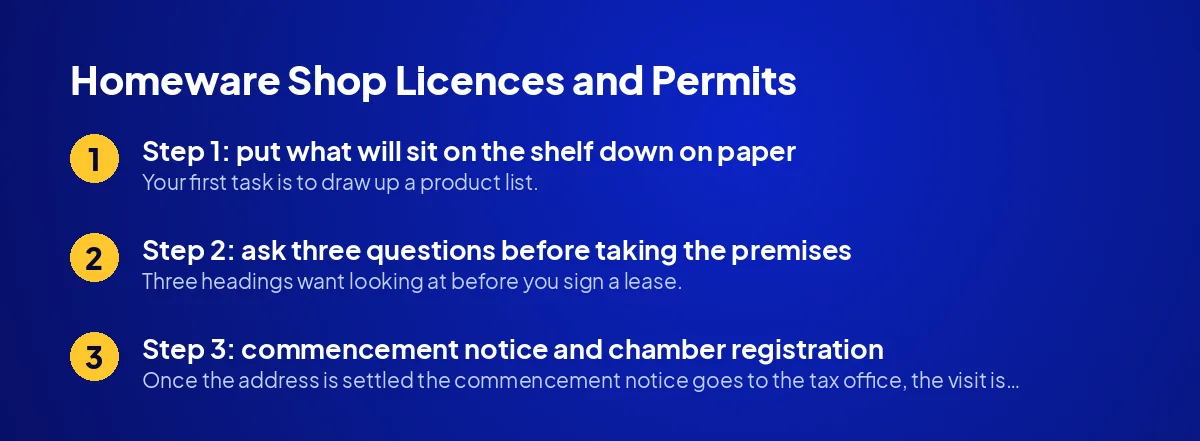
Step 2: ask three questions before taking the premises
Three headings want looking at before you sign a lease. All three are either expensive or impossible to put right afterwards.
- Whether the building holds an occupancy permit and whether it suits commercial use
- Whether the zoning status of the address allows retail selling
- Whether condominium consent can be obtained if the building is residential
Add one question peculiar to homeware: is the load capacity of the floor and shelving enough? Porcelain and glass are heavy and fragile at once, and the way goods are carried in and set out decides your breakage rate.
Step 3: commencement notice and chamber registration
Once the address is settled the commencement notice goes to the tax office, the visit is made and the tax certificate is issued. Sole traders then register with the tradesmen’s and craftsmen’s chamber, companies with the trade chamber.
This stage usually runs without trouble, yet it feeds every application that follows. A day lost here throws the whole timetable back by a day.

Step 4: ask for the class assessment in writing
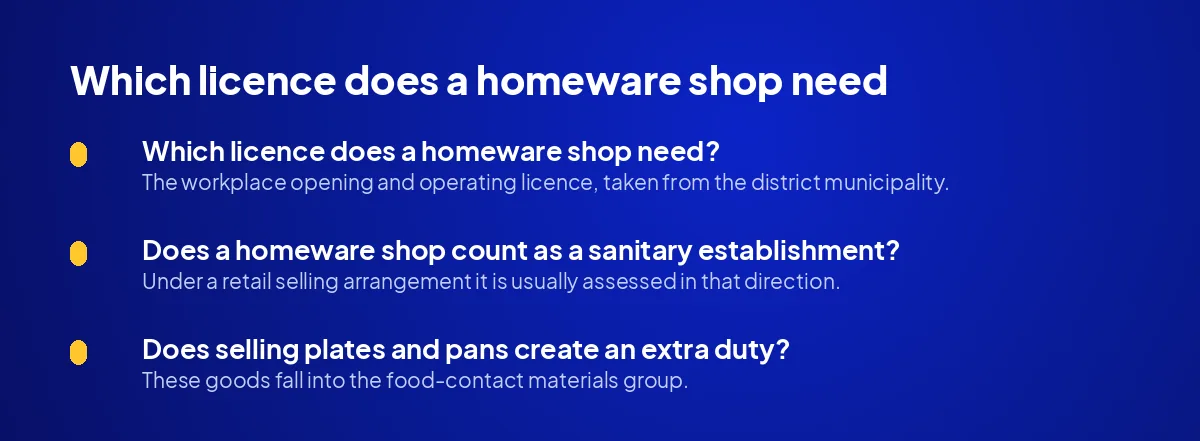
A homeware shop, being a retail business, is typically assessed towards a sanitary establishment. Even so, that direction can move once a workroom, assembly work or high-volume storage enters.
Take the list you prepared in Step 1 to the licensing unit of the district municipality and ask for the assessment in writing. Do not embark on alterations on the strength of what is said across a counter.
Step 5: build the licence file
The workplace opening and operating licence is taken from the district municipality. In this branch the following headings are typically asked for; the final list always appears on the municipality’s own form.
- Application form and declaration
- Lease agreement or a copy of the title deed
- Occupancy permit
- Information on the zoning status
- Tax certificate and chamber registration document
- Identity document and photograph
- Condominium consent in a residential building
- A fire brigade report according to the premises and the activity
- Social security workplace notification if staff will be employed
This is a framework for preparation, not a closed list. Municipalities may ask for further papers in line with their own practice.
Step 6: store room, shelving and the escape route
In homeware the store room answers to two jobs: holding breakage down and keeping the escape route clear. Both are solved on the same drawing.
Before the shelves go in, mark the escape line on the floor. Put heavy goods on the lower shelves and fragile, light pieces at eye level. This settles the escape heading an inspection asks about and the daily breakage at once.
What changes once food-contact goods go on the shelf
Plates, cutlery, glasses, pans and storage containers fall into the food-contact materials group. With these goods responsibility does not stop with the manufacturer; because you hand the item to the consumer, you are the last link in the chain.
Rather than settle the matter here, be prepared. Have the district municipality, and where needed the provincial directorate of environment and urbanisation, set out in writing which duty arises for your product group.
What to ask the supplier for
- A declaration or certificate of conformity that the item is fit for food contact
- Use and temperature information on the packaging in Turkish
- Invoice and batch details by product group
- A specimen laboratory analysis report where one exists
Keeping these four in one folder means the answer is ready when a question is put about an item. Setting it up takes an afternoon.
Ornaments only, or tableware as well: two arrangements side by side
The same floor area asks for different preparation according to what is sold inside it. The table gives the general frame; the detail can shift from district to district.
| Heading | Ornaments and gifts only | Tableware and kitchenware included |
|---|---|---|
| Typical class direction | Sanitary establishment | Sanitary establishment, assessed by volume |
| The product paper side | General product safety | Food-contact conformity comes forward |
| Label expectation | Brand and price information | Use and temperature information in Turkish |
| Supplier file | An invoice is thought enough | Declaration of conformity and batch records looked for |
| Shelf arrangement | Appearance leads | Cleanliness and separate sections lead |
Moving into the right-hand column is a choice. Tableware turnover is steadier, but the preparation it brings should be visible from the start.
Step 7: the last look before opening
Once the licence is in your hands check three things: whether the signboard’s size and position follow the municipality’s rule, whether the till and document routine is in place, and whether price labels stand where the customer can see them.
All three look like small headings. They are exactly the places an inspection looks at first.
The one thing that does not change about fees
The licence fee, the signboard tax and items like them are tied to each municipality’s own schedule, and that schedule is renewed every year. So do not write figures you meet on forums into a budget line.
Ask the revenue department of the district municipality for the schedule in force, in writing, before the file is opened. For the capital and monthly cost bands, glance at our home and building sector page.
Timetable: how long each step takes
| Stage | Typical duration |
|---|---|
| Product list and premises search | A few days |
| Commencement notice and tax certificate | Up to a week |
| Chamber registration | A few days |
| Class assessment | Days, depending on the activity |
| Municipal licence | Weeks if the papers are complete |
The only way to shorten the total is to run the steps in parallel. To see the general order of the authorities look at the business licence roadmap; if the gift side interests you read our stationery and gift shop article, and if you are going into glass and mirrors our glass and mirror shop article.
In Short
- The load on the file comes from the product group on the shelf, not the floor area
- Write every product group you will sell on opening day on a single sheet
- Before taking premises, check the occupancy permit, the zoning and consent
- Floor and shelf load capacity decides the breakage rate in this branch
- A homeware shop is typically assessed towards a sanitary establishment
- Ask the municipality for the class assessment in writing
- Mark the escape line on the floor before the shelves are lined up
- Tableware and kitchenware fall into the food-contact materials group
- Ask the supplier for a declaration of conformity, batch records and Turkish labelling
- Fee items are tied to the municipal schedule and updated annually
- Running the steps in parallel pulls the opening forward by weeks
Quick Glossary
Sanitary establishment: the class of workplace accepted as carrying no heavy physical or chemical effect into its surroundings. Condominium consent: the written approval taken from the other owners for commercial activity in a residential building. Food-contact material: the group formed by items such as plates, glasses and pans that touch food directly, carrying a conformity regime of its own. Mastership certificate: the certificate of occupational competence that may be asked of the person heading the work in certain trades.
Next Step
Let us build your product list and your licence timetable together: consultation request form.
Frequently Asked Questions
Updated: September 2026
Sık Sorulan Sorular
The workplace opening and operating licence, taken from the district municipality. Which class you are assessed in is settled by the scope of your activity.
Under a retail selling arrangement it is usually assessed in that direction. Ask the district municipality for your exact position in writing.
These goods fall into the food-contact materials group. Have the municipality confirm the duty that arises for your product group.
Ask for a declaration that the item is fit for food contact, the batch details and a specimen Turkish use label.
It is tied to each municipality’s own schedule and updated annually. Ask the revenue department in writing for the current amount.
It varies with the premises and the activity. In store rooms thick with cardboard packaging the likelihood rises.
Under a retail selling arrangement no particular competence is usually looked for. Matters change once workroom operations enter the business.
You can, but that address is subject to an assessment of its own. Where everything is solved at one address the file moves forward together.
Between a few weeks and eight weeks if the address suits and the papers are complete. Should a premises problem appear, the timing becomes impossible to foresee.