
Opening a Glass and Mirror Shop: One Glazier’s Licensing Story

The documents needed to open a glass and mirror shop look ordinary: the lease, the occupancy permit, the tax certificate, chamber registration, a mastership certificate and the workplace opening and operating licence. Beneath the list one question waits, and most tradesmen meet it late: will glass be cut inside the shop?
What Hakan went through tells the part that never shows on paper: where the bench stood decided which desk his file was assessed on.
Hakan’s eleven years
Hakan spent eleven years in a glass workshop. He knows how to take a measurement, how to trim an edge, where the backing on a mirror fails. He can guess by how many millimetres a size given on the telephone will miss the wall.
His plan was simple: glass and mirror cut to size, shower screens, table tops and small framing jobs. He found premises on a main street, agreed the lease and ordered a cutting bench and an edging machine.

The bench question meets him at the municipality
At the municipality the first question was not about the product but the process: will you sell only ready-made glass, or cut and grind as well?
Hakan said he would be cutting. The answer shaped everything that followed. A shop selling only finished goods and a place where glass is cut, edged and drilled by machine are not assessed in the same frame. The second produces noise, dust and broken glass, so it can be examined against the non-sanitary establishment (second or third class) classification. The municipality decides that from its own site inspection report; no fixed provision can be read off a page.
The turning point
The premises were on the ground floor of an apartment block. Three residential storeys sat above, and machine noise carried straight up. The bench was on its way and the rent was running.
Two options appeared: take cutting out and do sales and fitting only, or set the machine section up separately. The first carried away the heart of the business, because cutting to size was where Hakan competed.
What did Hakan do?
He found a third way. The shop keeps sales, measuring and preparation for fitting; the cutting and edging machines moved to a small unit on an industrial estate. Glass cut to size comes from there and is handed over in the shop.
Two addresses, two rents, two files. In return his service list stayed whole and the noise problem never arose; the process ran about a month longer than planned.
In his own words
“I cut glass to the millimetre and it took me eleven years to learn that. But nobody told me the machine changes the class of the shop. I should have asked who lives above me before I took the place.”
Document table for a glass and mirror shop
| Document | From where | Note |
|---|---|---|
| Lease | Landlord | With permission to install machinery |
| Occupancy permit | Municipal zoning unit | Fitness for commercial use |
| Zoning status information | Municipal zoning unit | Asked with the description of activity |
| Consent of the flat owners | Building management | Arises in a residential building |
| Tax certificate | Tax office | After the commencement notice |
| Chamber registration | Tradesmen’s or trade chamber | According to the business structure |
| Mastership certificate | Vocational training side | May be sought from the person doing the work |
| Fire brigade suitability letter | Fire brigade directorate | According to the activity and the area |
| Workplace opening and operating licence | District municipality | Site inspection included |
| Social security workplace declaration | Social security institution | Before the first employee |
The items above are the headings typically asked for; no single list covers them all. Have the district municipality confirm in writing which annexes your own file will need.
The mastership certificate side
Hakan had eleven years of experience and no certificate. Years at the bench do not count as a competence visible in the paperwork.
Two tracks run together here: the mastership certificate and the vocational qualification certificate (MYK). Which is asked of you shifts with your description of activity and district practice. Hakan learned the examination timetable before opening his file and applied; that shortened the wait.
Safety and waste in the glass trade
Glass creates risk both when it is moved and when it is cut. Inspection looks at the items showing whether that risk is managed.
- Sheet glass on fixed stillages so it cannot topple
- Broken glass waste collected in a separate, closed and labelled container
- Gloves, goggles and aprons in place in the cutting section
- Dust from grinding drawn away from the working area
- Window and door glass chosen to withstand impact
The last item looks small, but a pane meeting the pavement falls inside the shop’s own responsibility if it breaks. Ask your district’s practice for glass waste and, if needed, the view of the provincial environment directorate.
Three things he learned in the first six months
BU BÖLÜMÜN ÖZETİ
- First, the measurement record
- Second, responsibility for fitting
- Third, the record across two addresses
Once the shop opened, unexpected items came up. He knew glass; the business side he was learning.
First, the measurement record
The size a customer gives has to be taken in writing. In the first weeks he cut to telephone measurements; after two wrong cuts he moved to a measurement slip.
Second, responsibility for fitting
Responsibility forms wherever the mirror was hung. On jobs he did not fit himself, he began writing that onto the slip.
Third, the record across two addresses
Cutting at another address made a dispatch record unavoidable. Without noting which glass arrived on which day, his stock would not hold.
Looking back today
Hakan says the two-address arrangement worked, but accepts the order was set the wrong way round. Paying two rents strained the first year; in exchange he never once dealt with a noise complaint.
The second thing he noticed was his service mix. Shower screens and mirror work flowed steadily; table tops arrived seasonally. Over time he weighted the business towards the steady jobs.
Three notes for anyone taking the same road
- Before buying the machine, ask who lives above the premises. Noise and dust are a file’s weakest point in a residential building
- Write your description of activity around whether you will cut; if it changes, the file is built again
- Plan refurbishment and machine layout after the conditions you hold in writing from the municipality
One sentence back to the reader
In this trade cutting glass is the easy part; seeing in advance which class the bench moves the shop into is the hard part. Set the order the wrong way round and you end up moving the machine.
No single figure can be written against licence and signage items; every municipality applies its own tariff, renewed at the turn of the year. The order of institutions sits in the business licence roadmap, the capital and expenditure bands in our home and building sector page. If a lighting line is on your mind, see our lighting and chandelier showroom article; if a homeware shelf is, our homeware shop article.
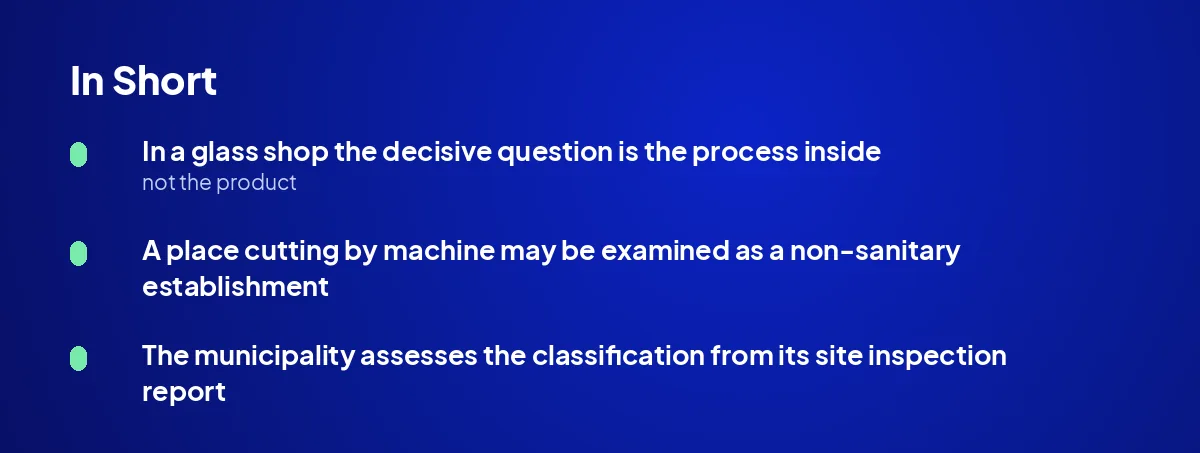
In Short
- In a glass shop the decisive question is the process inside, not the product
- A place cutting by machine may be examined as a non-sanitary establishment
- The municipality assesses the classification from its site inspection report
- In a residential building noise and dust are the file’s weakest point
- Setting sales and cutting at separate addresses protects the service list
- A two-address arrangement means two rents and two files
- Mastership and vocational qualification certificates are two separate tracks
- Broken glass waste is collected in a separate, closed and labelled container
- The measurement slip is the only ground in a dispute over a wrong cut
- Who carried out the fitting decides where responsibility arises
- Charge items follow the municipal tariff, renewed at the turn of the year
Quick Glossary
Non-sanitary establishment class: the grading of workplaces held to carry an effect into their surroundings through noise, dust or waste. Consent of the flat owners: written approval from owners for commercial activity in a residential building. Edging: taking the roughness off the edge of cut glass. Measurement slip: the document recording the customer’s size with a date and signature.
Next Step
Let’s plan your description of activity and your machine layout together: consultation request form.
Frequently Asked Questions
Updated: September 2026
Sık Sorulan Sorular
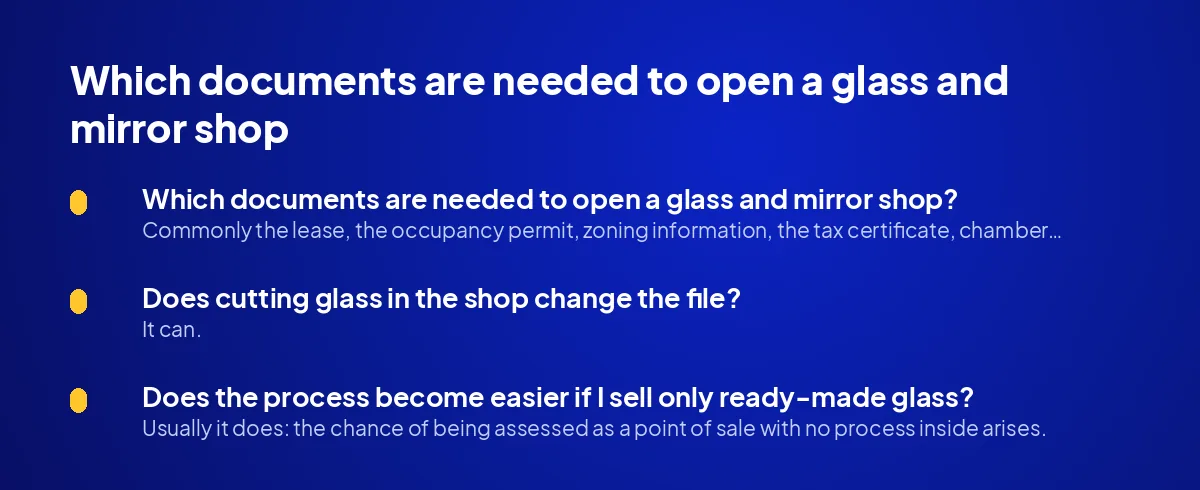
Commonly the lease, the occupancy permit, zoning information, the tax certificate, chamber registration, a mastership certificate and the workplace opening and operating licence.
It can. A place cutting by machine may be examined as a non-sanitary establishment; confirm the class with your district municipality.
Usually it does: the chance of being assessed as a point of sale with no process inside arises. The municipality decides.
It depends on the address’s zoning status and the nature of the building. In a residential building the flat owners’ consent may be sought.
It is, but a separate licence file is opened for each address and you will need to keep a dispatch record.
Collect it in a separate, closed and labelled container. Build the arrangement around your district’s practice and ask the environment directorate if needed.
It varies with district practice. Learning the examination timetable early and applying in good time shortens the wait.
The social security workplace declaration is given before the first employee; safety training and a record of personal protective equipment are also expected.
A few weeks if the address is suitable from the start. If the machine layout changes it can reach a month and beyond.
Source: Ministry of Environment, Urbanisation and Climate Change — Waste Management Pages