
Rug and Carpet Showrooms: Which Document Comes From Which Authority?
The question asked when opening a rug and carpet showroom is usually which documents are needed. Yet what blocks a file is rarely the list; it is the sequence — which document comes from which authority, and after which other document.
Below we have divided the process into four links. Each takes the output of the one before it as its own input, so skipping a place in the chain gets you turned back at the counter.
The right form of the document question
Asking for one document on its own rarely gets you anywhere. Chamber registration cannot be completed without a tax certificate, nor a licence application without the chamber registration.
The list therefore has to be read authority by authority. The table below draws that map for the sale of rugs and carpets.

The four-link authority table
| Link | Authority | Output obtained | What it needs as input |
|---|---|---|---|
| 1 | Tax office | Commencement registration and tax certificate | Lease agreement, identity document |
| 2 | Trade or tradesmen’s chamber | Chamber registration document and activity letter | Tax certificate |
| 3 | District municipality licensing unit | Workplace opening and operating licence | Chamber registration, occupancy permit, consent |
| 4 | Ancillary authorities | Fire opinion, social security notification, environmental opinion | Premises plan, staff details |
The fourth link is the one most often left incomplete. Once the licence is in hand the job is treated as finished, when the duties owed to the ancillary authorities continue after opening day.
The first link: the tax office
The commencement of business notice is filed here. If you are setting up as a sole trader the process is short; if you are forming a company the trade registry side comes in and the timetable lengthens.
In the rug and carpet trade a company structure is preferred above all by those aiming at corporate and project work. On home textile projects, hotel and office clients expect it on the invoicing and guarantee side.

The second link: chamber registration
As a sole trader you register with the chamber of tradesmen and craftsmen; as a company, with the chamber of commerce. This link moves quickly and is the input to the one that follows.
Having the field of activity recorded correctly at registration matters. If a washing or repair service is in your mind, adding it from the outset is easier than amending it later.
The third link: the municipal licensing unit
This is the principal link. The workplace opening and operating licence is issued here, and the premises side has to be ready before the file can be accepted.
For a carpet showroom two headings stand out on the premises side: the fire assessment, which follows from the floor area, and condominium consent where the building is residential.
The papers that go into the folder at the third link
When the licence application is made, the folder typically holds the following headings. The exact list comes off the municipality’s own form.
- Application form and activity declaration
- Lease agreement or title deed
- Occupancy permit and a zoning status statement
- Tax certificate and commencement of business notice
- Chamber registration document
- Identity document and photograph
- Condominium consent where the building is residential
- Premises layout plan and details of the storage arrangement
- A fire safety measures report, according to floor area and stock
The fourth link: the ancillary authorities
The fire brigade unit looks at the fire safety measures side. Social security expects a workplace notification before the first employee. If a service such as washing is added, the environmental side joins this link too.
Ask the district municipality in writing which of those three will come into play at your scale. The items that vary from province to province gather most densely in this link.
What changes if a washing service is added?
Carpet washing is the service most commonly added to selling and the decision that alters the file most. Water use, detergent waste and a drying arrangement carry the business into a different category.
| Heading | Selling only | Selling and washing |
|---|---|---|
| Nature of the activity | Commerce | Commerce and service production |
| Likely class | A sanitary assessment is common | A non-sanitary assessment is possible |
| The plumbing side | Standard shop installation | Water, drainage and treatment arrangements |
| Additional authority | Municipality and fire brigade | The environmental side joins them |
| Suitable location | A main road or a shop floor | Industrial land or a suitably zoned plot |
| Vocational document | Not expected | A qualification question may arise |
Directing customers to a partner facility rather than washing in house is a practical way of keeping the file light. The service is still offered, while the duty stays with the facility.
A separate heading for hand-woven and antique pieces
Old and hand-woven carpets may fall within a cultural property assessment. Trade in pieces of a certain age and character, and above all taking them out of the country, is subject to a permission regime of its own.
If you intend to work with that product group, it is worth asking the provincial directorate of culture and tourism about the scope. It is not the sale itself but the character of the piece that decides the matter.
Storage, moths and pest treatment
Wool and other natural-fibre carpets carry a risk from moths. Periodic pest treatment is therefore carried out in both the showroom and the store.
Buy that treatment from a licensed provider and keep the certificate on file. Applying chemicals yourself creates risk on the health side and on the inspection side alike.
Bring carpets taken in from customers for repair into the same routine. A piece arriving from outside carries risk to your stock, and holding incoming goods in a separate quarantine area is a simple but effective precaution.
How to get the sequence right
- While viewing premises, check the zoning status and the occupancy permit first
- Sign the lease agreement and pay the stamp duty on it
- File the commencement of business notice and obtain the tax certificate
- Complete the chamber registration and have the field of activity recorded correctly
- Apply to the municipality for the licence, with the premises plan attached
- Complete the fire opinion and the staff notifications
Do not commit a charge figure to your table; the relevant municipality’s annual tariff decides it. Leave that line elastic while you build the budget.
Where should you begin?
Begin with the address. With the right address the remaining links advance in order; with the wrong one, no link is ever completed.
For a general view of the order of the authorities look over the business licence roadmap, and for capital and profit margin bands our home and building sector page. For the textile group sold to the same customer, our curtain and home textiles article will help, and if you mean to widen into floor products, so will our bathroom and tile article.
In Short
- The document question is one of sequence, not of lists; each link wants the last one’s output
- The first link is the tax office, whose output is the commencement registration and tax certificate
- The second link is chamber registration, where the field of activity must be recorded correctly
- The third link is the municipal licensing unit, where the principal permission is issued
- The fourth link is the fire brigade, social security and, where needed, the environmental side
- Adding a washing service can carry the file over to the service production side
- Directing washing to a partner facility is one way of keeping the file light
- Hand-woven and antique pieces can bring a cultural property assessment into view
- Because of moth risk in wool carpets, a pest treatment certificate should be kept on file
- Duties owed to the ancillary authorities continue after the licence is obtained
- The charge amount comes from the relevant municipality’s annual tariff
Quick Glossary
Commencement of business notice: the first official step, by which the tax office is told that trading is to begin. Chamber registration document: the letter showing that a business has been entered on the register of its professional body. Cultural property: a movable or immovable object of a certain age and character that must be protected. Environmental opinion: the assessment letter obtained from the competent unit for activities generating waste or discharge.
Next Step
Let us order the four links to your own scale and place them on a timetable: consultation request form.
Frequently Asked Questions
Updated: September 2026
Sık Sorulan Sorular
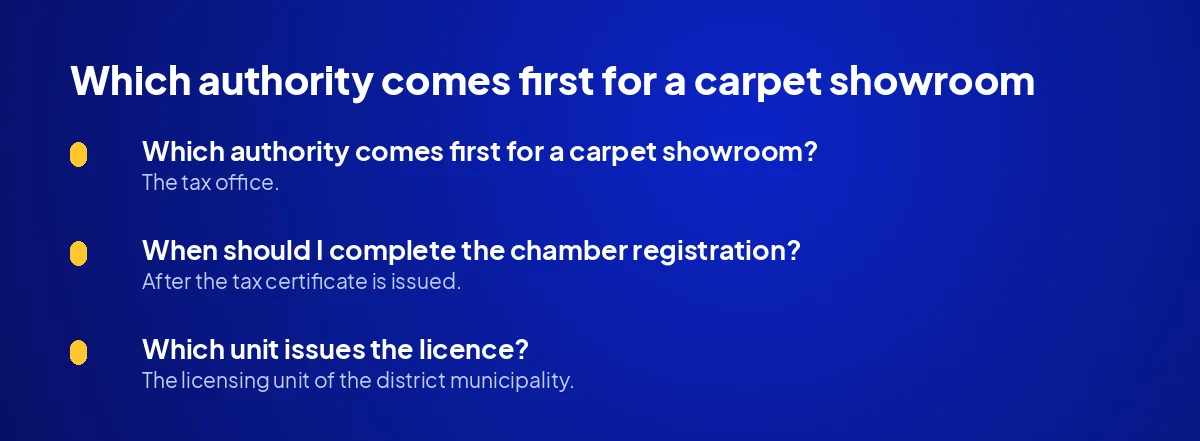
The tax office. Until the commencement notice is filed and the tax certificate obtained, the other links cannot advance.
After the tax certificate is issued. That document is the input to the registration, and the registration in turn goes into the licence file.
The licensing unit of the district municipality. If the premises side is not ready, the file will not be accepted.
The activity shifts towards service production. The class assessment, the plumbing arrangement and an environmental authority can all come into view.
You can. Directing it to a partner facility leaves the duty with that facility and keeps your own file light.
Depending on the character of the piece, a cultural property assessment may arise. Ask the provincial directorate of culture and tourism about the scope.
No upper limit is set on the number. A social security workplace notification is filed before the first employee, and health surveillance is put in place.
It may be. Buying the service from a licensed provider and keeping the certificate on file is the safest route.
No single figure is given. Ask the relevant municipality for its annual tariff and build the budget around it.
Source: Ministry of Environment, Urbanisation and Climate Change — institutional homepage