
Why did my new business ranking drop? 6 reasons you show up at launch, then fade
When a new business ranking dropped, the cause usually sits in one of six places: checking searches from inside your own shop, the launch buzz fading, your address and phone written differently in different places, a risky profile edit, reviews drying up, and nothing on the web pointing to your business. Google ranks local results by relevance, distance and prominence, and each of these six reasons touches one of those three.
The good news: all six can be measured, and most can be fixed. The bad news: there is no way to pay Google for a better local ranking. Google says so plainly on its help page.
Did your ranking really drop, or did the place you search from change?
Say you are opening a new patisserie in Esenyurt. In launch week, when you type “patisserie”, you are first on the map, but a month later your neighbour, searching from two streets away, sees you fifth. That may not be a drop at all. Google looks at how far the searcher is from you, and a search made from inside the shop will always put you up front.
Reason 1: The behind-the-counter illusion
Here is the surprise: owners usually check their ranking from the till, on their own phone. Yet your customer lives in the housing estate a kilometre away. From behind the counter you are first; from their sofa you are further down. Both are true.
Why didn’t the launch attention last?
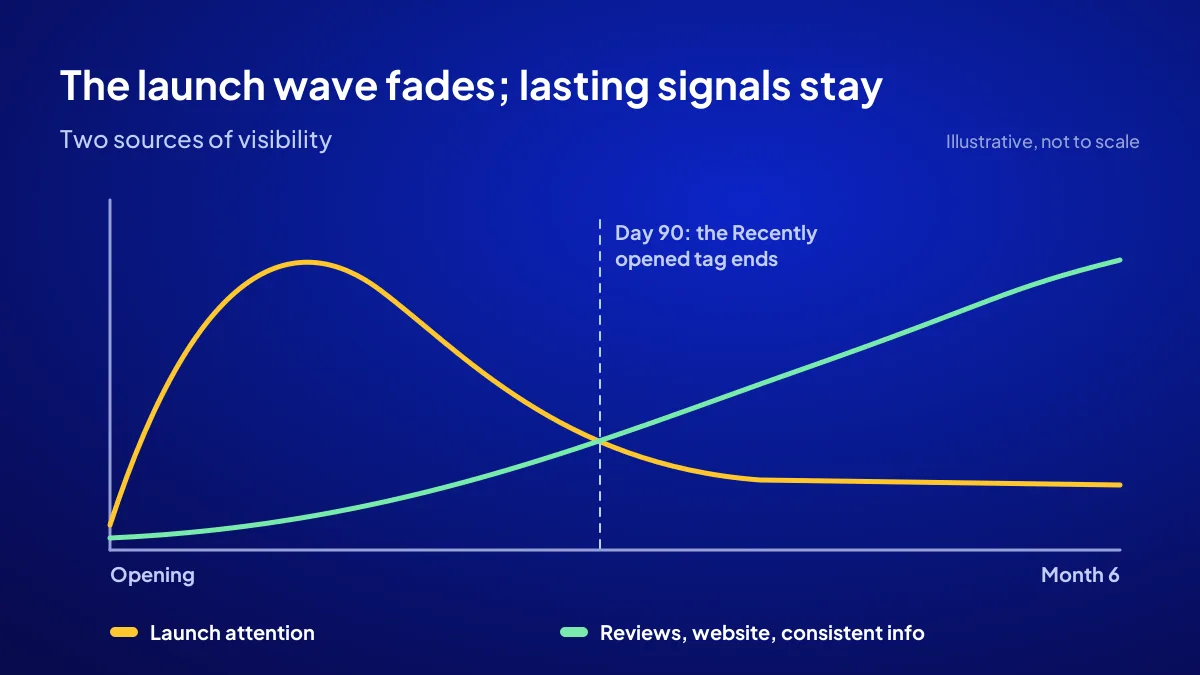
A newly opened business gets natural curiosity in its first weeks: neighbours look at the profile, ask for directions, call. That movement settles back to normal after a while. Google also shows a “Recently opened” tag on a new business’s profile for 90 days after opening; when it ends, the profile looks like any other business.
Reason 2: The novelty fading
We explain why this wave rises and falls in detail in the Google new business boost. One thing matters here: launch attention is temporary, and unless you put lasting signals in its place, the ranking settles.
Mark day 90 in your calendar
Mark the date 90 days after your opening. Having your reviews, photos and website ready before then fills the gap when the tag disappears.
Which three measures does Google use for local ranking?
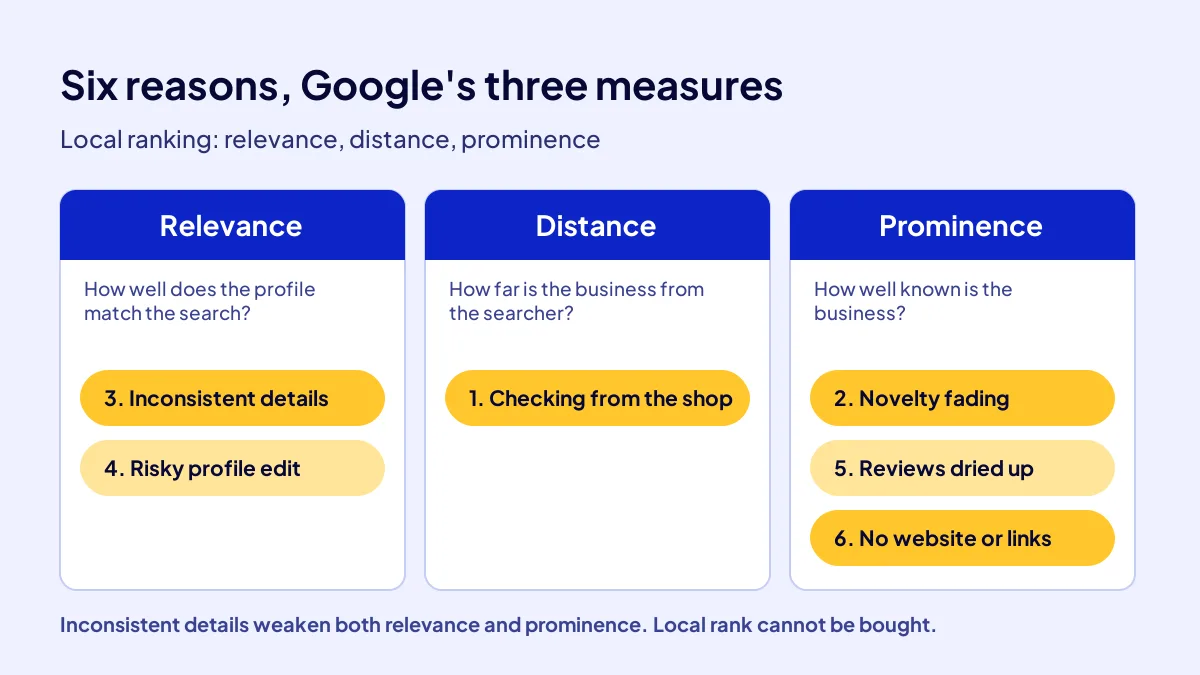
By Google’s own definition there are three: relevance is how well your profile matches what is being searched. Distance is how far the business is from the searcher. Prominence is how well known the business is; review count, rating and links across the web feed into it. Each of the six reasons weakens one of these three.
| Reason | Measure it touches | How you spot it |
|---|---|---|
| 1. Behind-the-counter illusion | Distance | Rank differs when searching from further away |
| 2. Novelty fading | Prominence | Profile visits fell after launch |
| 3. Inconsistent details | Relevance and prominence | Address or phone differs in two places |
| 4. Risky profile edit | Relevance | The drop came right after an edit |
| 5. Reviews drying up | Prominence | Last review was weeks ago |
| 6. No website or links | Prominence | No website on the profile, no page mentioning you |
Are your address and phone written the same everywhere?
This is the quietest reason in new businesses. In the rush of opening, one address goes on Google, another spelling on Instagram, an old phone number on a directory site. When Google sees the same business with different details in different places, it cannot be sure. That weakens both relevance and prominence.
Reason 3: Inconsistent name, address and phone
Say your patisserie’s address reads “Mehterçeşme Mah.” on Google, “Mehterçeşme Mahallesi” on your site, and a directory still lists the old shop’s address. It looks like a small difference, but it blurs the business’s identity. You will find the full routine in business name, address and phone consistency.
Keep one master record
Write the single correct spelling of your name, address and phone on one sheet. Copy from that sheet on every new platform. If a spelling changes, update all of them the same day.
Did a change you made to the profile push you back?
In the weeks after opening, owners edit their profile often: they lengthen the name, shuffle the category, fix the address. Some edits are reviewed again by Google. Adding words like “best patisserie Esenyurt” to the name breaks Google’s rules and can go as far as the profile being restricted. If the drop came right after an edit, that edit is the first suspect.
Reason 4: The risky edit
Whatever is on your sign should be on the profile. The primary category should be the narrowest description of what you sell: “Patisserie”, not “Cafe”.
Why did reviews and links go quiet?
In launch week friends and family write reviews, then the flow stops. When Google measures prominence it looks at review count and rating; a profile without new reviews for months can fall behind. If there is no website on your profile, or no other page mentions your business, one leg of prominence is missing.
Reason 5: Reviews drying up
Reviews are not a one-off campaign but a weekly habit. In a patisserie, a small card on every box asking “How did you find us? Would you write a line?” is enough. Offering a discount or gift in return for reviews breaks Google’s rules, so do not go down that road.
Reason 6: No website or links
If the website field on your profile is empty, Google learns about you only from the profile. Your own page tells your menu, address and story in the same voice. If you do not appear at all, you are looking at a different picture; we cover that in business not showing on Google Maps.
Quick Summary
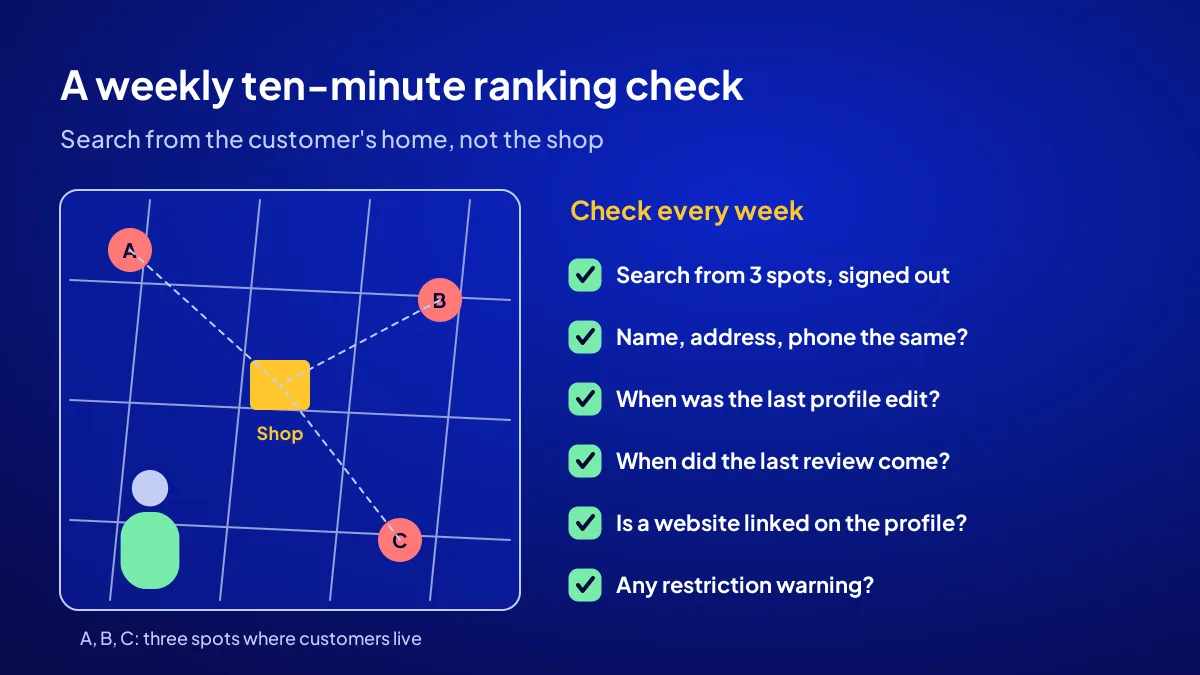
- Measure your ranking from three spots where customers live, not from the shop.
- Launch attention is temporary; the “Recently opened” tag ends after 90 days.
- Google sets local rank by relevance, distance and prominence.
- Name, address and phone must read the same on every platform.
- Adding words to the name and changing category often carry risk.
- A steady flow of reviews and a website are the lasting legs of prominence.
Short Glossary
Prominence: Prominence is the local ranking measure Google uses to weigh how well known a business is.
Primary category: The primary category is the profile field used to tell Google in one line what a business does.
Organic position: Organic position is the term used for the place a business holds in search results without paying for ads.
Next Step
If you want your profile, website and search presence to speak the same language, apply for the Get Visible Online campaign; a recipe is suggested based on your needs form.
Frequently Asked Questions
Source: Google Business Profile Help — Tips to improve your local ranking on Google
Sık Sorulan Sorular
Search from three different spots where your customers live, on a phone that is not signed in. Use the same word and note the result. Repeat weekly to see the real trend.
Not for local ranking. Ads appear in a separate area above the results, with an ad label; they do not change the organic map order. The only way to rise is to strengthen these three measures.
Undo the last change, go back to the name on your sign and leave the profile alone for a while. If there is a restriction warning on your profile, solve that first; while it stands, no other improvement will work.
The plan for building the map, search, social and AI legs of a new business together in the first 90 days is in the new business visibility guide. Which channel gets effort first is ranked in where a new business should appear first.
When your ranking drops, customers stop walking through the door while the rent still arrives every month. If you cannot afford to wait, in Adapte’s Get Visible Online campaign the Website Recipe builds your profile and website with the same details, and the Google Ads Recipe gets you seen at the moment of search while the organic position settles. The fee is TRY 36,000 + VAT, upfront and fixed, for a 3-month period; the ad budget is paid to Google separately. Details are on the Get Visible Online campaign page.
One principle to close: the launch lends you a position, and lasting signals make it yours.
No. Google states on its help page that there is no way to request or pay for a better local ranking. Ads appear in a separate area with an ad label.
According to Google’s help page, a profile with an opening date shows a “Recently opened” tag for 90 days after opening.
No. The TRY 36,000 + VAT package fee covers setup and 3 months of work. With the Google Ads or Meta Ads Recipe, the ad budget is paid separately to Google or Meta. Results are reviewed together at the end of the first month.
Updated: October 2026