
Business name, address and phone consistency: what it means for a new business
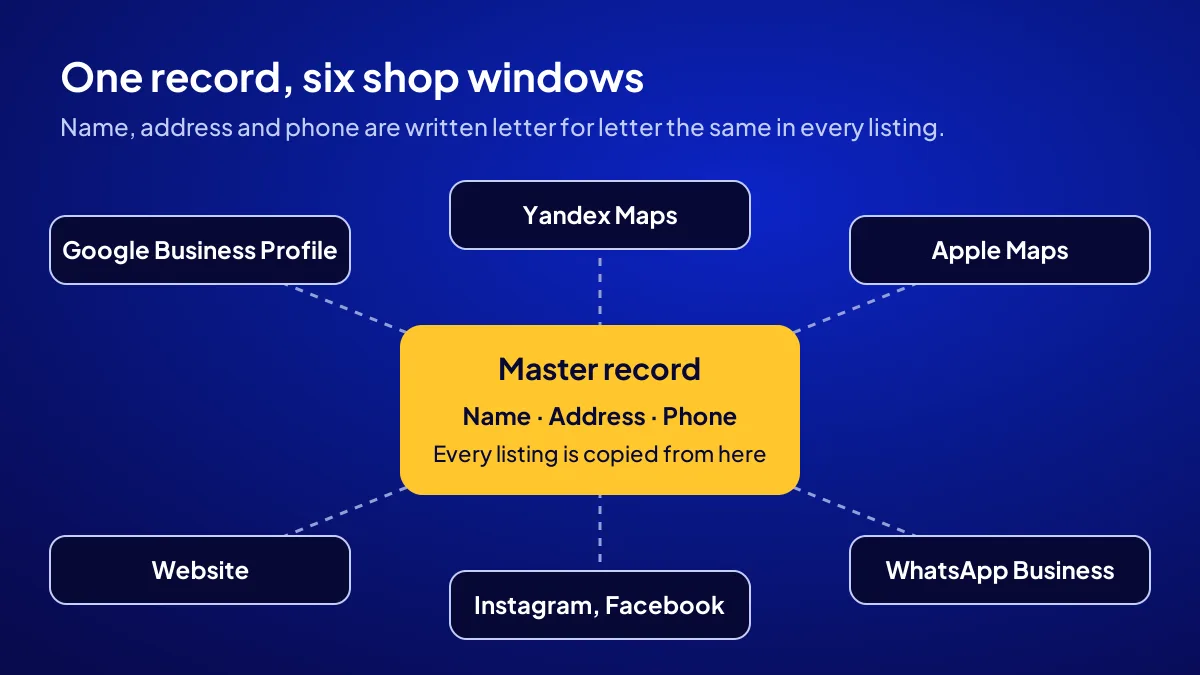
Business name, address and phone consistency means your shop’s name, address and phone number are written exactly the same in every listing online. Google Business Profile, Yandex, Apple Maps, your website, Instagram bio and WhatsApp Business should all show them in the same format. For a new business, it is the cheapest and most skipped step towards being found.
Most people do not know this: Google writes it into its rules that your business name must match the real name you use on your storefront, website and paperwork. Adding “best”, a district or a service keyword breaks that rule. So consistency is a condition for your listing to stay up. Below: what to align, where, and in which order.
What exactly does business information consistency cover?
BU BÖLÜMÜN ÖZETİ
- Name: the one on the sign
- Address: one written format
- Phone: one number tied to the location
In the trade, this trio is called NAP: name, address, phone. For a new business, hours, website and category join the list. Whichever app finds you, the customer should reach the same door, phone and hours.
Name: the one on the sign
The name in your listings is the name above your shutter. If the sign says “Ayşe Hair Salon” and one listing reads “Ayşe Hair Salon Beylikdüzü” while another says “Salon Ayşe”, it looks like three different businesses.
Address: one written format
Neighbourhood, avenue, street, building and door number are written with the same abbreviations and in the same order everywhere. If you have a floor or unit number, it appears in every listing or in none.
Phone: one number tied to the location
Google asks for a number tied to the business location and under your direct control. Using a landline in one listing and a mobile in another confuses customers before they ever walk through the door.
Why do inconsistencies appear faster in a new business?
In a new business, details are entered in a rush by different hands. The sign maker writes one name, the accountant uses the legal title, and the nephew who opens Instagram picks a short handle. Even the phone can change in the first weeks. So inconsistency happens on its own and must be prevented from day one.
Legal title and shop name get mixed up
“Yılmaz Gıda Sanayi ve Ticaret Limited Şirketi” on the tax plate and “Yılmaz Bakery” on the sign are not the same thing. Maps and social profiles use the shop name customers see. The legal title stays on the invoice.
The temporary number becomes permanent
The mobile number given at opening keeps living in old listings even after the landline is connected. A customer calls, nobody answers, and some of the days when you think the till is not ringing come from that silent number.
Which address spelling differences cause the most trouble?
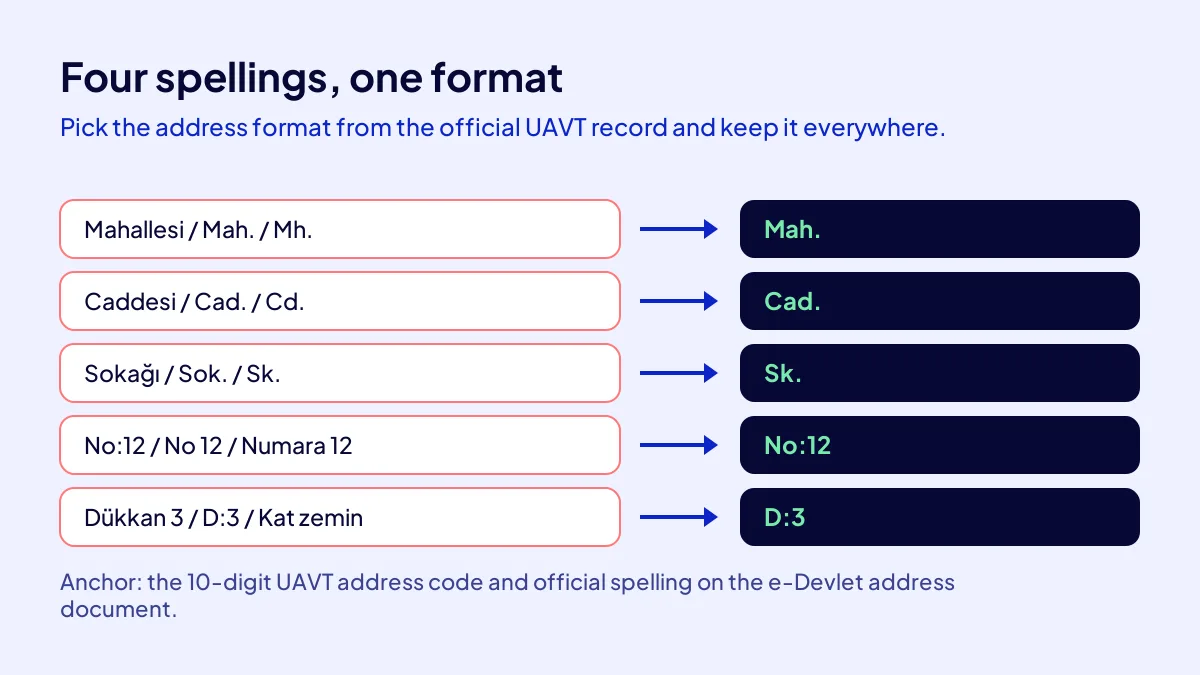
In Turkish addresses, the most common differences are abbreviations: “Mahallesi, Mah., Mh.” or “Caddesi, Cad., Cd.”. A person reads them as the same address, but they make matching harder across listings. The fix is to choose one format and use it everywhere. When choosing, take the spelling in the official record as your base.
| Address part | Variants you see | Format to choose and keep (example) |
|---|---|---|
| Neighbourhood | Mahallesi, Mah., Mh. | Mah. |
| Avenue | Caddesi, Cad., Cd. | Cad. |
| Street | Sokağı, Sok., Sk. | Sk. |
| Door number | No:12, No 12, Numara 12 | No:12 |
| Shop / unit | D:3, Dükkan 3, Kat zemin | D:3 |
| District / city | Beylikdüzü İstanbul, Beylikdüzü/İst. | Beylikdüzü/İstanbul |
A little-known anchor: the 10-digit address code
Every independent unit in Türkiye has a 10-digit address code in the National Address Database (UAVT). You can see it on the address document in e-Devlet, in DASK’s address code lookup, or on your electricity and water bills. The official spelling next to that code is your single, undisputed source.
The map pin is part of the address
A pin on the next street sends customers to the wrong door. Move it to your shopfront in every app.
What do Google, Yandex and AI do when they see different details?
When listings disagree, systems guess which is right. Google can correct a name or address that breaks its rules, and a violating profile can be suspended. AI assistants struggle to recognise the business as one entity. Consistency narrows that guesswork in your favour.
Structured data makes it easier
Marking up your name, address and phone on your website with structured data (schema) repeats the same details in a format machines can read. Yandex also states in its help pages that it can read address and organisation details from this kind of markup.
Which 6 places should you check for consistency?
The first checklist covers six places. Start where customers find you most. In each, compare name, address, phone, hours and website with your master record. We explain step by step how a listing is opened in adding a new business to maps.
- Google Business Profile (Search and Maps)
- Yandex Maps organisation listing
- Apple Maps place card
- Your website footer and contact page
- Instagram and Facebook profile details
- WhatsApp Business profile
Value card: a bakery example
Say you are opening a new bakery in Beylikdüzü. Google shows “Yılmaz Bakery”, Instagram shows “yilmazbakery_official”, and the website shows “Yılmaz Pastries”. The phone is a mobile in two places and a landline in one. The fix takes half an hour: pick the sign name and the landline, then correct all six listings to match.
How do you keep a master record and update it when things change?
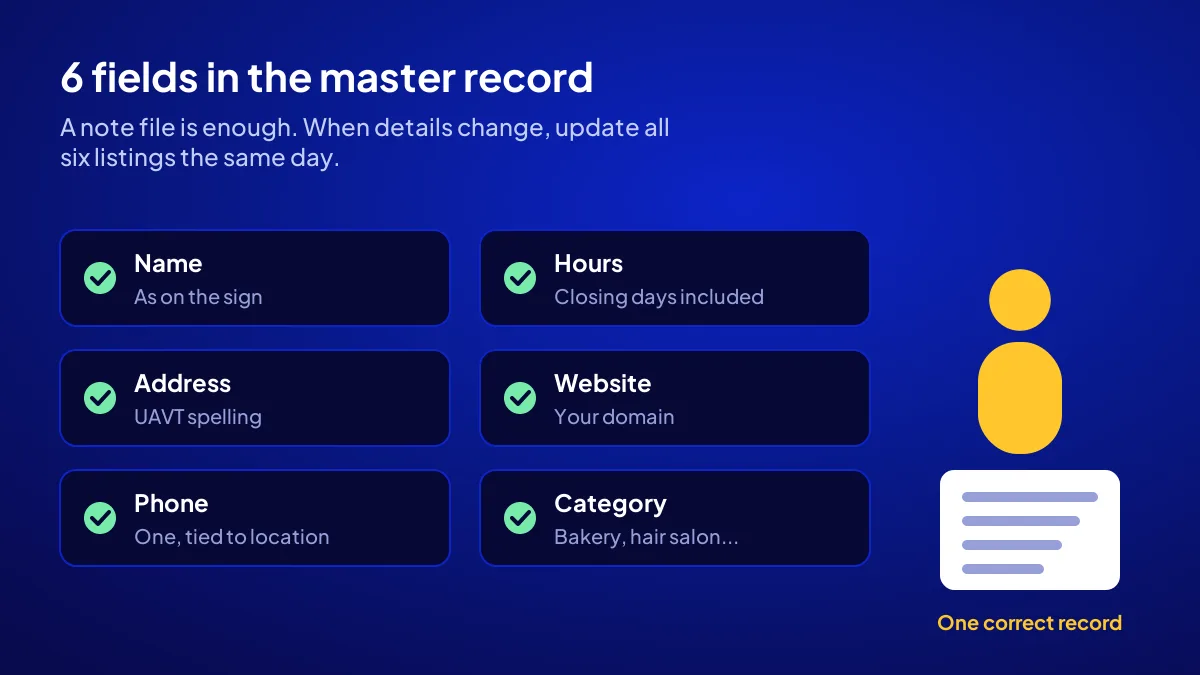
A master record is a simple note or spreadsheet holding the one correct version of your details. Every new listing is copied from it, never typed by hand. When something changes, update the master record first, then all six places on the same day.
6 fields your master record needs
- The name on your sign, letter for letter
- The address in the official UAVT spelling
- One phone number tied to the location
- Opening hours and closing days
- Website address (your domain)
- Primary category, for example “bakery” or “hair salon”
Quick Summary
- Business information consistency means name, address and phone are written the same in every listing.
- Google wants the name to match your real-world sign; adding keywords to it breaks the rules.
- Choose one abbreviation format for the address and anchor it to the 10-digit UAVT address code.
- Check six places: Google, Yandex, Apple, website, social profiles, WhatsApp Business.
- Move the map pin to your shopfront in every app.
- Keep the details in one master record and apply changes everywhere on the same day.
Short Glossary
NAP: NAP is the abbreviation used to refer to a business’s name, address and phone together.
Entity: An entity is the identity search engines and AI use to recognise one specific business.
UAVT address code: The UAVT address code is the 10-digit number used to identify each independent unit in Türkiye’s National Address Database.
Next Step
If your details are consistent, the next step is getting AI to recognise you too. Apply through the AI SEO Campaign page, share your website and target questions, and start with your diagnosis card.
Frequently Asked Questions
Source: Google Business Profile Help — Guidelines for representing your business on Google
Sık Sorulan Sorular
An entity is the identity that represents one specific thing online, such as your shop. Think of an ID card: walk into a bank with three IDs showing three different birth dates and the clerk will rightly raise an eyebrow. Systems do the same.
First the Google Business Profile, then the website, and the social profiles last. The reason is simple: the map is usually where customers get directions and call from. For the other reasons a business does not appear on the map, see business not showing on Google Maps.
You can run this check yourself. If you also want AI assistants to recognise your business as one entity, with entity setup, structured data, brand profiles and directory signals built together, Adapte’s AI SEO Campaign covers them. Where the AI side is heading is in new business AI visibility towards 2027.
Now you know: to be visible, you first have to be consistent. The name as on the sign, the address as in the official record, one phone. Which channels a new business should appear in and in what order is covered in where a new business should appear first, and the full picture in the new business visibility guide.
Google’s rules do not allow unnecessary information in the business name. The name should be the real name you use on your sign and paperwork. A name that breaks the rules can lead to the profile being corrected or suspended.
The address document in e-Devlet, DASK’s address code lookup and your electricity or water bills show the 10-digit UAVT address code and the official address spelling. Use that spelling as your master record.
No. The campaign gives no recommendation guarantee; it builds and measures the infrastructure for being readable and recognisable. The fee is TRY 36,000 + VAT and fixed; with 20 percent VAT it comes to TRY 43,200, so check the current rate on your invoice. For the 10 percent coupon, just mention the code when you apply.
Updated: October 2026