
Medical practice website: the 9 pages a clinic or doctor’s office needs, with a checklist
A medical practice website is built from 9 pages: home, specialties, doctors, appointments, before your first visit, directions, about the practice, health guide, and imprint with legal pages. Each page has a time, inputs and a question it answers.
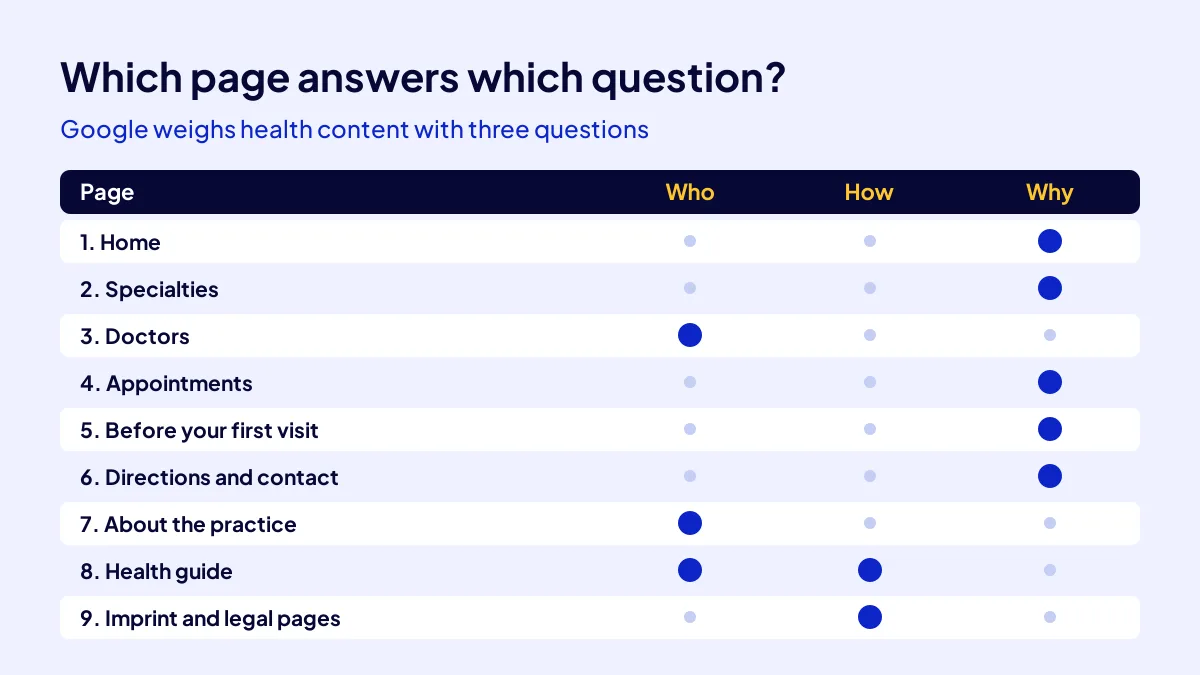
The question matters. Google looks harder at content on topics that affect people’s lives, such as health, and weighs a page with three questions: who wrote it, how was it made, why does it exist? The whole job, articles included, takes about two weeks.
Which 9 pages does a medical practice website need?
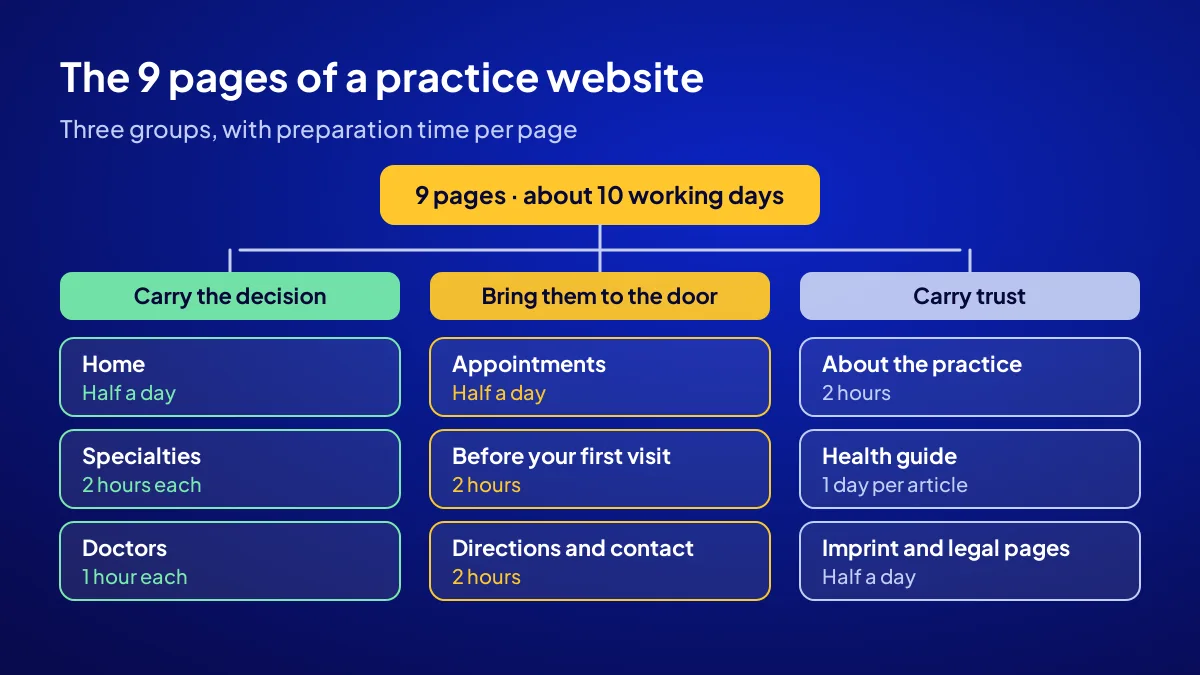
The nine pages fall into three groups: pages that carry the patient to a decision, pages that bring the patient to the door, and pages that carry trust. The last column shows which of Google’s questions the page answers. Skip one and its question goes unanswered.
| Page | Time | Inputs | Google’s question |
|---|---|---|---|
| 1. Home | Half a day | Licensed name, specialties, address, booking button | Why |
| 2. Specialties | 2 hours each | Specialty list from the activity permit | Why |
| 3. Doctors | 1 hour each | Main and sub-specialty, academic title, patient days | Who |
| 4. Appointments | Half a day | Short form, link to the KVKK privacy notice | Why |
| 5. Before your first visit | 2 hours | List of documents to bring | Why |
| 6. Directions and contact | 2 hours | Map, floor, entrance, parking | Why |
| 7. About the practice | 2 hours | Facility type, medical director, year founded | Who |
| 8. Health guide | 1 day per article | Author doctor, sources, update date | Who, How |
| 9. Imprint and legal pages | Half a day | Editor contact, last update, KVKK, cookies | How |
Pages in a solo office
Specialty and doctor pages drop to one each; the list keeps nine headings.
Why does Google look harder at a health website?
Because health information affects the reader’s life. Google says that on health and safety topics it gives more weight to signals of experience, expertise, authoritativeness and trust. Its own help page suggests judging content by “who, how and why”. An unsigned page carries little trust.
Who: the doctor behind the page
The doctors page and the author line in the health guide answer this.
How and why: method and purpose
The imprint, sources and update date answer “how”. “Why” is answered by the page doing a job for the patient: booking a slot, finding the way, preparing for the first visit.
How do you build the 3 pages that carry the decision?
BU BÖLÜMÜN ÖZETİ
- 1. Home: half a day
- 2. Specialties: 2 hours each
- 3. Doctors: 1 hour each
Home, specialties and doctors answer the patient’s “is this the right place” question. All three are filled with information Turkey’s health promotion regulation explicitly allows: the facility’s address, hours and the specialties it accepts patients in; the doctor’s main specialty, sub-specialty and academic title. A specialty not on your activity permit is not on the site.
1. Home: half a day
Inputs: licensed name, specialties, address and a visible booking button with the phone number. The first screen answers “what, where, how do I book”.
2. Specialties: 2 hours each
Inputs: the specialty list on the permit. Give each specialty its own page with the doctor, patient days and a booking button.
3. Doctors: 1 hour each
Inputs: certified titles, patient days and a portrait; one page per doctor.
How do you build the 3 pages that bring patients to the door?
BU BÖLÜMÜN ÖZETİ
- 4. Appointments: half a day
- 5. Before your first visit: 2 hours
- 6. Directions and contact: 2 hours
Appointments, before your first visit and directions turn a decision into a visit. A patient who has decided but cannot book, does not know what to bring or cannot find the building never walks in. For a patient driving to Sarıyer or Mavişehir, parking details matter as much as the appointment time. Keep them short and phone-friendly.
4. Appointments: half a day
Inputs: a form asking for name, phone, preferred day and specialty, linked to the KVKK privacy notice. Do not ask for symptoms. Under Turkey’s data protection law, health data is a special category of personal data.
5. Before your first visit: 2 hours
Inputs: a short list of what to bring, such as ID, earlier test results and reports, and current medication.
6. Directions and contact: 2 hours
Inputs: map, floor, entrance, parking or valet, phone. The address must match the Google profile letter for letter.
How do you build the 3 pages that carry trust?
BU BÖLÜMÜN ÖZETİ
- 7. About the practice: 2 hours
- 8. Health guide: 1 day per article
- 9. Imprint and legal pages: half a day
About the practice, health guide and imprint answer “who is giving this information”. Turkey’s health promotion regulation requires a website to state clearly its last update date and contact details for the site editor. Guide articles stay within what the regulation allows as health-protecting information.
7. About the practice: 2 hours
Inputs: facility type (polyclinic or doctor’s office), the medical director’s name, year founded and address.
8. Health guide: 1 day per article
Inputs: author doctor, sources and update date. Your doctor reads each one first. How AI assistants read these articles is covered in medical practices and AI.
9. Imprint and legal pages: half a day
Inputs: editor contact, the site’s last update date, KVKK privacy notice and cookie policy.
Common mistake: Going live with a template’s “our prices”, “campaigns” and “patient reviews” pages still in place. All three break health promotion rules. What cannot be written is listed in advertising rules for medical practices.
How many working days until the site is ready?
For a polyclinic with three doctors and three specialties, the eight pages besides the guide take about 27 hours, or 3–4 working days. Six guide articles add six working days. That is roughly ten working days, two calendar weeks. Put those two weeks in the calendar before opening day.
Order: door pages first
Home, appointments and directions are done in the first three days. General build steps: how a website is built.
For the guide articles, structured data and Q&A blocks in one package, the AI SEO Campaign includes 108 articles across 6 question groups, schema markup and Q&A blocks for existing pages. TRY 36,000 + VAT at a fixed price, with a 10 percent coupon; just mention the code when you apply or in the call. 12 businesses are taken per period, delivery is 30 days. Details are on the campaign page.
Which 6 items do you check before going live?
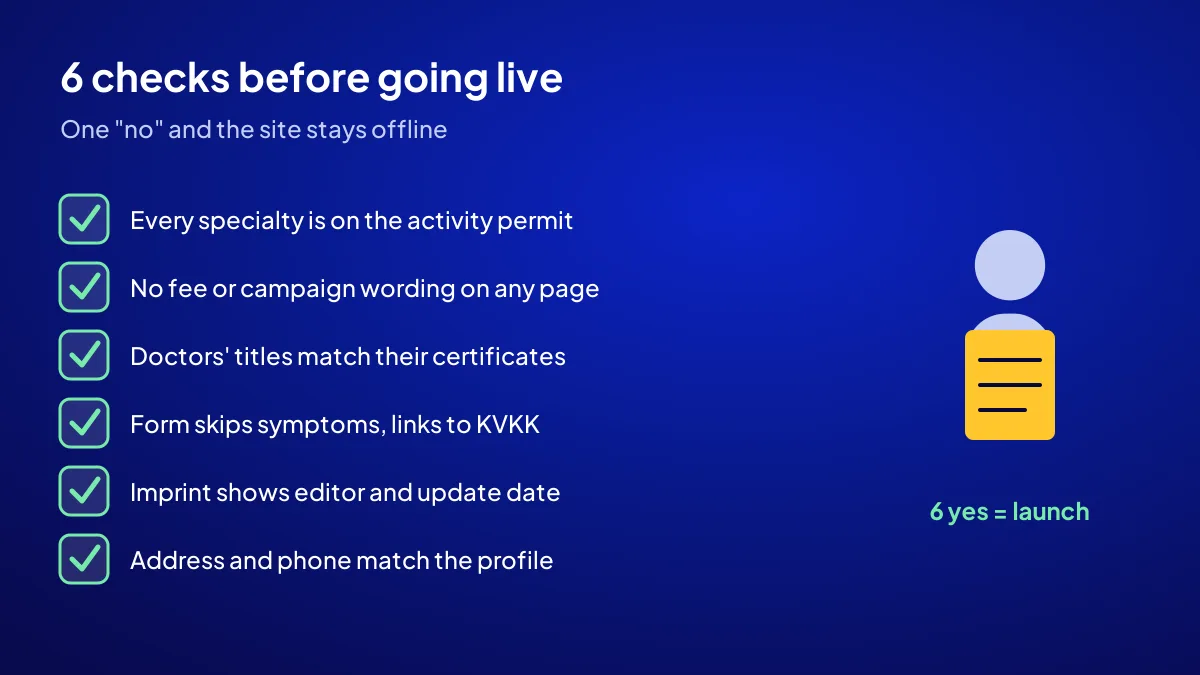
Run the six-item checklist in one sitting the day before launch. It tests the points that touch the rules and the patient, not the page copy. Someone from the practice should run it. A single “no” keeps the site offline until fixed.
- Is every specialty on the site listed on the activity permit?
- Is any fee, discount or campaign wording left on any page?
- Do each doctor’s specialties and title match their certificates?
- Does the booking form avoid symptoms and link to the KVKK notice?
- Does the imprint show editor contact and last update date?
- Do address and phone match the Google profile letter for letter?
Quick Summary
- A polyclinic site has 9 pages; a solo office has one specialty and one doctor page.
- Google weighs health content by who, how and why.
- Specialties on the site match the activity permit exactly.
- The booking form skips symptoms and links to the KVKK notice.
- Editor contact and last update date are required.
- The site is ready in about ten working days, articles included.
Short Glossary
Imprint: An imprint is the page used to show the site’s editor, contact details and last update date.
Medical director: A medical director is the title used for the doctor responsible for running a private health facility on its behalf.
KVKK privacy notice: A KVKK privacy notice is the text used to tell patients why and how their personal data is processed.
Next Step
To set up the health guide, structured data and Q&A blocks within the rules, apply for the AI SEO Campaign. Share your site and target questions to start with a diagnosis card.
Frequently Asked Questions
Source: Google Search Central — Creating helpful, reliable, people-first content
Sık Sorulan Sorular
Photo shoots and doctor sign-off. Schedule both while copy is written.
With many foreign-language patients in Beşiktaş or Sarıyer, an English summary of directions and booking helps. Health tourism promotion has separate rules; this page only informs.
When a new doctor joins, when a specialty is added to the permit, and every three months.
The site should be ready in the second week of the first 90 days. See first 90 days of a new practice and the new medical practice promotion guide.
No. Turkey’s health promotion regulation bans fees, discounts, campaigns and promotions in promotion and information. Fees are explained face to face when a patient asks.
Yes. The regulation requires a website to state clearly the last update date of its information and contact details for the site editor. The imprint page holds both.
The campaign lists clinics among its target users and includes 108 articles, structured data, Q&A blocks and AI traffic measurement in GA4. No recommendation guarantee is given; the readability and recognisability groundwork is built and measured. The price is TRY 36,000 + VAT; at 20 percent VAT that is TRY 43,200, so check the current rate on your invoice.
Updated: October 2026