
Medical practice advertising rules in Türkiye: 3 things you can say and 6 you cannot
Medical practice advertising rules in Türkiye in 2026 come from one text: the Regulation on Promotion and Information Activities in Health Services, published in the Official Gazette on 12 November 2025. A private office or polyclinic may say who it is, where it is and share health-protecting information. Fees, discounts, campaigns, patient thank-you notes, superiority claims and content steering patients to a particular doctor are banned.
Most people do not know this: the same regulation also bans writing a “specialist” title based on certificate training. So “laser specialist” cannot go on a sign or profile. Paid boosting is allowed only in the first month after opening. Check the Provincial Health Directorate and your medical chamber first.
What do the medical practice advertising rules say in short?
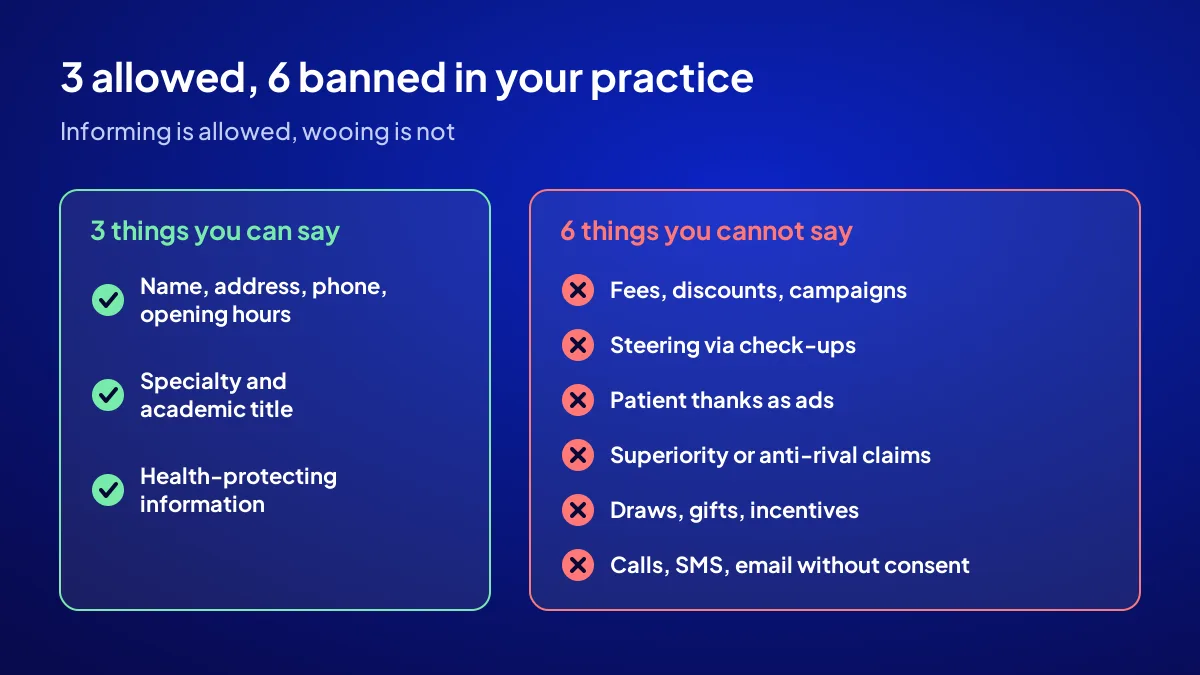
The regulation defines advertising as any activity that puts a health institution or doctor forward beyond the limits of promotion. Promotion means address, hours, specialty, academic title and preventive health information. Informing is allowed, wooing is not.
| 3 things you can say | 6 things you cannot |
|---|---|
| 1. Name, address, phone, opening hours | 4. Fees, discounts, campaigns, promotions |
| 2. Specialty and academic title | 5. Steering to a doctor via check-ups and similar |
| 3. Information that protects and improves health | 6. Turning patient thanks into advertising |
| 7. Superiority claims and attacks on rivals | |
| 8. Draws, gifts, incentives | |
| 9. Calls, SMS or email without consent |
The question that separates ads from information
Ask: does this sentence inform the patient, or pull them through the door? “Open Saturdays 10:00 to 16:00” is information. “Check-up deal this month” is advertising, and the banned kind.
What are the 3 things you can say?
BU BÖLÜMÜN ÖZETİ
- 1. Who, where, when
- 2. Specialty and academic title
- 3. Health-protecting information
You can say who you are, where and when you serve, which field you specialise in, and share information that protects the patient’s health. In an affluent district, these three are exactly what the discerning patient looks for.
1. Who, where, when
The licensed name, full address, phone, consultation days and hours, directions and parking. These should read the same on the sign, the Google profile and the website.
2. Specialty and academic title
Titles such as “Uzm. Dr.” (specialist), “Doç. Dr.” (associate professor) or “Prof. Dr.” and the main or sub-specialty set by law. Registered certificates and publications may also be listed.
3. Health-protecting information
Preventive and improving information such as “how to measure blood pressure at home” is allowed. Only an authorised health professional may provide it.
Why is the word “specialist” the most confused point?
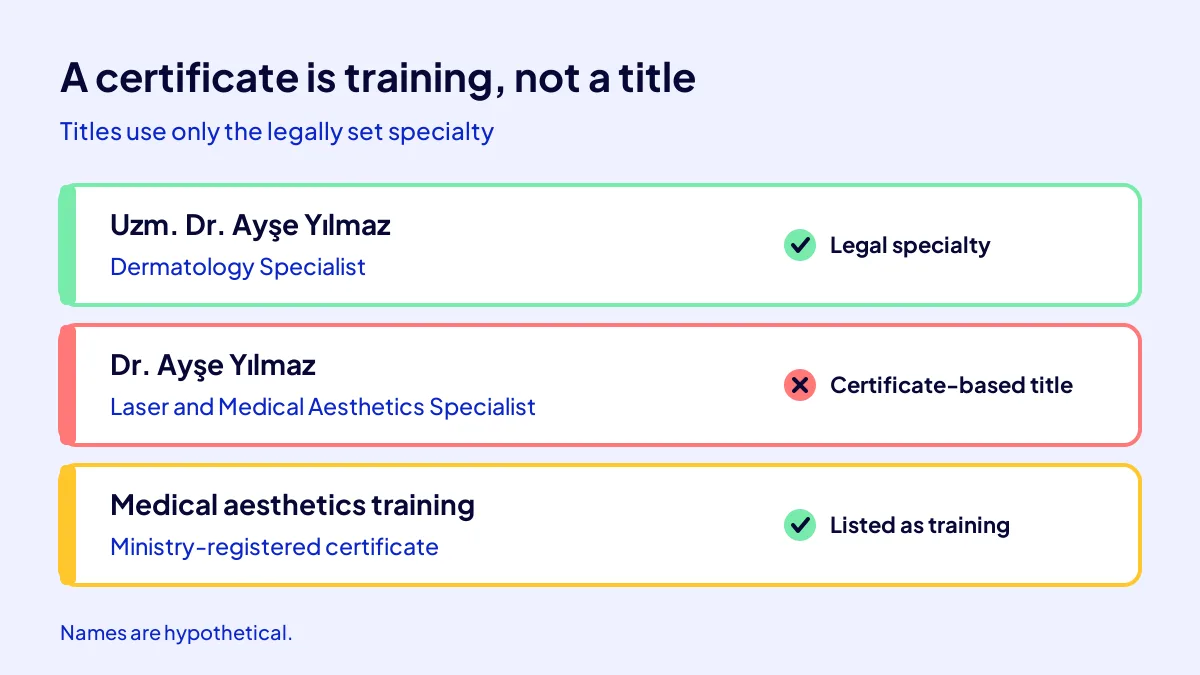
Because a certificate and a specialty are not the same, and the regulation spells out the difference. Outside the main and sub-specialties, no specialist title of any name may be used on the basis of certificates or similar training documents. A ministry-registered certificate can be listed as training, but it does not become a title.
An analogy to smile at
The weekend defensive driving course gives you a certificate, but it does not make you an airline captain. A medical certificate is the same: valuable training, not a title.
Right and wrong wording
“Uzm. Dr. Ayşe Yılmaz, Dermatology Specialist” is correct. “Dr. Ayşe Yılmaz, Laser and Medical Aesthetics Specialist” breaks the rule if that field is not a legal specialty. The correct form is “Medical aesthetics training (ministry-registered certificate)”. Names are hypothetical.
Which 6 things can you not say?
The six bans meet at one point: bringing the patient to the door through incentive or pressure instead of information. A practice that reaches for one because the till is not ringing may spend year one writing defences. The list starts with the most commonly broken:
- Fees, discounts, campaigns and promotions, including “opening specials”.
- Steering patients to a specific doctor through check-ups, screenings or consultations.
- Sharing patient or family thank-you notes as advertising.
- Superiority and anti-rival claims such as “best”, “only” or “pain-free guarantee”.
- Draws, gifts and similar incentives.
- Calling, texting, emailing or messaging people without their consent.
Keywords follow the rule too
Keywords used in search engines and the details on the results page must not breach the regulation’s principles. We track the latest version of the rule in medical practice latest rules and market.
Why the shopkeeper’s giveaway does not fit you
A café may run an opening giveaway; in health, draws and gifts are closed. You can find the rules for other businesses in opening giveaway rules.
Under what conditions can before-and-after images be shared?
Before-and-after images are not banned outright, but the conditions are heavy. The patient’s explicit consent is taken in writing or electronically, the patient sees the image first and may withdraw consent at any time. Images use the same setting, no make-up or editing, carry procedure and photo days, cannot be sponsored and are closed to comments.
The mandatory warning
The image carries a warning to this effect: results of any surgical or interventional procedure can vary from person to person; get detailed advice from your doctor before the procedure.
What can never be shared
Patient images taken during an intervention or surgery and images of intimate areas cannot be shared.
When is sponsored publishing allowed?
In two cases. First, health facilities may run compliant sponsored promotion on all platforms for the first month after opening. Second, for a new medical method accepted by the Ministry. Otherwise, listings must be free and not boosted.
Using month one well
The window is for announcing the opening; prices and discounts stay banned in that month too. We collected compliant announcement examples in medical practice opening announcement.
What happens to a practice that breaks the rule?
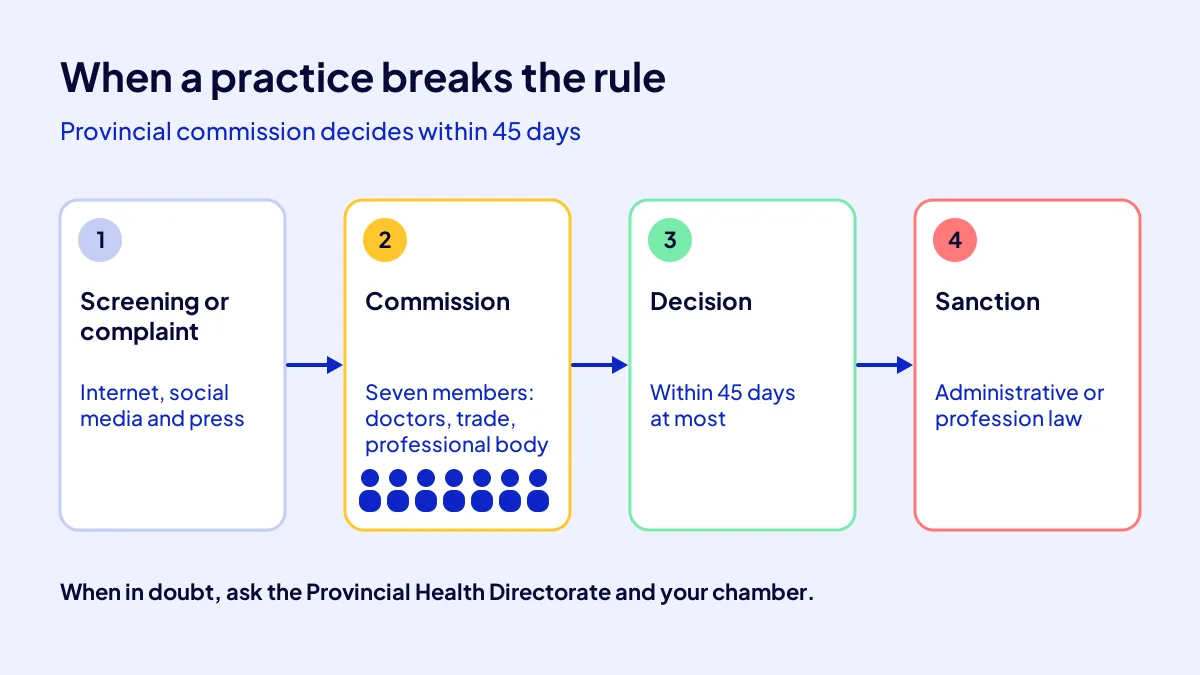
Each province sets up a seven-member evaluation commission that decides a file within 45 days at most. Private health facilities face administrative sanctions. For self-employed doctors, the relevant articles of Law No. 1219 apply.
A little-known detail: television
A doctor appearing on a radio or TV programme signs a written undertaking in two copies before speaking.
The rule-safe way to be visible
There are many bans, but the information space is open. Adapte’s AI SEO Campaign lists clinics among its audience: for a fixed TRY 36,000 + VAT it builds 108 articles in 6 question groups, structured data and entity setup, delivered in 30 days. The doctor approves every article with health information; no recommendation is guaranteed. For the order of the first 90 days, see first 90 days of a new medical practice.
Now you know: in your practice there are three things you can say with peace of mind and six you stay away from. The full promotion order is in the new medical practice promotion guide.
Quick Summary
- Open or covert advertising is banned in health; promotion and information are allowed.
- Certificate-based “specialist” titles cannot be used.
- Fees, discounts, check-up steering and patient thanks are banned.
- Before-and-after images need explicit consent, identical shooting conditions and a warning.
- Sponsored publishing is allowed only in the first month after opening.
- The provincial commission decides within 45 days at most.
Short Glossary
Covert advertising: Covert advertising is the indirect promotion format used to pull patients towards an institution while appearing to inform them.
Sub-specialty: A sub-specialty is the training stage used to earn a legally defined specialist title in a narrower field after the main specialty.
Explicit consent: Explicit consent is the legal concept used for a patient’s informed, freely given approval to the use of their image or information.
Next Step
To become visible within the rules through doctor-approved information, apply to the AI SEO Campaign; share your site and the questions your patients ask, and we start with the diagnosis card.
Frequently Asked Questions
Sık Sorulan Sorular
Both the doctor named on the sign and the company behind it.
The regulation does not mention signs, but the title rule covers every channel. Ask the Provincial Health Directorate about sign details.
The “VIP check-up package” announcement. Price plus steering: two bans in one sentence.
The text writes the window for “health facilities”. Ask the Provincial Health Directorate in writing how your office fits.
The regulation states that promotion and information activities cannot include fee, discount, campaign or promotion details. Ask the Provincial Health Directorate about your case.
Thank-you and satisfaction statements from patients or relatives cannot be shared as advertising. You may reply briefly to a review left on Google of the patient’s own accord, without mentioning treatment.
Not if that field is not a legal main or sub-specialty. You may list the certificate as training.
No. The campaign builds readability and recognisability infrastructure for AI answers and measures it with start and end diagnosis cards; no recommendation is guaranteed.
Twelve businesses are taken per period. There is a 10 percent coupon; just mention the code in your application or call.
The provincial evaluation commission decides within 45 days at most. Private health facilities face administrative sanctions; for self-employed doctors, the provisions of the medical profession law apply.
Updated: October 2026