
New medical practice, no patients? The 6 parts of a selective patient’s trust threshold
When a new medical practice gets no patients, the cause is rarely the doctor’s skill or the quality of the equipment. Before walking in, a selective patient weighs six questions: who is the doctor, what is the place like, is my privacy safe, will my time be wasted, can I reach them, does anyone else talk about this place? Every question left unanswered on screen raises the threshold a little more.
We call the sum of those answers the trust threshold. In a new practice it starts high, because most answers are not written yet. In Türkiye in 2026, health promotion is limited by regulation, so you cannot buy your way past it either. Below: the six parts, the moves that raise it and the order to lower it.
Why does a new polyclinic in Bakırköy stay quiet?
Say you have just opened an internal medicine and cardiology polyclinic on a street near Ataköy in Bakırköy. The waiting room is elegant and the two doctors are experienced. The phone rings three times a day; plenty of people walk past the door, few come in. The reason is not the space, it is the screen the patient checks before leaving home.
The patient checks the phone first
A patient living here, office worker or retiree, does not ask for an address when a heart concern appears; they search. If your polyclinic shows three photos and no reviews, they pick a hospital that has been there for ten years. That is not a judgement, it is an escape from uncertainty.
The gap is structural, not personal
“Did we pick the wrong district?” Usually not. The threshold is high for every new place, from barbers to boutique hotels. In health it is higher, because a wrong choice costs health, not a haircut.
What does a selective patient weigh before walking in?
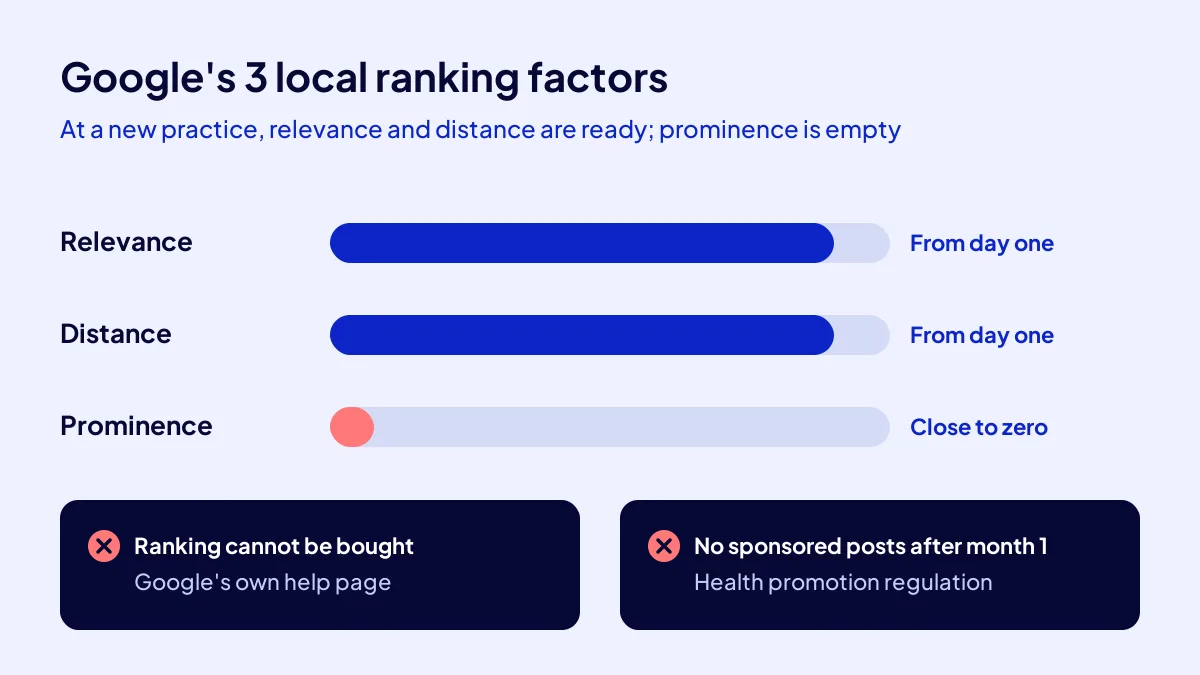
Each of the six parts answers one question, and each answer sits in a particular place. Patients do not visit those places in order; they start wherever they look first. One missing part lowers the value of the other five; the table shows where each answer is looked for. Your job is to put a true and consistent answer on every row.
| Part | The patient’s question | Where the answer sits |
|---|---|---|
| Doctor | Is this doctor really a specialist in this field? | Website, doctor bio, chamber record |
| Space | Is the place in the photo real? | Google profile photos |
| Privacy | Will my data be protected? | Privacy notice, entrance layout |
| Time | Will I be seen at my appointment time? | Hours, appointment routine, parking |
| Reachability | Will someone answer when I call? | Phone, messaging, online booking |
| Being mentioned | Do others talk about this place? | Reviews, other sites, AI answers |
Why does Google show a new polyclinic further down?
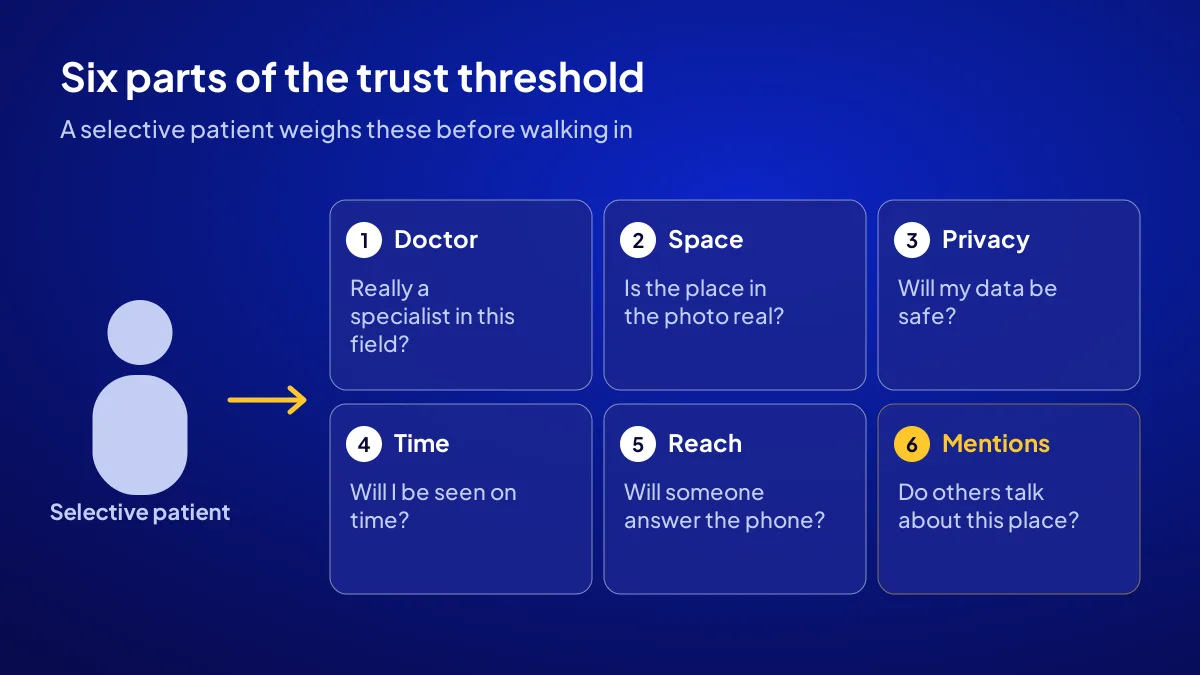
Google ranks local results on three factors: relevance, distance and prominence. Relevance and distance are in place from day one; prominence starts close to zero in a new place. Prominence reflects how well known a business is, its reviews and how often it is mentioned elsewhere online. The surprise is this: Google’s own help page says plainly that you cannot pay for a better local ranking.
Two doors closed at once
Ranking cannot be bought. The health promotion regulation does not allow sponsored promotion after the first month following opening. So both paid shortcuts are closed for a new polyclinic. What remains is building mentions through work.
Doctor, space and privacy: what do the first three parts need?
BU BÖLÜMÜN ÖZETİ
- Doctor: the title as on the diploma
- Space: photos without make-up
- Privacy: a visible promise
The first three parts tell patients who you are and what kind of place awaits them. All three can be filled within the limits of information. The doctor’s title, real photos of the space and how personal data is protected are information, not advertising. In an affluent district, patients usually look for these three on the website and profile before booking.
Doctor: the title as on the diploma
The doctor page lists medical school, specialty and academic title exactly as registered with the Ministry. The regulation bans specialist titles based on certificates.
Space: photos without make-up
Shoot the waiting room, entrance and consulting room in real light. A heavily retouched image turns into disappointment at the door.
Privacy: a visible promise
Put the privacy notice on personal data clearly on the website. So does not calling a patient’s full name across the waiting room. Nobody wants to share a heart or stomach complaint with a room.
Time, reachability and mentions: how are the last three completed?
BU BÖLÜMÜN ÖZETİ
- Time: hours and parking
- Reachability: an unanswered phone is a closed door
- Mentions: AI included
The last three parts concern the patient’s time and how they find you. In these districts, part of what you sell is time: being seen without a wait, not hunting for parking, a phone answered on the first ring. Being mentioned depends on time and is the slowest part to fill.
Time: hours and parking
Show real working hours, how appointments are kept and the nearest car park or valet on the profile and website. “Where do I leave the car?” is enough to put off a patient in Bakırköy.
Reachability: an unanswered phone is a closed door
A call missed during working hours is a shop with its shutters down. Return missed calls the same day and make it clear who watches the messaging line.
Mentions: AI included
Selective patients now ask AI assistants for “a cardiology polyclinic in Bakırköy”. Whether your name appears depends on readable, consistent information about you online. Where this is heading is covered in new medical practice and AI in 2027.
Why doesn’t an opening discount lower the threshold?
A shopkeeper’s first reflex is a discount: if nobody comes through the door, cut the price; in health that road is closed. The regulation bans fee, discount, campaign and promotion information in promotion, and raffles and gifts are on the same list. There is a second problem beyond the rule: for a selective patient a discount raises the threshold. The question becomes “why is it empty, why is it cheap?”
Review campaigns end up in the same place
Asking patients for reviews in bulk or sharing thank-you messages runs into the regulation’s ban on using gratitude and satisfaction in promotion. You can reply to reviews that arrive on their own, without personal details.
In what order does the threshold come down?
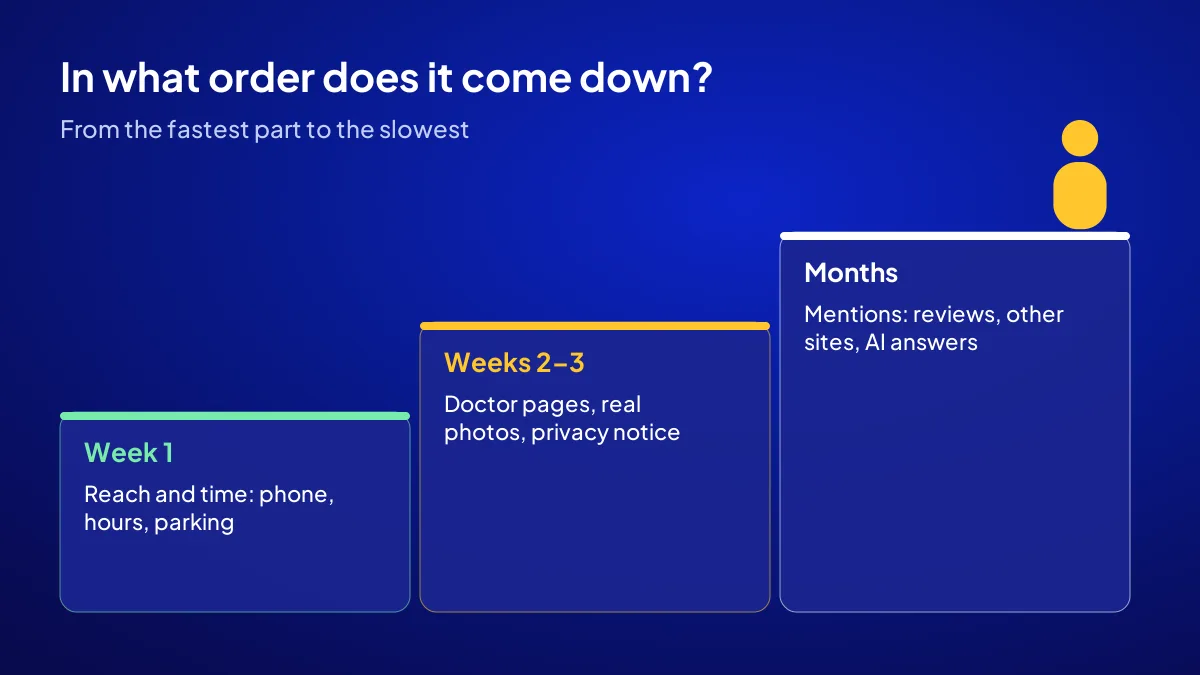
The order runs from the fastest part to the slowest. In week one, reachability and time information are completed, because they are entirely in your hands. In weeks two and three come doctor pages and photos of the space; being mentioned is last and longest, growing from months of consistent information. The general shop logic is also in new shop, no customers.
The rule-abiding way to speed up mentions
Answer the questions patients ask with informative articles approved by an authorised doctor. The regulation requires health information to come only from a health professional authorised in that field.
Quick Summary
- A selective patient weighs six questions before walking in.
- Google ranks local results on relevance, distance and prominence; ranking cannot be bought.
- In a new practice, being mentioned is the slowest part to fill.
- Discounts and review campaigns are banned and raise the threshold.
- Order: reachability and time, then doctor and space, mentions last.
- Informative articles must be approved by an authorised doctor.
Short Glossary
Trust threshold: The trust threshold is the concept used to describe the questions a patient needs answered before choosing a health provider.
Prominence: Prominence is the local ranking factor Google uses to measure how well known a business is.
Privacy notice: A privacy notice is the legal statement used to tell patients how their personal data is processed.
Next Step
To grow the “being mentioned” part within the rules, apply for the AI SEO Campaign. Share your website and the questions your patients ask, and we start with the diagnosis card.
Frequently Asked Questions
Source: Google Business Profile Help — Tips to improve your local ranking on Google
Sık Sorulan Sorular
Owners often search for “clients”; the rules say “patient”. Same person, with heavier expectations than a shop customer.
A polyclinic with five parts complete and one empty can leave the impression that something is being hidden. The empty part is usually “being mentioned”, because in a new place it takes time.
Through a complete profile in the right category, reviews that arrive on their own, and the doctor’s name spelled identically on the website, the chamber record and the profile. How to fill the profile field by field is covered in new medical practice Google Business Profile.
Prices are not written in promotion. Tell a caller politely that information follows the examining doctor’s assessment.
Adapte’s AI SEO Campaign builds the groundwork for your name to be readable in AI answers at a fixed TRY 36,000 + VAT: diagnosis card, entity setup, structured data and 108 articles across 6 question groups. No recommendation is guaranteed; readability is measured. Details are on the campaign page. For the full route see new medical practice promotion, and for the first three months a new medical practice’s first 90 days.
One principle: a selective patient goes where they find their answer before reaching the door.
No. Google states that local ranking is based on relevance, distance and prominence, and that you cannot pay for a better ranking. Türkiye’s health promotion regulation also bars sponsored promotion after the first month following opening.
No. The Regulation on Promotion and Information Activities in Health Services bans fee, discount, campaign and promotion information in promotion. Raffles and gifts fall under the same ban.
No. The campaign guarantees no recommendation; it builds the groundwork for your name to be readable and recognisable and measures it with start and end diagnosis cards. The price is TRY 36,000 + VAT, and you just mention the 10% coupon code when applying.
Updated: October 2026