
Clinic neighbourhood search: being found in Beşiktaş, Kadıköy, Çankaya and Mavişehir
A clinic neighbourhood search is one where the patient types a neighbourhood or street, more often than a district, next to the specialty: “Etiler dermatologist”, “Bağdat Avenue eye doctor”, “Çukurambar polyclinic”. A newly opened practice or polyclinic in Turkey shows up in these searches by writing the neighbourhood in the right fields, keeping its address identical everywhere and letting patients verify the doctor on its website.
Google ranks local searches by relevance, distance and prominence. Distance you cannot change; it is wherever you opened your doors. Relevance and prominence are in your hands, and both start with the neighbourhood name.
What does a patient type when searching by neighbourhood?
BU BÖLÜMÜN ÖZETİ
- Specialty plus neighbourhood
- Doctor’s name plus district
- Specialty plus “near me”
Three patterns stand out: specialty plus neighbourhood, doctor’s name plus district, and specialty plus “near me”. Someone in Beşiktaş thinks of themselves as from Etiler, Levent or Bebek, and searches that way; Moda and Suadiye in Kadıköy, Çukurambar in Çankaya and Mavişehir in İzmir work the same. This is a local observation; check it with your own searches.
Specialty plus neighbourhood
The most common and most intent-driven pattern. Someone typing “Suadiye cardiologist” is not reading promotions; they are looking for a door.
Doctor’s name plus district
Used by former patients of a doctor who left a hospital post. If name and new address do not meet on one page, they go to the old one.
Specialty plus “near me”
Typed on a phone, based on where the person is right now. The general logic is in showing up in near me searches.
How does search language differ across six premium districts?
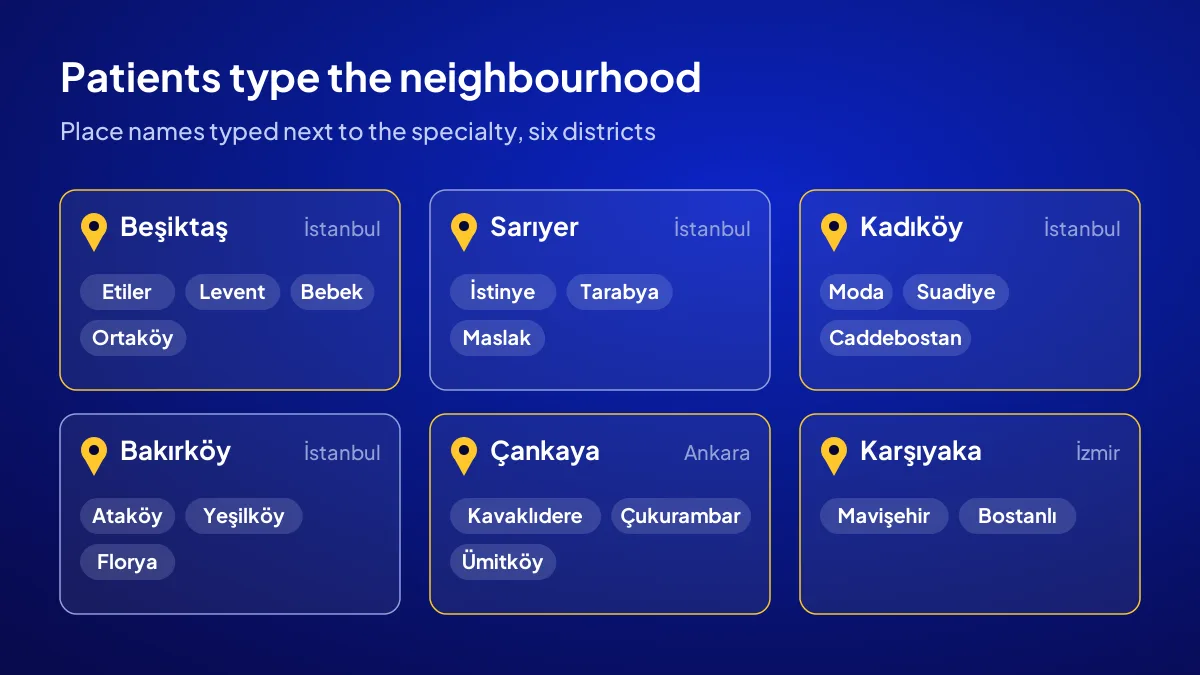
Every district contains neighbourhood and street names patients identify with. The table pairs them with the local detail a selective patient checks before deciding. It is our Local Desk’s observation, not search-volume data; test the same patterns in your own area.
| District | Place name the patient types | Local detail they check | Where to explain it |
|---|---|---|---|
| Beşiktaş | Etiler, Levent, Bebek, Ortaköy | Parking, valet, floor | Site’s directions section |
| Sarıyer | İstinye, Tarabya, Zekeriyaköy, Maslak | Weekend and evening hours | Profile opening hours |
| Kadıköy | Moda, Caddebostan, Suadiye, Bağdat Avenue | Walk from the Marmaray station | Site’s route description |
| Bakırköy | Ataköy, Yeşilköy, Florya | Access from the coast road, parking | Profile photos |
| Çankaya | Kavaklıdere, Çukurambar, Ümitköy, Çayyolu | After-work appointment times | Hours on profile and site |
| Karşıyaka | Mavişehir, Bostanlı | Patients who spend summer in Çeşme | Season hours; a note if no second address |
Do not claim the neighbouring area
Nişantaşı is in Şişli. A polyclinic that opens in Beşiktaş cannot put Nişantaşı in its address; the patient notices on the way, and trust cracks in the first minute.
Keep the neighbourhood consistent on the sign too
“Etiler” on the site, “Levent” on the profile and “Beşiktaş” on the card look like three places. Use your official address.
How does Google rank clinics in a neighbourhood search?
BU BÖLÜMÜN ÖZETİ
- Relevance: category and services
- Distance: fixed, but explainable
- Prominence: builds slowly
Google ranks local results on relevance, distance and prominence. Relevance is how well a profile matches the search; distance is how far the business is from the searcher, estimated from what Google knows if location is not shared. Prominence is how well known the business is, seen through links and reviews.
Relevance: category and services
The right primary category and completed service fields build relevance. Category choice is covered in Google Business Profile for a medical practice.
Distance: fixed, but explainable
You cannot change the address, but you can explain the journey. Parking, metro and ferry information shortens the distance in the patient’s mind.
Prominence: builds slowly
A new practice has few reviews and links. Offering incentives for reviews breaks both Google’s rules and the health promotion regulation; reply kindly to the ones that come on their own.
Where does the neighbourhood name go on the profile, site and address?
BU BÖLÜMÜN ÖZETİ
- The profile’s address line
- The site’s location section
- The doctor’s page
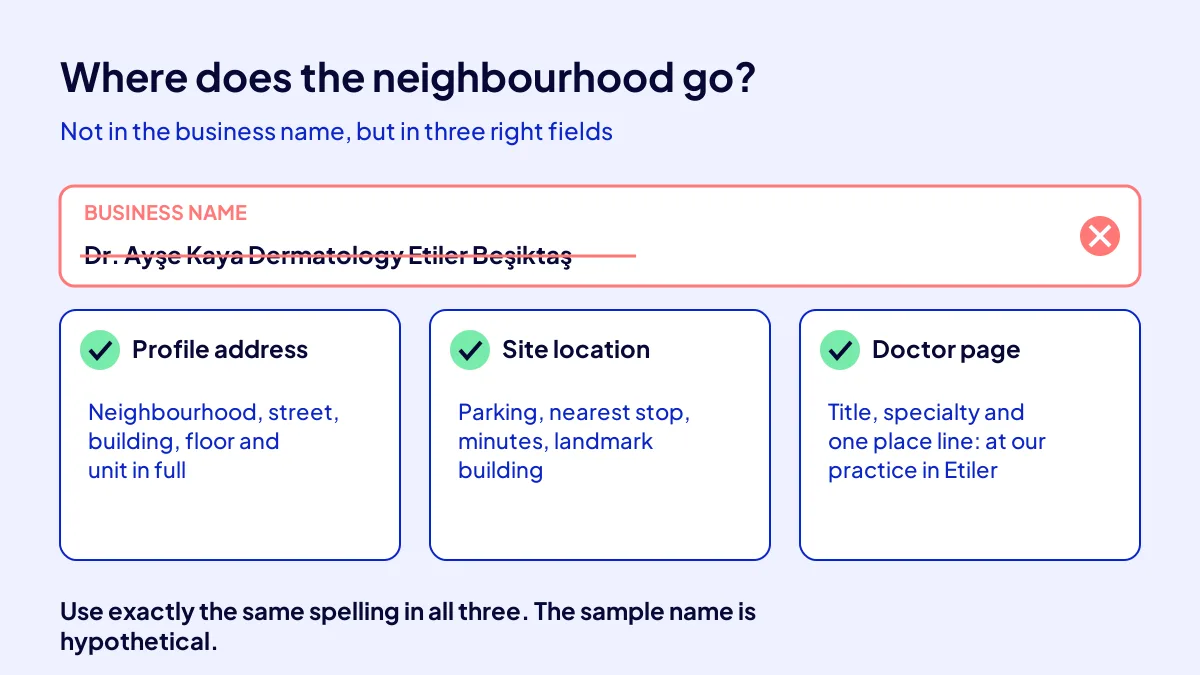
The neighbourhood is not added to the business name; Google treats stuffing location and keywords into the name as against its rules. It belongs in three places: the profile’s address line, the site’s location and directions section, and the place line on each doctor’s page. Use exactly the same spelling in all three.
The profile’s address line
Enter the official address in full with neighbourhood and street. Floor and unit details stop patients getting lost in the building.
The site’s location section
One paragraph: neighbourhood, street, landmark, parking, minutes from the nearest stop. Other must-have pages are in website pages for a medical practice.
The doctor’s page
Each doctor’s page carries the title, specialty and one place sentence such as “at our practice in Etiler”. Searches for the doctor’s name plus district connect to that sentence.
Why is “near” measured in minutes, not kilometres, in a premium district?
BU BÖLÜMÜN ÖZETİ
- Valet and parking
- Public transport
- Seasonal districts
For a selective patient, nearness is the time to the door, not the line on the map. In bridge traffic or the evening rush on Bağdat Avenue, a short distance takes long, and a patient who cannot park feels late already. So answer “how do I get there” in minutes and parking on the site and in profile photos.
Valet and parking
On a busy street in Etiler or Kavaklıdere, say if there is valet parking; if not, name the nearest car park.
Public transport
Marmaray in Kadıköy, the ferry in Bostanlı and the metro in Levent can change a patient’s decision. Naming the stop is enough.
Seasonal districts
Some patients living in Mavişehir spend the summer in Çeşme. Update summer hours on the profile, and if you have no branch in Çeşme, do not look as if you do.
How do patients from neighbouring districts find you?
Patients from a neighbouring district usually come through the doctor’s name or a recommendation, not a neighbourhood search. Word of mouth works as far as the name can be verified online. So keep the doctor’s name and title consistent rather than opening a page per area; a made-up branch in the address breaks the rules.
Ataşehir, next door to Kadıköy
A patient leaving an office in Ataşehir finds a Caddebostan practice through the doctor’s name. The doctor’s page has to be strong.
Long, precise searches climb fast
In Adapte’s own Search Console data for 14 June to 13 September 2026, a long, intent-driven Turkish query meaning “how to open a dental supply store” sits at an average position of 2.5 with 219 impressions and 11 clicks. Specialty plus neighbourhood is the same kind of search: narrow, precise and intent-driven.
How do you track neighbourhood visibility in the first 90 days?
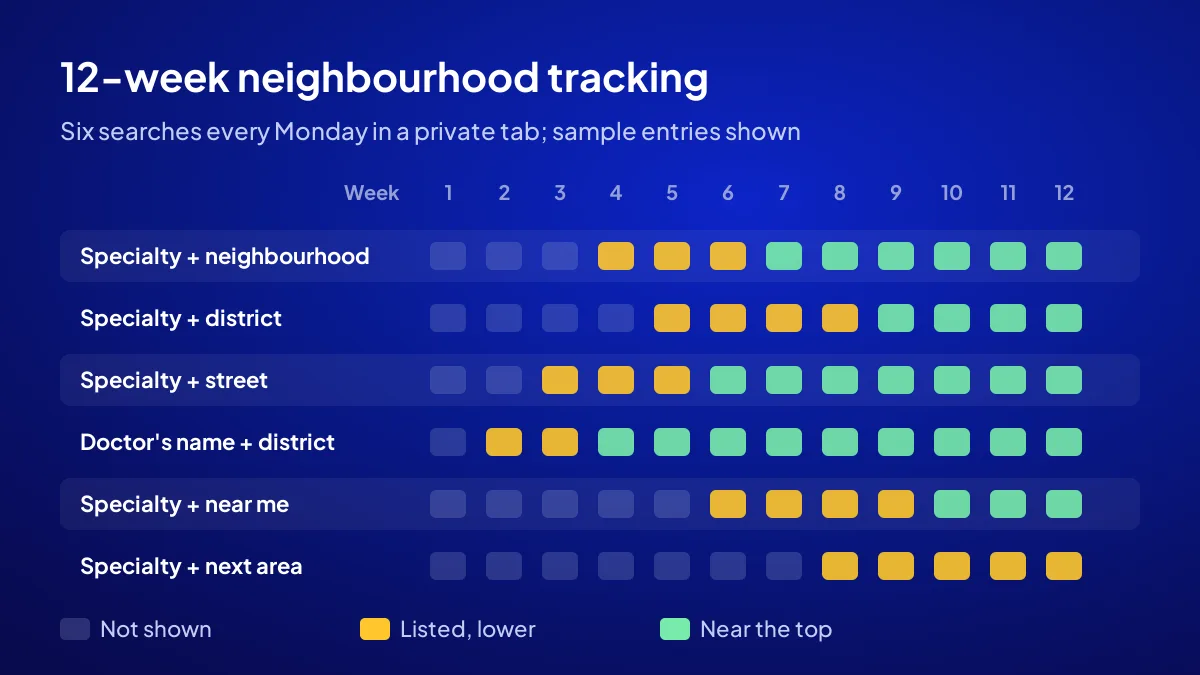
Every Monday, type six searches on a phone in a private tab and note whether your profile appears. At month end, check the search terms on the Google Business Profile performance screen, and add the neighbourhood to the “how did you find us” question. After 90 days you know where patients come from.
- Specialty plus your neighbourhood.
- Specialty plus district name.
- Specialty plus street name.
- Doctor’s name plus district.
- Specialty plus “near me”, typed outside the practice.
- Specialty plus the neighbouring area.
Keep the six searches in one table
Searches in rows, weeks in columns; write the position if you appear and a dash if you do not. Twelve weeks of trend speak more accurately than a hunch.
Setting it up in one go
Google Business Profile, a mobile site, basic SEO and visitor tracking come together in the Website Recipe of the Get Visible Online campaign: TRY 36,000 + VAT, upfront and fixed, for 3 months. Details are on the campaign page. The full promotion framework is in the new medical practice promotion guide, and the 90-day plan in the first 90 days of a new medical practice.
Quick Summary
- Patients often type a neighbourhood or street next to the specialty.
- Google looks at relevance, distance and prominence.
- The neighbourhood goes in the address, site and doctor page, not the name.
- Claiming a neighbouring area cracks trust in the first minute.
- In a premium district, nearness is explained in minutes and parking.
- Six search patterns are checked every Monday for 12 weeks.
Short Glossary
Prominence: Prominence is the factor Google uses in local ranking to measure how well known a business is.
Address consistency: Address consistency is the local search principle used to keep a business’s name, address and phone identical everywhere.
Neighbourhood search: A neighbourhood search is the search pattern a patient uses to find a nearby doctor by adding a neighbourhood, street or district to the specialty.
Next Step
To set up your profile, your site’s location section and visitor tracking together, apply for the Get Visible Online campaign. Fill in the needs form and the right recipe will be suggested.
Frequently Asked Questions
Source: Google Business Profile Help — Tips to improve your local ranking on Google
Sık Sorulan Sorular
Google treats adding location and keywords to the business name as against its rules. The neighbourhood belongs in the address line, the site’s location section and the doctors’ pages.
Google ranks local results by relevance, distance and prominence. Distance depends on your address; relevance and prominence grow with the right category, a complete profile, a consistent address and links and reviews that build over time.
You fill in the needs form, Adapte suggests the right recipe, and delivery starts on payment. The package is TRY 36,000 + VAT, upfront and fixed, for 3 months; results are reviewed together at the end of the first month.
Updated: October 2026