
Therapist office district search: being found in Beşiktaş, Kadıköy, Çankaya and Mavişehir
A therapist office district search is the search a client types as “Kadıköy psychologist” or “Çankaya couples therapist”, and it is where a new practice can show up fastest. Three things work together to appear there: the real address on the Google profile, a page on the site describing the neighbourhood and how to get there, and the same name and title spelled the same way everywhere. Adding the district to the profile name breaks the rules.
One more detail: a selective client usually picks an office by their weekly route, not their home address. For someone who takes the ferry from Beşiktaş, an office a ten-minute walk from Kadıköy pier is as close as one in their own neighbourhood. District visibility is built with that route in mind.
What is a client looking for when they search by district?
Three things: nearness, expertise and quiet. “Beşiktaş psychologist” really means “an office I can reach weekly after work and enter unseen”. The district word says nearness; added words like “couples therapy”, “teenager” or “anxiety” say the area. Quiet isn’t written on the page, but it shows in the office entrance and the confidentiality notes on the site.
Three forms of the query
District plus profession (“Kadıköy psychologist”), district plus area (“Bakırköy family counselling”), and a nearness phrase (“therapist near me”). The same page and profile should answer all three.
Title comes before district
Clients increasingly ask how a “clinical psychologist” differs from a “psychological counsellor”. Use only the title you hold on paper; the district gets you listed, the title gets you chosen.
Do clients choose by home address or by weekly route?
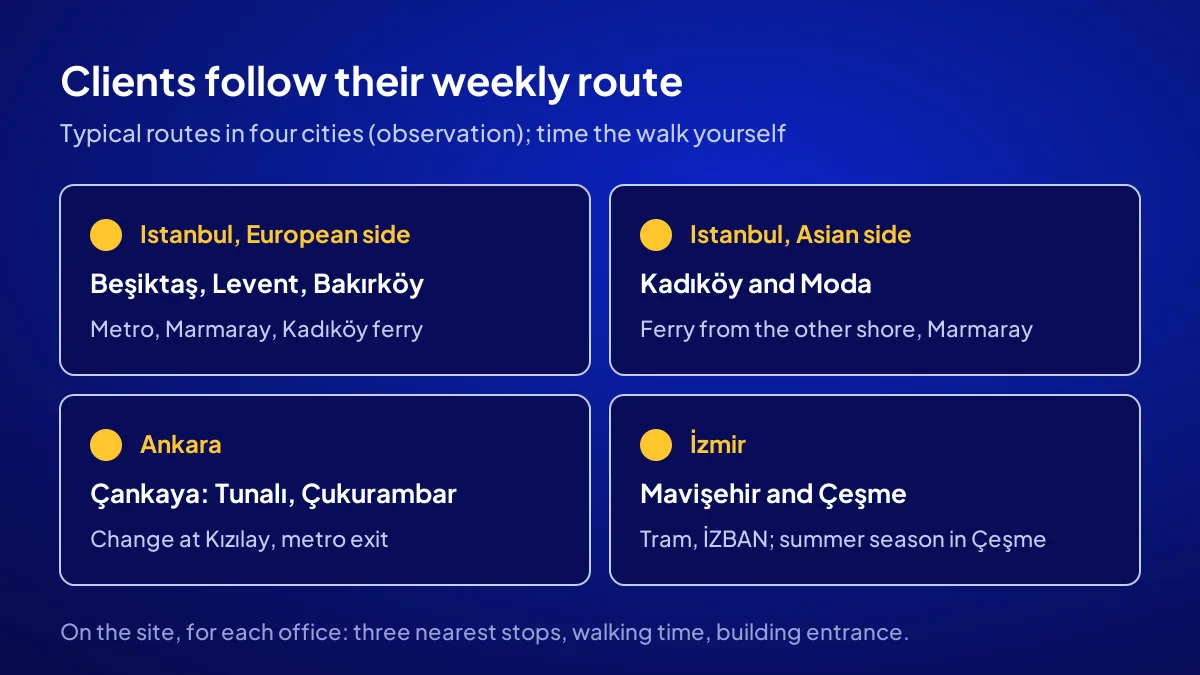
Usually by route, because a weekly session has to fit the calendar every week. So the workplace, the pier, the metro or Marmaray stop matters as much as home. For someone who lives in Sarıyer and works in Maslak, an office in Levent may be easier to reach than one in their own coastal neighbourhood. The table below sums up typical routes in four cities as observation.
| District | Client’s typical route (observation) | What goes on the site and profile |
|---|---|---|
| Beşiktaş and Levent | Metro after work, or the Kadıköy ferry | Walking time to the nearest stop and pier |
| Kadıköy and Moda | Ferry from the other shore, Marmaray | Directions from the pier and Söğütlüçeşme |
| Bakırköy | Marmaray and the coast road | Distance to the station, parking |
| Çankaya | Change at Kızılay, the Tunalı and Çukurambar office axis | Metro exit, evening hours |
| Mavişehir and Çeşme | Karşıyaka tram, İZBAN; summer season in Çeşme | Stop, seasonal hours, online session option |
The route test
Pick the three stops around your office and time the walk from each to your door. Those three times form the directions section of your site.
Figures about the district
Quote district population or income only from an official source, with the year. An unsourced “demand is high here” tells a client nothing.
Can you put the district in your profile name?
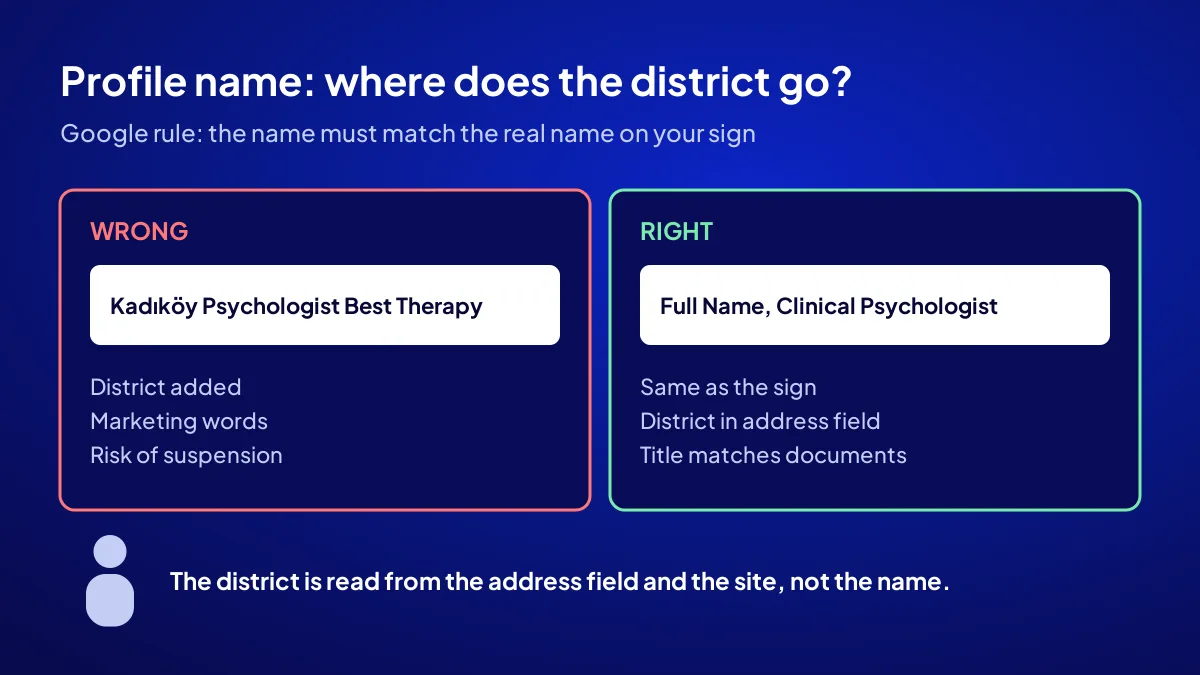
No. Under Google’s rules the profile name must match the name the business uses in the real world, on its sign and documents. Adding location, marketing phrases, phone numbers or service keywords is not allowed. A name like “Kadıköy Psychologist Best Therapy” can get the profile suspended. The district is read from the address field and the site content.
The individual practitioner rule
If you work under your own name, Google treats you as an individual practitioner: you serve clients one to one and must be reachable at the stated address. Don’t open a separate profile for each specialty; one profile is enough. Setting up categories and services correctly is covered in the therapy practice Google Business Profile article.
The same name in three places
Name and title should match letter for letter on profile, site and door sign; three spellings make a client wonder if it’s the same person.
Address or service area: how do you show your door?
If clients come to the office, the address is shown. Google does not accept virtual offices or addresses where nobody is present during opening hours. If you work in an apartment flat in Moda or Nişantaşı, the address is still shown in full; privacy is kept at the entrance instead: floor and flat number rather than a large sign at the door, and a “how to enter the building” note on the site.
If you have two offices
Say, Bakırköy on weekdays and Çeşme on Saturdays. If you are genuinely present at both addresses during the stated hours, a profile for each is within the rules. If you aren’t, leave the second address out.
How do you describe the district on your site?
One page for each office you genuinely work from: address, route, the three nearest stops, building entrance, opening hours, a confidentiality note. Opening pages for districts where you have no office misleads clients, and search engines don’t like such copy pages. The full page structure is in the therapy practice website article.
Long question, fast ranking
In Adapte’s own Search Console data for 14 June – 13 September 2026, a long, intent-driven question like “how to open a dental supply store” reaches an average position of 2.5 with 219 impressions. The short, generic query “digital agency” sits at position 66 with 478 impressions. A question like “how does teen therapy start in Kadıköy” finds its place faster than the bare word “psychologist”.
Building the content in one go
The AI SEO campaign sets up 108 articles answering district and area questions, structured data and AI crawler settings together: TRY 36,000 + VAT fixed, delivery in 30 days, 12 businesses per round. Details are on the campaign page.
What does AI look at for a district question?
For a question like “suggest a couples therapist in Çankaya”, AI wants to see your name, address and title consistent across several places. That is being recommended. Linking your page as the basis for “how does teen therapy start” is being cited. District visibility lays the ground for both, and neither is guaranteed. For the practice’s big picture see the new therapy practice promotion guide.
The consistency chain
Profile, website, professional body record and any directory listings: the same name, address and title in all four. If one link in the chain differs, AI may take you for two different people.
District logic in general
District visibility rules that apply to any business are in the district-level business visibility article.
How do you check district visibility over 90 days?
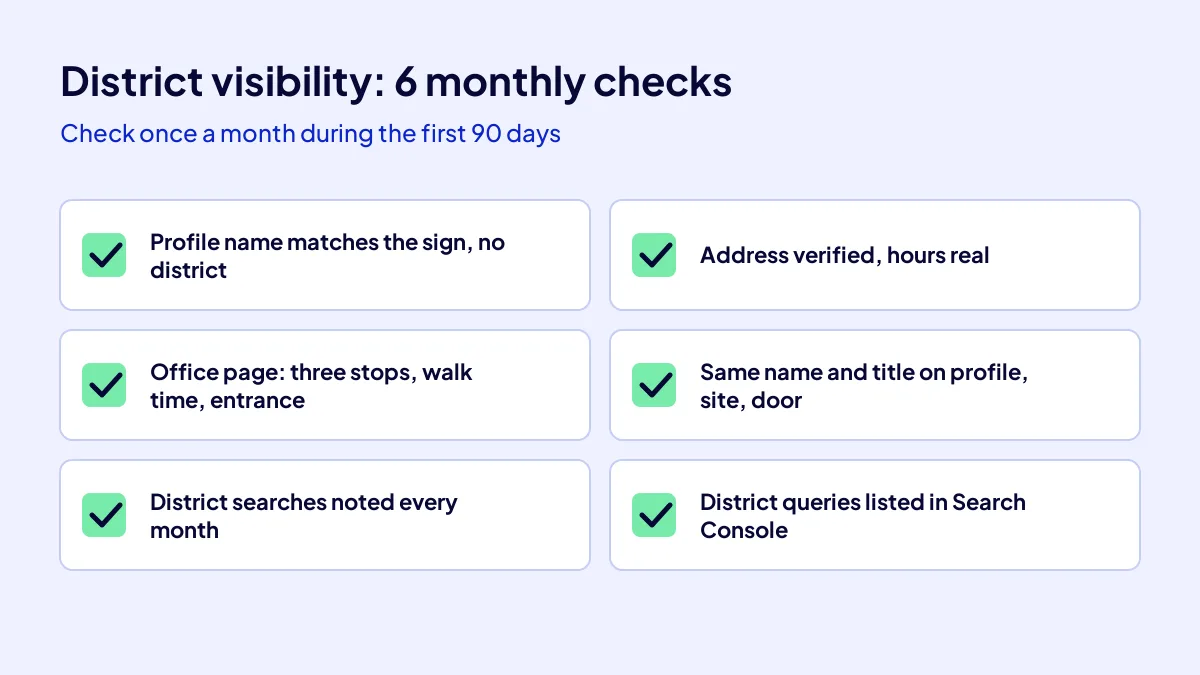
Once a month, against the same six items. The first 90 days after you open your doors are when the profile and pages settle in; results are read month by month, not week by week. If all six are done and searches stay low, the gap is usually content. The full calendar is in the first 90 days plan.
- Profile name matches the sign, with no district added.
- Address verified, hours real.
- Office page on the site: three stops, walking times, building entrance.
- Name and title spelled the same on profile, site and door.
- District-keyword searches in profile performance noted monthly.
- Queries containing district and area listed in Search Console.
Quick Summary
- District search is where a new practice can show up fastest.
- Clients usually choose by weekly route, not home address.
- No district, area or marketing words in the profile name.
- If clients visit, show the address; keep privacy at the entrance.
- Open a district page only for an office you genuinely work from.
- In AI, recommendation grows with consistency and citation with content; neither is guaranteed.
Short Glossary
District search: A district search is a search form used to find a service together with a specific neighbourhood or district name.
Individual practitioner: An individual practitioner is a profile type Google uses to describe experts who serve clients one to one under their own name.
Consistency chain: A consistency chain is a check used to make sure name, address and title are spelled the same across every listing.
Next Step
To build content and structured data that answer district and area questions, apply to the AI SEO campaign. It starts with a diagnosis card; there is a 10% coupon, just mention the code when you apply.
Frequently Asked Questions
Source: Google Business Profile Help — Guidelines for representing your business on Google
Sık Sorulan Sorular
In the profile’s services section and on a separate site page. Never a second profile or a fake address.
No. Under Google’s rules the profile name must be the real name on your sign and documents; adding location or marketing words is not allowed and can get the profile suspended. The district is read from the address field.
If you never see clients face to face, a Google Business Profile may not suit you; the rules are built around businesses that meet customers in person. Virtual office addresses are not accepted either. Describe online sessions on a separate page of your website.
No. No recommendation is guaranteed; the groundwork for being readable and recognisable is built and measured with diagnosis cards. Check the health promotion rules for your own status separately.
Updated: October 2026