
New therapy practice promotion: 9 compliant steps to a first client in Turkey
New therapy practice promotion in Turkey in 2026 happens between two rules. The Regulation on Promotion and Information Activities in Health Services, published on 12 November 2025, bans advertising by health professionals. The Regulation on the Independent Practice of Health Professionals, dated 29 March 2025, sets the licence, name and sign of the unit a clinical psychologist opens. Session fees, discounts, client testimonials and paid boosting are therefore off the table.
The open road is being found when someone searches. Your name and title read the same everywhere, your Google profile is set up correctly, your website answers the client’s question plainly, and AI can read you as a source. In Beşiktaş, Kadıköy or Çankaya, a selective client weighs your title first and your quiet second. The 9 steps below start these four jobs before opening and settle them within the first 90 days.
What can a new therapy practice announce in 2026?
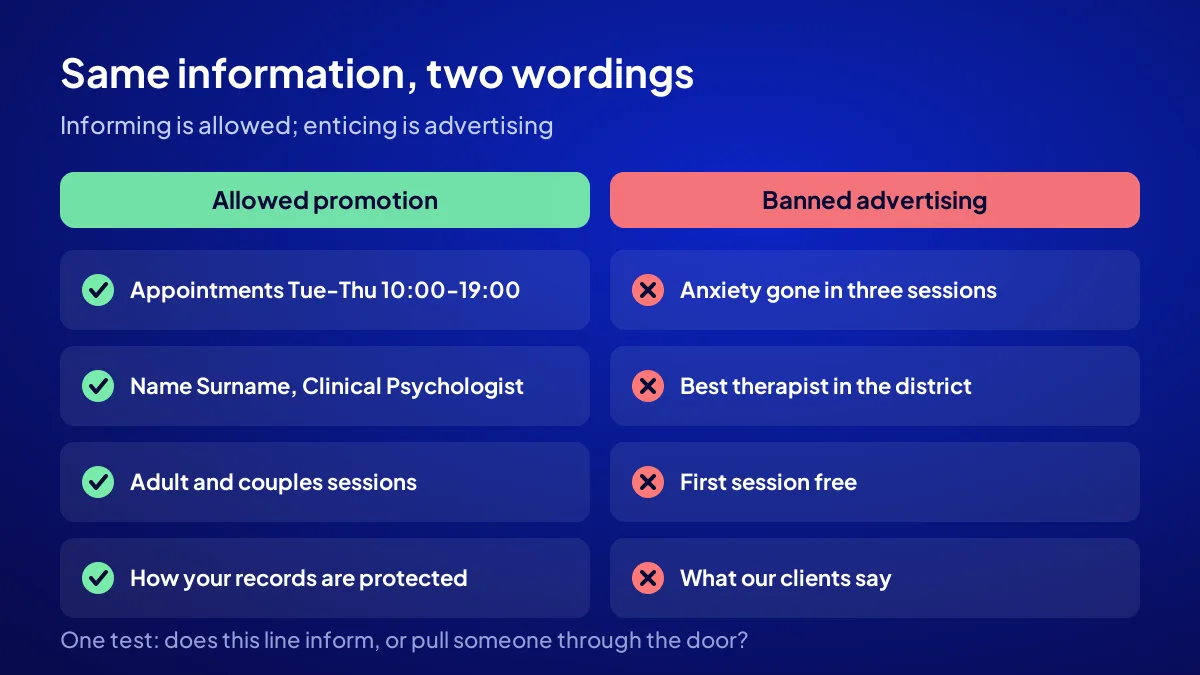
You can announce who you are and where you are. Address, phone, working days and hours, professional and academic titles, and general information that protects mental health are all allowed. What is banned is putting yourself forward and enticing the client. Look, the line hides in one question: does this post inform, or does it try to pull someone through the door?
| Allowed promotion | Banned advertising |
|---|---|
| Address, phone, working days and hours | Session fees, discounts, package offers |
| Professional and academic title, areas of work | Using client thanks in promotion |
| General information that protects mental health | Paid, sponsored or boosted listings |
| Free listings on search engines and social media | Giveaways, gifts, “first session free” |
How does a selective client choose a therapist?
A selective client does not decide fast; they research quietly. They search your name or a question such as “couples therapy in Kadıköy”, then check your title, your place on the map, your website and the tone of your Instagram. In recent years one more step is joining: asking an AI assistant. There is no price tag at any stage of this road, and the decision is made on trust.
Why is your title the first line of promotion?
In mental health, the title is the heaviest word on the sign. Psychologist, clinical psychologist and psychological counsellor come from different training and carry different authority. “Therapist” on its own is not a legal professional title in Turkey. The Independent Practice Regulation allows only the professional’s name and title on the sign of a clinical psychologist’s unit; in other words, your brand is your name.
In what order are the 9 steps to the first client taken?
BU BÖLÜMÜN ÖZETİ
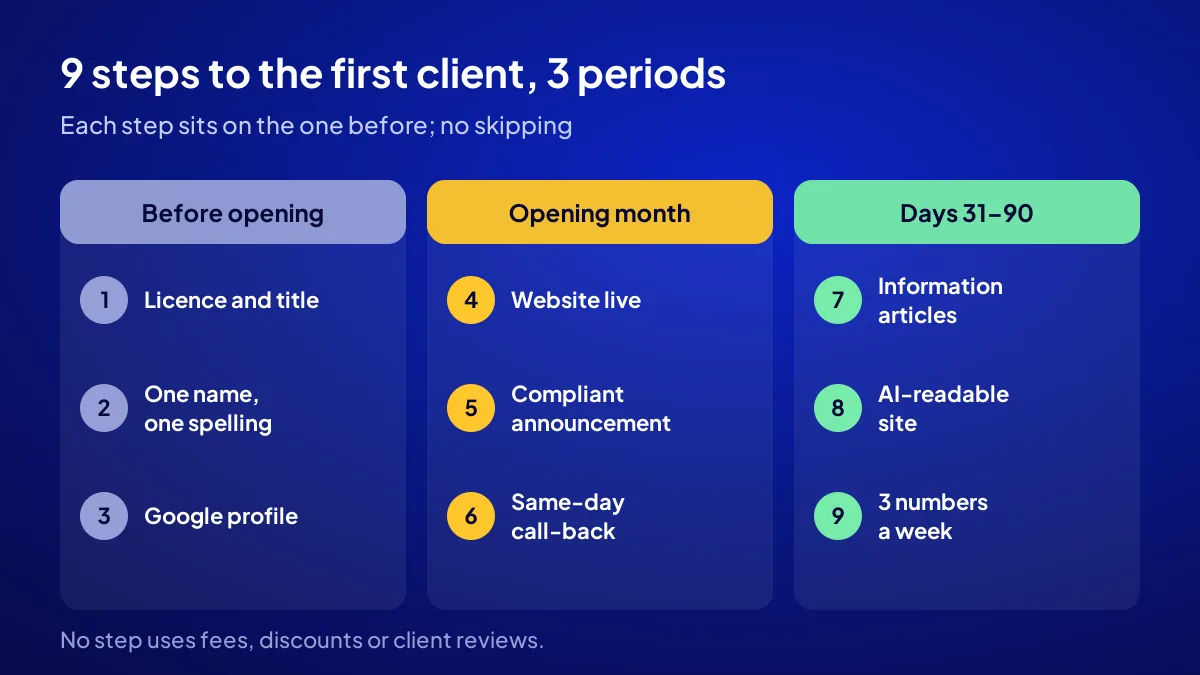
- Before opening: licence, name, profile
- Opening month: website, announcement, phone
- Day 31 to 90: information, AI, measurement
The nine steps fall into three periods: the 3 weeks before opening, the opening month, and day 31 to day 90. Now let me give you a system idea: place each step on top of the one before, and do not skip the order. A practice that announces before the shutters go up has to take its word back when the licence is late.
Before opening: licence, name, profile
- Licence and title are confirmed; the promotion calendar is built around that day.
- One spelling of name and title is fixed and used everywhere.
- Google Business Profile is prepared with category, hours and address.
How to fill the profile field by field is in therapy practice Google Business Profile.
Opening month: website, announcement, phone
- The website goes live: title, areas of work, address, privacy and booking page.
- The opening announcement is made in compliant language.
- Calls and messages are answered the same day.
We listed the pages your site needs in therapy practice website pages.
Day 31 to 90: information, AI, measurement
- Informative articles are added for questions clients often ask.
- The site is arranged so AI can read it.
- Three numbers are written down every week: profile searches, appointment requests, first sessions.
How is the first-month window used?
The regulation lets newly opened health facilities run sponsored promotion and information on all platforms for one month after opening. The window exists to announce the opening. Fees, discounts and outcome promises stay banned in that month too. If you are not a licensed unit, or are unsure, get the provincial health directorate’s written view before using the window.
Why do clients find you on their phone?
Clients often search for you at night, on their phone, when no one is watching. Here is what I see in our own data: of the 1,699 clicks adaptedijital.com received between 14 June and 13 September 2026, 1,267 came from mobile, roughly three quarters. Mobile click-through rate is 1.86 percent, desktop 0.57 percent. It is easy to guess the share is even higher for people looking for a psychologist, but do not claim it before you measure it.
A fifteen-year observation
I have been watching search results for fifteen years and I keep seeing the same thing: the page that answers the question plainly gets ahead of the fancy shop window. My tests with more than a hundred domains say the same.
Is being recommended by AI the same as being cited?
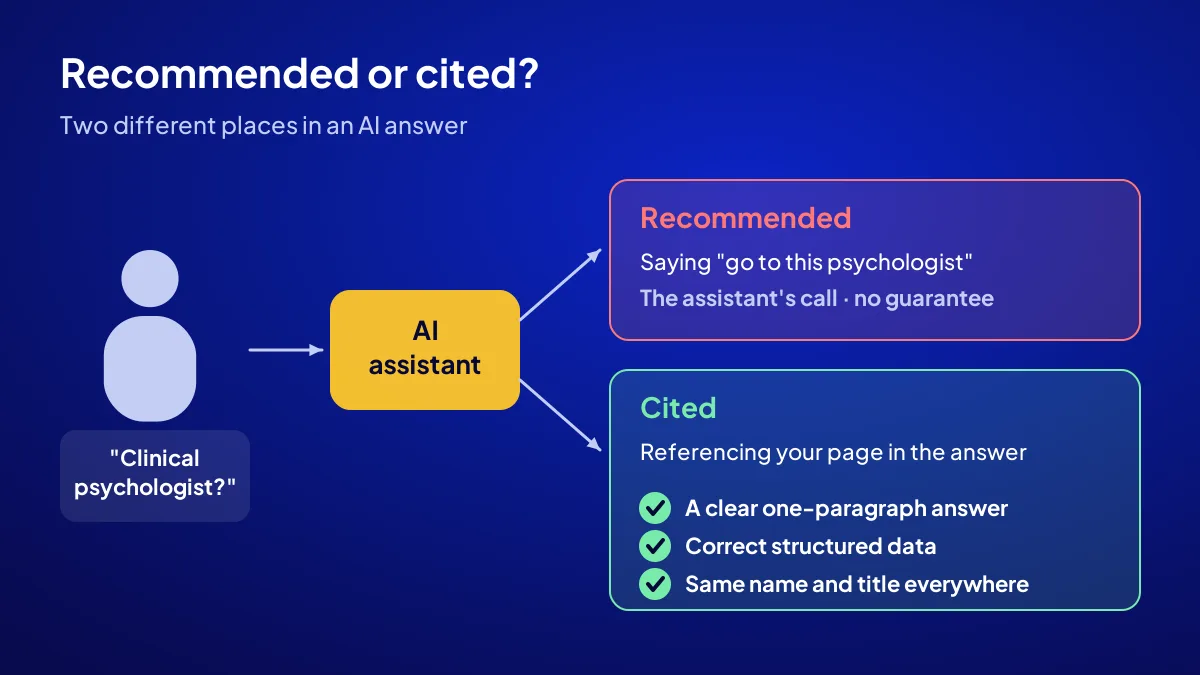
Being recommended means the assistant says “go to this psychologist”; nobody can guarantee that. Being cited means the assistant reads your page while answering a question and references it. The first is the assistant’s decision, the second is your preparation. For a practice that stays within health promotion rules, the realistic goal is to be citable.
Which shopkeeper tactics backfire in a therapy practice?
Many tricks a neighbourhood shop uses to get the till ringing are both banned and trust-breaking in mental health. Opening discounts, “bring a friend” rewards and showcasing client reviews come to mind first. In health these become inspection matters; provincial commissions scan social media and the internet. Never try the six tactics below.
- Announcing session fees, package prices or discounts.
- Using client thanks or reviews as promotional material.
- Promise and superiority language such as “heals”, “certain results”, “best therapist”.
- Giveaways, gifts or a “first session free” call.
- Calling, texting or messaging people who have not consented.
- Continuing sponsored posts and search ads after day 31.
Where does the budget go, and what do you check at 90 days?
Because the ad budget is squeezed into the first-month window, most of a new practice’s money goes into lasting ground: website, content, profile and AI infrastructure. For those who want this ground built in one go, the AI SEO Campaign is a fixed TRY 36,000 + VAT. With 20 percent VAT that is TRY 43,200; check the current rate on your invoice. Just mention the 10 percent coupon when you apply.
My decision is this: in a new practice, put the first investment into the ground where you are found, not into noise.
Quick Summary
- In health, advertising is banned; promotion and information are allowed.
- The sign shows only the name and professional title.
- Name and title read the same, letter for letter, on every channel.
- Sponsored promotion is limited to the first month after opening.
- With AI, the goal is to be cited, not to be recommended.
- Three numbers are written down every week for 90 days.
Short Glossary
Health profession service unit: A health profession service unit is the licensed private health establishment used by health professionals such as clinical psychologists for independent practice.
Being cited: Being cited is the term used when AI references your page as a source while answering a question.
Entity: An entity is the concept used for search engines and AI to recognise a person or business as one consistent record.
Next Step
To build your practice’s readable ground in search and AI within the rules, apply for the AI SEO Campaign. Share your website and target questions, and we start with a diagnosis card.
Frequently Asked Questions
Source: Google Business Profile Help — Guidelines for representing your business on Google
Sık Sorulan Sorular
It starts in the wording. “I take appointments Tuesday and Thursday, 10:00 to 19:00” is information. “Anxiety gone in three sessions” is both an advert and a promise of outcome. You will find the nine-point breakdown in therapy practice advertising rules.
The regulation lets you register on search engines and social media. The one condition: the listing is not paid, sponsored or aimed at pushing you forward. The single exception is the one-month sponsored window granted to a newly opened health facility after opening. Ask the provincial health directorate in writing whether that window applies to your type of unit.
A client in a high-income district wants comfort, privacy and saved time. Not meeting anyone in the waiting room, a session starting on the minute, a call returned the same day are part of the service in their eyes. You describe these with plain information, not advertising language: “a 15-minute gap is left between appointments” is information.
Clients do not want anyone to know they called you. That is why the entrance, the parking note and even the wording of the confirmation message carry trust. Your client will not tell their own mother they are looking for a therapist, but they will tell Google. A plain answer on your site to “how are my records protected” does more than the most expensive photo.
Mostly on three things: an unclear title, an unanswered phone and scattered information. If one place says “specialist psychologist”, another “therapist” and a third “life coach”, the client asks “who is this?” and moves to the next name.
Under the regulation, the outdoor sign is at most 4 square metres and uses no more than two colours. It shows the professional’s name and title; no other name, job description or specialism phrase may be added. All materials of the unit carry the phrase “Private Health Profession Service Unit” (Özel Sağlık Meslek Hizmet Birimi).
The regulation lists the clinical psychologist among the professions that may open a licensed unit. If you are a bachelor-level psychologist or a psychological counsellor, ask the provincial health directorate and your professional association which structure you can work under before you open. Your promotion plan is built on that answer.
Yes, letter for letter. On the sign, the Google profile, the website and the Instagram bio, name and title appear in the same order. We explain why this consistency works in business name, address and phone consistency.
Your name, title, address, consulting hours and areas of work. That is all. We collected compliant sample texts in the opening announcement article of this set.
From day 31, paid boosting stops. So the first month is a month for the lasting ground, not for sponsored posts. Profile, website and name consistency keep working after the window closes.
Yes. A practice that opens with only a profile and a website, without any sponsored announcement, moves slower but cleaner. A selective client trusts quiet clarity more than noise anyway.
One-tap call, address and directions, title, areas of work and a booking form. In Google’s page experience metrics, loading the main content within 2.5 seconds counts as good. Heavy video and large galleries eat that time.
In our own data, a long question such as “how to open a dental supply store” sits at an average position of 2.5 with 219 impressions and brings 11 clicks; a short word like “digital agency” sits at position 66 with 478 impressions and zero clicks. Clients do not type “psychologist” either; they ask long, like “clinical psychologist working with adults in Beşiktaş”.
A page that answers the client’s question clearly in one paragraph, correct structured data, and the same name and title everywhere. AI recognises an entity through this consistency.
Information questions such as “what is the difference between a clinical psychologist and a counsellor”, “what happens in the first session” or “how are therapy records protected”. Do not write answers to questions that involve diagnosis or a promise of treatment; neither the regulation nor professional ethics allow it.
First, the regulation bans turning expressions of satisfaction into promotion. Second, a review shows everyone that the person is in therapy. When you reply to a review, do not even confirm that the person is your client.
Put the right information where the banned thing would be: title, area of work, how a session works, how privacy is protected. Information is what the selective client looks for most.
AI visibility diagnosis, entity setup, structured data, llms.txt and AI crawler settings, 108 articles across 6 question groups, AI traffic measurement in GA4, Search Console and Bing Webmaster Tools setup, and start and end diagnosis cards. Delivery takes 30 days. No guarantee of being recommended is given; the readability infrastructure is built and measured. Details are on the AI SEO campaign page.
The articles are written in informative language: preventive information, how the process works, frequently asked questions. They carry no treatment promise, no price and no steering. Still, read the text against your own professional rules before publishing.
Three numbers: weekly profile searches, appointment requests and first sessions. We planned the first 90 days week by week in the first 90 days of a new therapy practice. Let me ask you one thing: when your phone rings, which sentence would you like the caller to have found you with?
The regulation allows newly opened health facilities sponsored promotion for one month after opening. Fees, discounts and outcome promises stay banned in that month too. Ask the provincial health directorate in writing whether it applies to your type of unit.
Under the Independent Practice Regulation, the sign of a licensed unit shows only the professional’s name and title. No other name, job description or specialism phrase may be used.
No. No guarantee of recommendation is given. For a fixed TRY 36,000 + VAT, the campaign builds the readability infrastructure in 30 days with 108 articles and structured data, and measures it with start and end diagnosis cards.
Updated: October 2026