
Therapy practice AI visibility: how a new practice gets cited as clients ask AI in 2027
A therapy practice shows up in AI answers by being cited as a source, not by being recommended. Heading into 2027, a prospective client in Turkey often types the first question into a chatbot or reads Google’s AI summary. The practice whose information is read inside that answer carries its name into it. For a newly opened practice, the goal is not “recommend me” but “use my information as a source”.
Two reasons. First, the rule: in Turkey, a regulation published on 12 November 2025 bans health content that steers a client toward a specific professional. Second, behaviour: people who see an AI summary click less. Nobody can guarantee being recommended or cited; what can be built is a readable foundation.
What will clients ask AI on the way to 2027?
Say you have a new practice in Kadıköy, a short walk from Moda. A prospective client opens their phone at midnight and types “how do I know if I need therapy”. Then “what happens in the first session” and “what is the difference between a psychologist and a counsellor”. The address comes last. Process first, then trust, then place.
The question starts with the process
A first-time client is not looking for an office but for an answer: what to expect, how many sessions. Whichever page answers that becomes the first name in their mind.
The selective client checks twice
In higher-income districts such as Beşiktaş or Sarıyer, the client checks the name heard from AI on Google, Instagram and the association’s list. Three spellings of one title, and trust drops.
The surprising finding: clicks nearly halve when an AI summary appears
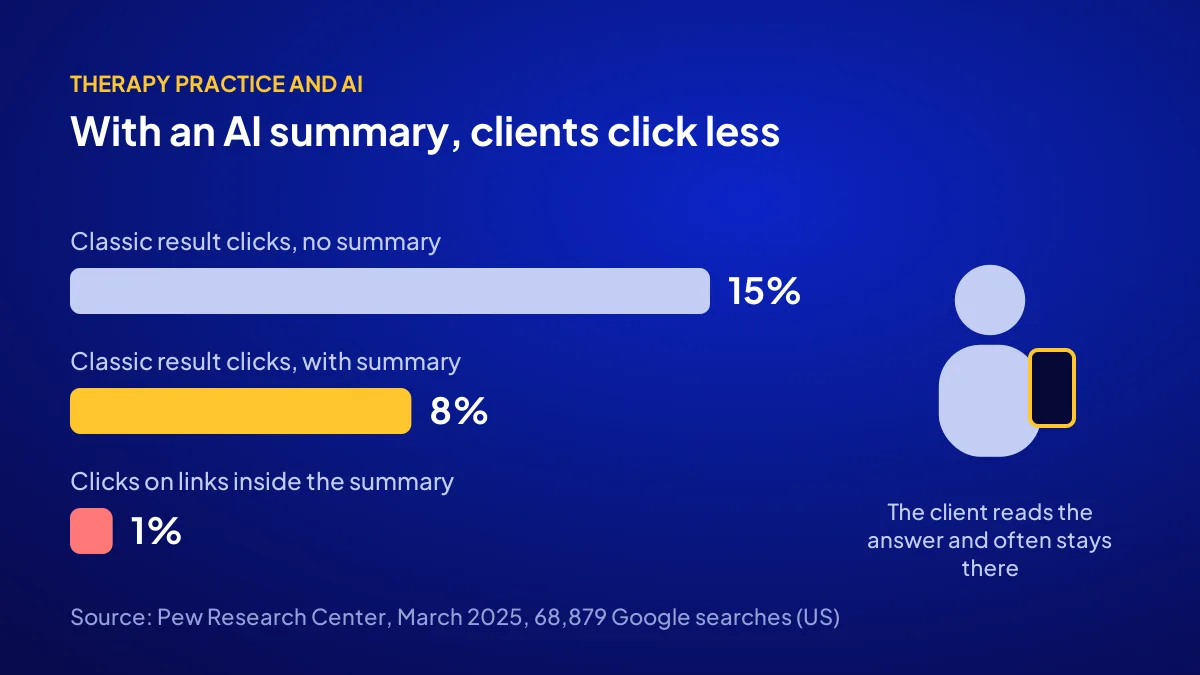
Pew Research Center tracked 68,879 Google searches by 900 US adults in March 2025. When an AI summary appears, users click a traditional result in 8 percent of visits. Without a summary, it is 15 percent. A link inside the summary gets clicked in just 1 percent of visits.
Being seen is not being clicked
In the same study, roughly one in five searches produces an AI summary. It is a shop with the shutters up and nobody walking through the door: the client can decide before reaching your site.
The takeaway: the name must live inside the answer
If clicks fall, trust is built inside the answer: the right title, a consistent address, a clear information page.
What is the difference between being recommended and being cited?
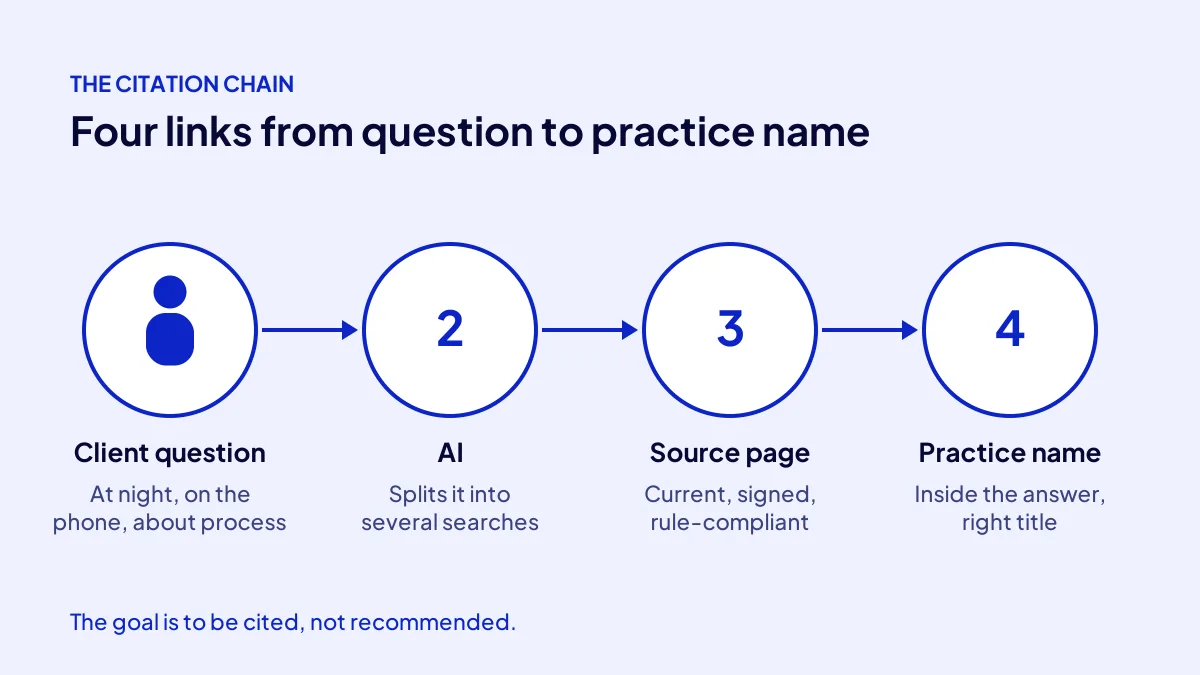
Being recommended means the AI says “go to this practice”. Being cited means the answer shows which page its information came from. Nobody controls the first, and Turkey’s health promotion rule cannot take you there anyway. The second is possible with a well-written, current, signed information page.
What does the health promotion rule keep the same in the AI era?
The regulation does not mention AI, but it names search engines: keywords and results-page information cannot break the rules. A website must also show when its information was last updated and how to reach the editor. The road to an AI answer runs through the rule; there is no shortcut.
- Do not turn a certificate-based training into a “specialist” title.
- Avoid treatment promises, fees, discounts and superiority claims.
- Show an update note and editor contact on every information page.
The opening-month window
Health facilities may run sponsored promotion on all platforms in the first month after opening. After that, search engine listing is allowed only if it is not paid or boosted. We put the whole framework together in the new therapy practice promotion guide.
Check your own title first
Psychologist, specialist clinical psychologist and psychological counsellor are different training paths. Ask your provincial health directorate or professional association which rules bind you.
Which questions can you be a source for, and which not?
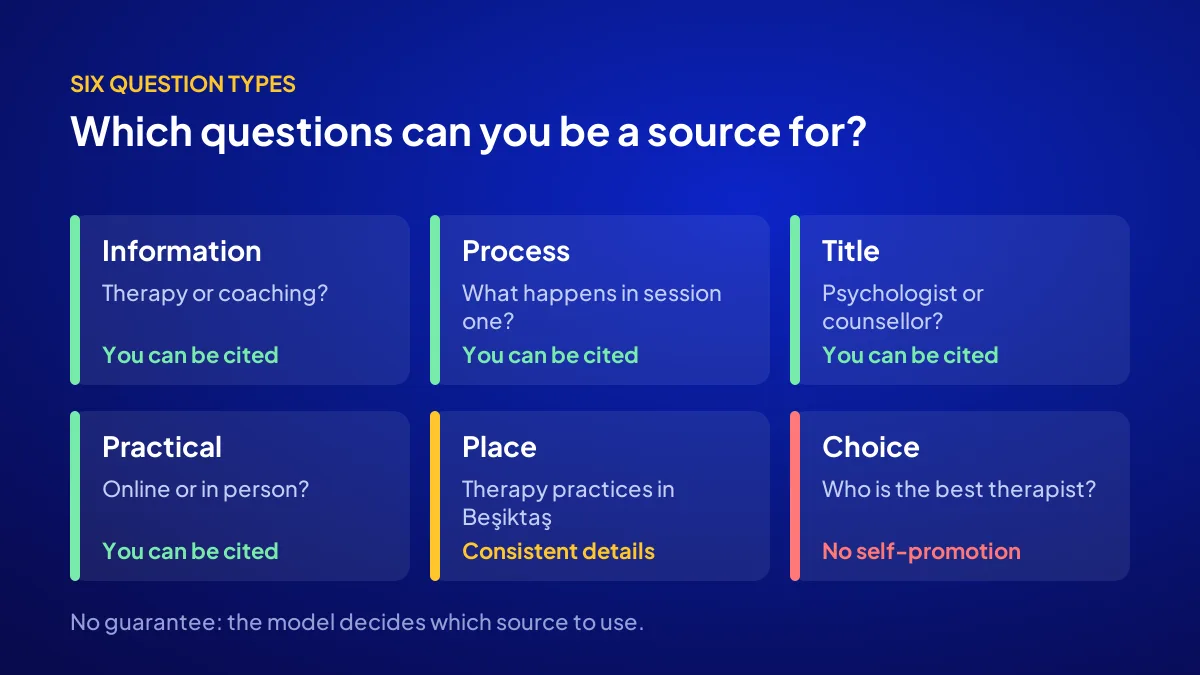
Client questions fall into six types: information, process, title, practical setup, place and choice. AI looks for a clear source in the first four, and your page can be that source. Place questions need consistent public details. In choice questions you cannot recommend yourself.
| Question type | Example | What AI looks for | What the practice can do |
|---|---|---|---|
| Information | Therapy or coaching: what is the difference? | A clear, current, signed definition | Information page by a titled author |
| Process | What happens in the first session? | A step-by-step account | Process and privacy pages |
| Title | Psychologist or counsellor? | A distinction based on training | Title and training page |
| Practical setup | Online or in person? | Length, frequency, routine | How-we-work page |
| Place | Therapy practices in Beşiktaş | Consistent name, address, hours | Same details on profile and site |
| Choice | Who is the best therapist? | Its own judgement | Produce nothing outside the rules |
Choice questions are not in your hands
AI answers “who is the best therapist” with its own judgement. Content aimed at that question breaks the rule, so leave it alone.
Place questions feed on the profile
For searches like “psychologist in Çankaya”, having the same name, address and hours everywhere is decisive. We explain which profile fields must be right in therapy practice Google Business Profile.
What changes on the way to 2027, and what stays?
What changes is where the question is first asked; what stays is how trust is built. Google’s own documentation says no extra requirements or special markup are needed to appear in its AI features; a page must be indexed and follow search rules. The work of 2027 is not a new trick but a properly laid foundation.
What changes: one question, many searches
To build an AI answer, Google splits a single question into several related searches, a technique called query fan-out. That means a practice is read through a set of pages that complete each other, not a single page. For how AI weighs local businesses, read how AI recommends local businesses.
The new practice’s hidden advantage
A new practice starts from a blank page and can get it right from day one. You will find the order of the first 90 days in a new therapy practice’s first 90 days.
What does a 108-article foundation give a new practice?
The AI SEO Campaign sets up a practice’s information in a form AI can read: AI visibility diagnosis, entity setup, structured data, llms.txt and crawler settings, 108 articles in 6 question groups, Search Console and Bing Webmaster Tools, and AI traffic measurement in GA4. No recommendation is guaranteed; the foundation is built and measured.
Every article answers one question
Each of the 108 articles answers one client question and intent. For a therapy practice they stay within information: no case stories, no promised results, no steering.
Price, timing, places
The price is fixed at TRY 36,000 + VAT; at 20 percent VAT that is TRY 43,200, but check the current rate on the invoice. Delivery takes 30 days; 12 businesses per period. A 10 percent coupon applies; mention the code when you apply. Details are on the AI SEO Campaign page.
One principle remains: do not chase recommendations, aim to be read.
Quick Summary
- A practice appears in AI by being cited, not recommended.
- With an AI summary, classic-result clicks fall from 15 to 8 percent.
- Steering content is banned; aim to be an information source.
- Four of six question types leave room to be cited.
- Every information page needs an update note and editor contact.
- Nobody can guarantee being recommended or cited.
Short Glossary
Citation: A citation is the reference used to show which page an AI answer took its information from.
Query fan-out: Query fan-out is the method used to split one question into several related searches to build a fuller answer.
Entity: An entity is the concept used to identify a person or business through consistent details such as name, title and address.
Next Step
To set up your practice’s information in a form AI can read, apply for the AI SEO Campaign. Share your site and target questions, and a diagnosis card comes first.
Frequently Asked Questions
Sık Sorulan Sorular
The regulation bans content that directly or indirectly steers a client toward a professional. So “the most experienced therapist in Kadıköy” cannot appear anywhere. The full boundaries are in therapy practice advertising rules.
Picture a plain, current answer to “what do we talk about in the first session”, signed with a professional title. AI can read it as a source. The page invites nobody; it only explains, which is exactly the space the rule allows.
There is no guarantee; the model decides which source to use. What can be built is information that is readable and consistent. Turkey’s health promotion rule also points you toward informative content, not content that asks to be recommended.
A page that gives health-protective information without steering, superiority claims, fees or treatment promises stays within information. Still, check the regulation, your provincial health directorate or your professional association for your own title and content.
Delivery takes 30 days. The price is fixed at TRY 36,000 + VAT, and 12 businesses are taken per period. There is no guarantee of being recommended; a foundation for readability and recognisability is built and measured with starting and closing diagnosis cards.
Updated: October 2026