
Boutique district search: being found in Beşiktaş, Kadıköy, Çankaya and Mavişehir
The ferry from Kadıköy pier to Beşiktaş takes about 20 minutes. A selective client hunting a vintage jacket will make that trip, but first types a district name into their phone. A boutique district search has three layers: district plus product (“kadıköy vintage”), street or neighbourhood (“tunalı boutique”) and intent (“antique shop open sunday”). Google ranks shops here on relevance, distance and prominence.
A new niche boutique, vintage or antique shop needs the right information in each layer. Adding the district to the business name or opening an address where you do not operate looks like a shortcut but risks the profile. Build a real address, the right category and pages in the district’s language.
What does a selective client type with a district name?
BU BÖLÜMÜN ÖZETİ
- Layer one: district and product
- Layer two: street and neighbourhood
- Layer three: intent
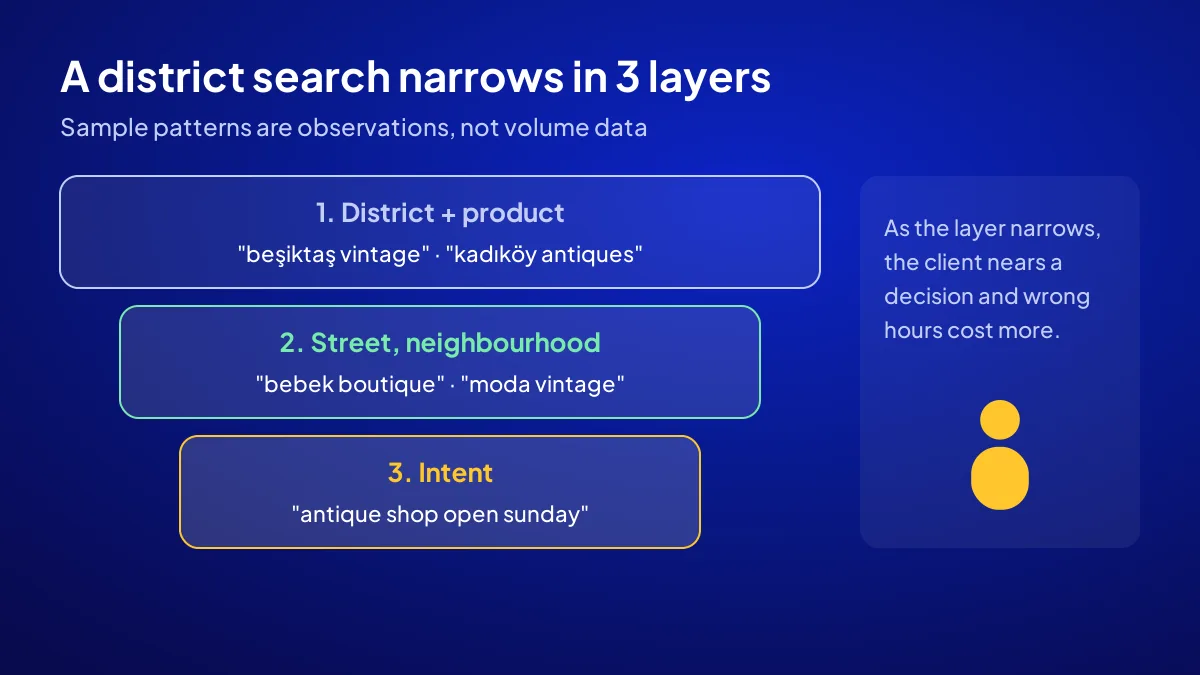
A selective client searches in three layers: district plus product type, a street or neighbourhood name, and intent (open now, today, near me). The patterns below are observations, not volume data; your own will show up in Search Console.
Layer one: district and product
“Beşiktaş vintage,” “Kadıköy antique shop,” “Çankaya boutique,” “Mavişehir concept store.” This pattern shows the client has chosen an area but not yet a shop.
Layer two: street and neighbourhood
“Bebek boutique,” “Moda vintage,” “Tunalı Hilmi antiques.” Here the client targets a narrower area. In a search that names a street, shops within walking distance come forward.
Layer three: intent
“Antique shop open on Sunday,” “vintage store near me.” If your opening hours are wrong in this search, the client finds the shutters down and does not come back.
How does Google decide which shop in a district comes first?
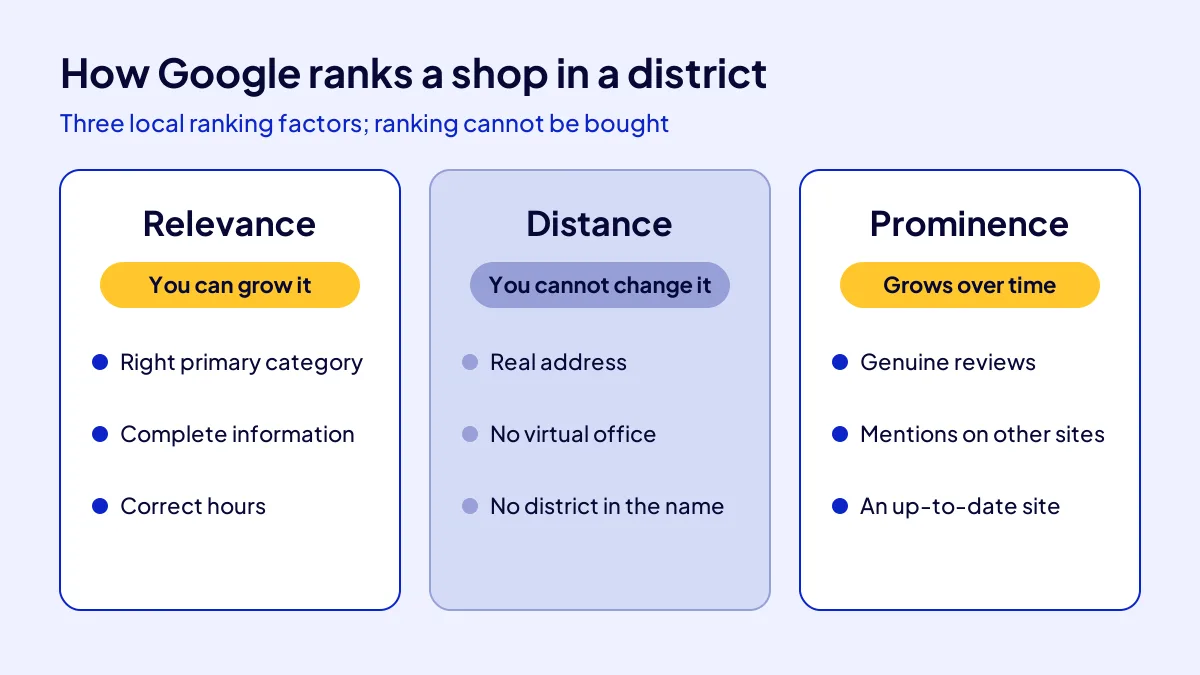
Google sets local results by relevance, distance and prominence. Relevance is how well the profile matches the search; distance is how far the shop is; prominence is how well known it is, helped by reviews and mentions elsewhere. Google states that local ranking cannot be bought.
You cannot change distance
A shop in Moda is physically far from a client in Bebek, so the effort goes into the other two factors. Relevance grows with the right category and complete information; prominence grows over time with genuine customer reviews.
Category is the first lever
“Antique store,” “vintage clothing store” and “boutique” are different categories. Choosing the right primary category is the first step of relevance. We explained how to fill in each field in the niche boutique Google Business Profile article.
How does search differ across the four districts?
Each district has its own search language: in Beşiktaş the neighbourhood name leads, in Kadıköy the street culture, in Çankaya the avenue, in Mavişehir the season. The table is based on observation, not measured volume; update it as your data comes in.
| District | Leading place names | Sample search pattern | Point to watch |
|---|---|---|---|
| Beşiktaş (İstanbul) | Bebek, Akaretler, Levent | “bebek boutique” | Let the neighbourhood name appear naturally on the page |
| Kadıköy (İstanbul) | Moda, Bahariye, the market area | “moda vintage” | Directions for clients coming from the European side |
| Çankaya (Ankara) | Tunalı Hilmi, Kavaklıdere | “tunalı antiques” | Avenue name and parking information |
| Mavişehir, Karşıyaka (İzmir) | Mavişehir, Bostanlı | “mavişehir concept store” | Write summer and winter hours separately |
Neighbouring antique dealers in Kadıköy
In the Kadıköy market area, antique dealers sit side by side on some streets. For a new shop that is competition but also foot traffic; you only need to be in the right spot on the map.
Mavişehir and Çeşme are not the same map
Both are in İzmir, roughly an hour apart by motorway. In summer, a Mavişehir shop can lose on distance for a client searching in Çeşme, so do not open a Çeşme address without a seasonal branch.
Why does a client from across the water accept the distance?
For a vintage or antique client, the shop is a destination. Before setting out they ask, “is it worth the trip?” Hours on the map, current stock on the site and an easy appointment answer that; without them, the client stays off the ferry.
A “new this week” page
Gather each week’s new pieces on one page. A client across the city checks it before setting out; an out-of-date page costs trust.
Appointments and holding a piece
Set a clear rule such as “we hold a piece for 24 hours.” A client coming from far away fears the piece will be sold before they arrive. This rule takes that fear away.
Should the site have district pages or collection pages?
They do different jobs, and you need both. A district page covers the real address, how to get there and the surroundings; a collection page describes the product and carries the district name naturally. Cloning pages for districts where you do not operate fools neither readers nor search.
One real address, good directions
On the address page, give real transport details such as “by ferry from Beşiktaş” or “on foot from Kavaklıdere.” This teaches both clients and search the district’s language.
Which district shortcuts put the profile at risk?
Google’s guidelines are clear: no unnecessary information in the business name, a profile only for a real-world location, and no virtual offices or PO boxes. Shortcuts that push these rules seem to work for a week; then the profile can be suspended and the effort resets to zero.
- Adding “Beşiktaş” or “Bebek” to the business name.
- Opening a second profile with a virtual office address in a district where you do not work.
- Having friends and family write your reviews.
Under the amendment to Türkiye’s Commercial Advertising and Unfair Commercial Practices Regulation published in the Official Gazette on 1 July 2026, reviews whose purchase cannot be verified may not be published. Ask real customers for reviews, and do not collect reviews in exchange for rewards.
How do you track district visibility over 90 days?
BU BÖLÜMÜN ÖZETİ
- Day 0 and day 30
- Day 60 and day 90
- Getting the setup done in one place
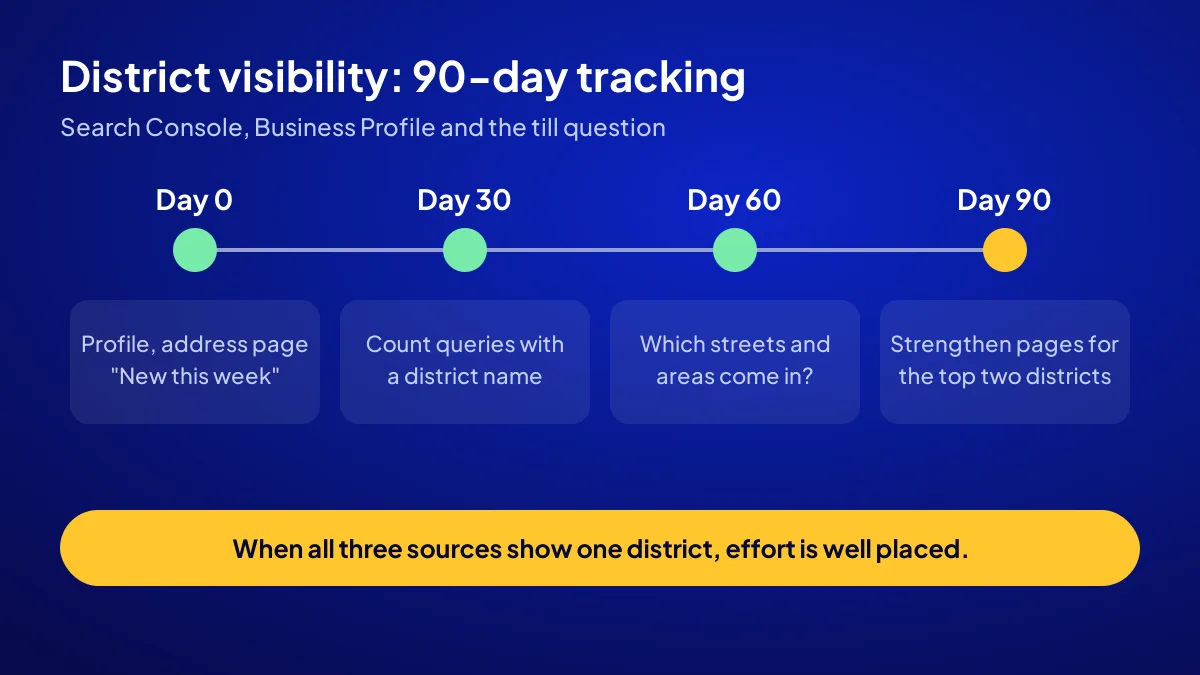
Four checkpoints are enough: opening day and days 30, 60 and 90. Filter Search Console queries for district and street names, check Business Profile performance, and ask at the till which district clients came from. When all three agree, the effort is in the right place.
Day 0 and day 30
At opening, have the profile, the address page and the “new this week” page ready. On day 30, write down how many queries contain a district name; a low number is normal.
Day 60 and day 90
On day 60, see which street and neighbourhood names come in; on day 90, strengthen collection pages for the top two districts. The frame is in the new niche boutique promotion guide, the order in the first 90 days plan.
Getting the setup done in one place
The Start a Business Online campaign sets up a Google Business Profile, a 6 + 12-page site, 108 articles and area-and-demand measurement (GA4, Search Console) for TRY 36,000 + VAT, fixed. Profile verification depends on Google and can take a few days. Details are on the campaign page.
Quick Summary
- A district search has three layers: district and product, street and neighbourhood, intent.
- Google ranks local results on relevance, distance and prominence.
- Local ranking cannot be bought.
- District names in the business name and virtual offices put the profile at risk.
- Open a “new this week” page for clients who travel.
- Measure district visibility on day 0, 30, 60 and 90.
Short Glossary
District search: A district search is the term used for a client searching for a product or service together with a district, street or neighbourhood name.
Prominence: Prominence is the factor Google uses to weigh how well known a business is, through reviews and mentions on other sites.
Virtual office: A virtual office is the term used for an address a business rents for mail or registration without actually operating there.
Next Step
To show up in your district with the right address, the right category and pages in the district’s language, apply to the Start a Business Online campaign. Write your district and the type of products you sell in the application.
Frequently Asked Questions
Source: Google Business Profile Help — Guidelines for representing your business on Google
Sık Sorulan Sorular
We listed every page a boutique site needs, with a checklist, in the niche boutique website article.
You reach clients in a neighbouring district with content, not by opening an address. We explained the general logic of district visibility with a Beylikdüzü example in district-level business visibility.
Google sets local results by relevance, distance and prominence. If the category is wrong, hours are missing or the profile is new, visibility stays low. It grows over time with the right category, complete information and genuine customer reviews.
Not unless it is on your real signage and in your official name. Under Google’s guidelines, unnecessary information cannot be added to the business name, and the profile can be suspended. Use the district name naturally on your site and in the description.
The deadline is 1 November 2026, with 12 places. The price is TRY 36,000 + VAT, upfront and fixed; with 20 percent VAT that is TRY 43,200 (check the current rate on the invoice). The delivery schedule is given in writing.
Updated: October 2026