
New boutique first customers: a 90-day plan to build trust in a vintage or antique shop
A new boutique finds its first customers on the day trust is built, not on opening day. In a vintage or antique shop a selective customer rarely buys at first sight; they look, come back, then decide. So the 90-day plan is built around making those three steps easier: being found, earning the second visit and getting the first review.
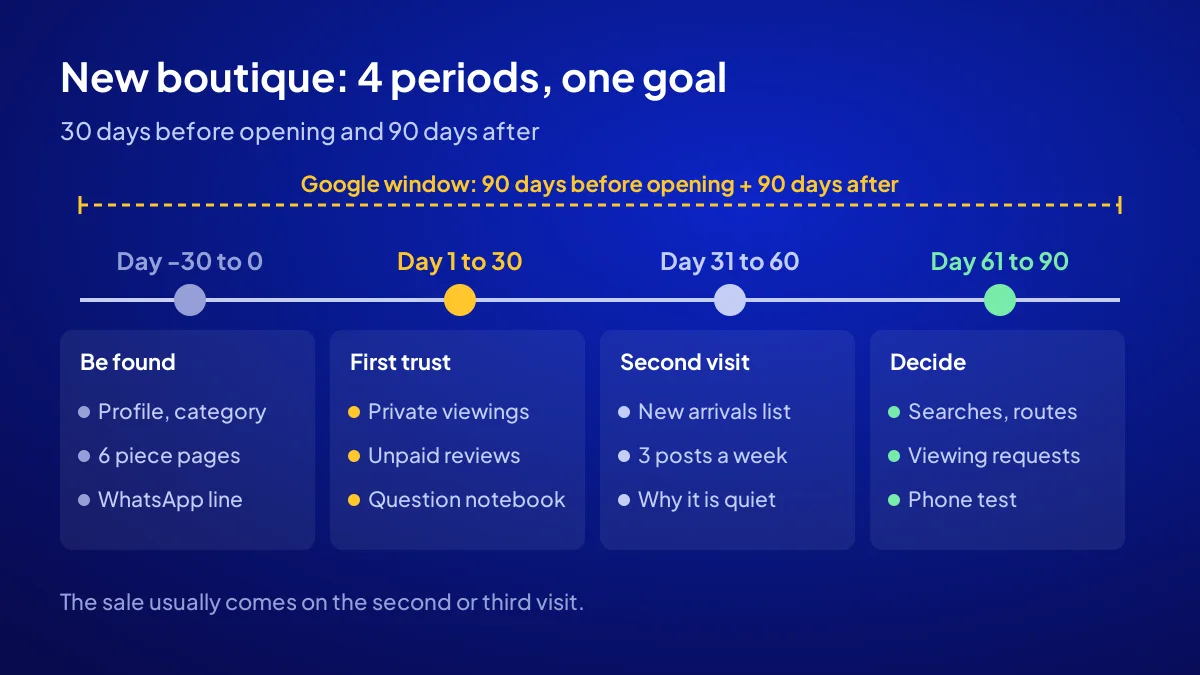
Now, the plan has four periods: the 30 days before opening, the first 30 days with the door open, days 31–60 for the second visit, and days 61–90 when the numbers speak. In 2026 the order works the same in any selective district of Istanbul, Ankara or İzmir.
Why does a new boutique find its first customers late?
BU BÖLÜMÜN ÖZETİ
- Selective customers do not buy on day one
- Google’s 180-day window
- Here is what I do myself
Because buying is slow in a niche boutique. The customer is buying a piece that will stay in their home for decades. They want to know the shop, believe the story and understand the price. A new shop has neither reviews nor history; in the first 90 days information, order and patience fill that gap.
Selective customers do not buy on day one
Say you are opening a vintage shop in Çankaya and thirty people walk in during the first week. Most look and leave. That is discovery, not failure. The real question: how many of those thirty can find you again? A customer who cannot recall your name, account or website is lost even after walking in.
Google’s 180-day window
According to Google’s help page, a profile with an opening date appears 90 days before opening, and afterwards carries a “recently opened” label for 90 days. That is a window of roughly 180 days. A shop that leaves it empty does not get the same chance twice.
Here is what I do myself
When I launch a new site, I look at the twelve-week line, not the first weeks. For fifteen years I have seen the same thing: in month one everyone loses heart, by month three the picture is clear. That is why this plan runs 90 days.
What do you do in the 30 days before opening?
BU BÖLÜMÜN ÖZETİ
- Profile: opening date and the right category
- The first 6 piece pages
- Phone and message line
The 30 days before opening prepare the places where customers will find you: the Google Business Profile with its opening date, the first piece pages and the phone and WhatsApp line. Google does not let users add reviews or photos before opening, so your own photos and description do the talking.
Profile: opening date and the right category
Month and year are enough, but enter the full date once you know it. Avoid a vague category like “store”; pick one that says what you sell, such as antique store or vintage clothing. Put your district and the direction of your selection in the description.
The first 6 piece pages
Before opening, give your 6 strongest pieces their own web pages, each with era, origin, material, size, condition and any intervention. A customer who sees the announcement should find something to tap. An empty “coming soon” page sparks doubt, not curiosity.
Phone and message line
Selective customers ask things like “What is the seat height of this chair?” Without a same-day reply, they message another shop. Set up hours, an address link and a greeting in WhatsApp Business before you open.
How do you build trust in the first 30 days with the door open?
BU BÖLÜMÜN ÖZETİ
- Viewings by appointment
- First reviews
- Question notebook
In the first 30 days the goal is not a sales figure but the first traces of trust: first reviews, first private viewings and first followers. A selective customer remembers a calm first visit more than a crowded party. Give every visitor time and note every question; those notes become website content.
Viewings by appointment
Two evenings a week, offer private viewings by appointment for up to two guests. They touch the piece, open the drawer, check the fabric. One such evening with the shutter half down sells more than ten glances in the Saturday crowd.
First reviews
Ask buyers for a review without offering anything in return. Since 1 August 2026, publishing reviews from people whose purchase cannot be verified is banned. We explain step by step how to ask for first reviews in getting first reviews for a new business.
Question notebook
Keep a notebook by the till and write down every question: “Does this lamp fit Turkish sockets?”, “Do you ship?” The 6 most frequent ones become your first Q&A articles.
Why does the second visit matter more than the first sale in days 31–60?
BU BÖLÜMÜN ÖZETİ
- New arrivals list
- If customers are not coming
- Posting rhythm
In a niche boutique the sale often comes on the second or third visit: first the shop, then the piece again, then the decision. So between day 31 and day 60 the aim is to call back the people who walked in during month one, with news of new pieces, small viewing invitations and regular posts.
New arrivals list
Once a week, send customers who gave permission a short “arrived this week” message: three pieces, three photos, three sentences. Commercial messages need prior consent; a list without permission costs more than it earns.
If customers are not coming
If the shop is quiet, find the reason: not seen, seen but not chosen, or visitors not returning? We separate these in why clients don’t come to a new boutique.
Posting rhythm
You do not need to post daily. Three regular posts a week, one in-store video a month and a story per new piece are enough. Consistency beats frequency.
Which numbers decide in days 61–90?
BU BÖLÜMÜN ÖZETİ
- The decision is made on the phone
- The phone screen test
- The next 90 days
Three numbers decide: profile searches and direction requests, viewing requests, and sales from second visits. Put them in a twelve-week table. A rising line means the method works and needs patience. A flat line usually points not to visibility but to the first impression on the phone.
The decision is made on the phone
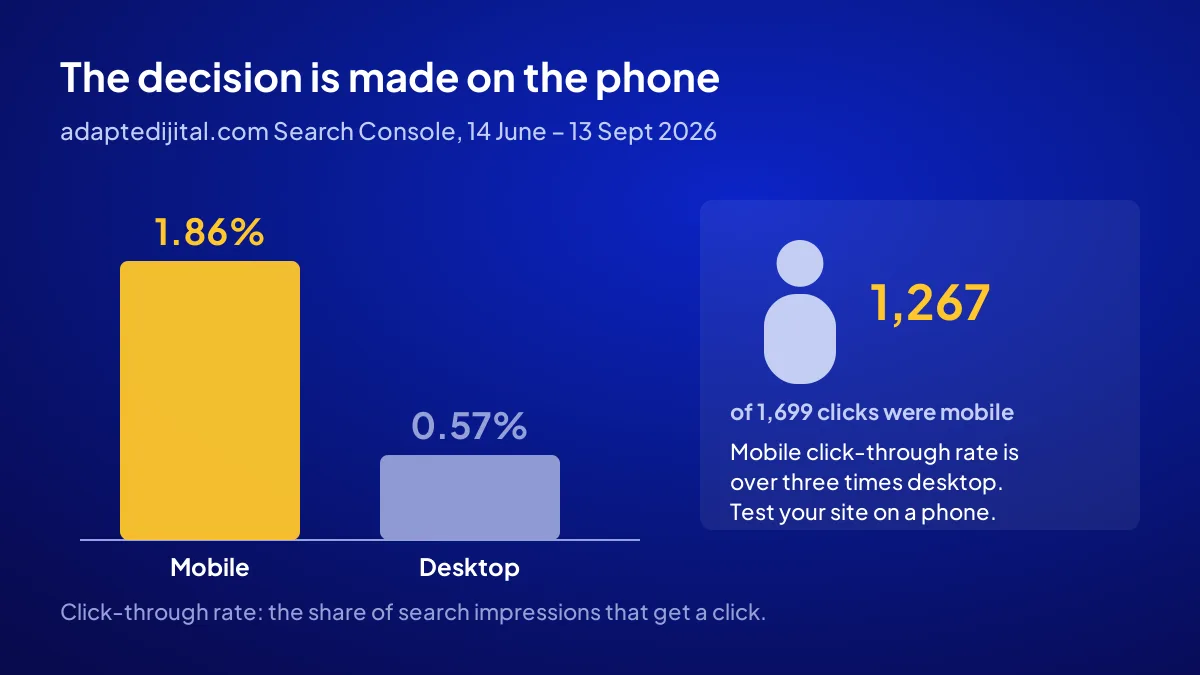
I look at our own Search Console data: between 14 June and 13 September 2026, 1,267 of our clicks came from mobile, roughly three quarters. Our mobile click-through rate is 1.86%, desktop 0.57%. The chance of a click on the phone is more than three times higher. Open your website on a phone first.
The phone screen test
Hand a friend your phone and ask: “What is this shop’s best piece and its price?” If they cannot find it in three taps, the problem is layout, not ad budget. The test takes five minutes, costs nothing and catches the most expensive mistake.
The next 90 days
Once the numbers point a direction, continue with how a new boutique finds clients to grow step by step. We put season and announcement timing on a calendar in when to start promoting a boutique.
Who builds the groundwork for these 90 days, and what does it cost?
BU BÖLÜMÜN ÖZETİ
- Slots and schedule
- The big picture
- Let me ask you one thing
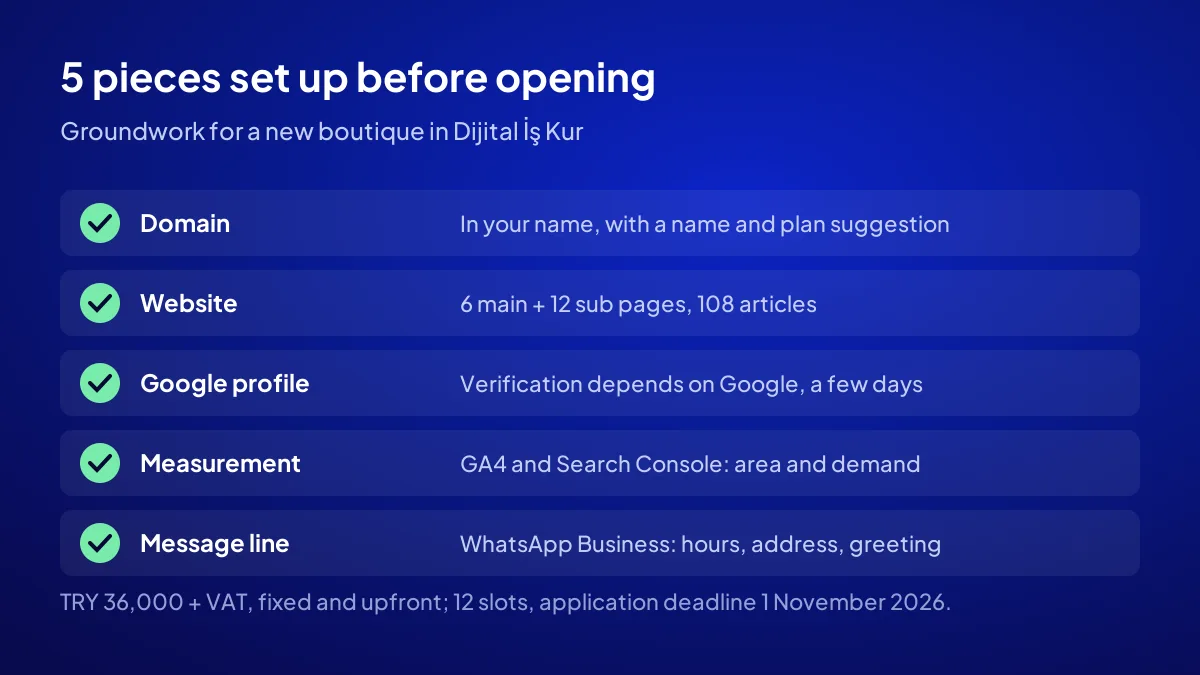
The groundwork is the domain, website, Google Business Profile, measurement and message line. Building it while opening a shop is hard. The Dijital İş Kur (Start a Business Online) campaign builds it for TRY 36,000 + VAT, fixed and paid upfront; with 20% VAT that is TRY 43,200, so check the current rate on the invoice. There is a 10% coupon.
Slots and schedule
There are 12 slots and the application deadline is 1 November 2026. After you apply, a name and plan are suggested, a slot is reserved and the delivery schedule is given in writing. Profile verification depends on Google and can take a few days. Details are on the Start a Business Online campaign page.
The big picture
We gathered the whole promotion order, the rules and the 9 steps in the new boutique promotion guide. This 90-day plan is that guide turned into a calendar.
Let me ask you one thing
A month after opening, will someone who walks in today find you from home tonight? If not, the job of the first 90 days is clear: groundwork first, then the window.
Quick Summary
- In a niche boutique the sale usually comes on the second or third visit.
- A Google profile appears 90 days before opening and carries a new label for 90 days after.
- Before opening, the profile, 6 piece pages and a message line are ready.
- In the first 30 days the goal is first reviews and private viewings, not sales.
- In days 61–90 three numbers decide: searches, viewing requests, sales.
- About three quarters of clicks come from phones; test the site on a phone first.
Short Glossary
Opening date field: Opening date field is the information used in a Google Business Profile to show in advance when a business will open.
Click-through rate: Click-through rate is the metric used to measure, as a percentage, how often a result shown in search is clicked.
Private viewing: Private viewing is the sales format used to show pieces to a selected customer at a reserved time without a crowd.
Next Step
To build the groundwork for your first 90 days before the shop opens, apply to the Start a Business Online campaign. Apply and receive a name and plan suggestion.
Frequently Asked Questions
Source: Google Business Profile Help — Add an opening date for a new business
Sık Sorulan Sorular
Domain suggestion, the domain plus one year of hosting, a site with 6 main and 12 sub pages, 108 AI SEO-ready articles, 3 social accounts, Google Business Profile, GA4 and Search Console measurement, WhatsApp Business and a handover video. The domain is in your name.
There is no fixed day; the sale often comes on the second or third visit. Build the first 90 days around being found, calling back and the first review.
No. According to Google, users cannot add reviews or photos to the profile in the 90 days before opening. In that period you post photos and the description yourself.
According to Google’s help page, the profile is labelled as recently opened for 90 days after opening.
Yes. Without a shop you appear with a service area. The whole point of the campaign is to test the business online before signing a lease.
Profile verification depends on Google and can take a few days. Start at least a month before opening.
There are 12 slots and the application deadline is 1 November 2026. The delivery schedule is given in writing after you apply.
Updated: October 2026