
New boutique, no customers? 6 parts of the trust threshold for vintage and antique shops
When a new boutique gets no customers, the problem is usually not the stock but the trust threshold. Before stepping inside, a selective client weighs six parts: can I find the shop, is it comfortable to walk in, can I guess the price, do I believe the piece is genuine, what do others say and will the shop keep its word. If one is missing, they look at the window and walk on.
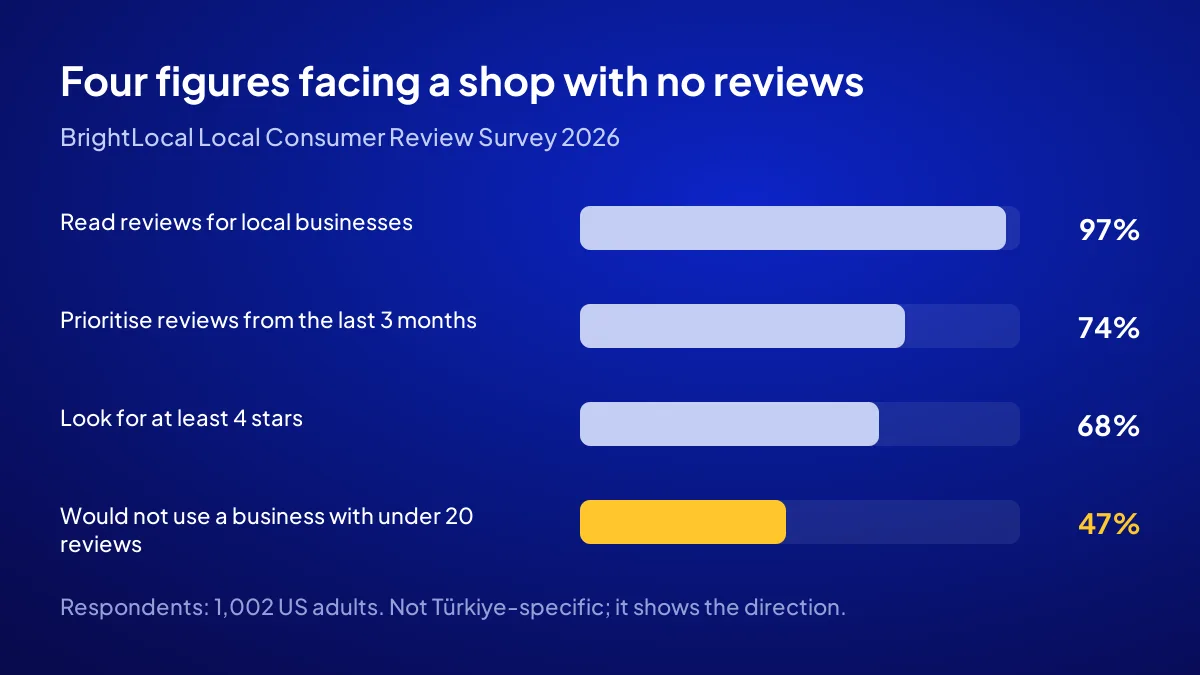
A new shop starts with one part already missing: it has no reviews. In BrightLocal’s 2026 local consumer survey, 47 percent of respondents say they would not use a business with fewer than 20 reviews. So a niche boutique, vintage or antique shop has to more than fill the other five parts in its first months.
Why does nobody walk into a three-week-old shop in Bakırköy?
BU BÖLÜMÜN ÖZETİ
- The ones looking are curious; the ones not entering are weighing
- The one checking a phone is looking through a second door
- The surprise: the problem is uncertainty, not stock
Let’s say you have a vintage bag and accessories shop on a side street in Bakırköy, close to Yeşilköy. The shop is three weeks old.
The window is careful, the light is warm and forty one-off pieces sit on the shelves. Plenty of people pass, plenty look at the window. Yet only two or three a day push the door open. The till is quiet and you are looking for the reason in your stock.
The ones looking are curious; the ones not entering are weighing
Someone standing at the window is interested. Not coming in is not indifference, it is hesitation. The question in their head: “If I go in, will I have to buy something, will the prices embarrass me?”
The one checking a phone is looking through a second door
Some people take out their phone at the window and search for the shop’s name. If the profile is thin, the hours are missing and there is not a single review, that second door closes too. The scene repeats every day and you never see it.
The surprise: the problem is uncertainty, not stock
Changing the stock is the first reflex. But a selective client weighs uncertainty before they ever see the product. When uncertainty drops, the same person at the same window pushes the door.
What is the trust threshold, and why is it higher for a new shop?
The trust threshold is the total doubt a client has to get past before paying an unfamiliar shop. For an established shop, years of trading, a known sign and word from the neighbours lower it. A new shop has none of these. In vintage and antiques the threshold is one step higher, because every piece is unique and the client also asks, “is it genuine, is it clean?”
The numbers show the cost of starting with no reviews
In the same survey, 97 percent of respondents say they read reviews for local businesses and 68 percent look for at least 4 stars. 74 percent give priority to reviews from the last three months. The survey covers 1,002 US adult consumers; it does not give Türkiye-specific figures, but it shows the direction.
In affluent districts clients forgive less
A selective shopper in Beşiktaş, Kadıköy or Mavişehir has plenty of options. Rather than try a shop they hesitate about, they go somewhere they know. A new shop rarely gets a second chance.
What the client is really buying in this decision is covered in what boutique clients really buy.
What are the 6 parts of the trust threshold?
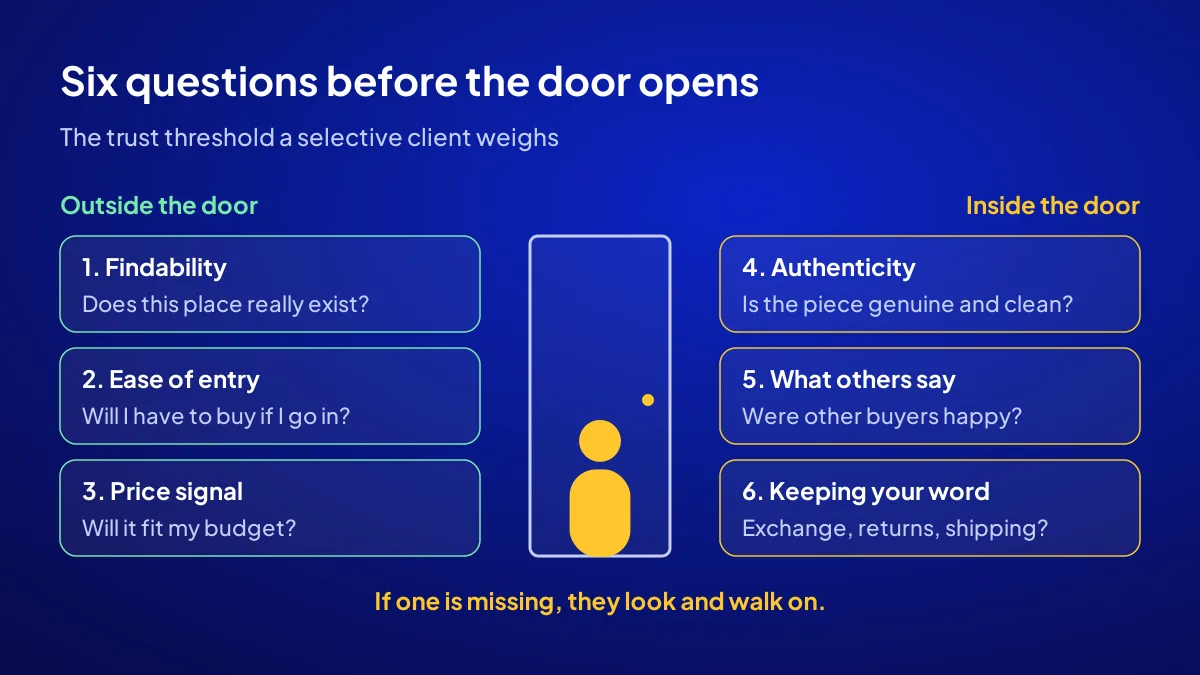
The six parts fall into two groups. Three are weighed before the door opens: findability, ease of entry and a price signal. Three are weighed inside or at the first purchase: proof of authenticity, what others say and keeping your word. The table shows the question each part raises in the client’s mind and the quickest fix for a new shop.
| Part | Client’s question | What they see if it’s missing | First fix |
|---|---|---|---|
| 1. Findability | Does this place really exist? | Not on the map, no hours | A complete Business Profile |
| 2. Ease of entry | Will I have to buy if I go in? | Closed door, empty shop | A “just browsing welcome” note |
| 3. Price signal | Will it fit my budget? | No prices at all | A price range in the window |
| 4. Proof of authenticity | Is the piece genuine and clean? | “Original” with no paperwork | Condition note and provenance |
| 5. What others say | Who bought here, were they happy? | Zero reviews | Asking real buyers for reviews |
| 6. Keeping your word | How do exchange, returns, shipping work? | No written rules | A one-page policy |
The three parts outside the door
These three are solved online and in the window. If the client cannot find the shop, hesitates to enter or cannot guess the price, they never see your stock.
The three parts inside the door
These three are tested at the first purchase. A client lost here does not come back, and tells others too.
Why does proof of authenticity come first in vintage and antiques?
BU BÖLÜMÜN ÖZETİ
- A condition note for every piece
- Provenance, but with paperwork
- For antiques, ask about permits first
With a new product the brand guarantees the quality; in vintage and antiques, you are the guarantee. The client wants to know the piece’s age, condition and origin. A shop that explains this honestly and in writing can justify even a high price. A shop that does not gathers doubt at the most reasonable price.
A condition note for every piece
Three lines on the label are enough: the period or estimated age, any flaws and the care it has had. A note like “small mark on the lining, cleaned” does not lose a sale; it builds trust.
Provenance, but with paperwork
Telling where a piece came from, its provenance, adds value. But stories like “from an Ottoman pasha’s mansion” are written only with documents. An undocumented story reads like a fairy tale to a selective client.
For antiques, ask about permits first
Trading in antiques and items that may qualify as cultural property is subject to separate rules, and a permit may be required. Ask your local museum directorate or the Ministry of Culture and Tourism about current requirements.
Why is the door threshold higher in an affluent district?
A quiet, carefully styled, empty shop looks expensive and formal from outside. A person who walks in feels watched. That feeling pushes them towards the exit, not the till. Lowering the door threshold takes two things: a price that can be guessed and a clear “browsing is welcome” message.
A price range in the window
A line such as “pieces from TRY 900 to TRY 18,000” answers the biggest question at the door. The figures here are hypothetical. Hiding prices adds hesitation, not value.
A greeting, not a shadow
Welcome the client at the door, then give them space. Following someone around makes a selective shopper uneasy. “I’m here if you’d like to ask anything” is enough.
How do you build trust before reviews arrive?
Reviews are not bought, invented or written by relatives. Since the 2026 regulation amendment, reviews whose purchase cannot be verified may not be published, and Google treats incentivised reviews as a policy violation. The work is simple: ask real buyers, after the purchase, politely, and reply to every review.
One sentence at the end of every sale
As you hand over the bag, say: “If you share your experience on Google, it really helps us.” A small card with a QR code also works. Do not promise a reward, discount or gift.
Lasting proof until reviews come in
In the first months, trust is carried by lasting digital traces: a consistent brand voice, a site that collects condition notes, a clear exchange policy. The Build Your Digital Brand campaign sets up brand consulting, a digital identity, a 6-page brand site and 108 AI SEO-ready articles for a fixed TRY 36,000 + VAT. Details are on the campaign page. The pages the site should carry are listed in boutique website pages.
Which part should you fix first?
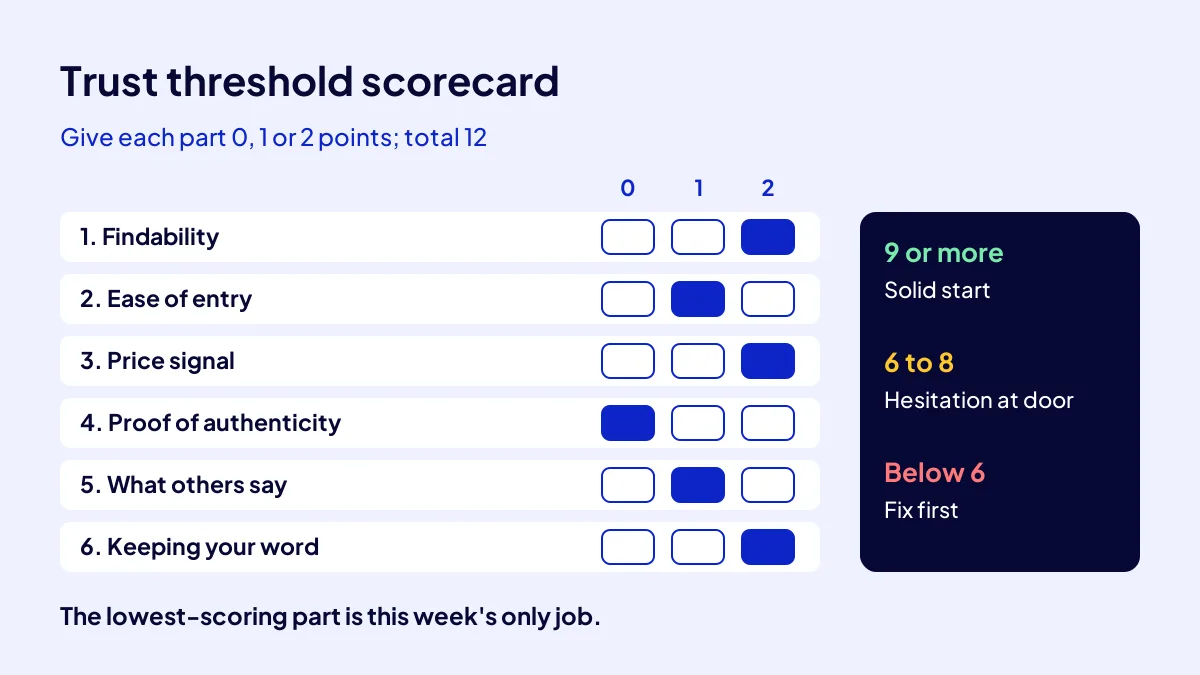
Fix the weakest part first, because the threshold works like a chain. Give each of the six parts 0, 1 or 2 points, for a total out of 12. Two means “complete”, one “partial”, zero “missing”; the lowest-scoring part is this week’s only job. For the overall picture see the new boutique promotion guide, and for the order of the first three months the first 90 days plan.
How to read the scorecard
Nine or more is a solid start. Six to eight shows clients hesitating at the door. Below six, running ads is like filling a leaking bucket.
The same problem from a general shop’s angle
The other side of this question, for shops in general, is covered in new shop with no customers. That piece talks about location and footfall; this one is about a selective client’s trust.
The single principle: a selective client weighs uncertainty, not stock. The shop that reduces uncertainty sees its door open more often.
Quick Summary
- If clients are not coming, check the trust threshold before the stock.
- Six parts: findability, entry, price, authenticity, reviews, word.
- A new shop starts without reviews; the other five must be strong.
- In vintage and antiques, condition notes and documented provenance build trust.
- Ask only real buyers for reviews, with no reward.
- On the scorecard, the weakest part is the week’s only job.
Short Glossary
Trust threshold: The trust threshold is the concept used to describe the total doubt a client gets past before paying an unfamiliar shop.
Condition note: A condition note is the label information used to show a vintage or antique piece’s age, flaws and care openly.
Provenance: Provenance is the record of origin used to document where and from whom a piece came.
Next Step
To lower the trust threshold with lasting digital proof, apply to the Build Your Digital Brand campaign. Just mention the 10 percent coupon code when you apply.
Frequently Asked Questions
Source: BrightLocal — Local Consumer Review Survey 2026
Sık Sorulan Sorular
Usually not because of the stock but because of the trust threshold. A selective client weighs findability, ease of entry, a price signal, proof of authenticity, reviews and whether the shop keeps its word. If one is missing, they look and walk on.
No. Reviews whose purchase cannot be verified may not be published, and Google treats incentivised reviews as a policy violation. Ask real buyers, after the purchase and without any reward.
The campaign is limited to 12 brands and the deadline is 1 November 2026. The price is TRY 36,000 + VAT, paid upfront and fixed; with 20 percent VAT it comes to TRY 43,200, but check the current rate on your invoice.
Updated: October 2026