
New boutique digital marketing recipe: how Adapte works for vintage and antique shops
We build new boutique digital marketing with a recipe. First we define who is looking for your shop, then we translate the nine question axes that person asks into your boutique’s language, and finally we turn them into a domain, a website, a Google Business Profile and 108 articles. In a vintage or antique shop, what sets the recipe apart is honest description of one-of-a-kind stock and measuring results question by question.
Which package you start with depends on where the shop stands. If the lease is not signed yet, or the shutters have only just gone up, it is Dijital İş Kur (Start a Business Online). If you have no name or identity yet, it is Senin de Dijital Markan Olsun (Your Own Digital Brand). Both are TRY 36,000 + VAT, fixed and paid upfront. Neither includes an ad budget, and we give no ranking or sales guarantee.
Why do we ask “who is searching” first in a new boutique?
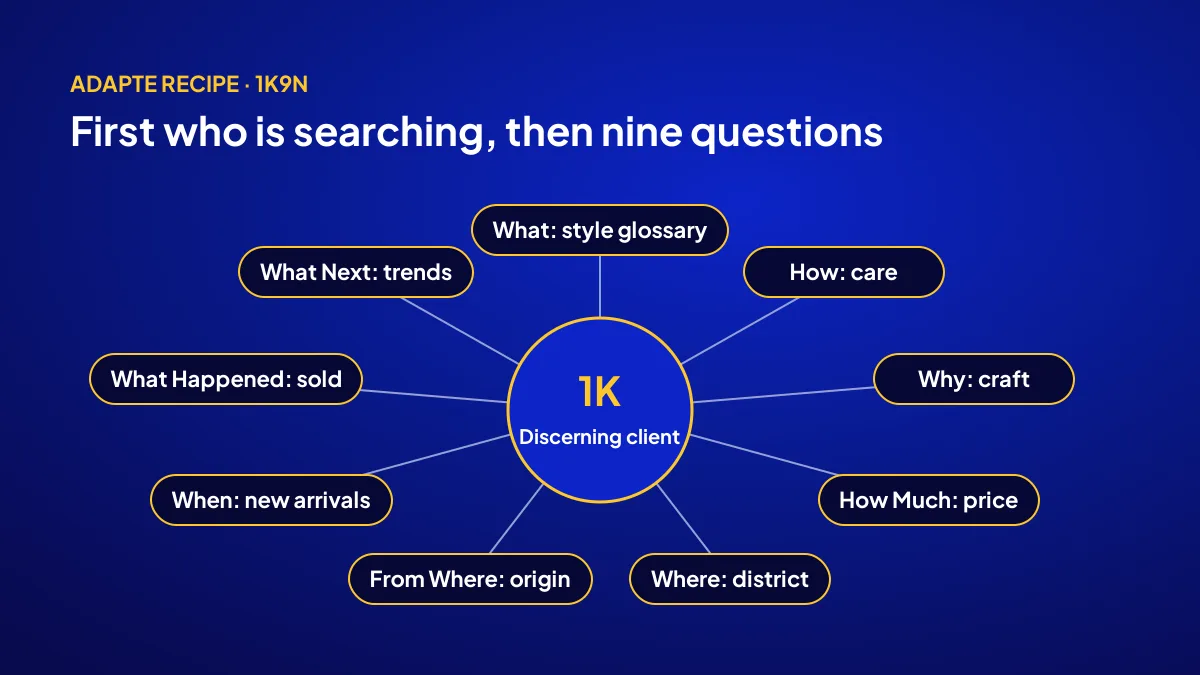
Because a boutique does not sell to everyone. The client looking for vintage and antiques in Beşiktaş, Moda or Mavişehir is selective: reads reviews, checks Instagram and Google, and increasingly asks AI. In our method this is 1K; the person, the audience and the community are defined before a word is written. We do not write sentences for someone we do not know.
The owner’s sentence and the client’s sentence
The owner says “the till isn’t moving”. The client asks “I’m looking for a 1970s lamp, where can I find one in Moda”. The recipe tries to solve the owner’s problem with the client’s sentence.
Audience and community are written separately
The audience is the discerning client looking for a boutique. The community is the circle that follows pieces professionally: collectors, interior architects, costume designers. We do not write to both in the same voice.
How are nine question axes translated for a vintage shop?
In Adapte’s 1K9N method every topic spreads across nine question axes: What, How, Why, How Much, Where, From Where, When, What Happened, What Next. Each axis is a separate search intent. In a boutique, these axes match the client’s questions about the piece, the shop and trust. The table below shows which question and which page each axis lands on in a vintage shop.
| Axis | Client’s question | Content that answers it |
|---|---|---|
| What | What does mid-century design mean? | Period and style glossary |
| How | How do I care for old wooden furniture? | Care and storage guide |
| Why | Why can vintage cost more than new? | Craft and scarcity article |
| How Much | What drives the price of a period lamp? | Price factors page |
| Where | Where to buy vintage in Kadıköy? | District and visit page, business profile |
| From Where | Where does this piece come from? | Origin information on the piece page |
| When | When do new pieces arrive? | New arrivals and newsletter |
| What Happened | What happened to the sold piece? | Archive page with a “sold” note |
| What Next | Which period is on the rise? | Style and trend article |
Each question has one page
If two pages answer the same question, they eat each other’s traffic. So every question gets a single owner.
Community questions are flagged separately
An interior architect’s question is more technical: size, material, quantity. We gather these questions in a separate group.
From our own data: why do long, intent-rich questions rise?
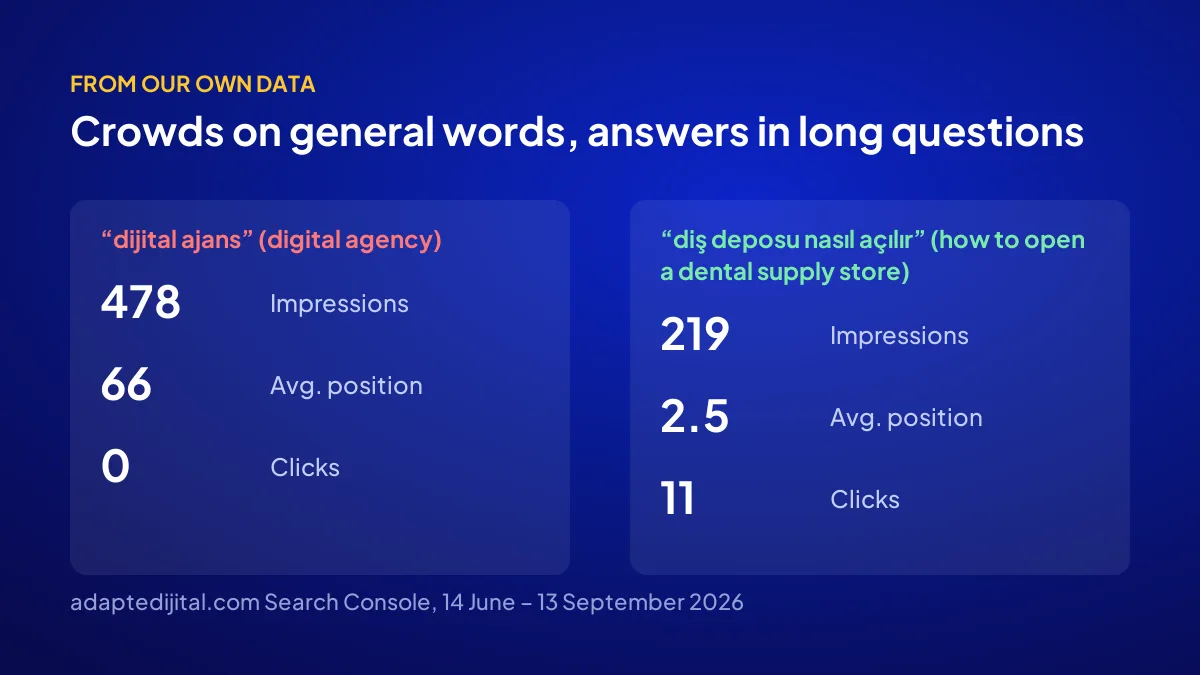
In adaptedijital.com’s Search Console data for 14 June to 13 September 2026, the query “dijital ajans” (digital agency) gets 478 impressions, sits at an average position of 66 and earns no clicks. Meanwhile “diş deposu nasıl açılır” (how to open a dental supply store) reaches an average position of 2.5 with 219 impressions and brings 11 clicks. Short, general words are crowded. Long, intent-rich questions have few answers.
What it means for a boutique
Ranking for “vintage store” is hard. Long questions like “1970s ceramic lamp in Moda” have fewer competitors, and the person asking is close to buying. We build the 108 articles on questions like these.
Being seen is not the same as being clicked
In the same period our site gets 142,296 impressions and 1,699 clicks; a click-through rate of about 1.2%. So at the end of month one we look not only at impressions but at which questions get clicked.
How are 108 articles split into 6 groups for a boutique?
In both packages, 108 articles spread across 6 keyword groups; 18 articles per group. We choose the groups in the consulting session, based on your inventory and district. The split below is an example for a vintage and antique shop. The articles are written by Adapte’s writer team and checked against the FORM-97 writing standard.
- Period and style: articles introducing mid-century, the 1970s, Art Deco and other eras.
- Material and craft: ceramics, glass, brass, solid wood.
- Care and storage: cleaning, humidity, moving.
- District and visit: the shop’s surroundings, transport, visiting hours.
- Gifts and occasions: weddings, new homes, corporate gifts.
- Trust and shopping: origin information, reservation, delivery, returns.
How it relates to budget
Articles and site are inside the fixed price. If you are also planning an ad or photography budget, see the line-by-line calculation in the boutique marketing budget article.
How do we read Search Console’s four numbers for a boutique?
Search Console’s performance report gives four core numbers: clicks, impressions, click-through rate and average position. Click-through rate is clicks divided by impressions. We read these four numbers question by question, not as totals. What we really want to know in a boutique is which piece and district questions get seen and clicked. Even when totals look good, if the till isn’t moving, the answer is in the question rows.
Impressions, but no clicks
If a question is seen but not chosen, the title and description are not speaking the client’s sentence. We bring that article’s title closer to the client’s question.
Average position is not moving
If position stalls in a group, we check the links between that group’s 18 articles and the question still missing. How item condition is marked with structured data on piece pages is covered in the boutique website article.
Start a Business Online or Your Own Digital Brand?
The two packages cost the same but serve different stages. Start a Business Online opens the shop online: a full website, business profile, WhatsApp Business and demand tracking. Your Own Digital Brand gives birth to the brand: positioning, name, logo and identity, brand guidelines and a six-page brand site. Both include 108 articles and structured data.
| Criterion | Start a Business Online | Your Own Digital Brand |
|---|---|---|
| For whom | A boutique about to open or newly opened | A boutique with no name or identity yet |
| Website | Corporate site, 6 main + 12 sub-pages | Six-page brand site |
| Identity | Optional, priced separately | Logo, colour, typeface; 3 directions offered |
| Local visibility | Google Business Profile, WhatsApp Business | Digital business card, social media kit |
| Extra deliverables | GA4, Search Console, AI-SEO Diagnosis Card, 3 social media accounts | TÜRKPATENT preliminary search, brand guidelines |
| Shared | 108 articles, structured data, handover video, domain in the client’s name, TRY 36,000 + VAT, upfront, 10% coupon | |
Our recommendation for a boutique
If your name is ready and clients are not walking through the door, Start a Business Online. If the name and identity are still on the table, the brand package. You do not need both at once.
Price and places
TRY 36,000 + VAT; at 20% VAT that is TRY 43,200, but check the current rate on the invoice. For the 10% coupon, just mention the code when you apply. Start a Business Online has 12 places, application deadline 1 November 2026. Details are on the Start a Business Online page.
What do we review together after setup?
After handover we look at three things: which districts demand comes from, which questions get clicked, and how the business profile performs. GA4 and Search Console answer these. The AI-SEO Diagnosis Card summarises how readable the site is in AI search. The recipe does not make the first sale of the day; you do. We keep the road open.
The schedule is given in writing
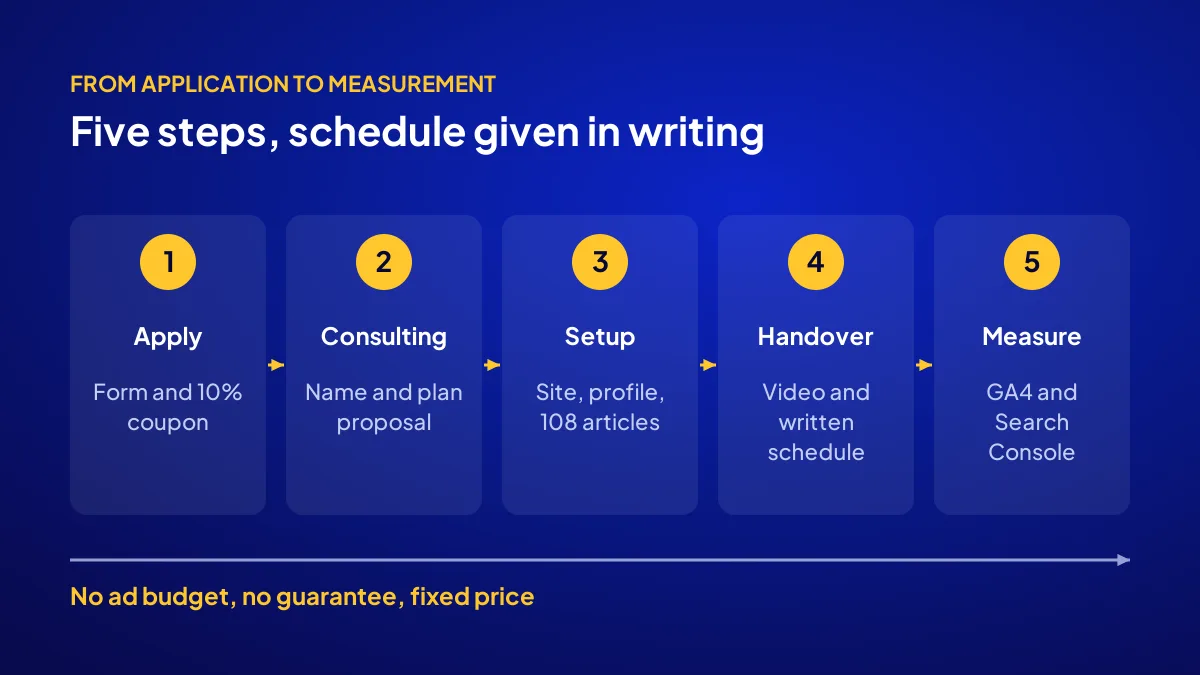
The schedule for application, name and plan proposal, setup and handover is given to you in writing. Business Profile verification depends on Google and can take a few days.
Handover video
At handover we provide a video explaining how to use every page and measurement screen. The boutique’s overall plan is in the new boutique promotion guide, the first three months in the first 90 days article.
Quick Summary
- The recipe starts with “who is searching”, then spreads across nine question axes.
- In our own data, long intent-rich questions rank far higher than general words.
- 108 articles are built in 6 groups, 18 per group.
- Search Console’s four numbers are read question by question, not as totals.
- A boutique with a ready name starts with Start a Business Online; one without a name starts with the brand package.
- Both packages are TRY 36,000 + VAT, upfront; no ad budget and no guarantee included.
Short Glossary
1K9N: 1K9N is the Adapte content method used to plan a topic first by who is searching, then by nine question axes.
Keyword group: A keyword group is a cluster used to gather searches with the same intent under one topic and answer them with linked articles.
Click-through rate: Click-through rate is the ratio, found by dividing clicks by impressions, used to measure how often a page is chosen when it appears in search results.
Next Step
To build your boutique’s digital recipe together, apply to the Start a Business Online campaign. Fill in the form, mention the coupon, and we start with a name and plan proposal.
Frequently Asked Questions
Source: Google Search Console Help — Performance report (Search results)
Sık Sorulan Sorular
One article on a topic is not enough to tell a search engine you know that topic. Eighteen linked articles in the same group leave an answer for every angle. We explain the logic in why a new site starts with 108 articles.
No. The package is TRY 36,000 + VAT, fixed and paid upfront. Google and Meta ads are optional and priced separately; if ads are run, the budget is paid to the platform separately.
If you also want a logo, identity and brand guidelines, Your Own Digital Brand; a name is proposed during consulting. If the name is secondary and a full site, business profile and demand tracking come first, Start a Business Online; a name and plan proposal is given there too.
Adapte’s writer team writes the 108 articles. The groups are chosen in consulting based on your inventory and district, and the articles are checked against the FORM-97 standard.
Updated: October 2026