
Dry cleaner AI visibility in 2027: how your name comes up when clients ask
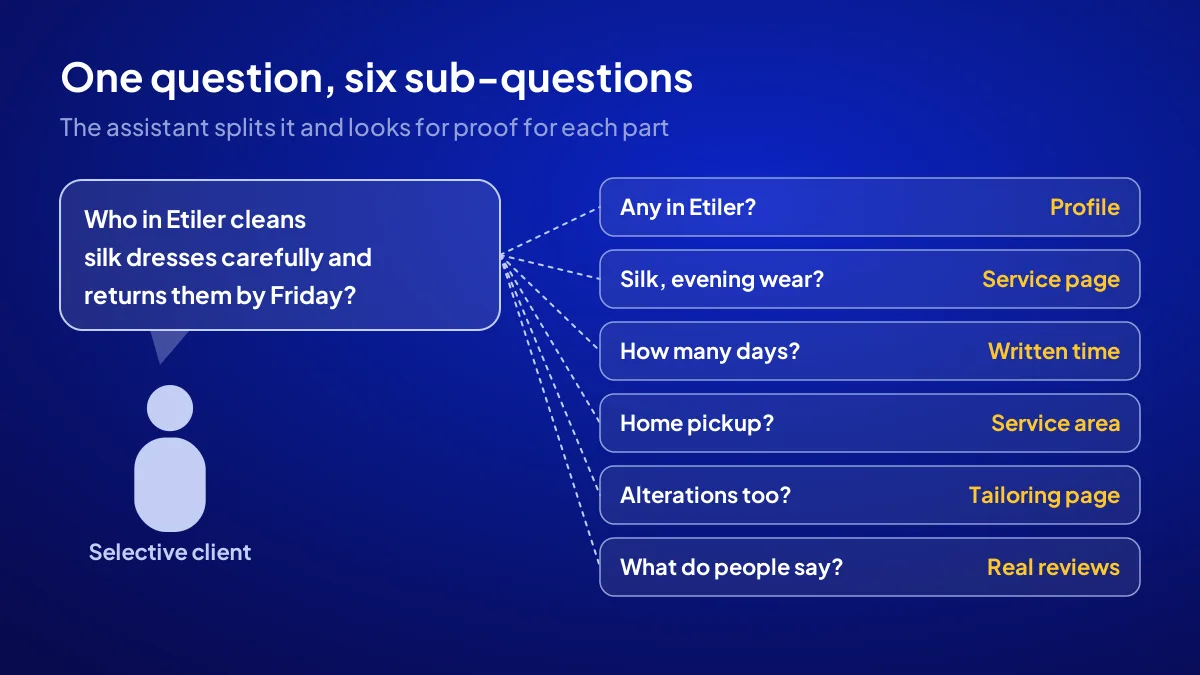
Dry cleaner AI search changes the question your client asks. A selective client no longer types only “dry cleaner near me”; they ask an assistant, “Is there a place in Etiler that handles silk dresses carefully and returns them by Friday?” Whether your name shows up in that answer depends on whether the web holds proof that meets the question piece by piece.
The likely direction toward 2027 is simple: questions get longer, answers get shorter, and the business with its proof ready gets mentioned. That is good news for a new premium dry cleaner and tailor: a page that answers the exact question, a correct profile and consistent details can be built within one season. There is no guarantee, only preparation.
What exactly does a selective client ask an assistant?
BU BÖLÜMÜN ÖZETİ
- The fabric and garment condition
- The time condition
- The district and delivery condition
Say you live in Etiler and have a wedding on Saturday. The sentence you type is long and full of conditions: fabric, timing, district, delivery; price comes later. First you want to know your dress is safe, that it will be back on time and delivered to your door. The assistant favours the business that meets each of those conditions.
The fabric and garment condition
Words like “silk”, “cashmere”, “evening gown” and “leather jacket” sit inside the question. If they never appear on your site or profile, neither will your name.
The time condition
“Ready by Friday”, “same day”, “within 48 hours”: if your turnaround is not written down, the assistant will not guess it.
The district and delivery condition
Write down the streets you serve and your pickup hours, because “Etiler” and “pickup from home” are in the question too. We look at district searches separately in visibility in affluent districts.
Why does an assistant split one question into six?
Google’s AI features use a method called query fan-out: they break one question into related sub-questions, run a separate search for each and then combine the answer. Most owners do not know this, and it means one elegant home page is not enough: every sub-question needs its own proof. The table shows how the Etiler question spreads out.
| Sub-question | Proof the assistant looks for | Where it lives for you |
|---|---|---|
| Is there a dry cleaner in Etiler? | Address, category, map listing | Google Business Profile |
| Do they accept silk and evening wear? | Service description by garment type | Service page on your site |
| How many days to return? | Written turnaround time | Service page, profile description |
| Is there home pickup? | Service area and time window | Profile and contact page |
| Do they do alterations too? | Tailoring service, real work photos | Tailoring page on your site |
| What do others say? | Genuine client reviews | Profile reviews |
The unexpected finding: no extra requirement
Google states plainly that appearing in AI Overviews and AI Mode needs no additional technical requirement and no special structured data. There is no separate door for AI. If your page is indexed and eligible to be shown with a snippet in normal search, it is a candidate to become raw material for an AI answer.
One row per sub-question
Adapt the table to your shop. Every empty cell on the right is where your name drops out.
What changes toward 2027, and what stays put?
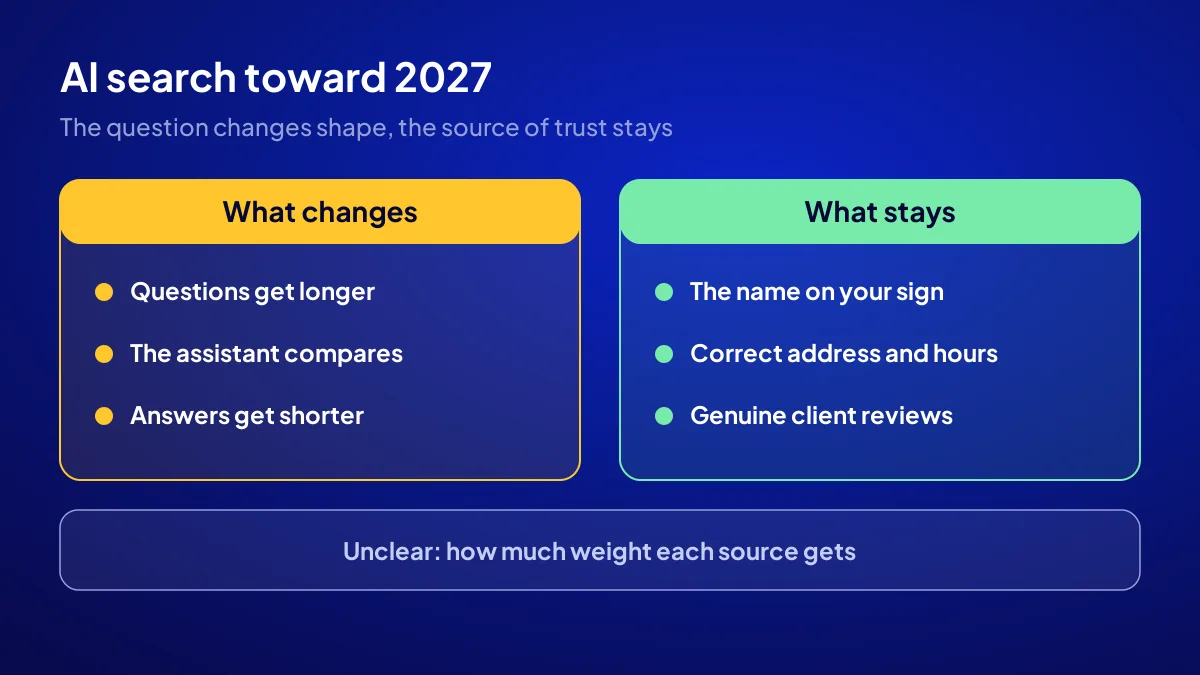
What changes is the shape of the question; what stays is the source of trust. Google’s AI Mode and AI Overviews have been available in Turkish in Türkiye since 18 February 2026, and wider use toward 2027 is the expected direction. We give no precise rate, because there is no verified Türkiye data on dry cleaning clients. What is certain is that a correct address and genuine reviews keep their value.
What changes: the assistant does the comparing
The client asks the assistant to compare three shops instead of browsing them. Your job is to leave complete information to compare.
What stays: the name on your sign
Google wants the business name entered exactly as it appears on signage and documents; adding a slogan breaks the rules. Inflating the name does not work in the AI era either.
Say you just opened in Etiler: what does the first season look like?
Say you open your shutters on a side street near Nispetiye Avenue. The window is elegant and your tailor experienced. In the first month clients are not exactly staying away; they come, but few, and the reason is rarely quality. Your name is not yet in any answer, because nothing about you has piled up online for anyone to read.
Before you open
You can enter your opening date in Google Business Profile up to a year ahead. The profile shows 90 days before opening; posts and photos are allowed, reviews come only after you open. We cover the key fields in the dry cleaner Google Business Profile guide.
The 90 days after opening
Once open, the profile carries a “recently opened” label for 90 days. That is when the first genuine reviews and service pages gather. You will find the order of those three months in the first 90 days plan.
Why should the tailoring side be described separately for AI?
BU BÖLÜMÜN ÖZETİ
- Two services, two pages
- Show the work in photos
- The primary category
Dry cleaning and tailoring may share one sign, but the client’s question is different. One asks “who can get a wine stain out”, the other “who can take in my jacket”. The assistant searches the two questions separately. If your tailoring service is a single line on the site, a client looking for alterations struggles to find you, even if they walk past your door every day.
Two services, two pages
Give dry cleaning and alterations separate pages, each stating garment types, turnaround and delivery options.
Show the work in photos
Share real photos of hemming, waist adjustments and zip replacements. Your own workbench persuades; stock photos do not.
The primary category
Google recommends the fewest, most specific categories. Make the service that earns most your primary category and the other a secondary one.
What should you put in order this season so your name appears?
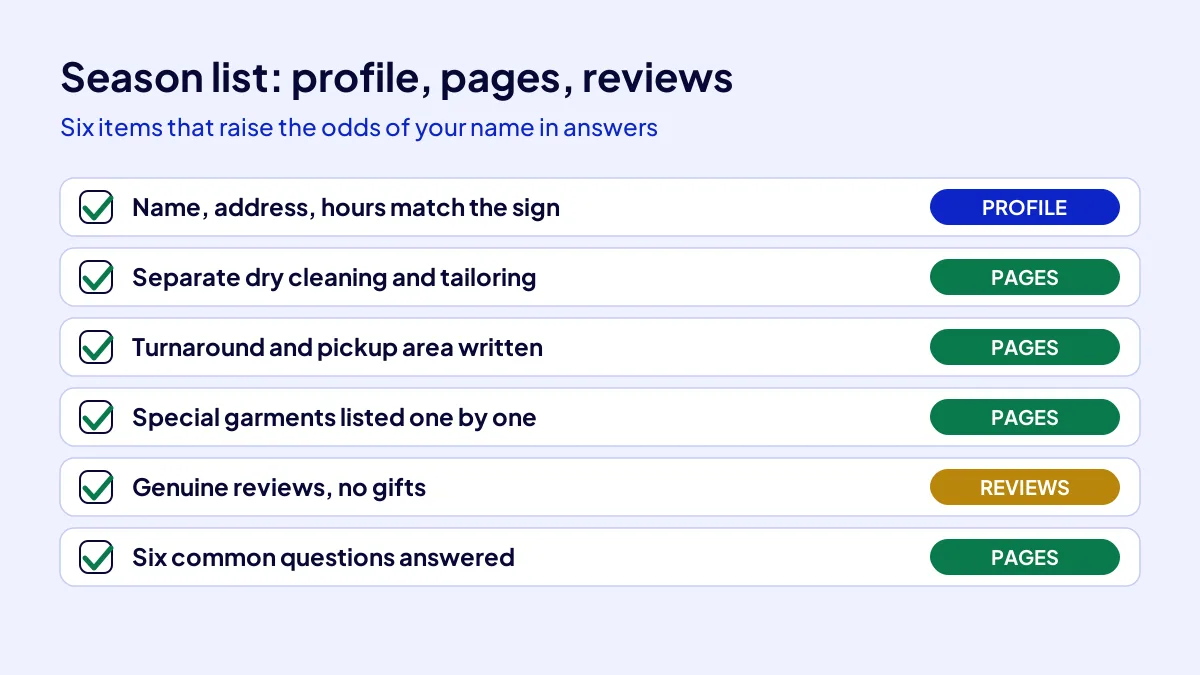
Three layers are enough: profile, pages and reviews. The profile gets you found, the pages get you understood, and reviews get you trusted. All three must match; if the address on your profile differs from your site, both the assistant and the client get confused. When the till is not ringing, complete these layers in order rather than attacking every channel.
- Profile name, address, hours and category match your sign exactly.
- Dry cleaning and tailoring are described on separate pages.
- Each page states turnaround time and the home pickup area.
- Special garments you accept (silk, cashmere, evening wear, leather) are listed one by one.
- After opening, genuine clients are asked for reviews, with no gift in return.
- The six questions clients ask most are answered on the site.
How local recommendations work
We outline what AI looks at when recommending a local business in how AI recommends local businesses. The full promotion map for a new shop is in the new dry cleaner promotion guide.
One principle
The longer the question, the more ready proof gets mentioned.
Quick Summary
- Clients ask assistants with fabric, timing, district and delivery conditions.
- Google’s AI features split the question into sub-questions and seek a source for each.
- AI Overviews and AI Mode have no extra technical requirement; core search basics apply.
- Dry cleaning and tailoring should be described on separate pages.
- Profile, pages and reviews must match each other.
- There is no guarantee of being mentioned; preparation raises the odds.
Short Glossary
Query fan-out: Query fan-out is the method used in AI search to break one question into related sub-questions and find a separate source for each.
AI Mode: AI Mode is the Google search experience used to get an AI-summarised answer with links to a question.
Primary category: The primary category is the Google Business Profile field used to define a business’s main work under a single heading.
Next Step
To build the brand site and the 108-article base that answer those sub-questions in one package, apply for the Senin de Dijital Markan Olsun campaign. Just mention your coupon code when you apply.
Frequently Asked Questions
Source: Google Search Central — AI features and your website
Sık Sorulan Sorular
The Senin de Dijital Markan Olsun (Your Own Digital Brand) campaign builds a brand site plus 108 AI SEO-ready articles across 6 keyword groups. It is a fixed TRY 36,000 + VAT, with a 10% coupon and 12 brand places, and the last day is 1 November 2026. Details are on the campaign page.
There is no guarantee. Google says AI Overviews and AI Mode have no extra requirements and that core search basics apply. When your profile, service pages and genuine reviews answer the client’s sub-questions, your chances of being mentioned rise.
According to Google, no special schema.org markup is needed. Structured data still helps your details get read correctly.
The domain is registered in the client’s name. The package is a fixed TRY 36,000 + VAT, which comes to TRY 43,200 at the 20% rate; check the current rate on the invoice. The first year of hosting is included, and second-year hosting renewal is the client’s responsibility.
Updated: October 2026