
What Determines Data Consulting Fees? The Real Cost of Pulling Scattered Data Together
Data consulting fees are mostly the price of untangling what already exists. Customer lists in three spreadsheets, a half-used CRM, invoices in the accounting software and orders in the online store: the work is less about new tools than about making old records agree. The messier the starting point, the larger the bill. 🧮
This guide explains what drives the fee, which working models exist and what you should hold when the work is done. We do not publish market price bands here, because quotes in this field vary widely and any range we invented would mislead you; the only figure we give is our own. The goal is a single, clean, usable record that your team keeps clean without the consultant, not a dashboard that looks good in the first meeting and is forgotten by the third month.
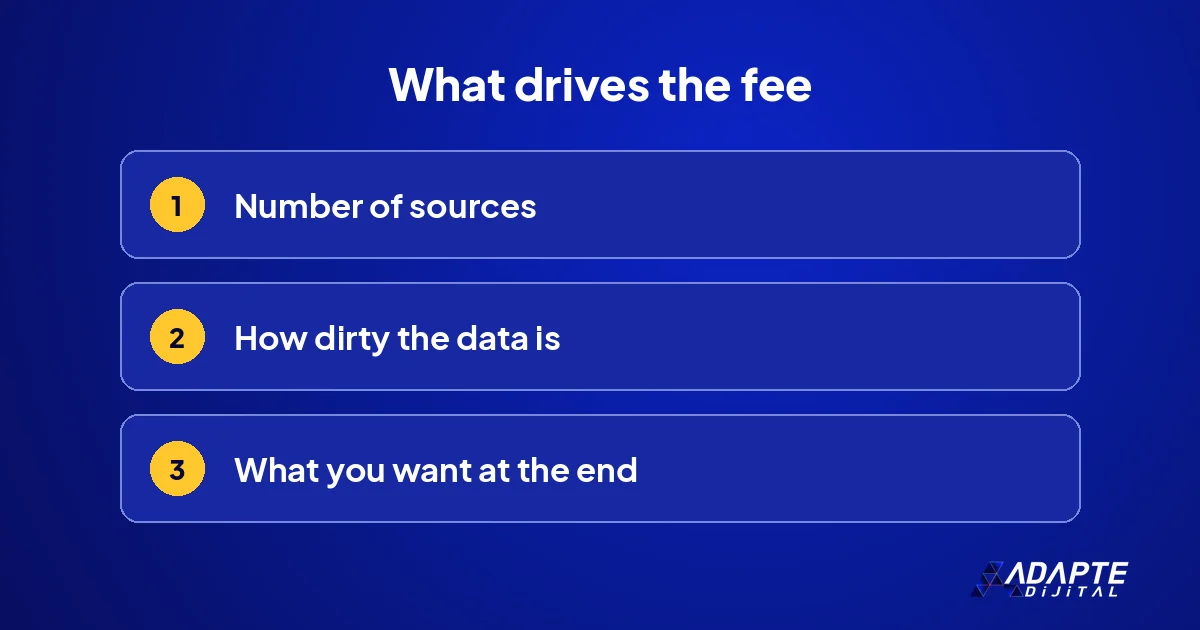
What drives the fee in data consulting?
Three questions explain most of the difference between quotes. Answering them honestly before asking for prices makes every quote more accurate.
Which working models exist?
BU BÖLÜMÜN ÖZETİ
- A one-off clean-up
- Setup and migration
- Monthly data support
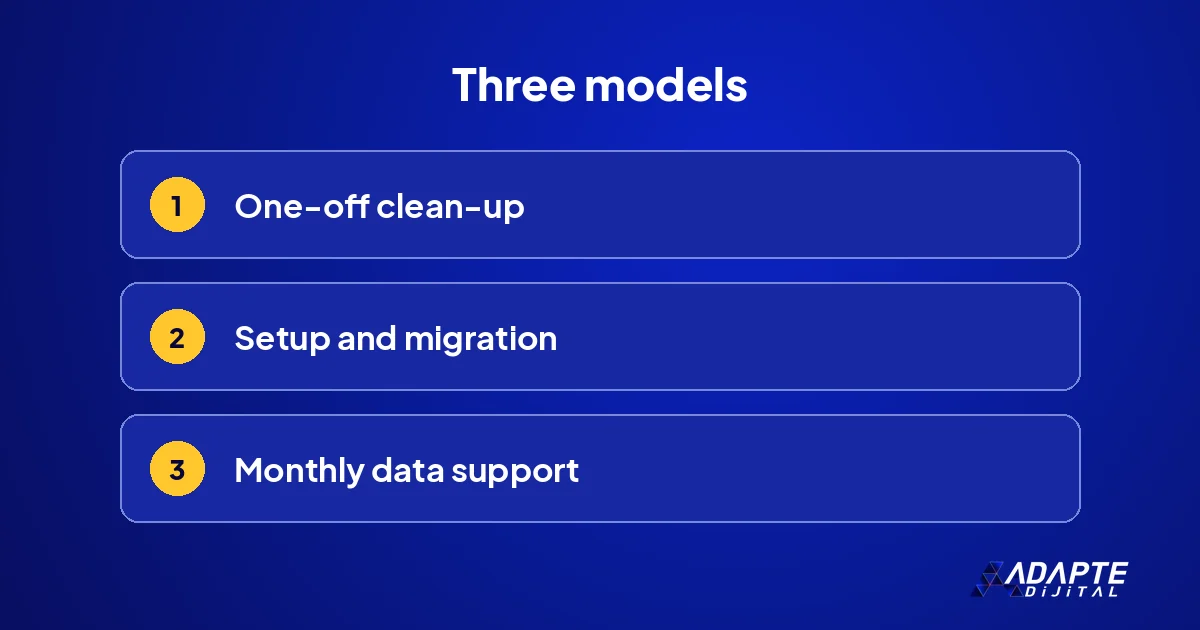
Three models are common in data work. They buy different results and suit different moments.
A one-off clean-up
The consultant gathers the sources, removes duplicates, fills gaps where possible and hands back one clean file. It suits a business that needs order once, for example before moving to a new system or before a marketing campaign. Without entry rules, the mess slowly returns, so ask what will stop that from happening. 🧹
Setup and migration
Data is cleaned and moved into a system the team will use, such as a CRM, with fields, permissions and entry rules defined. This is larger work, but the result lasts. Choosing the system is part of it; we discuss the decision in choosing a CRM. The system should fit the team’s habits, not the other way round.
Monthly data support
You pay monthly for someone to keep the data tidy and produce reports. It suits businesses with a lot of incoming data and nobody inside to look after it. Ask what changes each month because of the support, and how you would carry on if the support stopped tomorrow. 📅
What should you hold when the work ends?
BU BÖLÜMÜN ÖZETİ
- One clean record
- Entry rules
- Backup and access order
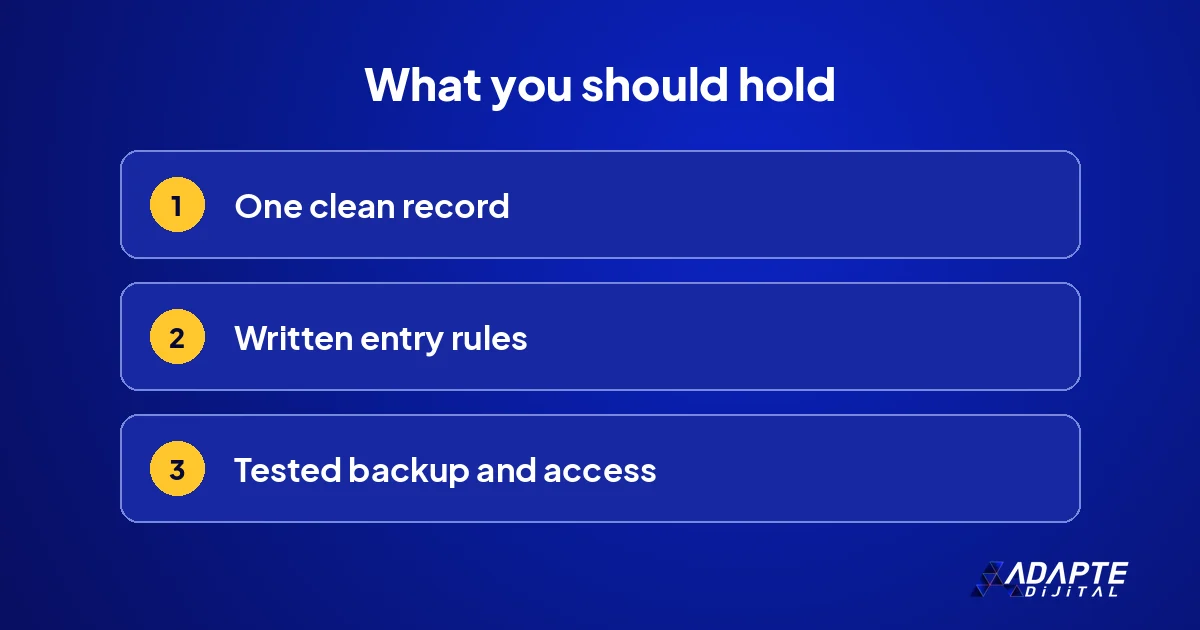
Whatever the model, three results show that the work was real and not just a well-presented file.
One clean record
Each customer, product or supplier exists once, with its fields filled in a consistent format. You can count your customers and trust the number. That alone changes how marketing, sales and accounting talk to each other, because they finally work from the same list. ✅
Entry rules
How a name is written, which fields are required, who may create a new record: these are written down and, where possible, enforced by the system. Rules are what keep the data clean after the consultant leaves; we give practical examples in data entry standards. Without them, every clean-up has a short life.
Backup and access order
Who can see, change and export the data is defined, and backups are tested by restoring one. Data without a tested backup is data you might lose, whatever the system promises. Access should also be removed promptly when someone leaves the business. 🔐
Which lines in a quote should you check?
Three lines show whether a quote fits your situation or is a generic offer.
Which model does Adapte Digital work with?
BU BÖLÜMÜN ÖZETİ
- A single delivery package
- Why we do not charge a monthly fee
- Where the scope is written
We work with a written delivery package and do not charge a monthly fee.
A single delivery package
Adapte Digital does not charge a monthly management fee. Work starts with a single delivery package whose scope is written down in advance: 36,000 TRY + VAT. If the work grows, the new need is defined as a separate add-on package, priced by what will be delivered rather than by the hours spent. 📦
Why we do not charge a monthly fee
Data order has a clear end point: one clean record, written rules and tested backups. We would rather deliver that end point than rent out time indefinitely. When the rules are written well, the team can keep the data clean itself, and that independence is the real result. The broader comparison is in monthly retainer or delivery package.
Where the scope is written
The contents and current price of our packages are written on our campaign pages, item by item, so they can be compared directly with other offers. 🧭
How do you tell a cheap quote from a right one?
BU BÖLÜMÜN ÖZETİ
- Ask for a trial on one file
- Check whether they write rules
- Ask for a numeric report
Three tests separate a price from a plan.
Ask for a trial on one file
Give the consultant one real, messy file and ask what they would do with it. The answer shows whether they understand your data or are reciting a method. A short paid trial is often the best money spent in the whole project. 🧪
Check whether they write rules
A consultant who only cleans will be needed again in six months. One who writes entry rules makes themselves less necessary, which is a good sign. Ask to see the kind of rules they usually leave behind, and whether a new employee could follow them.
Ask for a numeric report
At the end you should see numbers: how many records before and after, how many duplicates merged, how many gaps filled. A clean-up without numbers cannot be checked, and a claim that cannot be checked is only a claim. 📊
Quick Summary
- The fee depends on the number of sources, the mess and the goal.
- A one-off clean-up, a setup and monthly support buy different results.
- You should end with one clean record, entry rules and tested backups.
- Check which sources are included and who does the cleaning.
- Ask for before-and-after numbers.
Short Glossary
- Source
- Any place where business data is kept, such as a spreadsheet or CRM.
- Duplicate record
- The same customer or product entered more than once.
- Entry rule
- A written rule for how data is entered and who may create records.
Frequently Asked Questions
Next Step
List every place your customer data lives today, with a rough count of records in each. That list will make any quote you receive far more accurate.
Sources: KVKK — Personal Data Protection Authority · Google Analytics Help
Updated: November 2026
Sık Sorulan Sorular
Every place data lives is a source: spreadsheets, the CRM, the store, the accounting software, email inboxes, paper files. Each one has its own format and its own habits. Connecting two sources is a small job; connecting seven is a project. Listing the sources is the first and cheapest step, and you can do it yourself before any consultant arrives. 🗃️
Duplicate customers, missing phone numbers, three spellings of the same company, dates in four formats: cleaning takes far longer than moving. Cleaning is usually the largest line in a data quote, and it is the one most often underestimated by both sides. We describe the typical pattern in duplicate records, which is where most clean-ups begin.
A clean list once, or a system the team uses every day? The second includes setup, training and written rules for entering data. Defining the end result at the start matters as much as any technical decision, because it decides whether the work is a weekend clean-up or a change in how the business records things. 🎯
The quote should list the sources by name. “Data consolidation” without a list leaves room for disagreement later, usually about the one spreadsheet nobody mentioned. If a source is excluded, it should say so, and say who will deal with it. 📋
Some quotes move data but leave the cleaning to you. Ask directly whether duplicates will be merged, gaps checked and formats fixed, and how decisions will be made when two records disagree about the same customer.
Customer data is personal data. Ask where it will be copied, stored and processed during the work, and how it will be deleted afterwards. Data protection applies during the clean-up too, not only after it, and a good consultant raises this before you do. 🛡️
Because every inconsistency needs a decision: which spelling is right, which record to keep. Moving data is fast; deciding is slow.
Not always. A well-structured spreadsheet with rules can be enough for a small business. A CRM helps when many people work on the same records.
With written entry rules, required fields and one person responsible for the record.