
In-Answer Ads at Three Months: How Do You Move From a First Test to a Regular Campaign?
Three months into in-answer ads is when the results of the first test are read and the business decides whether the surface becomes a permanent channel. At the end of the first month there was an observation note; at the end of the third there should be a decision. A decision to stop counts as a result too, as long as it rests on data. 📊
This page is the second step of the in-answer advertising horizon series. It covers how to read the first results, how the campaign structure expands and which signs say stop. Technical details were checked on 12 November 2026, and forecasts are labelled as forecasts and revisited in the update log.
What is realistic in three months?
BU BÖLÜMÜN ÖZETİ
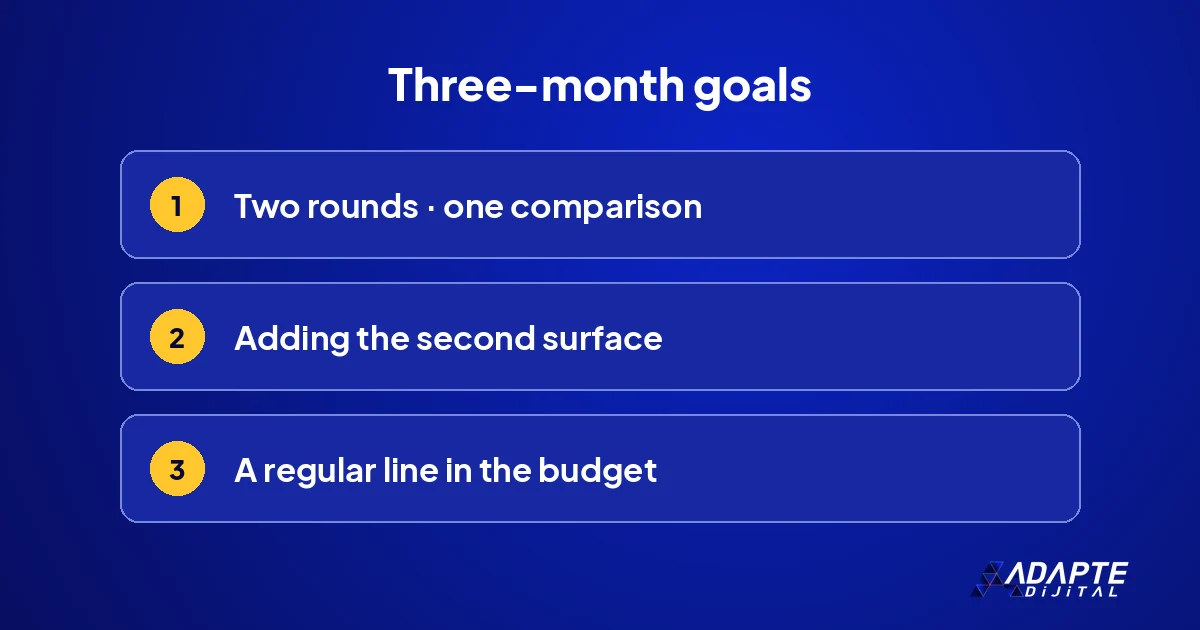
- Two rounds, one comparison
- Adding the second surface
- Entering the channel budget
Three months is enough for two test rounds and a comparison. It is not enough to settle the long-term value of the surface, but it is enough for a decision on whether to continue.
Two rounds, one comparison
A test ran in the first month; in the second and third months a second round runs, corrected according to the observation note. The results of the two rounds are then placed side by side. The comparison matters more than either round alone, because it shows whether the changes made between rounds moved the result. Keep the same conversion definition and the same source of truth across both rounds; otherwise you are comparing two different measurements, not two campaigns. 🔁
Adding the second surface
The second surface, only prepared in the first month, can be added in a measured way in the third month. If the ChatGPT test ran first, for example, the improvements to existing Google campaigns can now be read as well. When the second surface is added, the first surface’s budget stays unchanged; otherwise the effects of the two changes mix. Add one surface, read it for a full cycle, and only then adjust the split between them. Patience here keeps both results readable.
Entering the channel budget
If the result is positive, in-answer advertising leaves the test budget and becomes a small but regular line in the ad budget. That line is judged by the same yardstick as other channels: the cost and quality of conversions. No special treatment for a new surface; if it cannot hold its own against other channels on the same measure, it stays small. Write the share and the review date down, so the line does not quietly grow without anyone deciding that it should. 💼
How do you read the first results?
BU BÖLÜMÜN ÖZETİ
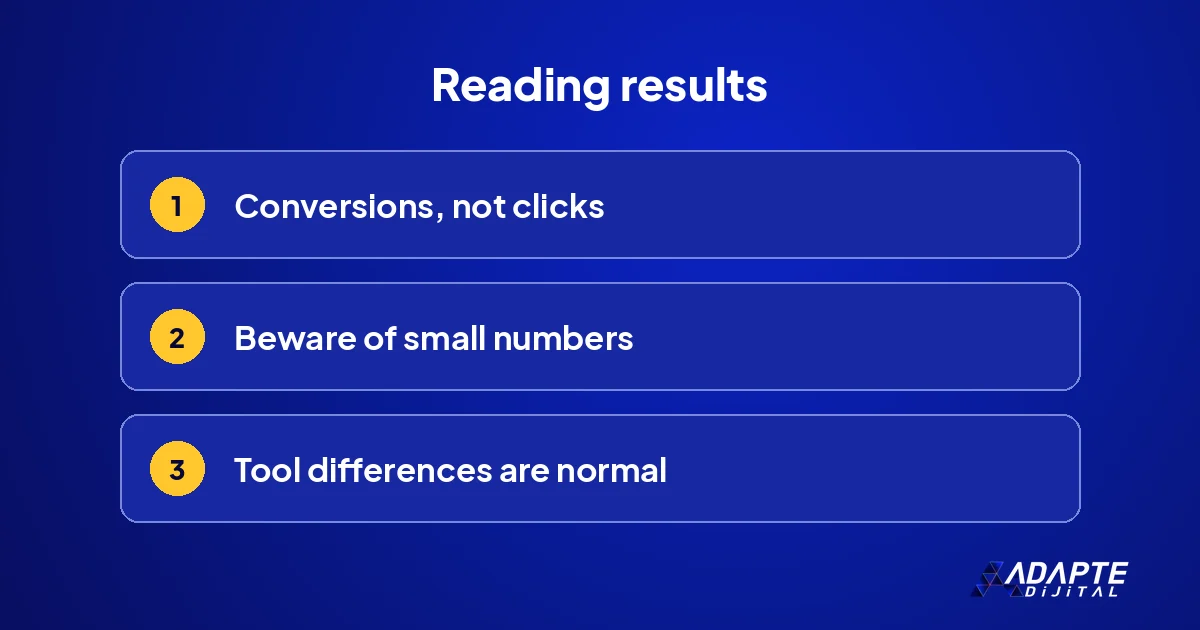
- Conversions, not clicks
- Beware of small numbers
- Differences between tools
Reading results on a new surface takes more care than on familiar channels. Three rules prevent the most common misreadings.
Conversions, not clicks
On new surfaces, click-through rates can look high because users click out of curiosity. The real question is whether the person who clicks does something valuable for the business. Evaluation is based on conversions, not clicks. A surface with fewer clicks but better conversions is the stronger channel, even if its dashboard looks less exciting. For each round, ask how many enquiries or sales came in and what each one cost, and leave the click numbers as background. 🎯
Beware of small numbers
The number of conversions collected in three months may be small. With small numbers, a single customer changes the result considerably. So results are read as a range rather than a single figure, and the decision rests on the total of two rounds rather than any single week. If both rounds point the same way, that is a signal; if they contradict each other, the honest conclusion is that more data is needed, not that one of the rounds was right.
Differences between tools
The ads manager, the analytics tool and the sales record can show different numbers; attribution windows, consent settings and time zones all differ. This gap is not an error but the nature of measurement. Which number counts is decided at the start and is not changed during the period. The performance side of this is covered in Google Ads performance measurement. Consistency matters more than finding one perfect number, because a stable yardstick is what makes two rounds comparable. 📏
How does the campaign structure expand?
BU BÖLÜMÜN ÖZETİ
- Separate objectives, separate campaigns
- Context groups
- Varying the copy
If the result is positive, the structure expands. If the expansion is orderly rather than scattered, results stay readable.
Separate objectives, separate campaigns
Different objectives, regions or product groups are kept in separate campaigns. OpenAI’s campaign guide also recommends separate campaigns for meaningfully different objectives, regions or product categories. Each campaign’s name should state its objective and region clearly, so that anyone reading the report three months later understands the structure from the names alone. The general principles of a clean structure are in Google Ads account structure. 🗂️
Context groups
Each ad group works with a context hint describing a specific customer situation. When expanding, new situations go into new groups; the hint of an existing group is not diluted. One group, one situation keeps it clear which situations convert and which do not. When a new group starts working, compare it with the old ones before moving budget, because early numbers in a fresh group are especially unstable. Let each group earn its share before it gets more.
Varying the copy
Each group runs at least two ad texts, and the weaker one is replaced regularly with a new one. Changes are made one text at a time, so that the cause of a result can be seen. What you learn is a language, not a single winning ad: which way of describing the offer works for this audience. Carry that language into new groups and into landing page headlines, where it often improves results beyond the ad itself. ✍️
Which signs say stop?
BU BÖLÜMÜN ÖZETİ
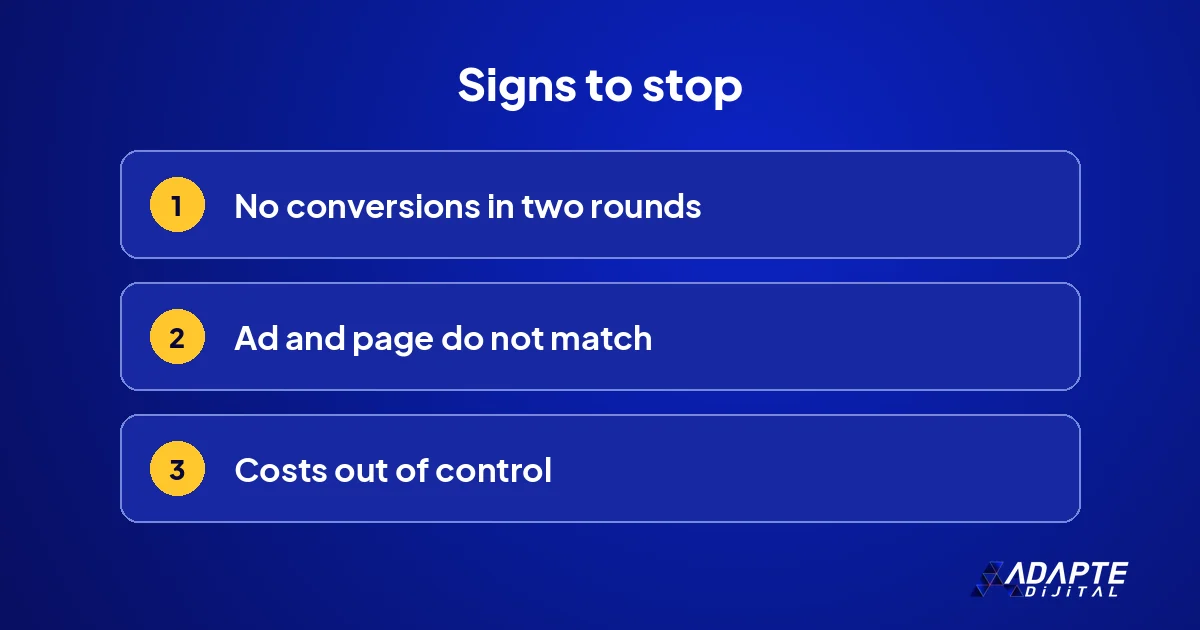
- No conversions in two rounds
- Ad and page do not match
- Costs getting out of control
Not every test has to continue. Three signs say it is time to pause and rethink.
No conversions in two rounds
If two test rounds produce no meaningful conversions despite corrections, the surface does not suit this offer. That does not mean the surface is bad; it means this offer does not fit this surface. A different offer, or a different customer situation, may still work. Record what was tried, so that a later test does not repeat the same combination. A clear no is also useful information, and it frees budget for something that works. ✋
Ad and page do not match
If ad approvals are delayed, or users arrive on the page and leave at once, the problem most likely lies with the landing page. In that case the page is fixed, not the ad. Once the page has been corrected, the same ad is tested for one more round and the difference is recorded. Changing the ad and the page together would hide which change helped, and the next decision would again rest on a guess.
Costs getting out of control
If the cost per conversion stays clearly above other channels and does not improve, the structure is reviewed instead of the budget being raised. Raising the budget of an expensive channel buys more of the same expensive result. First look at the offer, the page and the context groups; if the cost still does not come down, pause and move the budget to the channel that converts better. 💸
What is rising on this horizon?
BU BÖLÜMÜN ÖZETİ
- Today: new bidding options
- Forecast: competition increases
- Forecast and log
The three-month horizon looks at the first quarter of 2027. The first item is today’s status; the next two are forecasts.
Today: new bidding options
In the ChatGPT ads manager, alongside views and clicks, there is an objective optimised for conversions. As the platform develops, bidding options may become richer. Which objective to choose depends on the number of conversions collected in the first two rounds; an account with very few conversions gives an automated objective little to learn from. Start where your data is, and move to a conversion objective once enough conversions have been recorded. 🧩
Forecast: competition increases
Forecast: over the coming quarter, the number of advertisers on this surface will grow and the relatively calm auctions of the early period will change. The insights a business gathers during that early period give it an advantage when costs start to rise: it already knows which offers and which customer situations work, while newcomers are still paying to find out. That knowledge is the real return on an early test.
Forecast and log
Forecast: businesses that decide in the third month will either grow the channel with confidence or move its budget somewhere more efficient, and both are gains. Update log. 12 November 2026: first publication. The forecasts on this page are re-read when they fall due; a forecast that turns out wrong is not deleted but corrected here. The previous step is in-answer ads: first month; the next is in-answer ads: six months.
How do the first three months work with Adapte Digital?
BU BÖLÜMÜN ÖZETİ
- A single delivery package
- What is delivered
- Where to start
Third-month work is an evaluation and a restructuring: the results are read, the decision is written down and the structure is delivered.
A single delivery package
Adapte Digital does not charge a monthly management fee. Work starts with a single delivery package whose scope is written down in advance: 36,000 TRY + VAT. If the work grows, the new need is defined as a separate add-on package, priced by what will be delivered rather than by the hours spent. 📦
What is delivered
The output of this work is a comparative report on the two rounds, a written decision to continue or stop, and an expanded campaign structure. We review the state of your existing ad account alongside it, so the new channel is judged on the same terms as the rest.
Where to start
The written scope of each package, with current pricing and capacity, is on our campaign pages. 🧭
If you see a business opportunity here, we wrote a separate article on in-answer ads packages for small budgets.
Quick Summary
- Two test rounds run in three months and are compared.
- Evaluation is based on conversions, not clicks.
- Different objectives, regions and products stay in separate campaigns.
- No conversions in two rounds, a page mismatch and runaway costs are signs to stop.
- Forecasts are reviewed in the update log.
Short Glossary
- Test round
- A time-limited campaign period run with a specific offer, region and budget.
- Attribution window
- The period after an ad interaction within which a conversion can still be credited to that ad.
- Source of truth
- The one report agreed at the start as the number that counts for decisions.
Frequently Asked Questions
Next Step
Open the first month’s observation note and choose one change for the second round: the copy, the offer or the page. Our campaign pages list the packages that cover this evaluation.
Sources: OpenAI Help Center — Ads Manager Availability · OpenAI Help Center — Create campaigns for ChatGPT Ads
Updated: November 2026
Sık Sorulan Sorular
They show enough direction for a decision to continue. Long-term value needs longer observation, but comparing two rounds gives a reliable basis.
The ads manager, analytics and sales records can differ. Decide which one counts at the start and do not change it during the period.
Review the landing page and the offer first. If two rounds bring no conversions despite corrections, stop the surface for this offer and keep the lessons.