
What Is In-Answer Advertising? How Businesses Prepare for ChatGPT and Google AI Mode Ads
In-answer advertising is an ad labelled as sponsored that appears beside or below the answer an AI assistant gives. More and more people put their questions not to a search box but to assistants they talk to. Ads are following them there, and businesses that understand the surface early will spend more carefully than those who simply copy old habits. 🧭
This guide explains in-answer advertising from a business owner’s point of view: which surfaces are actually open today, how it differs from search ads, what a business should prepare and which risks it should know. Product details change quickly, so each technical fact was checked on 12 November 2026. Check the current help pages before you set anything up.
What is in-answer advertising?
In-answer advertising looks like search advertising moved to a new surface, but it works differently. Putting budget into it without understanding the difference means carrying an old habit onto a new surface. This section covers the definition, the moment an ad appears and the kinds of business it suits.
Definition
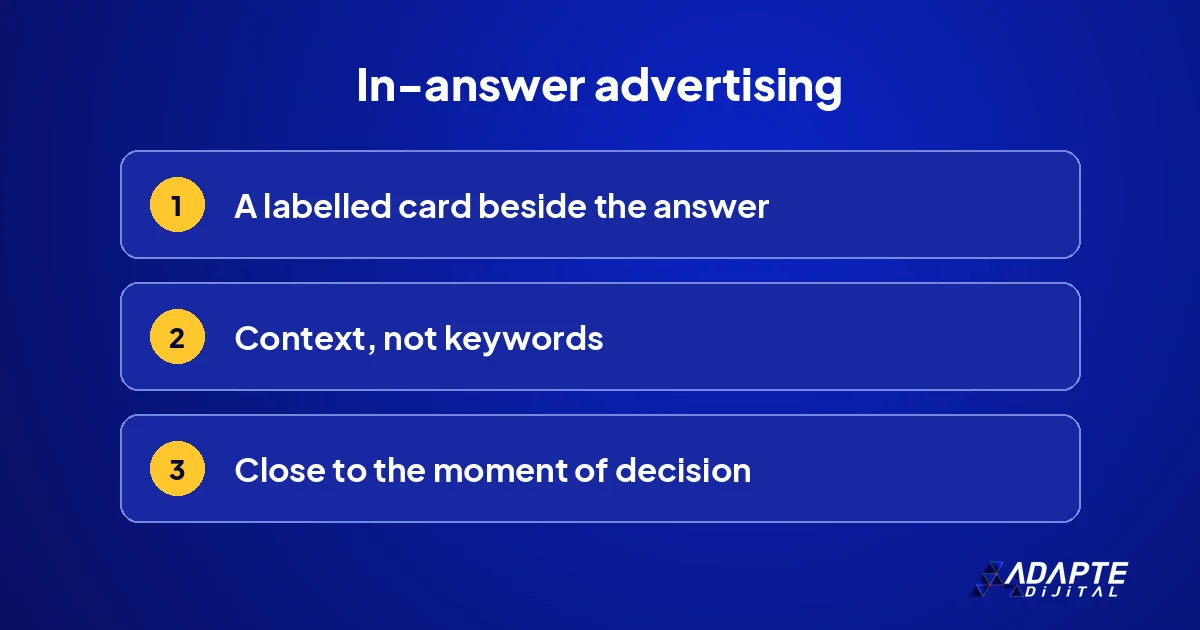
A user asks an assistant a question, the assistant answers, and next to or below the answer a suggestion appears that is clearly marked as sponsored. The suggestion is a product or service that fits the context of the question. The ad is not the answer itself; it is a card placed beside the answer. OpenAI has stated as a principle that ads do not influence the answers ChatGPT gives and that they are always kept separate and labelled. That separation protects the advertiser too, because users can tell at a glance what is a recommendation and what is paid for. 🧭
Which surfaces are open today?
BU BÖLÜMÜN ÖZETİ
- ChatGPT ads
- Google AI Mode and AI Overviews
- The budget floor
In-answer advertising is not one place but several surfaces. Two main surfaces stand out today and their status is different: one can be used now, the other needs preparation now. Putting them in the same basket leads to the wrong decision.
ChatGPT ads
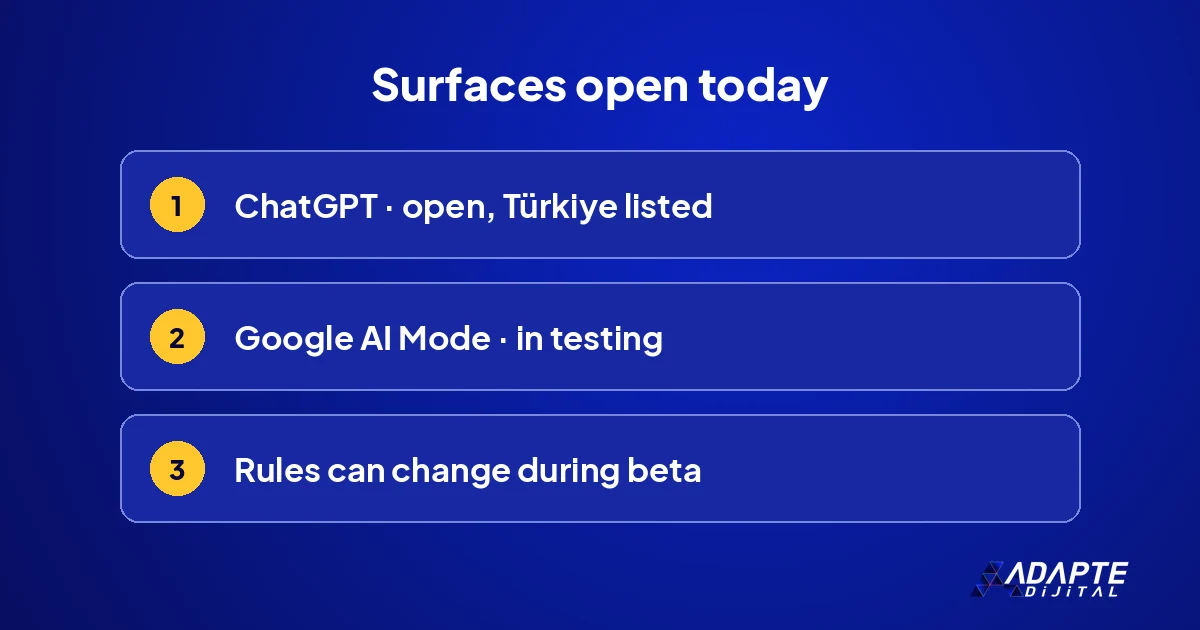
OpenAI began testing ads in ChatGPT in the United States in February 2026 and later opened a self-serve ads manager. Türkiye is listed as available on the eligibility list in OpenAI’s help pages, which means a legal entity established in Türkiye can use the ads manager. Campaign objectives include views, clicks and conversions. The ads manager is in beta, so rules and details can change; the facts here were checked against OpenAI’s help pages on 12 November 2026. The practical point is that a business in Türkiye can run a measured test today rather than wait. 🧾
Google AI Mode and AI Overviews
At its marketing event in May 2026, Google announced new ad formats that sit inside AI answers. According to industry coverage, there is no separate campaign type for these formats; eligibility comes from existing Performance Max, Shopping and Search campaigns using broad match or AI Max. When announced, the formats were in testing and shown first on English-language searches in the United States. We have not seen a confirmed launch date for Turkish searches. How AI Mode itself is evolving is covered in our Google AI Mode latest guide. Preparation still pays off in today’s campaigns. 🔎
The budget floor
On ChatGPT, the minimum daily budget depends on the billing currency of the ad account; OpenAI’s campaign page lists $25 per campaign per day for the United States. Daily spend stays within twice the daily budget, and spend over seven days stays within seven times. These limits show that even a small test can be run under control. Because the minimum differs by country, check the current figure for Türkiye in the ads manager. How to spend the first month is set out on the in-answer ads: first month page. Spread the budget over a period long enough to read results.
How is it different from search ads?
BU BÖLÜMÜN ÖZETİ
- Context, not keywords
- Close to the moment of decision
- Harder to measure
The logic of in-answer advertising differs from familiar search advertising in three ways. These differences decide where preparation should focus. Talking them through with the team before allocating budget prevents disappointment later.
Context, not keywords
In ChatGPT ads you write context hints that describe which conversations the ad suits; they are not exact-match keywords and do not guarantee that an ad appears in a given conversation. On Google, the new formats assemble the ad from the assets and product data you provide. In practice this means writing plain sentences about the customer’s situation instead of keyword lists. Control shifts from choosing words to the quality of the description and the cleanliness of the data. Google’s broader move in this direction is explained in Google Ads automation in 2026. 🧠
Close to the moment of decision
When talking to an assistant, users describe their problem in detail. That is a far richer context than a short search query, and an offer that matches well touches the exact need. For the same reason, an ad that does not match stands out more next to a careful answer and can damage trust in the brand. This closeness favours offers built around one specific customer situation, while general brand messages often find little response here. How to write for this is covered in writing ChatGPT ad copy. One situation, one offer is the safest rule.
Harder to measure
After seeing an ad, a user can keep talking to the assistant, visit the site later or buy from another device. Different tools can show different numbers. A business that does not set up measurement from the start cannot later tell whether the channel works. That is why the number that counts is written down before the campaign starts. The gap between the ads manager, the analytics tool and the sales record is not an error; it is the nature of different measurement methods. Agree on one source of truth and keep it for the whole test period. 📏
What should a business prepare?
BU BÖLÜMÜN ÖZETİ
- A consistent landing page
- Working measurement
- Assets and product data
Preparing for in-answer advertising comes before learning any ads manager. Three preparations pay off whichever surface opens, and none of them is a cost only for the new surface: each also improves the channels you already use.
A consistent landing page
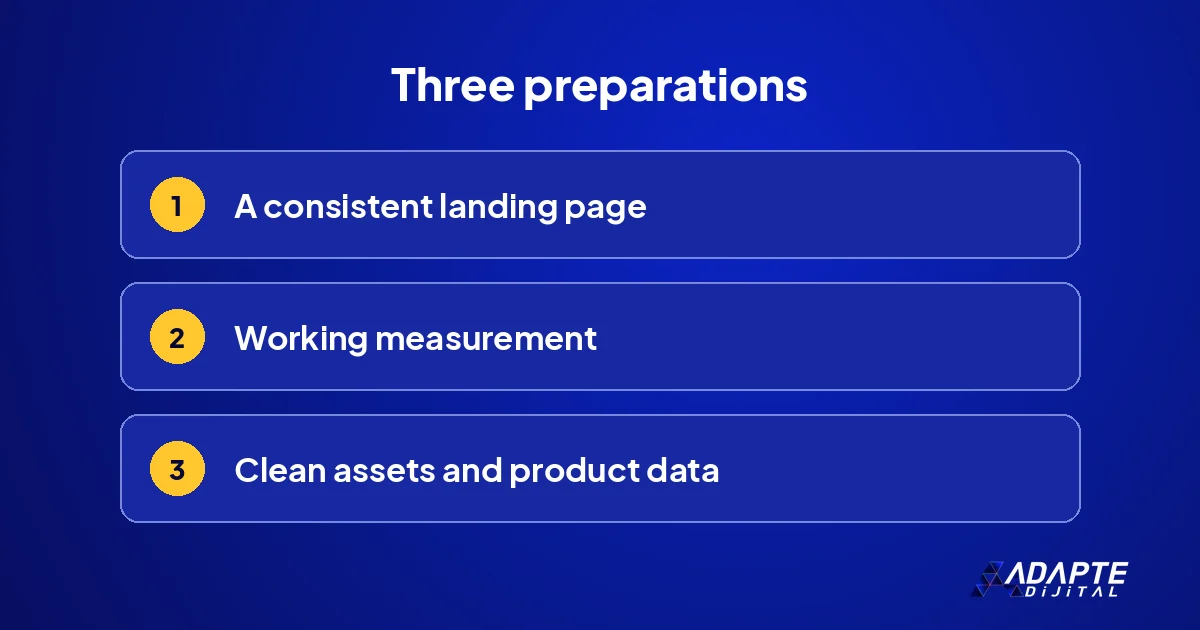
OpenAI says it may crawl an ad’s landing page for safety, policy and relevance review, and claims in the ad such as price, stock or timing are expected to match the page. So before any ad, the page is prepared: the offer is visible on the first screen, price and terms are clear, and contact takes one step. The first screen should repeat the promise made in the ad. When a promotion ends, the ad text is updated on the same day. A page that keeps the ad’s promise is the foundation of everything that follows. 📄
Working measurement
The conversion is defined and measured: a form, a call, a sale or a booking. On ChatGPT that means a pixel or server-side conversion reporting; on Google it means conversion tracking. Campaign objectives cannot easily be changed later, so measurement comes before the objective. Once measurement is in place, test it with a trial conversion. A campaign launched without measurement only produces impressions and clicks, which say nothing about whether the channel works. How to read performance properly is covered in Google Ads performance measurement. Measure first, then spend.
Assets and product data
Google’s new formats build the ad themselves from the assets and product data a business supplies. Incomplete descriptions, low-quality images and messy product data make it hard to win a share of these formats. For a business that sells products, titles, descriptions, prices and stock must be current; even one missing field can make it harder to match a product to the right question. For a service business, assets need enough variety to answer different customer questions. The account-side checklist is in preparing an account for AI Mode ads. 🗂️
What risks and limits exist?
BU BÖLÜMÜN ÖZETİ
- Beta and platform risk
- Restricted categories
- An ad is not a citation
A new surface brings real opportunity and real risk. Knowing the risks does not stop a test; it keeps the budget and the expectations the right size. The common answer to all three risks below is to start small and read results regularly.
Beta and platform risk
The ChatGPT ads manager is in beta; rules, minimum budgets and access conditions can change. OpenAI’s own FAQ says the platform is at an early stage and that there are no industry benchmarks yet. That makes it hard to say what a good result looks like. A test budget should therefore be an amount whose loss would not strain the business. Rule changes should be checked at regular intervals and reflected in the campaign. Treat early results as learning, not as a forecast of what the channel will deliver at scale. ⚠️
Restricted categories
In areas such as health, finance and law, ad rules are stricter, and in some countries these ads are open only to approved or licensed advertisers. Ads are not shown to accounts identified as belonging to users under 18. A business working in these areas should read the current ad policy before writing any copy; a well-written ad in a restricted category is an ad that never runs. For legal obligations, consult a qualified professional; this article is not legal advice. Policy pages change, so check them again before each new campaign.
An ad is not a citation
Buying an in-answer ad is not the same as being cited as a source in the assistant’s answer. An ad is a labelled card; a citation is the assistant’s own assessment and cannot be bought. To be cited, you need content that assistants can read and that is reliable and current. Advertising and content do not replace each other; planned together, they make more sense. We explain this difference in detail in can AI visibility be bought?. A business that wants both needs a paid plan and a content plan side by side. 📚
How do you prepare for in-answer advertising with Adapte Digital?
BU BÖLÜMÜN ÖZETİ
- A single delivery package
- What we do on the ads side
- Where to start
We approach this surface not with a management subscription but with delivered preparation: the page, measurement and campaign structure are set up and handed over to you.
A single delivery package
Adapte Digital does not charge a monthly management fee. Work starts with a single delivery package whose scope is written down in advance: 36,000 TRY + VAT. If the work grows, the new need is defined as a separate add-on package, priced by what will be delivered rather than by the hours spent. 📦
What we do on the ads side
We work on account audits, measurement setup and campaign structure. If a new surface is to be added, we first look at the health of the existing account, because a new channel built on broken measurement only multiplies the problem. The scope is written down before any work starts.
Where to start
Our current packages and capacity are listed on our campaign pages; scope and price are written there before any work starts. 🧭
Quick Summary
- In-answer advertising is a labelled suggestion beside an AI answer.
- ChatGPT’s ads manager lists Türkiye; Google AI Mode formats are in testing.
- Control is shifting from keywords to context and data.
- Preparation: a consistent landing page, working measurement, clean data.
- An ad is not a citation, and a citation cannot be bought.
Short Glossary
- In-answer advertising
- An ad labelled as sponsored and shown beside or below an AI assistant’s answer.
- Context hint
- A description of the conversations in which an ad may be shown; not an exact-match keyword.
- Eligibility
- The conditions an account must meet for its ads to be shown in a given placement.
Frequently Asked Questions
Next Step
Write down the five questions your customers ask before they decide, and check whether your landing page answers each one. To set up visibility and advertising foundations in a single package, see our campaign pages.
Sources: OpenAI Help Center — Ads Manager Availability · OpenAI Help Center — ChatGPT Ads: Frequently Asked Questions · OpenAI Help Center — Create campaigns for ChatGPT Ads · Search Engine Journal — How To Advertise In Google AI Mode For Ecommerce
Updated: November 2026
Sık Sorulan Sorular
A search ad is shown for the words a user types. An in-answer ad is shown for the context of the conversation: while the user describes a problem, compares options or gets close to a decision. That context is richer than the two or three words typed into a search box, which is why the same product can match better when it is described in the language of a specific situation. As the conversation moves on, the suitable offer can change as well. The value of the ad comes from reading correctly what the user is thinking about at that moment.
In-answer advertising makes sense where people ask questions, compare options and look for explanations before they decide: choosing a service, comparing products, looking for a solution. Local services, consulting, training and considered purchases are strong candidates. For low-priced impulse products, where price is the only deciding factor, the contribution of this surface may be more limited. The question to ask is simple: do your customers talk through their problem before they buy? If they do, the conversation is where the decision forms, and an offer placed there can be useful rather than intrusive. 🎯
Türkiye is on OpenAI’s eligibility list. The condition is that the legal entity advertising and being billed is established in a listed country. The list changes, so check its current version.
According to industry coverage, no. Eligibility comes from existing Performance Max, Shopping and Search campaigns using broad match or AI Max.
Not for now. It is a new surface, and a measured test alongside existing channels is the sensible way in.