
Google AI Mode in Turkey: what has changed for businesses so far in 2026?
Google AI Mode in Turkey has been rolling out gradually in Turkish since 18 February 2026, running on the Gemini 3 model family. At I/O on 19 May 2026, Google said AI Mode passed 1 billion monthly active users within a year, and AI Overviews passed 2.5 billion. According to Google’s Search Central documentation, there is no extra requirement to appear as a source link in AI Mode: the page must be indexed and eligible to show with a snippet.
What it means for a business: customers now arrive with a long, detailed question, and Google splits that question into sub-questions and searches several pages. A business with pages that answer those sub-questions gets a chance to enter the source list. A one-page shop-window site falls behind in this race.
How has AI Mode arrived in Turkey, step by step?
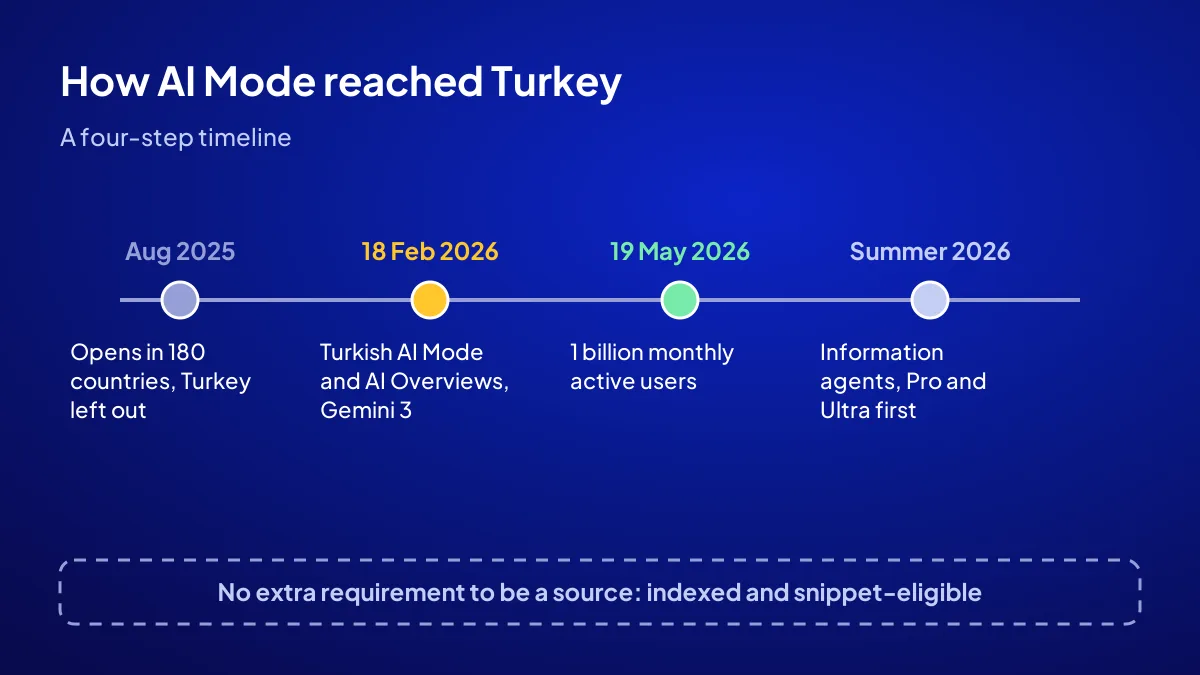
AI Mode reaches Turkey later than most countries. When it opens to 180 countries and territories in August 2025, Turkey is not on the list. The Turkish version is announced on 18 February 2026 and rolls out gradually on Android, iOS and the results page.
| When | What happens | Effect on businesses |
|---|---|---|
| 22 August 2025 | AI Mode opens in 180 countries and territories; Turkey left out | No change yet in Turkish search |
| 18 February 2026 | AI Mode and AI Overviews launch in Turkish, on Gemini 3 | Long questions and sourced answers begin |
| 19 May 2026 | I/O: AI Mode passes 1 billion monthly active users | AI answers become part of everyday search habits |
| Summer 2026 | Information agents roll out, starting with AI Pro and Ultra subscribers | Agents that search on your behalf in the background arrive |
Questions by voice and camera
According to Google Turkey’s announcement, AI Mode accepts questions by text, voice and photo. A customer standing at your counter can ask without typing a word.
How does AI Mode answer a question?
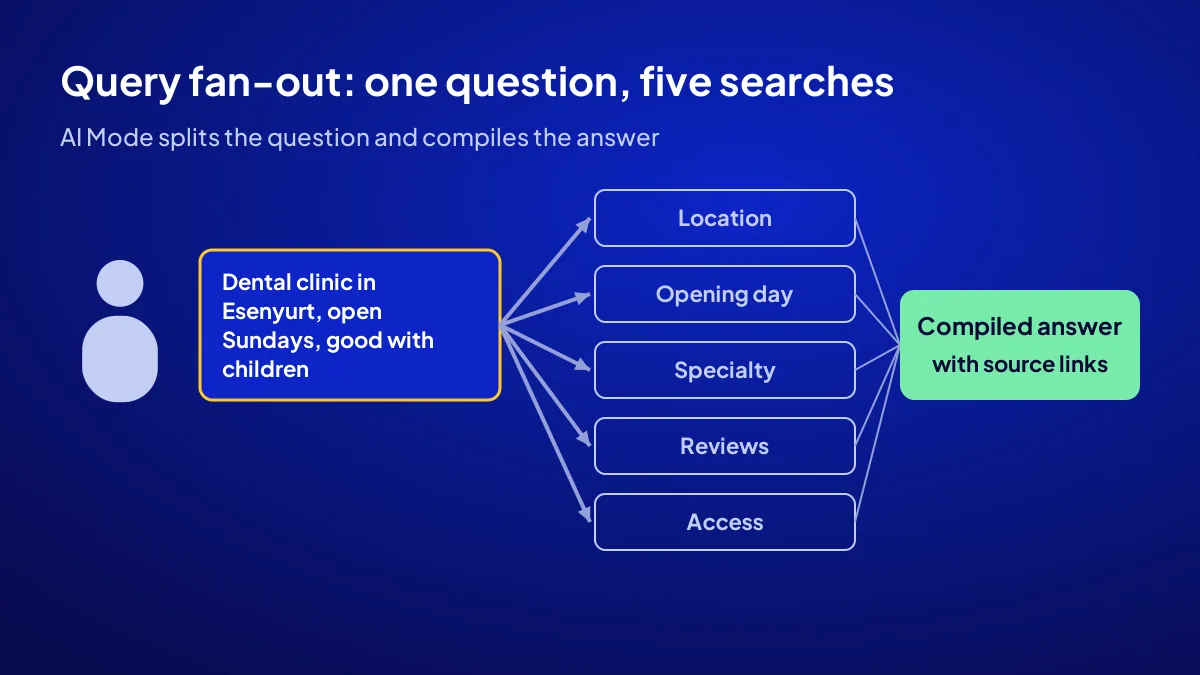
AI Mode does not treat a question as one search. Google describes a “query fan-out” technique: the question is split into subtopics, a separate search runs for each, and the answer is compiled from those searches. According to Google, this surfaces a wider and more diverse set of links than a classic web search.
One question, five small searches
Someone asking for “a dental clinic in Esenyurt open on Sundays that is good with children” is really asking several things. Location, opening day, specialty, reviews and access. Each one runs as its own search.
The page that answers wins
A page that clearly answers one of the sub-questions gets a chance to enter the source list. If “are we open on Sunday” is not written on your site, your name does not come up in that sub-search.
Which pages can appear as sources in AI Mode?
Google’s Search Central documentation states the condition plainly: the page must be indexed and eligible to appear in Search with a snippet. There is no additional requirement or special optimisation for AI Overviews or AI Mode. That does not make the job easy; for a site with weak foundations the door is closed from the start.
Snippet controls affect AI answers too
According to the documentation, nosnippet, data-nosnippet, max-snippet and noindex controls also limit how content is used in these features. A stray nosnippet tag can keep your page out of AI answers.
What is changing for ads and measurement?
According to Google Turkey’s February 2026 announcement, ads keep appearing in designated slots above and below the AI Overviews panel. On measurement, Google counts traffic from AI features inside the “Web” search type of the Search Console performance report, without a separate tab. So this traffic is in the report, but it is not labelled.
Being seen is not being clicked
adaptedijital.com’s Search Console data for 14 June to 13 September 2026 shows this clearly. The query “dijital ajans” (digital agency) has 478 impressions, an average position of 66 and zero clicks. Impressions do not put money in the till; customers who click do.
How to separate AI traffic
Since Search Console does not make this split, you need a separate channel in GA4. Separating visits from ChatGPT and Gemini is explained step by step in measure AI traffic in GA4.
What it means for you: customers arrive with long questions
Customers no longer type “dental clinic Istanbul”; they describe their problem in a sentence. If your site answers each part of that sentence, your name is more likely to appear in the answer AI Mode compiles. If not, the customer is steered elsewhere before reaching your door. What counts is how many questions your site answers.
Short queries are not ending, they are shrinking
Short searches continue, but the share of long questions grows. Long, intent-driven questions face fewer competitors. In Adapte’s data, the query “diş deposu nasıl açılır” (how to open a dental supply store) averages position 2.5.
The shop window is now the answer
In a shop, the window pulls customers in; online, the right answer does that job. Listing which question you answer, and how, is a good start.
What from the summer 2026 announcements reaches Turkey?
Information agents announced at I/O 2026 roll out this summer, starting with Google AI Pro and Ultra subscribers. Booking and shopping agents are announced to open first in the US. As of October 2026, no Turkey-specific timeline has been announced for these agents.
What should a business check this month?
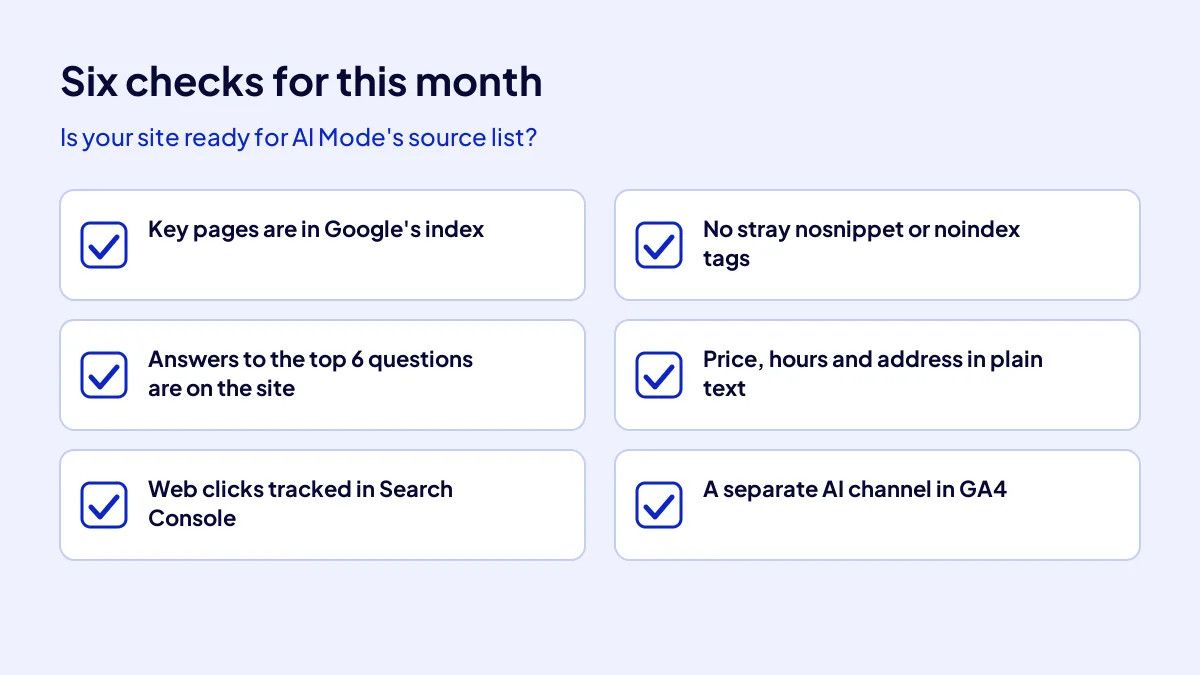
This month’s job is to check whether your site can enter AI Mode’s source list. The six basic checks below fit in one afternoon, and the first is the most critical. Cut your coat according to your cloth: do the free checks first, then decide on investment.
- Are your key pages in Google’s index? Check with URL Inspection in Search Console.
- Is there a stray nosnippet or noindex tag on any page?
- Are answers to customers’ 6 most common questions written on the site?
- Are prices, opening hours and address in plain text on the page?
- Are “Web” impressions and clicks in Search Console rising?
- Do AI-driven visits show as a separate channel in GA4?
Getting the groundwork built in one go
The AI SEO campaign builds these checks and more in 30 days: diagnosis, entity structure, structured data, 108 articles across 6 question groups, Q&A blocks on existing pages, and measurement. The fee is TRY 36,000 + VAT; with 20 percent VAT that is TRY 43,200, but check the current rate on your invoice. Details are on the AI SEO campaign page.
The logic of the package
Why 108 articles and why question groups is explained in AI SEO with 108 articles.
Quick Summary
- AI Mode has been rolling out in Turkish in Turkey since 18 February 2026.
- According to Google, AI Mode has passed 1 billion monthly active users.
- No extra requirement to be a source: indexed and snippet-eligible is enough.
- Questions are split into sub-questions; pages that answer them get a chance.
- AI traffic is counted within “Web” in Search Console, without a separate label.
- No Turkey timeline has been announced for agent features yet.
Short Glossary
AI Mode: AI Mode is a Google search experience used to get AI answers to complex questions and go deeper with follow-ups.
Query fan-out: Query fan-out is a technique used to split a question into subtopics and run a separate search for each.
Snippet: A snippet is a short excerpt used in search results to show part of a page’s content.
Next Step
If you want the groundwork for your name to appear in AI Mode’s answers built in 30 days, apply for the AI SEO campaign and get your starting diagnosis card.
Frequently Asked Questions
Source: Google Blog — I/O 2026: Welcome to the agentic Gemini era
Sık Sorulan Sorular
Not everyone sees the feature on the same day. One customer may use AI Mode while another sees classic results, so be ready for both.
The condition is the same, but the unit of competition changes. In classic search a page competes for a keyword; in AI Mode, it competes with answers to sub-questions. The difference is covered in what is GEO versus SEO.
In Turkey today, AI Mode and AI Overviews are available in Turkish. For agent features, waiting for an official announcement is safer than planning on guesses.
For AI search usage figures in one table, see AI search usage in numbers.
Classic SEO aims to move a page up the search results. AI SEO focuses on making the site readable and recognisable so the business name appears in AI answers. Core SEO is the foundation of AI SEO too.
According to Google’s Search Central documentation, there is no extra requirement for AI Mode. The page must be indexed and eligible to show with a snippet. For other AI assistants, additional structure such as structured data and llms.txt supports readability.
Google counts traffic from AI features within the “Web” search type in the Search Console performance report. There is no separate label; a detailed split needs a channel setup in GA4.
Updated: October 2026