
How to Disclose AI in a Chatbot: What to Tell Customers, When and How
AI disclosure in a chatbot is the note that lets customers know clearly that they are talking to an AI system rather than a person. For a chatbot serving people in Europe, it has been an obligation rather than a courtesy since 2 August 2026; for customers in Türkiye, it is the foundation of trust. 💬
This guide explains what the European rule requires, when and how the notice is given, the personal data side, handover to a human and common mistakes. The information was compiled from the official text and guidance on 12 November 2026. This article is for information only and is not legal advice; consult a lawyer about your own situation.
What does the European rule require?
The first provision of Article 50 concerns chatbots directly. Knowing three points is enough to set up the notice correctly. The full framework is in the machine trust and compliance guide.
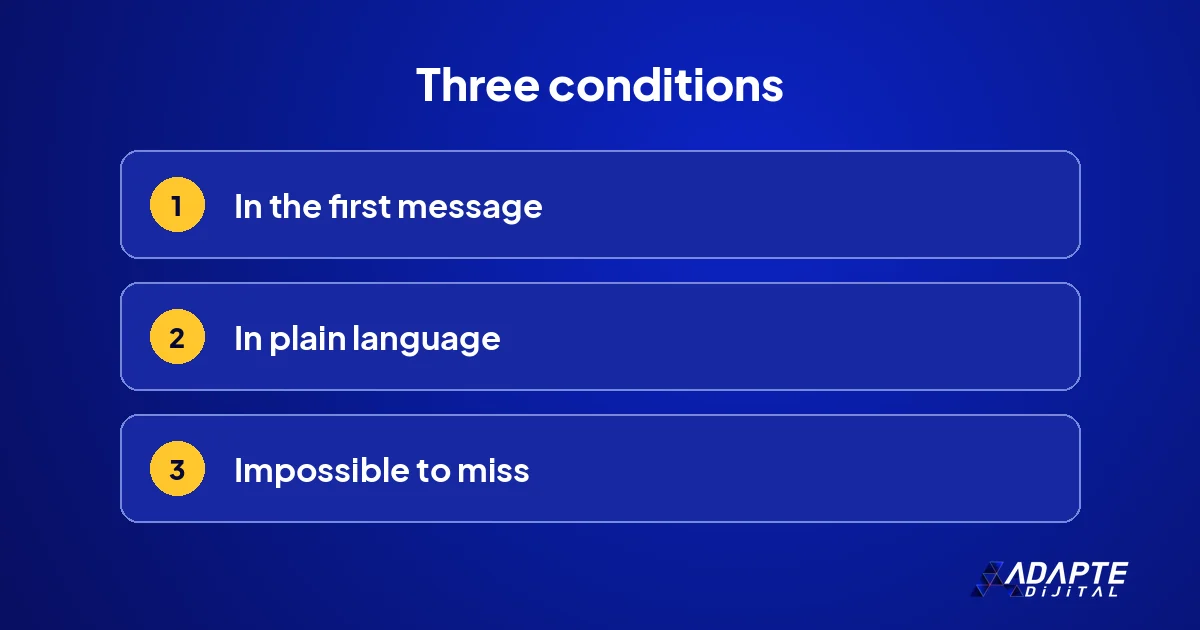
An interaction notice
Under the Act, the provider of an AI system that interacts directly with people must design it so that people learn they are interacting with AI. Chatbots, voice assistants and automated call handling are the most typical examples. The provision has applied since 2 August 2026, and it is the one most customers will actually notice. 📜
When it is obvious
The Act excludes cases where this is obvious from the point of view of a reasonably well-informed and observant person, given the circumstances and context. Relying on that exception is risky, though. A chat window that opens in the corner of a website and carries a name can easily look like a person to a user. When in doubt, give the notice.
When is the notice given?
BU BÖLÜMÜN ÖZETİ
- In the first message
- In voice calls
- When the channel changes
The timing of the notice matters as much as its content. Three moments need particular attention.
In the first message
Under the Act, information must be given at the latest at the first interaction or exposure, clearly and distinguishably. The safest place is the bot’s first message. Customers should know who they are talking to before they start typing. If the notice stays visible throughout the conversation, even better. ⏱️
In voice calls
In an AI system that answers the phone, the notice is given aloud at the start of the call. Because the voice is so natural, customers easily assume they are speaking to a person. A short, clear sentence is enough: who they are talking to and how to reach an agent if they wish. Keep it short enough not to interrupt the call.
When the channel changes
If a customer moves from the chatbot to email or a messaging app and AI keeps replying, the notice is given again in the new channel. Every channel is a separate first interaction. A notice in one channel does not carry over to another automatically. 🔀
How is the notice written?
BU BÖLÜMÜN ÖZETİ
- Plain language
- No human impression
- Stating the limits
A good notice is short, plain and honest. Three principles are enough.
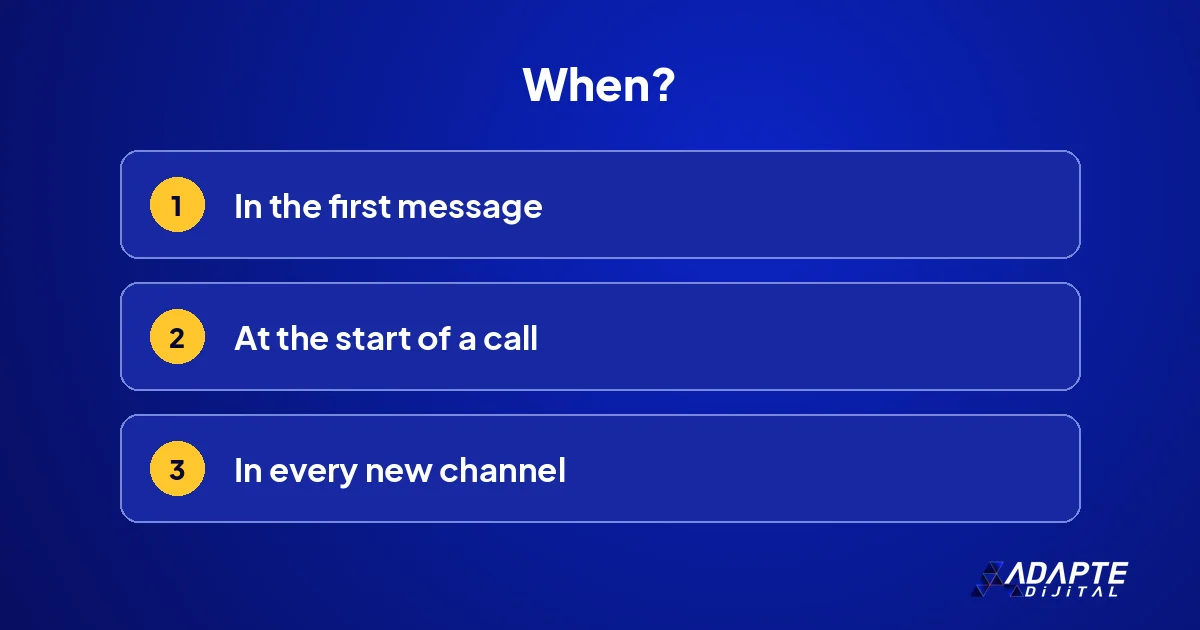
Plain language
The notice is written without technical terms: “Hello, I’m this site’s AI assistant”, for example. It is an introduction, not a legal warning. A notice customers understand on first reading is the right notice. For accessibility, it should also be readable by screen readers. ✍️
No human impression
Giving a bot a human name and a human photo can be misleading even with a notice. If the bot has a name, the fact that it is AI is stated clearly next to it. Answers such as “I’m human too” must never be given; the bot’s instructions should forbid them explicitly.
Stating the limits
The notice can also say briefly what the bot can and cannot do: which topics it helps with and which tasks it passes to an agent. A customer who knows the limits is not disappointed by false expectations. A limit sentence also stops the bot pretending to do something it cannot. One short sentence prevents many complaints. 🧭
Personal data and handover to a human
BU BÖLÜMÜN ÖZETİ
- Information notice
- Not asking for more data than needed
- Handover to a human
A chatbot often collects personal data and needs to hand some conversations to a person. Both should be set up from the start.
Information notice
If the bot collects personal data such as names, phone numbers or order numbers, the information duty under Türkiye’s data protection law applies. The authority’s generative AI guide recalls that the law applies regardless of technology. The privacy notice should be easy to reach from inside the chat. The details are covered in KVKK and EU rules together. 🔐
Not asking for more data than needed
The bot should ask only for data needed for its task. Asking for an ID number or full address for a product question is both unnecessary and risky. A data limit is written into the bot’s instructions and a retention period is set for conversation logs. The wider privacy picture is discussed in the future of digital marketing: privacy and trust.
Handover to a human
When a customer asks, or when the bot cannot resolve an issue, the conversation should pass to an agent. The handover route should be visible and easy, and the agent should see the conversation history. Making a customer repeat everything from the start damages trust. Handover requests are logged. 👤
Common mistakes
BU BÖLÜMÜN ÖZETİ
- Hiding the notice in the footer
- Trusting the provider without checking
- A bot that thinks it is human
Three mistakes come up often with chatbot notices. All three are easy to prevent.
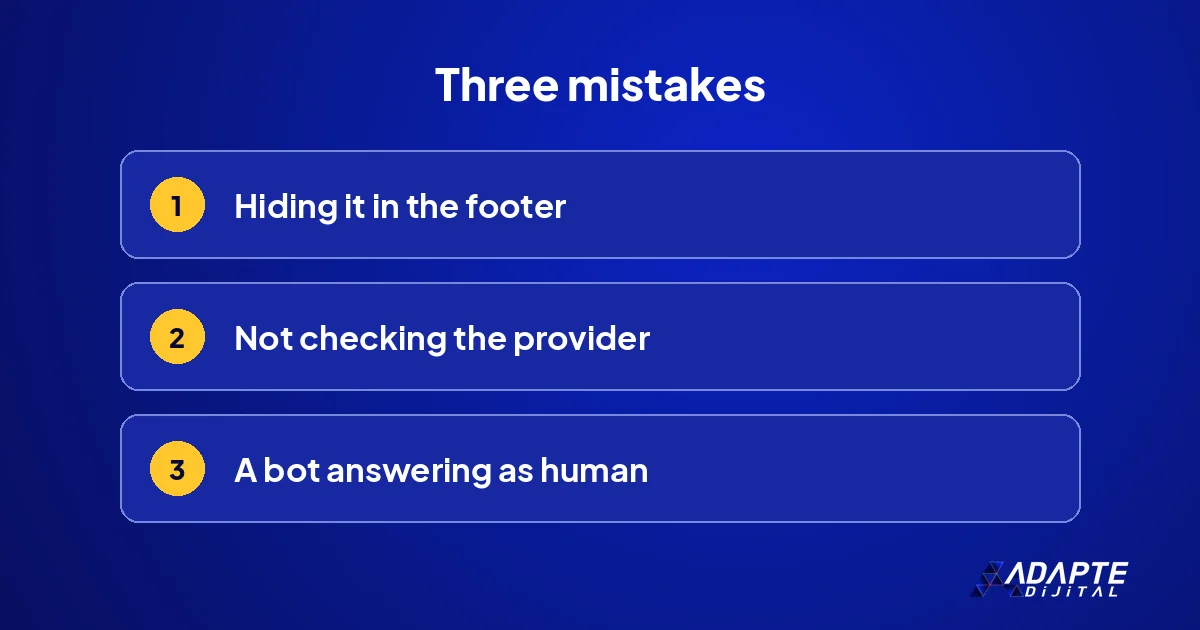
Hiding the notice in the footer
Putting the notice in the site footer or inside the terms of use does not meet the requirement of clear information at the first interaction. The notice belongs inside the chat. Customers should see it when they look at the chat window, without searching for it. 🙈
Trusting the provider without checking
With a ready-made service, it is assumed the provider gives the notice; but the settings are in the business’s hands and the notice may have been switched off. Trying the bot once as a customer reveals the mistake. Provider updates can change settings quietly, so the test is repeated at least once a year, as part of the review described in business AI usage audit.
A bot that thinks it is human
A bot with poorly written instructions may give a vague answer to “are you human?”. That question should always get a clear “no, I’m an AI”. The rule is written into the instructions and tested regularly. A single misleading answer can spread quickly as a screenshot. 🤖
How does Adapte Digital set up chatbot disclosure?
BU BÖLÜMÜN ÖZETİ
- A single delivery package
- What is delivered
- Where to start
We test your bot through a customer’s eyes, set up the notice text and the handover route, and handle the personal data side together with your lawyer.
A single delivery package
Adapte Digital does not charge a monthly management fee. Work starts with a single delivery package whose scope is written down in advance: 36,000 TRY + VAT. If the work grows, the new need is defined as a separate add-on package, priced by what will be delivered rather than by the hours spent. 📦
What is delivered
The output is notice texts, rules to add to the bot’s instructions and a handover flow. The rules are written so your team can maintain them after delivery.
Where to start
Our current packages and capacity are listed on our campaign pages; scope and price are written there before any work starts. 🧭
Quick Summary
- In Europe, a notice for systems that interact with people has been required since 2 August 2026.
- The notice is given at the latest at the first interaction, clearly and distinguishably.
- A human name and photo for a bot can be misleading.
- If personal data is collected, a privacy notice and a data limit are needed.
- Customers should be able to reach a human easily; this article is not legal advice.
Short Glossary
- Interaction notice
- Telling a person that they are interacting with an AI system.
- Handover to a human
- A chatbot passing a conversation, with its history, to an agent.
- Information notice
- Telling a person whose data is processed why and how the data is processed.
Frequently Asked Questions
Next Step
Open the chatbot on your site as a customer would and check whether its first message says it is AI. Our campaign pages list the delivery packages that cover this work.
Sources: EUR-Lex — Regulation (EU) 2024/1689 (Artificial Intelligence Act) · KVKK — Üretken Yapay Zekâ ve Kişisel Verilerin Korunması Rehberi (15 Soruda)
Updated: November 2026
Sık Sorulan Sorular
The duty falls on the provider that designs the system. A business using a ready-made chatbot service should check how the provider gives the notice; a business that develops and offers a bot under its own name may face provider duties. Write down in the inventory which role you are in, because it decides who must act. 👥
The European rule applies to systems reaching people in Europe. Türkiye has no specific provision on this, but a notice is the right practice for customer trust.
You can, but the fact that it is AI should be stated clearly next to the name, and the bot should never present itself as human.
In the bot’s first message and, ideally, somewhere that stays visible in the chat window. The footer or the terms of use are not enough.