
Machine Trust and Compliance: A Guide to AI Labels, Content Provenance and Audit Logs
Machine trust means that where and how a business uses AI can be verified by people and by machines alike: which content was generated with AI, where an image comes from, and which task an agent carried out with whose approval. Since August 2026, these questions are no longer a matter of goodwill alone; they are the subject of rules in force both in Türkiye and in the European Union. 🧭
This guide explains machine trust from a business owner’s point of view: which rules are in force, what the three layers of trust are, what a business should prepare and which limits it should know. The information was compiled from official and legal sources on 12 November 2026. This article is for information only and is not legal advice; consult a lawyer about your own situation.
What is machine trust?
As AI enters everyday business work, the question “who made this?” has taken on a new meaning. Machine trust is being able to answer that question with evidence. This section covers the definition, the timing and who needs to pay attention.
Definition
Machine trust is an arrangement in which AI use is not hidden and can be verified. A reader understands from a label that an image was generated with AI; a platform reads the same information from a marker inside the file; the business follows an agent’s work through a log. Trust here is not a feeling but a state that can be proven. Machine trust concerns a business’s whole digital operation, from the content team to customer service, which is why it belongs in a written arrangement rather than in one person’s head. Use that leaves no evidence invites suspicion even when it is lawful. 🔎
Which rules are in force?
BU BÖLÜMÜN ÖZETİ
- EU AI Act Article 50
- Türkiye: the advertising regulation
- KVKK
Three groups of rules concern a Turkish business. Each answers a different question, and they should be read together; the same use can touch all three.
EU AI Act Article 50
Article 50 requires that people be told when they are interacting with AI, that generated content be marked in a machine-readable way and that deepfakes be labelled; it has applied since 2 August 2026. Under the amending regulation, generative systems already on the market before that date have until 2 December 2026 for the machine-readable marking duty only. Under the Act’s penalty provisions, breaches of these obligations can lead to fines of up to 15 million euros or 3 percent of worldwide annual turnover. Every chatbot and content tool serving Europe is directly affected by this timetable. ⚖️ How the code of practice turns this into steps is explained in the AI content code of practice.
Türkiye: the advertising regulation
The amendment published in the Official Gazette on 1 July 2026 took effect on 1 August. Under it, where AI is used in an ad in a way that significantly affects consumers’ decisions, or where digital characters indistinguishable from humans appear, this must be stated clearly and understandably. Showing an AI-generated copy of a real person as if they had tried a product is prohibited outright. Administrative fines for 2026 range from 79,161 to 31,808,530 lira. The advertiser’s duty to prove its claims also continues; a label does not make an exaggerated or misleading ad acceptable.
KVKK
On the personal data side, the basic framework is Law No. 6698, and according to the Authority’s guidance the law is technology-neutral: it applies whenever personal data is processed at any stage of a generative AI system’s life cycle. The Authority published a generative AI guide in November 2025 and a document on agentic AI in March 2026. The guide covers legal grounds, transfers abroad, information duties, data subject rights and security measures for generative AI. AI rules do not replace personal data rules; they add to them. 🔐
The three layers of trust
BU BÖLÜMÜN ÖZETİ
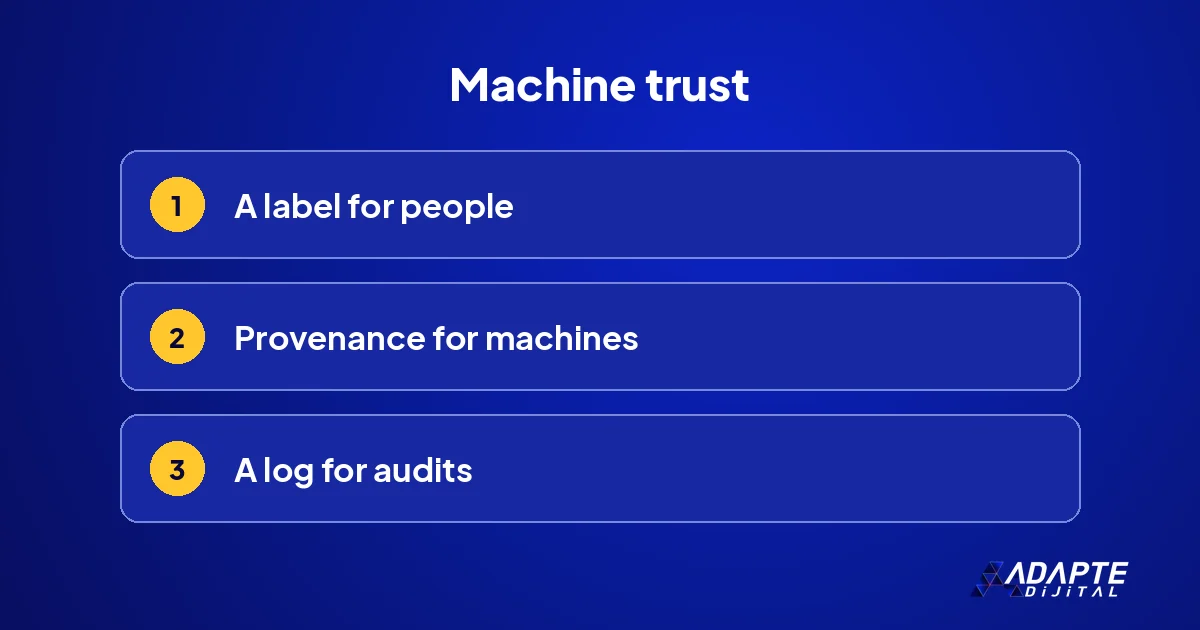
- A label: for people
- Provenance: for machines
- A log: for audits
Machine trust is built in three layers. Each speaks to a different reader, and none replaces the others. When all three are in place, the story of a piece of content or a transaction can be followed from start to finish.
A label: for people
A label is the visible sign a reader or customer sees: a note saying “this image was generated with AI”, or the common icons published by the European Commission. A label lets users make informed decisions. But a visible note alone can be lost when a file is moved elsewhere, so a label is not enough on its own; behind it there should be a marker machines can read. Its wording should be plain and placed where the reader will see it at first glance. How a labelling system is set up is covered in setting up an AI content labelling system. 🏷️
Provenance: for machines
Provenance information is a marker placed inside the file that machines can read: signed metadata, an invisible watermark or a fingerprint. Open standards such as C2PA record which tool produced a piece of content and how it was edited. Europe’s code of practice expects providers to use at least two layers of marking. Provenance also helps a brand prove its own content when images or videos are copied without permission. How provenance works is covered in detail in what C2PA content credentials are.
A log: for audits
A log is the record showing what an AI agent did, which data it touched and who approved it. As agents start writing emails, processing orders and talking to customers on a business’s behalf, this log is becoming a necessity. A log is the only reliable answer to “what happened?” when something goes wrong. It is also the raw material for correcting an agent’s mistakes and improving its rules; a business that does not know what happened cannot know what to change. An agent without a log is like an employee who cannot be supervised. 🗂️
What should a business prepare?
BU BÖLÜMÜN ÖZETİ
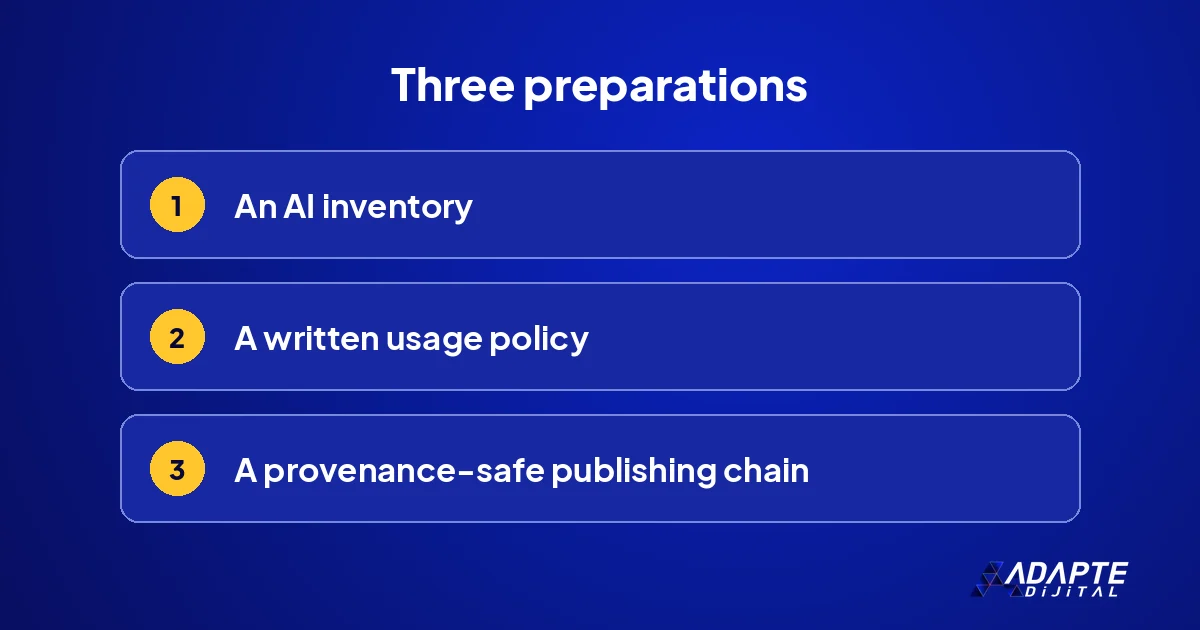
- An AI inventory
- Rules and a policy
- Tools and process
Preparation takes three steps. The aim is not a perfect system but an arrangement that can answer when asked; each step is set up once and then kept up with regular maintenance.
An AI inventory
The first step is a list of where AI is used in the business: content and image production, advertising, chatbots, call handling, agents and internal processes. A business without an inventory cannot know which rules bind it. For each use, the list should show the tool, the person responsible and where the content is published. The inventory is not made once and forgotten; new tools are added as they arrive and the list is reviewed every quarter. A first audit of AI use is described in business AI usage audit. 📋
Rules and a policy
The second step is a written policy explaining how employees use AI: which tools are allowed, which data must never be entered, which output is checked before publication and which content is labelled. A written policy makes labelling decisions independent of any one person. The European rule also links AI literacy to the transparency obligations, so the team knowing the rules is part of compliance. A policy need not be long; a page or two is enough for most small businesses.
Tools and process
The third step is keeping labels and provenance intact along the publishing chain. Some content management systems and image compression tools strip a file’s metadata, which means provenance is lost before publication. Testing the publishing chain once prevents many later problems. The result is recorded in a short note, including where agent logs are kept and who can access them, and the test is repeated whenever the chain changes. For agents too, check that action logging is switched on. 🛠️ The first month’s task list is set out step by step in machine trust: first month.
What risks and limits exist?
BU BÖLÜMÜN ÖZETİ
- Too many or too few labels
- Technical limits
- Interpretation is still settling
Machine trust is not built overnight, and not every question has a technical answer. Knowing the limits does not make preparation pointless; it helps focus effort in the right place.
Too many or too few labels
The European rule does not require a label for every AI touch; obligations attach to particular kinds of content and particular actors, and most routine AI-assisted work falls outside them. Labelling everything makes labels meaningless; labelling nothing may breach both the Turkish advertising rule and the European rule. The right measure comes from knowing the scope. Where a case is unclear, the reason for the decision is written down, so it can be shown later why something was or was not labelled. ⚖️
Technical limits
According to legal commentators, no single marking technique today meets all four of the European requirements at once: effectiveness, interoperability, robustness and reliability. Metadata can be stripped, watermarks can be damaged, and social platforms can lose information on the way. That is why a layered approach is recommended. A visible label and an internal log sit beside the marker, so the three layers cover each other’s gaps. No technique is absolute proof on its own; together, the layers produce trust.
Interpretation is still settling
The guidelines the European Commission published in July 2026 do not present themselves as a final interpretation of Article 50, and the practice of supervisory authorities will become clearer over time. In Türkiye, the application of the advertising regulation will be shaped by decisions of the Advertising Board. Following the rules matters more than reading them once. When a rule changes, the inventory, policy and labelling arrangement are updated together. This article is for information only and is not legal advice; consult a lawyer about your own situation. 🔔
How do you prepare for machine trust with Adapte Digital?
BU BÖLÜMÜN ÖZETİ
- A single delivery package
- What we do on the audit side
- Where to start
We approach this area not with a monthly subscription but with delivered order: the inventory, policy and labelling workflow are set up and handed over to you.
A single delivery package
Adapte Digital does not charge a monthly management fee. Work starts with a single delivery package whose scope is written down in advance: 36,000 TRY + VAT. If the work grows, the new need is defined as a separate add-on package, priced by what will be delivered rather than by the hours spent. 📦
What we do on the audit side
We map your AI use, set up the labelling and logging arrangement and test whether your publishing chain keeps provenance intact. Legal assessment is done together with your own lawyer. The wider privacy context is discussed in the future of digital marketing: privacy and trust.
Where to start
Our current packages and capacity are listed on our campaign pages; scope and price are written there before any work starts. 🧭
Quick Summary
- Machine trust means AI use that people and machines can verify.
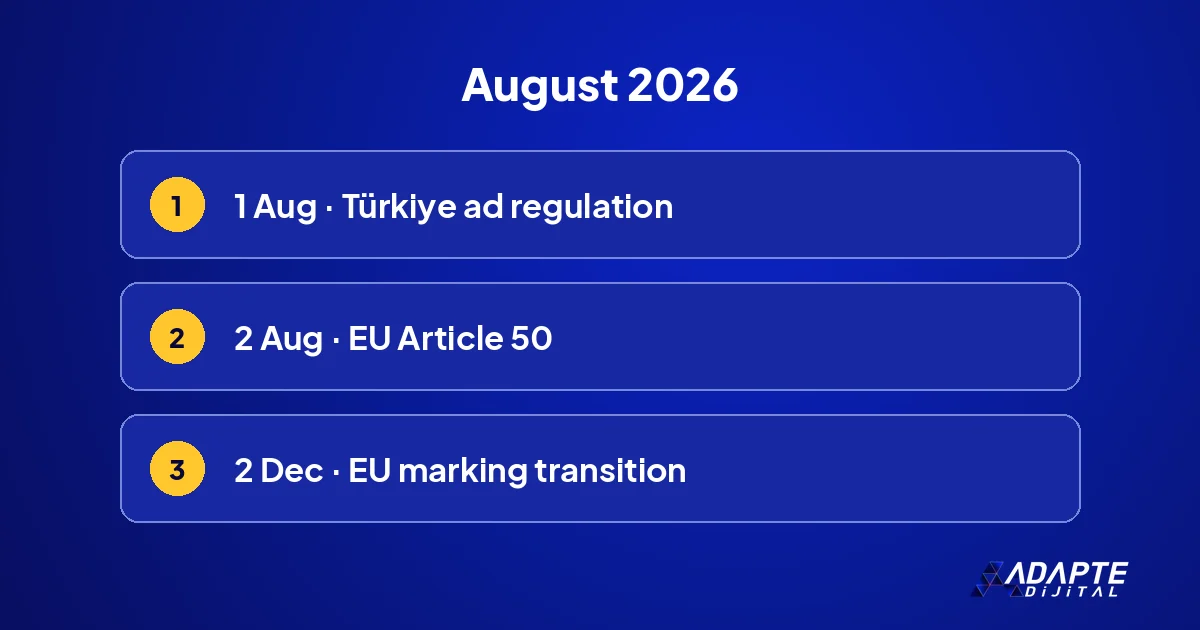
- Türkiye’s ad regulation took effect on 1 August and the EU’s Article 50 on 2 August 2026.
- Three layers of trust: a label for people, provenance for machines, a log for audits.
- Preparation: an inventory, a written policy and a provenance-safe publishing chain.
- Rules and interpretations are evolving; this article is not legal advice.
Short Glossary
- Machine trust
- AI use that can be verified through labels, provenance information and logs.
- Provenance information
- A machine-readable marker showing which tool produced a piece of content and how it changed.
- Deepfake
- Image, audio or video content generated or manipulated to resemble real people, places or events and that could be taken as real.
Frequently Asked Questions
Next Step
Gather the places where your business uses AI in one list: the tool, the person responsible and where the content is published. Our campaign pages list the delivery packages that cover this work.
Sources: EUR-Lex — Regulation (EU) 2024/1689 (Artificial Intelligence Act) · Alomaliye — Reklam Yönetmeliğinde Kapsamlı Değişiklik · KVKK — Üretken Yapay Zekâ ve Kişisel Verilerin Korunması Rehberi (15 Soruda) · Freshfields — The final Code of Practice on transparency of AI-generated content
Updated: November 2026
Sık Sorulan Sorular
The first two days of August 2026 brought two rules into force. In Türkiye, the amendment to the Regulation on Commercial Advertising and Unfair Commercial Practices took effect on 1 August; in the European Union, the transparency article of the AI Act began to apply on 2 August. Both require AI use to be disclosed clearly. That the two dates fell so close together may be a coincidence, but the result is the same: for a business that uses AI, transparency is no longer a choice but an obligation, and machine trust can no longer be postponed.
It concerns every business that uses AI in its content, advertising, customer service or workflows. For a business selling to Europe, the European rule matters directly; according to the Commission’s interpretation, even publishing deepfake content on the openly accessible internet may trigger the obligation. A business that sells only in Türkiye is still bound by the AI provisions of the advertising regulation. Businesses that use agents, run a chatbot or use AI imagery in their ads should count themselves in. Fewer businesses fall outside these rules than is often assumed. 🏢 Preparation for businesses selling to Europe is covered in AI compliance preparation for EU exporters.
Yes. The advertising regulation that took effect on 1 August 2026 requires AI use in ads to be disclosed in certain cases. The European rule may also come into play if your content reaches people in Europe.
The European rule does not cover all AI-assisted content; obligations attach to particular kinds of content. Write down which content is in scope in your policy and consult a lawyer.
Assistants and platforms increasingly assess content using provenance and trust signals. Verifiable content earns the trust of both users and machines.