
Machine Trust at Three Years: As Trust Signals Become a Selection Criterion
Three years into machine trust, provenance, labels and logs will likely have become not just compliance tools but trust signals that customers, partners and machines look at when choosing a business. The three-year horizon looks at what that shift will bring. 🔭
This page is the seventh step of the machine trust horizon series. It covers what is realistic in three years, which skills gain value, which risks persist and how a business can stand out. Most statements on this horizon are forecasts. This article is for information only and is not legal advice; consult a lawyer about your own situation.
What is realistic in three years?
BU BÖLÜMÜN ÖZETİ
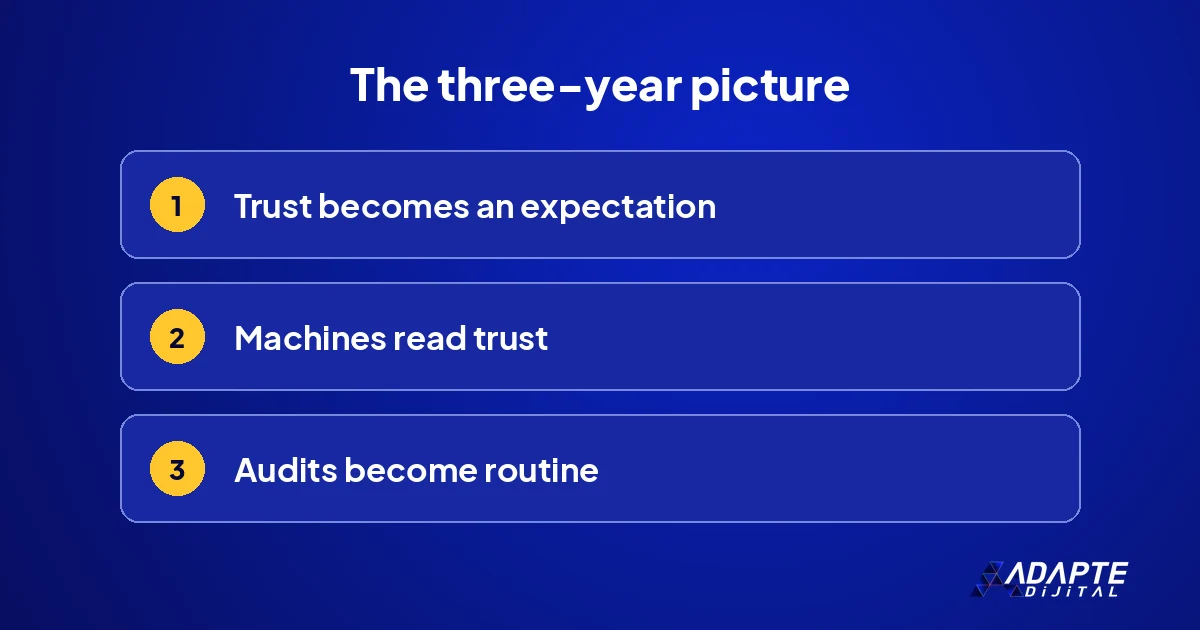
- Trust becomes an expectation
- Machines reading trust
- Audits become routine
Three years is long enough for trust signals to move from novelty to ordinary expectation.
Trust becomes an expectation
Forecast: within three years, customers and partners will see a business’s ability to show its AI use transparently as an ordinary expectation. Transparency, an advantage today, will be a minimum requirement in three years. A business without it will have to explain why. The expectation will appear first with large customers. 📈 The expectation will spread from large customers to the customers of small businesses within the same period.
Machines reading trust
Assistants and platforms increasingly assess content using provenance and trust signals. Forecast: within three years, assistants will weigh provenance and consistency more when choosing a business’s content as a source. That is where machine trust connects directly with visibility, as discussed in the AI visibility audit.
Audits become routine
Large customers and partners are starting to ask suppliers for AI usage information. Forecast: within three years, this information will be an ordinary part of contract and tender processes. A ready inventory and policy will speed those processes up. 📑 Questionnaires that today arrive as one-off requests will become standard sections of supplier onboarding.
Which skills gain value?
BU BÖLÜMÜN ÖZETİ
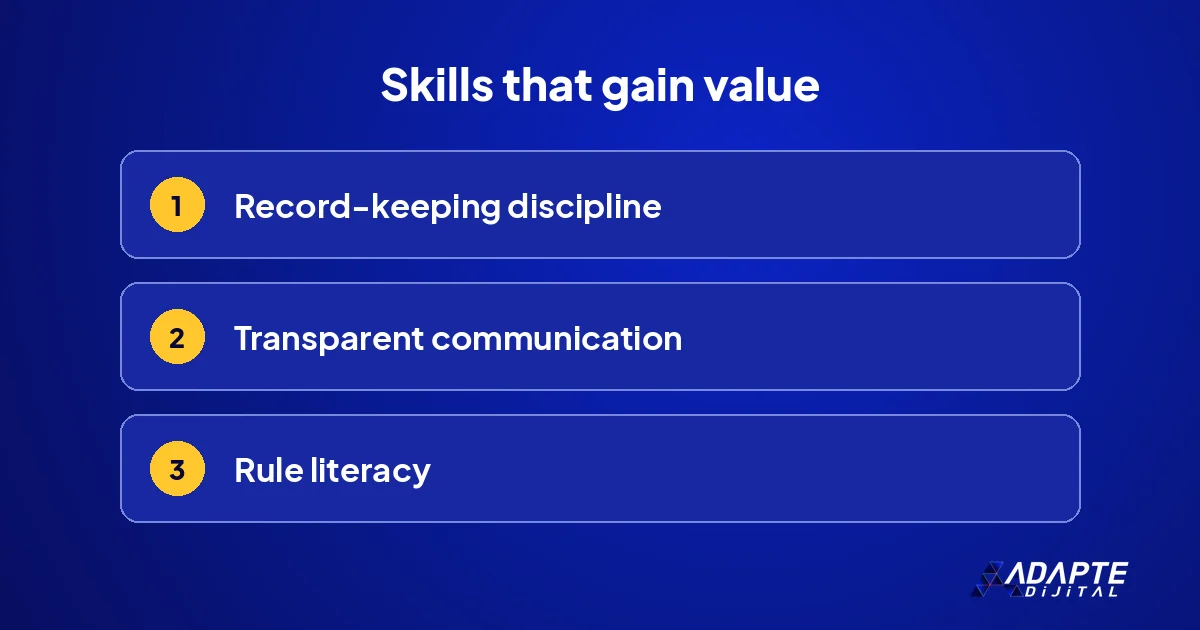
- Record-keeping discipline
- Transparent communication
- Rule literacy
In a period when trust signals matter, some skills inside the business become more valuable. None of them requires large budgets; all of them require habits.
Record-keeping discipline
Regularly recording who produced which content with which tool, and which agent did what, takes discipline. That discipline is a difference that is hard to copy; a competitor can use the same tools without having the same record history. A record history is an asset whose value grows over time. 🗂️ A business that starts keeping records today will have three years of history when others are only starting.
Transparent communication
Explaining AI use to customers in plain, honest language is a communication skill. A business that neither hides nor exaggerates its use earns trust. This skill shows in label texts, the policy summary and answers to customer questions. Plain language makes even a complex arrangement understandable.
Rule literacy
A team that can follow European, Turkish and sector rules and translate them into the business adapts quickly to each new regulation. The European rule already requires AI literacy; within three years, that literacy will become a competitive factor. 🎓 Short internal briefings after each rule change keep that literacy current without large training budgets.
Which risks persist?
BU BÖLÜMÜN ÖZETİ
- Deepfakes keep improving
- Rules diverge by region
- The speed of lost trust
Rules and tools may change, but some risks will still apply in three years.
Deepfakes keep improving
Producing deepfakes is getting easier and closer to reality. That is why signed originals and the second-channel rule will remain among the most effective defences in three years. Technical detection alone will not be enough; process and evidence will work together. ⚠️ Payment and approval procedures should be reviewed with this in mind at least once a year.
Rules diverge by region
Europe, Türkiye and other markets may develop different rules. A business selling to several markets will have to manage those differences. Building a shared minimum arrangement and adding regional differences on top will be the most sustainable approach, especially if the minimum follows the strictest rule.
The speed of lost trust
A single unlabelled deepfake or misleading chatbot answer can spread quickly as a screenshot. Trust is earned slowly and lost quickly. A fast response plan should be ready in every business in three years too. 🛡️ The plan names who decides, who speaks and which evidence is gathered first.
How does a business stand out?
BU BÖLÜMÜN ÖZETİ
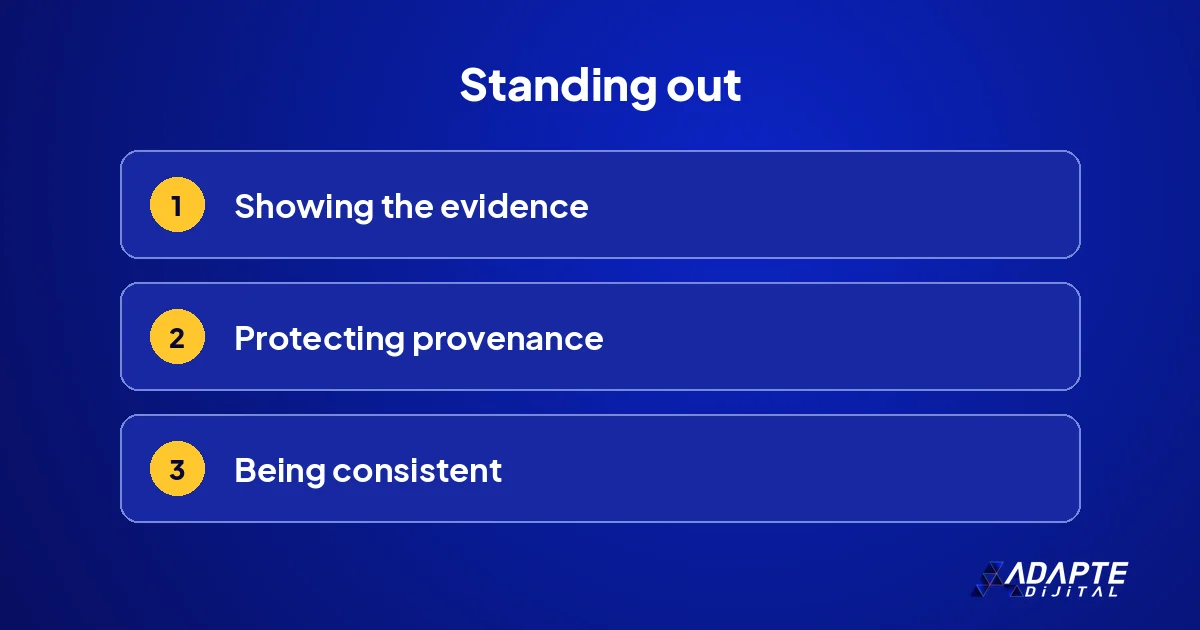
- Being able to show the evidence
- Protecting content provenance
- Being consistent
When everyone follows the rules, the difference comes from going beyond them. Each of the three can be started this month.
Being able to show the evidence
Following the rules is one thing; showing compliance within minutes when asked is another. A business with evidence ready stands out in tenders and partnerships. The way there is keeping the inventory, policy, audit notes and logs in order. An evidence file can be tidy enough to attach to proposals. 📂
Protecting content provenance
A business that signs its important content and keeps provenance intact through publication can show its difference at once when it meets a fake. Provenance becomes the brand’s signature. How the standard works is explained in what C2PA content credentials are.
Being consistent
Consistency between what is said and what is done is the strongest trust signal: what the policy says shows in the label, and what the label says shows in the content. A consistent business is believed in a crisis. Consistency is a difference no tool can buy. 🤝 Consistency is also easier to keep when the policy is short and the team knows it.
What is rising on this horizon?
BU BÖLÜMÜN ÖZETİ
- Today: the provenance standard is growing
- Forecast: trust signals become machine-readable
- Forecast and log
The three-year horizon looks at the end of 2029. The first item is today’s status; the next two are forecasts.
Today: the provenance standard is growing
The Content Authenticity Initiative passed 6,000 members in early 2026, and OpenAI joined the C2PA steering committee in May 2026. The provenance standard is becoming a common language of major technology companies. That forms the basis of trust signals on a three-year horizon. 🌐
Forecast: trust signals become machine-readable
Forecast: within three years, businesses’ AI usage information will begin to be published in a machine-readable form, like provenance, and assistants and platforms will read it directly. A business that keeps its information in order will be among the first to be read.
Forecast and log
Forecast: in three years, the difference will come not from following the rules but from being able to prove compliance. Update log. 12 November 2026: first publication. The forecasts on this page are re-read when they fall due; a forecast that turns out wrong is not deleted but corrected here. The previous step is machine trust: two years; the next is machine trust: six years.
How does Adapte Digital look at a three-year horizon?
BU BÖLÜMÜN ÖZETİ
- A single delivery package
- Today’s step
- Where to start
We do not sell a three-year plan; we build today the record-keeping discipline and evidence arrangement that will make the difference in three years.
A single delivery package
Adapte Digital does not charge a monthly management fee. Work starts with a single delivery package whose scope is written down in advance: 36,000 TRY + VAT. If the work grows, the new need is defined as a separate add-on package, priced by what will be delivered rather than by the hours spent. 📦
Today’s step
The present-day version of the three-year direction is record-keeping discipline and an evidence archive. We decide together which comes first.
Where to start
Which packages are open, and at what price, is shown on our campaign pages, item by item. 🧭
Quick Summary
- In three years, transparency will move from advantage to minimum requirement; this is a forecast.
- Assistants are forecast to weigh provenance more when choosing sources.
- Record-keeping discipline, transparent communication and rule literacy gain value.
- Deepfakes and regional divergence of rules are persistent risks.
- Forecasts are revisited in the update log; this article is not legal advice.
Short Glossary
- Trust signal
- A sign of a business’s reliability that people or machines can read.
- Record history
- The body of records built up over time that shows a business’s practices.
- Rule literacy
- The skill of following rules and translating them into a business’s daily work.
Frequently Asked Questions
Next Step
List the documents you could show if a partner asked about your AI use tomorrow, and note the gaps. Our campaign pages list the delivery packages that cover this work.
Sources: Content Authenticity Initiative — The State of Content Authenticity in 2026 · EUR-Lex — Regulation (EU) 2024/1689 (Artificial Intelligence Act)
Updated: November 2026
Sık Sorulan Sorular
Our forecast is that assistants will weigh provenance and consistency more when choosing sources. There is no certainty, but preparation can start today.
Building a shared minimum arrangement and adding regional rules on top is the most sustainable path. Consult a lawyer for each market.
Showing compliance quickly when asked, protecting content provenance and keeping what you say consistent with what you do are the strongest differences.