
Starting a Business with Agents, Month 1: The First Agent Job, Accounts and Usage Rules
The first month of starting a business with agents is when the business’s digital foundation is built and the first agent job begins, together with its rules. The goal for this month is not a large system but a small, solid start. 🗓️
This page is the first step in the agent business horizon series. It covers what is realistic in the first month, which foundations come first, a four-week task list, common mistakes and what is rising over this time frame. Forecasts are marked as forecasts.
What is realistic in the first month?
BU BÖLÜMÜN ÖZETİ
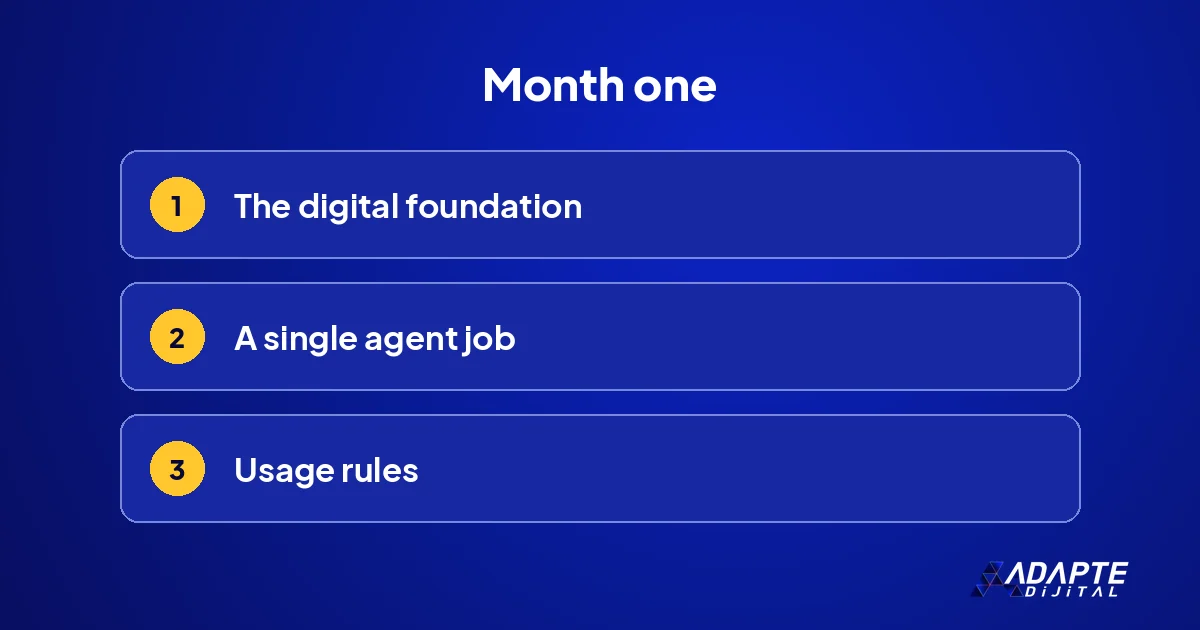
- The digital foundation
- A single agent job
- Usage rules
A month is not enough to hand all of a business’s processes to agents, but it is enough to lay the right foundation.
The digital foundation
The business’s domain name, company email, basic web page and contact channels are set up in the first month. Agents work on top of this foundation; an arrangement built on scattered personal accounts causes problems as the business grows. The digital setup for the first thirty days is covered step by step in a new business’s first 30 days of digital setup, and the first agent job follows that setup. 🌐
A single agent job
In the first month, only one agent job is started: drafting replies to frequently asked questions, preparing quote texts or sorting incoming email, for example. Focusing on one job makes it possible to write the rules properly. Throughout the first month, every output of that job is approved by a person and the results are noted, including which outputs were corrected and why. That record becomes the evidence for every later decision.
Usage rules
Which tools will be used, which data may go into them and who approves what are written down in a short document. In OWASP’s risk list for AI applications, prompt injection ranks first, so the outside content an agent reads is also considered in the rules. The rules fit on one page and are read by everyone in the business. How to build them into a fuller rulebook is covered in writing an agent rulebook. 📜
Which foundations come first?
BU BÖLÜMÜN ÖZETİ
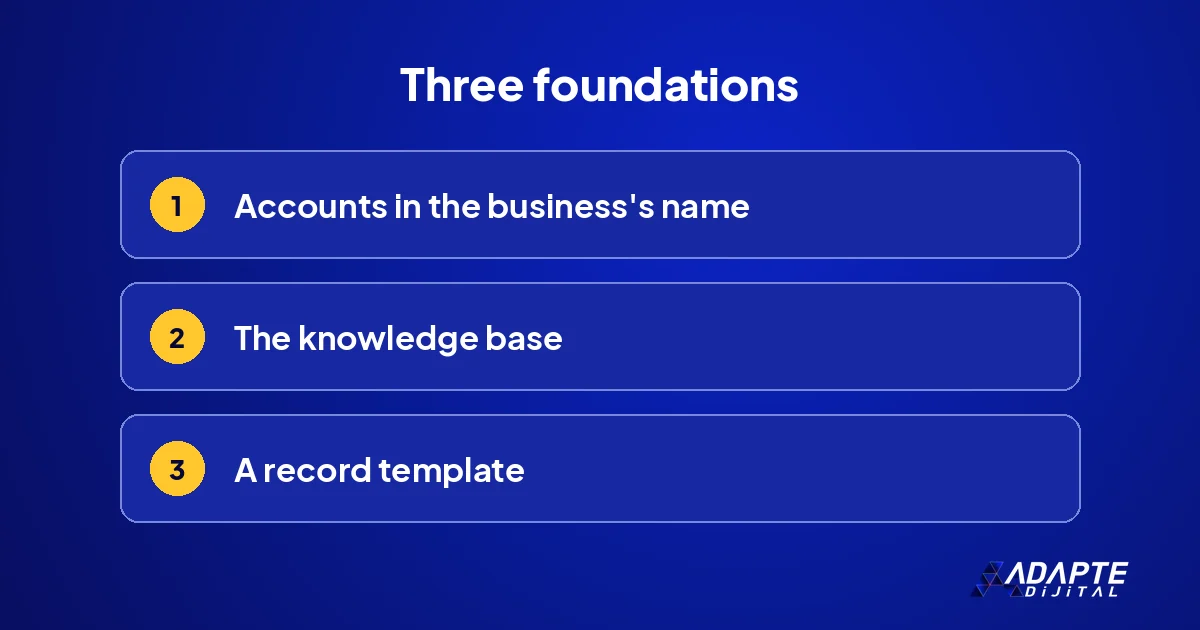
- Accounts in the business’s name
- The knowledge base
- A record template
The foundation of an agent-run business has three parts. If they are not built in the first month, building them later takes more effort.
Accounts in the business’s name
Accounts for AI tools, email and storage services are opened in the business’s name, not a personal one. Invoices issued to the business make both expense records and tax arrangements easier. A tool started on a personal account creates data and access problems as the business grows; when an employee leaves, access may leave with them. Keeping a list of accounts, owners and administrators prevents that. 🔑
The knowledge base
For an agent to work correctly, products, services, prices, frequently asked questions and tone rules are gathered in one document. The knowledge base is where the agent gets to know the business; missing or outdated information leads the agent to draft wrong replies for customers. The document is updated on the same day as any change to prices or services, and the date of each change is noted.
A record template
The date, time taken, approver and whether a correction was needed are kept in a simple table for every job the agent does. From the first month, the record builds data that drives decisions. The table is used in the second month to decide whether to add a new agent job, and it also forms the basis of the cost calculation. Keeping it simple is what keeps it going. 📒
A four-week task list
BU BÖLÜMÜN ÖZETİ
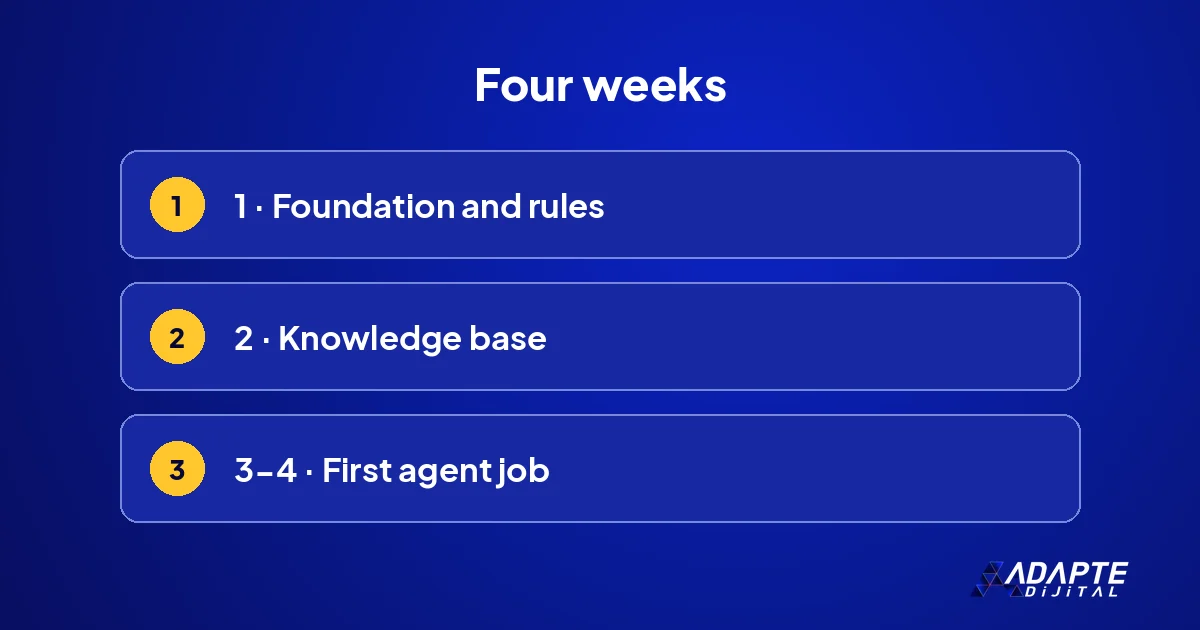
- Week 1: foundation and rules
- Week 2: the knowledge base
- Weeks 3 and 4: the first agent job
The order below is enough for a one-person or small business. Each week uses the output of the one before.
Week 1: foundation and rules
The domain name, company email and accounts in the business’s name are opened, and the usage rules document is written. The output of the week is an orderly digital foundation and a one-page rules document. No agent job starts this week; an agent job started without a solid foundation builds an arrangement that is hard to move later and wastes time. 🧱
Week 2: the knowledge base
Products and services, prices, frequently asked questions and tone rules are written into the knowledge base document. The list of frequently asked questions can be drawn from first customer conversations and competitors’ sites. The clearer the knowledge base, the fewer corrections the agent’s first drafts need. The document is kept simple so that it is easy to update, ideally by anyone in the business.
Weeks 3 and 4: the first agent job
The chosen agent job begins; every output is approved and corrections are recorded. At the end of week four, a short review asks: how much time was saved, how many outputs were corrected, how did customers respond? The review note feeds the three-month plan. If results are poor, the rules are fixed first; rules are tried before the job itself is changed. 🛠️
Which mistakes happen in the first month?
BU BÖLÜMÜN ÖZETİ
- Handing every job to agents at once
- Skipping approval
- Starting on personal accounts
First-month mistakes usually come from excitement and the expectation of quick results.
Handing every job to agents at once
In the excitement of new tools, it is tempting to hand everything from correspondence to content and from quotes to bookkeeping to agents at once. Five agent jobs started at once mean five sets of rules and checks. In that confusion it is also impossible to see which job works; starting with one job makes both learning and measuring possible, and it shows where a mistake comes from. ⚠️
Skipping approval
Even when early drafts look good, sending texts to customers without approval is the riskiest shortcut of the first month. The trust a new business builds with its first customers can be damaged by a single wrong message. In the first month, the approval step is not up for negotiation. It can become faster over time, but it is not removed, and any speeding up rests on the records.
Starting on personal accounts
Using personal email and personal AI accounts to start quickly later raises the question of who holds the data and the access. A business’s information should live in the business’s accounts. If this arrangement is set up in the first month, granting and withdrawing access also becomes easy when the first employee arrives. It is a small step now that avoids a tangle later. 🔐
What is rising over this time frame?
BU BÖLÜMÜN ÖZETİ
- Today: the data authority offers guidance
- Forecast: rules documents become routine
- Forecast and log
Over a one-month horizon, the clearest development is that the rules around AI use are becoming clearer. The first item is today’s status; the next two are forecasts.
Today: the data authority offers guidance
On 24 November 2025, Türkiye’s Personal Data Protection Authority published a 15-question guide on generative AI and personal data protection. The guide reminds businesses that Law No. 6698 is technology-neutral and that using a provider based abroad raises the rules on cross-border transfer. For a new business, the guide is a good starting point for its usage rules. 📅
Forecast: rules documents become routine
Forecast: in the coming months, whether a small business has written down its AI usage rules will come up more often in conversations with accountants and customers. Businesses that write their rules in the first month will be ready for those questions.
Forecast and log
Forecast: within a month, the time saved by businesses started with agents will depend less on the tool and more on the choice of the first agent job and the clarity of the knowledge base. Update log. 12 November 2026: first publication. The forecasts on this page are re-read when they fall due; a forecast that turns out wrong is not deleted but corrected here. The next step in this series is starting a business with agents: month 3.
How does the first month work with Adapte Digital?
BU BÖLÜMÜN ÖZETİ
- A single delivery package
- What is delivered
- Where to start
We do the first month’s work as a delivered setup: the digital foundation is built, usage rules and a knowledge base are written, and the first agent job is started.
A single delivery package
Adapte Digital does not charge a monthly management fee. Work starts with a single delivery package whose scope is written down in advance: 36,000 TRY + VAT. If the work grows, the new need is defined as a separate add-on package, priced by what will be delivered rather than by the hours spent. 📦
What is delivered
The output is an account structure in the business’s name, a usage rules document, a knowledge base and a record template. A wider first-year view is covered in an AI roadmap for the first year.
Where to start
Which packages are open, and at what price, is shown on our campaign pages, item by item. 🧭
Quick Summary
- The first month is when the digital foundation is built and a single agent job begins.
- Three foundations: accounts in the business’s name, a knowledge base and a record template.
- Four weeks: foundation and rules, knowledge base, first agent job.
- Handing every job to agents at once and skipping approval are first-month mistakes.
- Forecasts are re-read in the update log.
Short Glossary
- Usage rules
- A short document stating which AI tool may be used, with which data and with whose approval.
- Record template
- A table holding the date, time, approval and correction details of the jobs an agent does.
- Company email
- An email account on the business’s own domain that belongs to the business rather than a person.
Frequently Asked Questions
Next Step
This week, write a one-page AI usage rules document for your business: which tool, which data, whose approval. Our campaign pages list the delivery packages that cover this work.
Sources: KVKK — Üretken Yapay Zekâ ve Kişisel Verilerin Korunması Rehberi (15 Soruda) · OWASP GenAI Security Project — LLM01:2025 Prompt Injection
Updated: November 2026
Sık Sorulan Sorular
One. Starting with a single job makes it possible to write the rules properly and measure the result.
It may work at first, but accounts opened in the business’s name are healthier for data, access and invoicing.
Products and services, prices, frequently asked questions, delivery and returns terms, and tone rules.