
Agent Output Quality Review: A Human-Eye Service Before Anything Goes Out
Agent output quality review is the work of checking the texts, customer answers, proposals and documents AI agents produce with human eyes before they reach a customer or go live, and classifying the errors. An agent produces fast; the business pays the price of a mistake. 👀
This file describes the door of the person who reviews agent outputs: who the work suits, who the first client is likely to be, how income is built and where the risks lie. This article is not a promise of income or investment advice; it describes what one business door looks like. Forecasts are labelled throughout.
What is behind this door, and why is now the time?
Agents produce more and more work, and every piece of it is waiting for someone’s approval.
Who is this work a good fit for?
BU BÖLÜMÜN ÖZETİ
- Skills and habits
- Capital
- Team size
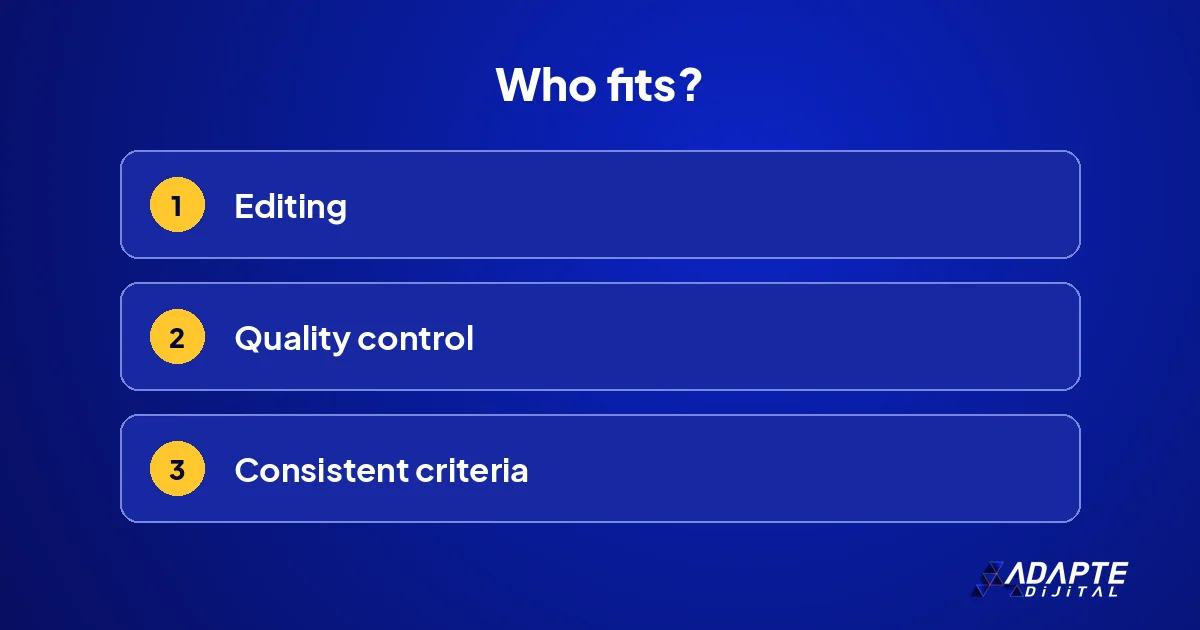
Quality review combines careful reading with consistent criteria.
Skills and habits
The best candidate has experience in editing, quality control or customer service. Assessing every output against the same criteria, scoring accuracy, tone and rule compliance separately, is the foundation of the work. Classifying errors and tracing their root causes is a skill too; practical verification habits are covered in how do I verify the output. 🧠
Capital
The work runs on knowledge. A set of assessment criteria, an error classification list and a log are enough. The most valuable asset is the build-up of error records; after a few weeks, those records show which rule is missing.
Team size
One person can start; as output volume grows, several reviewers and shared criteria become necessary. Measuring consistency between reviewers, checking whether two reviewers give the same output the same score, is how quality itself gets reviewed.
Who is the first client, and how is income built?
BU BÖLÜMÜN ÖZETİ
- The first client
- Forms of income
- The promise not to make
The first client for quality review usually arrives after an embarrassment.
The first client
The first client is most likely a business whose agent gave a customer wrong information or published text that did not fit the brand. “Who should have seen this before it went out?” is this door’s entry point. Content agencies and customer service teams are good candidates too. 🤝
Forms of income
Income can come from per-output or periodic review services, preparing assessment criteria and proposing rule fixes. Teaching the business team the review method is another form of income. We state no amounts; the field is new and there is no reliable market data.
The promise not to make
Review does not guarantee that no error will slip through; it lowers the error rate and shows where recurring errors come from. The sample reviewed and the criteria used are stated clearly in the report. If a sample is checked rather than every output, that is stated too. ⚠️
Where are the costs, and where are the risks?
BU BÖLÜMÜN ÖZETİ
- Cost lines
- Time-pressure risk
- Liability risk
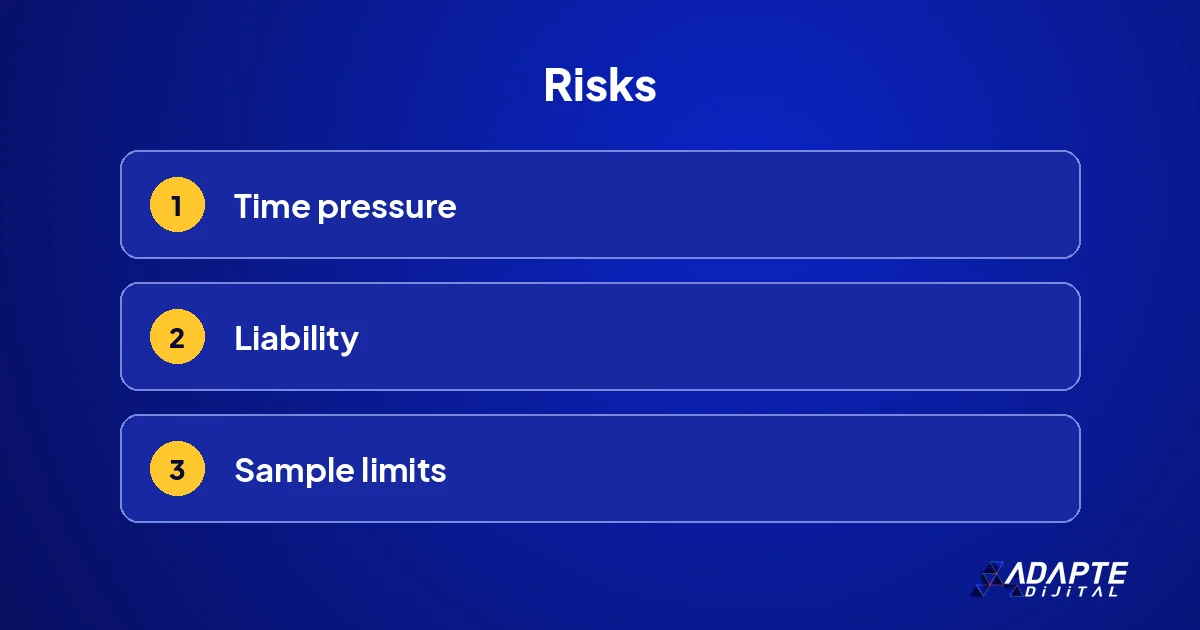
The risks of this work are time pressure and unclear responsibility. Both are easier to manage when the review routine is written down before the first output is checked.
Cost lines
The lines are preparing criteria, review time, record-keeping and regular reporting. Review time is the largest line; an agent produces in seconds, while a person reads for minutes. That is why which outputs are checked in full and which by sample is decided at the start. 🧮
Time-pressure risk
As output volume grows, rushed review lets errors slip through. Separating outputs by risk level, always checking outputs involving money, health or law in full, makes sure limited time is spent where it matters.
Liability risk
An error in an output that passed review may draw questions to the reviewer too. The criteria checked, the sample and who gives final approval are set in writing. The final decision to publish always stays with the business. 🔍
What is on the horizon, and what happens in the first 90 days?
Two forecasts first, then the order of the first three months.
The first 90 days
Month one: prepare five assessment criteria and an error classification list. Month two: review, with permission, 100 outputs from the agents of a business you know. Month three: turn the most frequent error types and the proposed rule fixes into a report. An error classification is this door’s most persuasive document. 🗓️
How do you approach this door with Adapte Digital?
BU BÖLÜMÜN ÖZETİ
- A single delivery package
- What we do on the review side
- Where to start
We set up a routine for checking agent outputs before they go out as delivered work: criteria, approval order and error log are handed over in writing.
A single delivery package
Adapte Digital does not charge a monthly management fee. Work starts with a single delivery package whose scope is written down in advance: 36,000 TRY + VAT. If the work grows, the new need is defined as a separate add-on package, priced by what will be delivered rather than by the hours spent. 📦
What we do on the review side
We decide together with the business which output is checked by whom, and against which criteria. Where the productivity gain actually comes from is covered in where is the productivity gained.
Where to start
The written scope of each package, with current pricing and capacity, is on our campaign pages. 🧭
Quick Summary
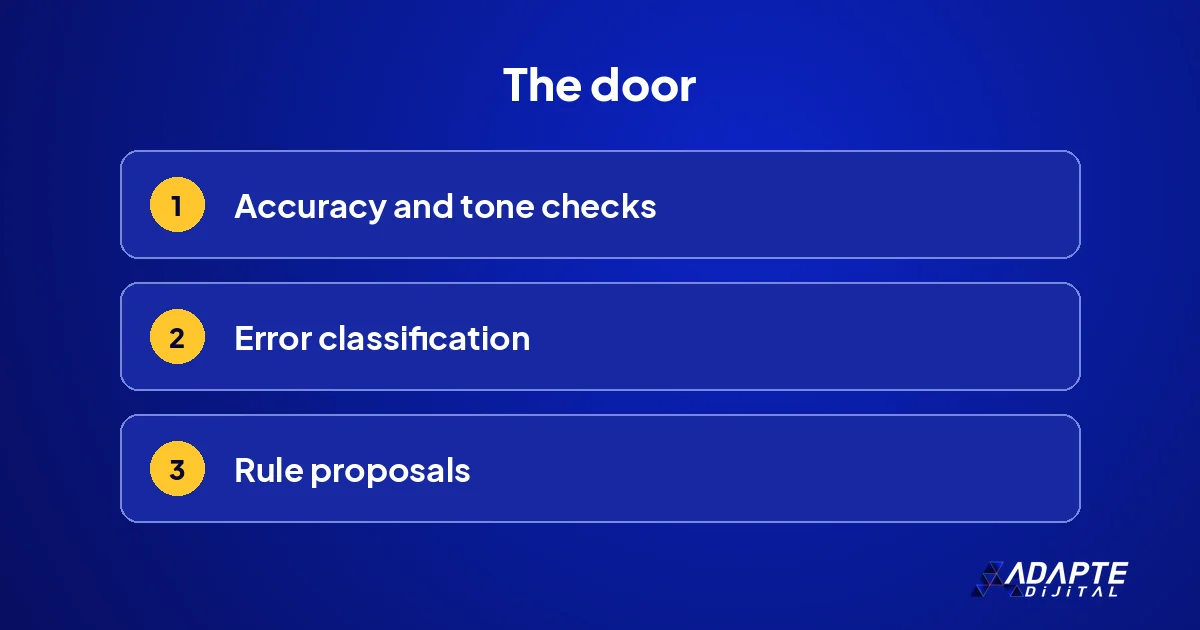
- The door: being an independent eye that checks an agent’s work against criteria, records errors and proposes rule fixes.
- OWASP’s 2025 list ranks misinformation among the main risks and recommends human oversight.
- Article 14 of the EU AI Act requires effective human oversight for high-risk systems.
- The biggest risks are time pressure and unclear responsibility.
- Review does not guarantee that nothing slips through; no figures are given.
Short Glossary
- Assessment criteria
- A list setting out how an output is scored on accuracy, tone and rule compliance.
- Sample
- A portion selected by set rules and checked instead of every output.
- Human oversight
- A person being able to monitor an AI system’s output and stop it when needed.
Frequently Asked Questions
Next Step
Pick 20 outputs your agent produced in the past week and mark each one for accuracy, tone and rule compliance; the most frequent error is the first rule to fix. Our campaign pages list the delivery packages that cover this work.
Sources: OWASP Gen AI Security Project — LLM09:2025 Misinformation · EU Artificial Intelligence Act — Article 14: Human Oversight · American Bar Association — BC Tribunal Confirms Companies Remain Liable for Information Provided by AI Chatbot
Updated: November 2026
Sık Sorulan Sorular
What is sold is a review service: checking agent outputs for accuracy, tone, brand rules, legal notices and personal data; recording errors by type; and proposing rules for errors that keep recurring. The buyer is a business that produces a lot of content or customer answers with agents but has no time to check each one. 🧾 Each finding is logged with the question, the output and the rule it broke, so patterns become visible.
OWASP’s 2025 list ranks misinformation among the main risks of language model applications and recommends human oversight and fact-checking, especially for critical information. Article 14 of the EU AI Act also requires high-risk systems to be designed so that effective human oversight is possible. A human eye is a safeguard the rules themselves recommend.
In February 2024 a Canadian civil resolution tribunal held an airline responsible for wrong information given by its chatbot. The business answers for what its agent says, which makes checking output before it goes out valuable. We explain what to do when something goes wrong in when an agent makes a mistake.
Forecast: as the volume of content and answers produced with agents grows, human review will become an expected safeguard in many sectors within the next two years. We look at the two-year direction in machine trust: the next 2 years.
Forecast: as automated evaluation tools spread, the reviewer’s value will shift from reading every output to finding the error types the tools miss and designing the criteria. Update log. 12 November 2026: first publication. The forecasts on this page are re-read when they fall due; a forecast that turns out wrong is not deleted but corrected here.
No, but outputs involving money, health, law or personal data should all be checked. For the rest, sample checks may be enough.
Yes; what matters is shared criteria, an error log and written clarity on who gives final approval. An outside eye can more easily see errors a team has grown used to.
We give no figures; the field is new and there is no reliable market data. Income depends on the volume of outputs checked and the scope.