
Why is my article not cited by ChatGPT? Six gaps in the posts AI won’t quote
Why is my article not cited by ChatGPT? Usually the cause is not the writing itself but one of six gaps: the crawler door is closed, the answer is buried, the heading does not match the question, the author is unclear, there is no original information, or the post sits alone on the site. Fixing these raises the odds of being cited, but no method guarantees it.
Say you run a small coffee roastery in Moda, Kadıköy. Your blog has a 2,400-word post called “Everything About Filter Coffee”. It is careful work with lovely photos. A customer asks ChatGPT “how many grams of coffee for a V60”, and two other sites appear under the answer. Your post answers that question in paragraph eleven.
What does AI check before it quotes an article?
BU BÖLÜMÜN ÖZETİ
- The surprise: your heading is not searched as written
- Why the “everything” post loses
- Citation, recommendation and Google’s bar
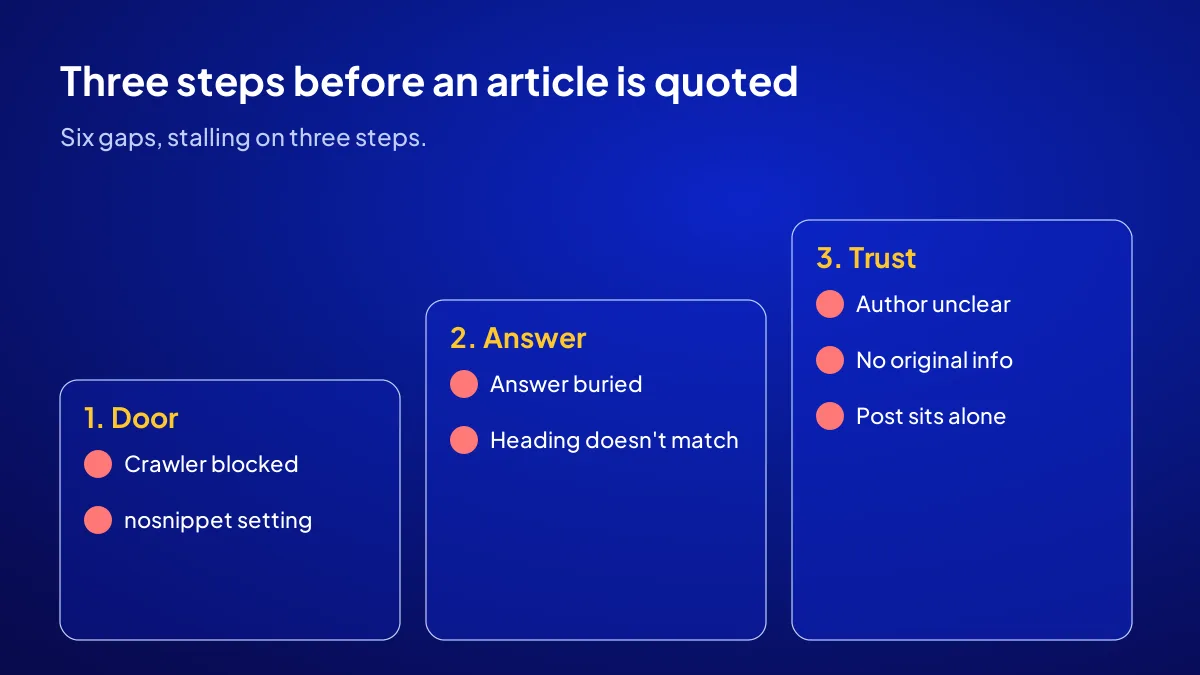
First, whether it can reach the page. Then, which paragraph answers the sub-question clearly. Finally, who the answer belongs to and whether it can be trusted. OpenAI says ChatGPT ranks search results using multiple factors meant to surface relevant, reliable information. If a post stalls on any of these three steps, the citation goes elsewhere.
The surprise: your heading is not searched as written
Most people assume AI searches the customer’s question word for word. It does not. OpenAI’s help page says ChatGPT search typically rewrites the question into one or more targeted queries sent to its search providers. Google’s AI features can likewise run many related searches across subtopics.
Why the “everything” post loses
The roaster’s post covers everything but answers no sub-question in its first sentence. “Grind size”, “water temperature” and “brew time” are searched separately, and in each one the page with a clear answer wins. The problem is not length; it is scatter.
Citation, recommendation and Google’s bar
A citation means being named as the source under an answer; a recommendation means being pointed to as an option. For an article, the goal is the first. Google says a page only needs to be indexed and snippet-eligible to be a supporting link, with no special structured data. The business-wide picture is in how to get my business place cited by ChatGPT.
Gap 1: Could the crawler door be closed?
Yes, often without the owner knowing. OpenAI’s crawler documentation says sites that block OAI-SearchBot in robots.txt are not shown in ChatGPT search answers. On Google, a nosnippet or very short max-snippet setting limits how much of the page can appear in AI features. If the shutters are down, the window display does not matter.
Check: robots.txt
Add /robots.txt to your site address and open it. If you see a block on OAI-SearchBot, ask your developer whether it was deliberate. OpenAI says robots.txt changes can take about 24 hours to reach its systems.
Check: snippet settings
Some SEO plugins or themes add nosnippet quietly. Search the page source for “nosnippet”. Google suggests confirming the setting with the URL Inspection tool.
Gaps 2 and 3: Is the answer buried, and does the heading match the question?
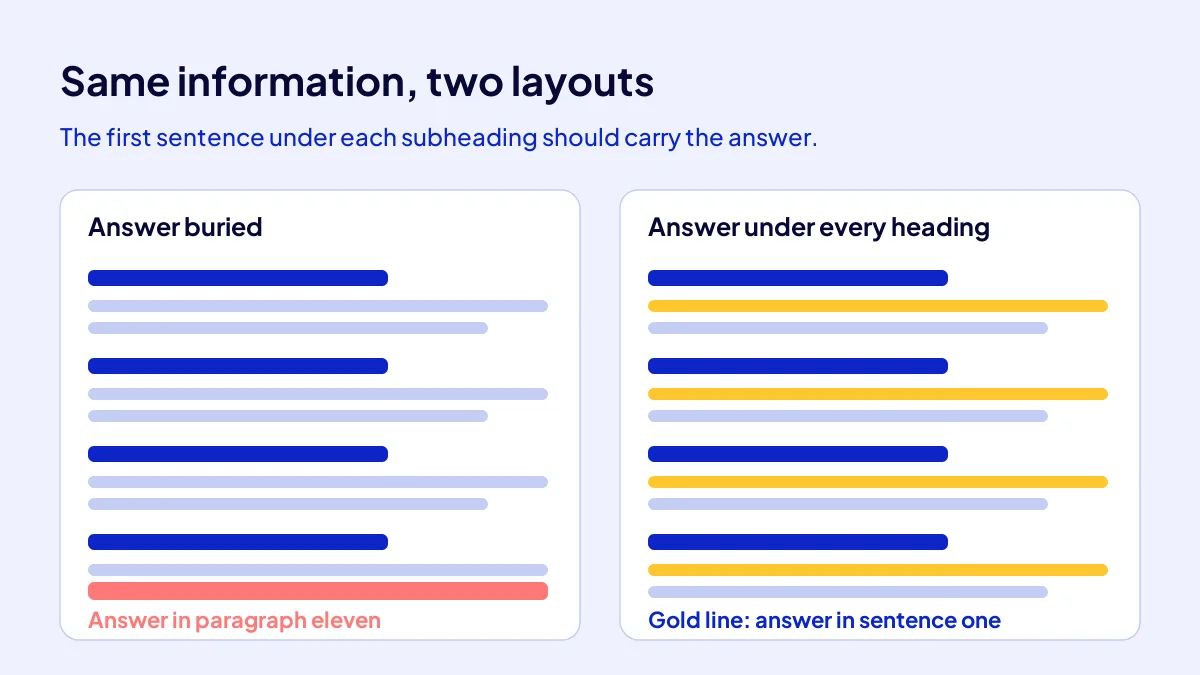
These are the two most common gaps. If the answer sits in paragraph eleven, AI finds a clearer page first. If the heading is a slogan like “A Journey into Coffee”, it matches no sub-query. The fix is simple but takes effort: frame each subheading as a question and answer it right below.
How to spot a buried answer
Read only the first sentence under each subheading. If those sentences say nothing on their own, the answer is buried. The rules for answer blocks are already in how to write FAQ blocks AI quotes.
The heading should be the customer’s sentence
At the counter, a customer asks “Does this coffee work in a V60?” Your heading should sit close to that. Keep the slogan for the shop window.
Gap 4: Is it clear who wrote the post?
Google’s helpful content guidance asks whether it is self-evident who authored the content and strongly encourages accurate author information. It also calls trust the most important part of E-E-A-T. A post signed “admin” tells nobody whose knowledge it rests on.
A byline and a short author note
Even one line under the roaster’s post, such as “Head roaster, ten years in Moda”, changes things. Readers know who is speaking, and AI sees the knowledge tied to a person and a business.
Invented authors backfire
Google treats fabricated author profiles as deceptive and a low-quality signal. If there is no real person to name, the business name is the more honest byline.
Gap 5: Does the post say something other sites do not?
Google’s own checklist asks whether content provides original information, reporting, research or analysis. It also says attribution does not replace original effort. A post that averages other sites gives AI nothing new; it already has that answer.
The roaster’s original material
The roaster roasts the same bean at different times each week and keeps tasting notes. Those notes exist nowhere else. “In our tastings, a light roast in a V60 gives this result” is more quotable than a hundred recycled guides.
The easiest source of originality
Your customers’ questions and your answers. Note what you hear on the phone, at the till and in DMs; none of it is written down anywhere else.
Gap 6: Is the post alone on the site?
One post cannot prove expertise on its own. Other pages written for the sub-questions of the same topic, linked to each other, show depth. When customers are not walking through the door, sometimes the missing piece is not one post’s quality but the shelf behind it.
How to build a family of posts
A main post opens the topic; support posts each answer one question. Our writing standard is explained in content guide for ChatGPT answers, and the set’s main frame is how to get my website cited by ChatGPT.
How do you diagnose the six gaps in 30 minutes?
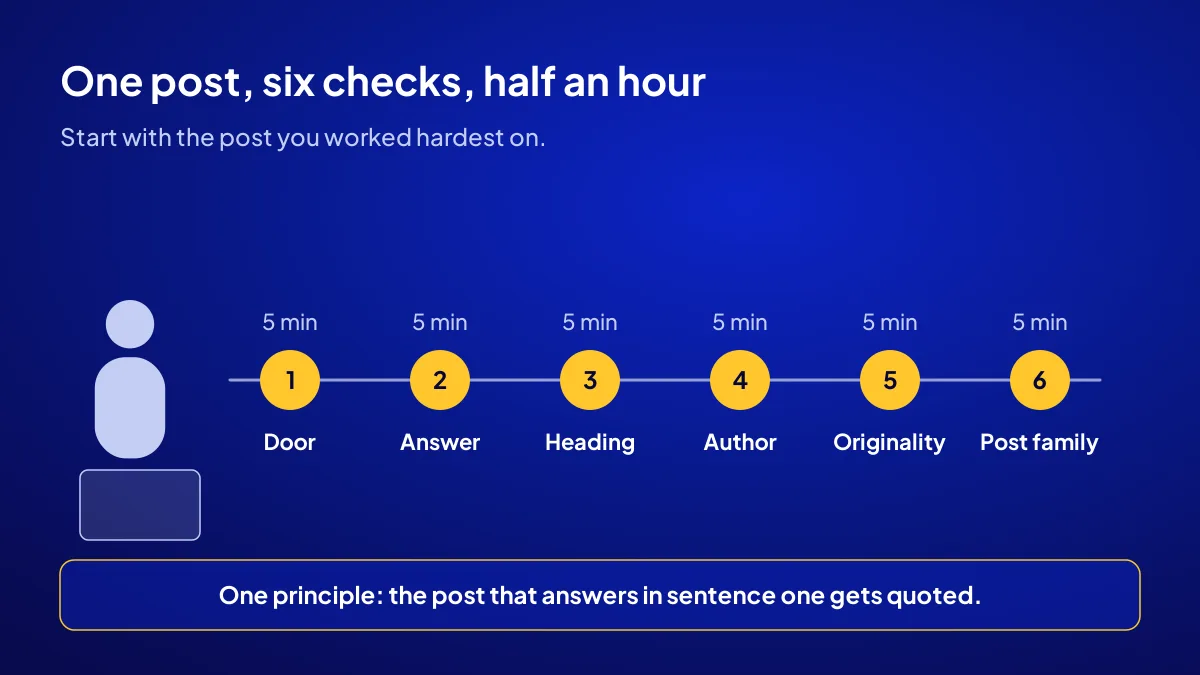
The table lists each gap’s symptom and the check to run. Start with one post, the one you worked hardest on. The six checks take about half an hour, and the result is often surprisingly simple.
| Gap | Symptom | Check |
|---|---|---|
| Door closed | Absent from every AI answer | robots.txt and nosnippet |
| Buried answer | First line under subheadings is empty | Read first sentences only |
| Heading mismatch | Heading reads like a slogan | Compare with the customer’s words |
| Unclear author | Signed “admin” | Name and short note |
| No original info | Summary of other sites | A number or note of your own |
| Post alone | No other page on the topic | Sub-questions and internal links |
If you want all six built at once
Adapte’s AI SEO campaign writes 108 articles across 6 question groups, adds Q&A blocks to existing pages and sets AI crawler access. Each article targets a specific question and intent. Fixed TRY 36,000 + VAT, delivered in 30 days, no recommendation guarantee.
One principle
The roaster’s story comes down to one line: AI does not quote the most beautiful post, it quotes the one that answers the question in its first sentence.
Quick Summary
- An uncited article usually has one of six gaps.
- AI splits a question into sub-queries; the clearest answer to each wins.
- Sites that block OAI-SearchBot are not shown in ChatGPT search answers.
- Bylines and original information are the most visible trust signals.
- Build a family of posts around a topic’s sub-questions.
- No method guarantees a citation.
Short Glossary
Citation: A citation is the term used when AI shows the page it relied on as a source beneath its answer.
Snippet: A snippet is the short text excerpt from a page shown in search results or AI answers.
E-E-A-T: E-E-A-T is the abbreviation Google uses for experience, expertise, authoritativeness and trust.
Next Step
Run your best post through the six checks today; to build the post family, answer blocks and crawler settings together, apply for the AI SEO campaign.
Frequently Asked Questions
Source: Google Search Central — Creating helpful, reliable, people-first content
Sık Sorulan Sorular
Crawling and indexing take time; Google notes recrawling can take days to months. Timing is covered in when new content gets cited.
ChatGPT search relies on its own crawler, OAI-SearchBot, and its search providers. If robots.txt blocks that crawler, the post is not shown in ChatGPT search answers.
No. The problem is a buried answer, not length. A long post with a short answer under each subheading can still be quoted.
Google says no special schema.org markup is needed for its AI features. Being indexed and snippet-eligible is the requirement.
Google wants readers to know who wrote the content and strongly encourages accurate author information. Fake author profiles count as deceptive.
No. There is no recommendation guarantee; readability and recognisability groundwork is built and measured with start and end diagnosis cards.
108 articles across 6 question groups, each written for a specific question and intent. The price is a fixed TRY 36,000 + VAT, or TRY 43,200 at 20 percent VAT; check the current rate on the invoice.
Updated: October 2026