
How to get my website cited by ChatGPT: the 9 signals AI uses to choose its sources
How to get my website cited by ChatGPT comes down to three things. Your site has to be open to ChatGPT’s search crawler, it has to answer the question in plain text, and it has to say who you are the same way everywhere. OpenAI recommends allowing its crawler, OAI-SearchBot, if you want to appear in ChatGPT search. A site that blocks it is not shown as a source in ChatGPT search answers.
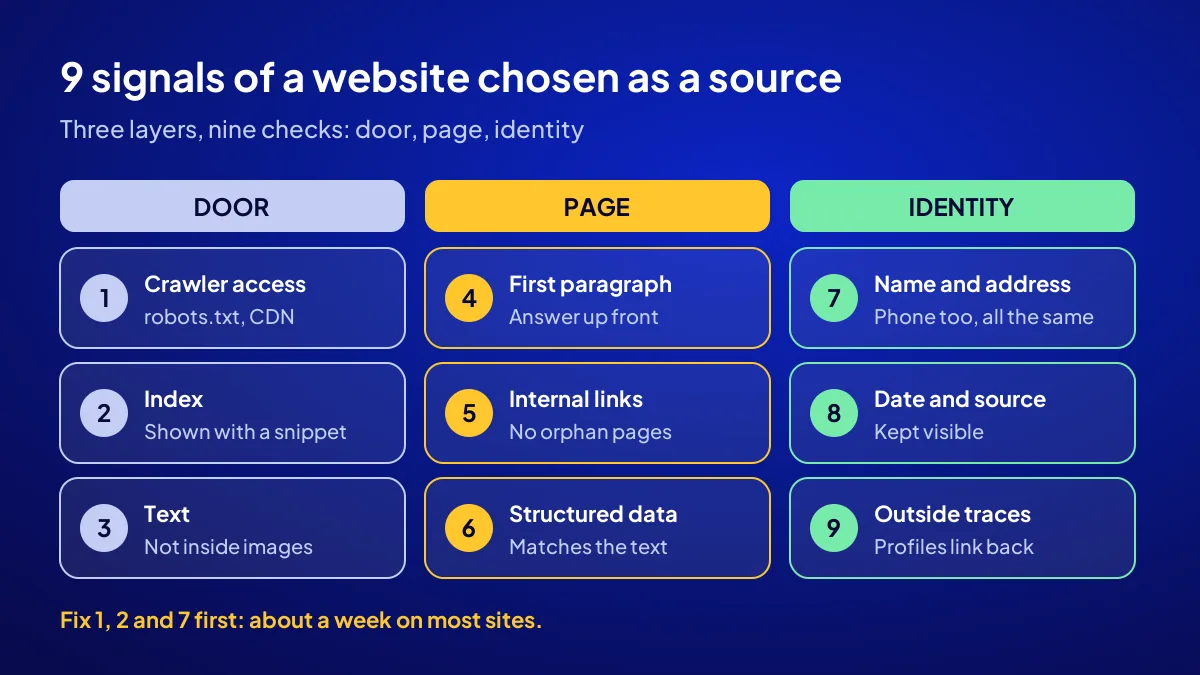
Look, let me be clear from the start. Being cited means ChatGPT places a link to your page next to its answer as a source. Nobody can guarantee that; OpenAI’s own help page says placement is not guaranteed. What you can do is build and measure the 9 signals that make your site a candidate. I group them into three layers: the door, the page and the identity.
Where does ChatGPT find the websites it cites?
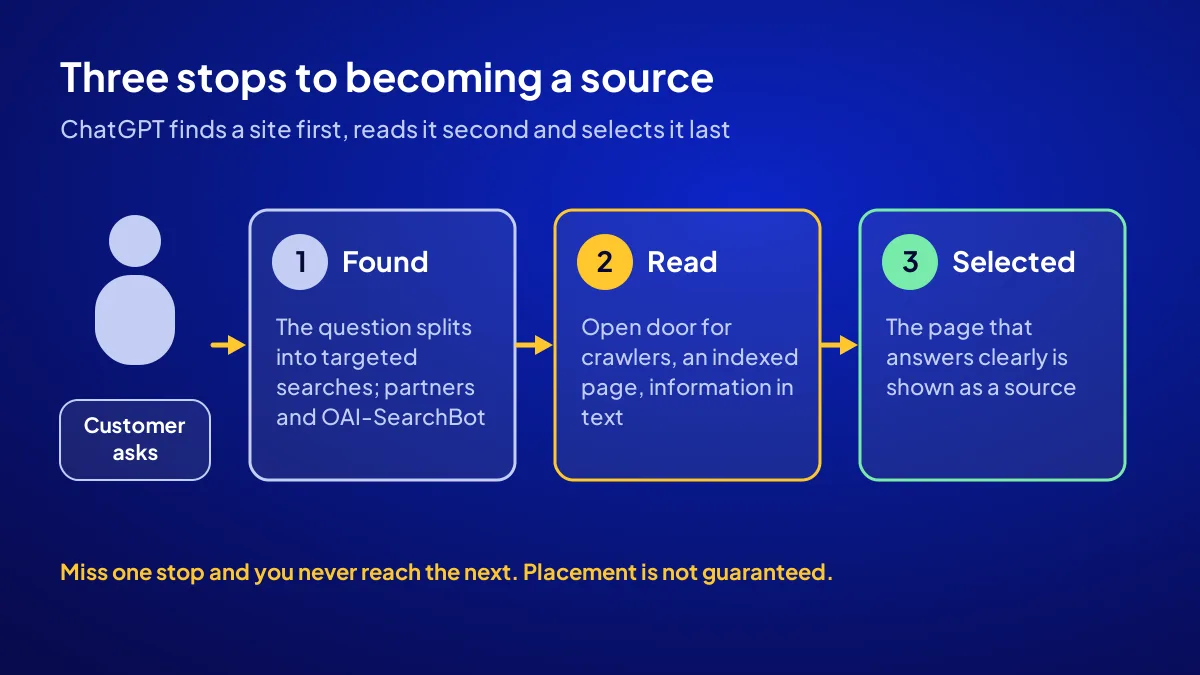
When a question needs a web search, ChatGPT turns it into several targeted searches and gathers the results. It then shows the pages it relied on as inline citations or under a “Sources” button. So your site is found first, read second and chosen last. Each stage has its own signals, and a gap in one stage stops you from reaching the next.
Search partners and OAI-SearchBot
OpenAI says ChatGPT search sometimes works with other search providers, while its own crawler, OAI-SearchBot, surfaces websites in search answers. Both routes share one condition: be indexed and reachable.
GPTBot is a separate door
GPTBot is OpenAI’s training crawler. OpenAI says each setting is independent, so you can stay open to search while opting out of training. Just do not lock the search door by accident.
Is being cited the same as being recommended?
No. A citation is the link to the page an answer relies on; a recommendation is the AI saying “go to this business”. A site can be a source without being recommended: the hair care article on your salon’s site can sit under an answer that recommends your competitor. A business can also be named without being cited. The article what being cited by AI means explains the difference in detail.
Here is what I see: being seen is not being clicked
adaptedijital.com’s Search Console data for 14 June to 13 September 2026 shows 142,296 impressions and 1,699 clicks, a click-through rate of about 1.2 percent. The query “dijital ajans” (digital agency) appears 478 times at an average position of 66 with no clicks. A source list is similar: your name is there, but the shutters do not lift by themselves.
Recommendation is a different road
Being listed as an option runs on other signals, such as reviews and brand mentions; see how to get recommended by assistants. Here we focus on becoming a source.
Door signals: can your site be read at all?
BU BÖLÜMÜN ÖZETİ
- Signal 1: an open door for crawlers
- Signal 2: indexed and eligible for a snippet
- Signal 3: key information as text
The first three signals decide whether anyone can get in. If the crawler is blocked, the page is not indexed or key information is locked inside an image, even the best writing goes unread. On most sites this is an afternoon of checks, not a project.
Signal 1: an open door for crawlers
Check whether OAI-SearchBot is blocked in your robots.txt. Google likewise asks that crawling be allowed in robots.txt and in your CDN or hosting setup. Firewalls sometimes turn crawlers away quietly, so ask your host.
Signal 2: indexed and eligible for a snippet
Google’s rule is plain: to appear as a supporting link in AI features, a page must be indexed and eligible to be shown in Google Search with a snippet. Google also says there are no additional technical requirements or special optimizations. If your basic SEO is sound, this door is already ajar.
Signal 3: key information as text
If your prices live inside a photo and your hours inside a poster, AI cannot read them reliably. Google recommends keeping important content in text form. Keep the PDF menu, but add a text summary.
Page signals: is the answer on your site?
BU BÖLÜMÜN ÖZETİ
- Signal 4: the answer in the first paragraph
- Signal 5: found through internal links
- Signal 6: structured data that matches visible text
An open door does not mean ChatGPT will cite every page. It is more likely to pick a page that answers the question directly, is easy to find and describes itself correctly. Signals four, five and six live here, and the work is writing more than design.
Signal 4: the answer in the first paragraph
Say you run a boutique bakery in Kadıköy, and someone asks ChatGPT how far ahead to order a gluten-free birthday cake in Moda. Your “About us” page does not answer that. A page opening with “We take gluten-free cake orders two days ahead and deliver to Moda the same day” gives AI a quotable sentence.
Signal 5: found through internal links
An article no page links to is like stock forgotten in the back room. Google lists making content easy to find through internal links among its best practices. Every new page should get at least one link from a main page or a topic page.
Signal 6: structured data that matches visible text
No special schema is needed for AI features; Google says so directly. It does ask that your structured data match the visible text on the page. Write “09:00-20:00” in schema and “10:00-19:00” on the page, and you sound like two different businesses.
Identity signals: who does AI think you are?
BU BÖLÜMÜN ÖZETİ
- Signal 7: one correct name, address and phone
- Signal 8: sourced figures and a visible date
- Signal 9: outside traces that point to your site
The last three signals tell AI who owns your site and how current it is. If your name, address and phone match everywhere, your information is dated and your profiles point back to your site, AI reads you as one consistent record. A scattered identity creates hesitation, and hesitation pushes you out of a source list.
Signal 7: one correct name, address and phone
If the site says “Moda Pastanesi”, the map “Moda Pastacılık” and Instagram “modapasta”, every reader pauses. Google also recommends keeping your Business Profile up to date. Pick one name and spell it the same everywhere.
Signal 8: sourced figures and a visible date
OpenAI itself says search results and citations can be incomplete, outdated or incorrect. So make dates and sources visible on your page. A single line such as “Updated: October 2026” tells readers and machines when you are speaking. A percentage without a source is like selling without scales.
Signal 9: outside traces that point to your site
Do your social accounts, directory listings and map profile link back to your site? These traces confirm that the site really belongs to that business. The article how to get my business cited by ChatGPT lists them one by one.
Which path fits which of your assets?
Getting cited changes with what is being cited. Your website is a source, your business place is a location, your article is an answer and your name is expertise. The six assets below are the doors into this cluster.
- Your business place: a shop, clinic or studio people search for by address. The roadmap is in how to get my business place cited by ChatGPT.
- Your website: the pages linked as sources; the subject of this page.
- Your business and company: legal identity, brand name, corporate traces.
- Your social accounts: Instagram, LinkedIn and YouTube profiles.
- Your products and services: product pages, service pages, neighbourhood questions.
- Your articles and your name: quoted as writing, named as an expert. The gaps of uncited writing are collected in why my articles are not cited.
How many signals does your site carry today?
The table below is a self-check for all 9 signals, with a question and a place to look in each row. The closer your “yes” count gets to 9, the readier your site is. The “no” rows may explain why the till is not ringing.
| Signal | Check question | Where to look |
|---|---|---|
| 1. Crawler access | Are OAI-SearchBot and search crawlers blocked? | robots.txt, CDN and firewall |
| 2. Index | Is the page indexed and shown with a snippet? | Search Console, URL Inspection |
| 3. Text | Are prices, hours and services in text? | The page itself |
| 4. First paragraph | Is the question answered in the first 2 paragraphs? | Service and guide pages |
| 5. Internal links | Does every page get at least one link? | Menu, topic pages |
| 6. Structured data | Does schema match the visible text? | Rich Results Test |
| 7. Name, address, phone | Are they spelled the same everywhere? | Site, map, social profiles |
| 8. Date and source | Are the update date and sources visible? | Article footers |
| 9. Outside traces | Do profiles and listings link to the site? | Social media, directories |
The gap I have seen most in fifteen years
I have been watching search results for fifteen years and have tried more than 100 domains and sites. The picture I see most often: serious money goes into design, and nobody opens the robots.txt file. With signal 1 closed, the other eight work for nothing.
How do you measure whether you are cited?
BU BÖLÜMÜN ÖZETİ
- Bing: the first report that counts citations
- Google: AI traffic inside the main report
- Your own test: the same 9 questions every month
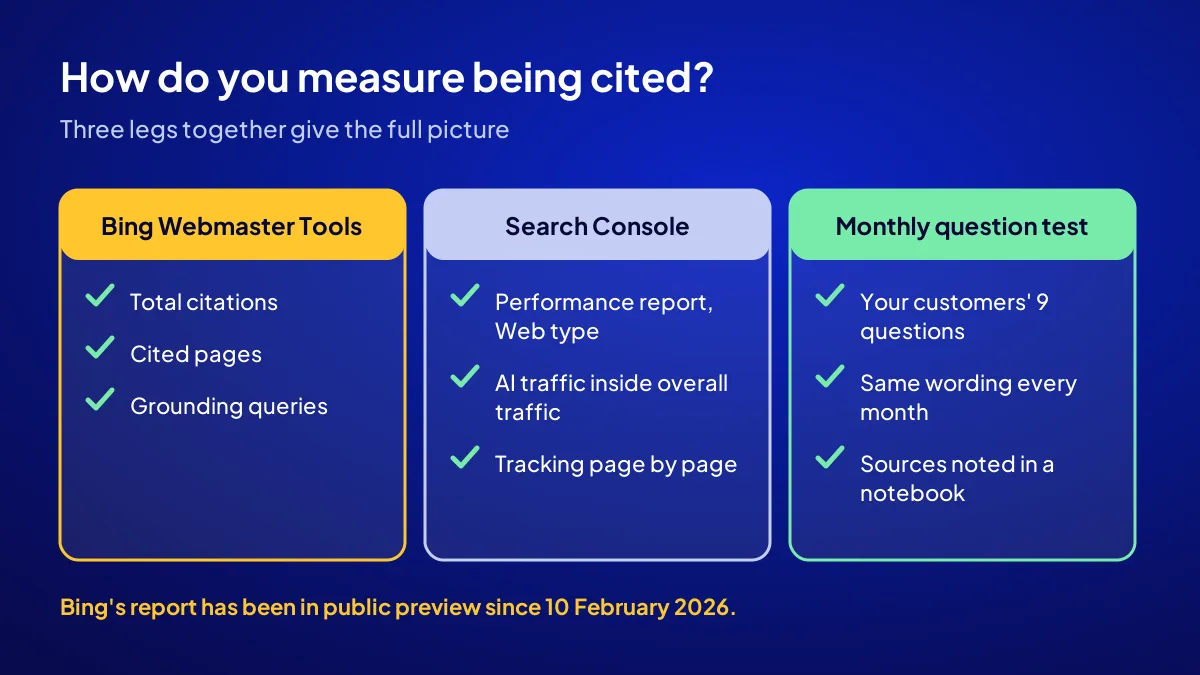
Measurement stands on three legs: the AI Performance report in Bing Webmaster Tools, the Search Console performance report and a monthly test with your own questions. Together they show which questions cite your site and which do not.
Bing: the first report that counts citations
On 10 February 2026, Microsoft added the AI Performance report to Bing Webmaster Tools as a public preview. It shows total citations, cited pages and the grounding queries AI used when retrieving content. It covers Microsoft Copilot, AI-generated summaries in Bing and select partner integrations.
Google: AI traffic inside the main report
According to Google, traffic from AI features is reported in the Search Console performance report under the “Web” search type, as part of overall search traffic. There is no separate switch; you watch growth page by page.
Your own test: the same 9 questions every month
Put your customers’ 9 questions to ChatGPT once a month and note whether your site appears among the sources. A notebook is more honest than many dashboards.
Do it yourself, or have it set up for you?
Most businesses can fix the door signals themselves. Page signals need steady writing: a page per question, the answer first, a source and a date. Now, if you lack the time or the question list, handing the setup over is faster. Adapte’s AI SEO campaign builds this foundation at a fixed price.
Quick Summary
- The first condition for a ChatGPT citation is a site open to OAI-SearchBot.
- The 9 signals sit in three layers: door, page and identity.
- Being cited and being recommended are separate; one does not bring the other.
- Google asks for no extra technical requirement or special schema for AI Overviews.
- Measure with Bing’s AI report, Search Console and a monthly question test.
- Nobody can guarantee a citation; what gets built is a measurable foundation.
Short Glossary
Being cited: Being cited is the term used when an AI shows the reader a link to the page its answer is based on.
OAI-SearchBot: OAI-SearchBot is the web crawler OpenAI uses so that sites can be shown in ChatGPT search answers.
Grounding query: A grounding query is the search phrase an AI uses in the background to find content while writing an answer.
Next Step
Your decision fits in one sentence: if your customers ask AI, your site should be a candidate to be the source of the answer. Apply for the AI SEO campaign and see which of the 9 signals are open on your starting diagnosis card.
Sık Sorulan Sorular
Let me ask you one thing: where does your customer type the question before finding you? If the answer is “the AI on my phone”, your starting point is your website. Most of your other assets end up linking to it anyway.
A premium business in Beşiktaş, Çankaya or Mavişehir serves selective customers who read reviews, check Instagram and increasingly ask an AI. Sit among the sources of that answer and you reach the decision earlier.
Fix 1, 2 and 7 first; they take about a week. Then write a page for each of your 9 most common questions, and 4 and 5 follow. Refill the table monthly.
The package is TRY 36,000 + VAT at a fixed price; at 20 percent VAT that is TRY 43,200, but check the current rate on the invoice. It includes an AI visibility diagnosis, entity setup, structured data, llms.txt and AI crawler settings. On top come 108 articles across 6 question groups, Q&A blocks on existing pages, AI traffic tracking in GA4, and Bing Webmaster Tools and Search Console setup. Delivery takes 30 days, and 12 businesses are taken per period.
No citation or recommendation guarantee is given; the company running the AI makes the final call. You get start and end diagnosis cards showing, in writing, which signals are open and which questions you answer. With a coupon code you get 10 percent off; just mention the code when you apply. Details are on the AI SEO campaign page.
According to OpenAI’s help page, the site must be crawlable by OAI-SearchBot, and its hosting or CDN must allow traffic from OpenAI’s published search crawler IP addresses. Placement itself is not guaranteed.
OpenAI says the GPTBot and OAI-SearchBot settings are independent of each other. GPTBot is for training; to appear in search answers, allowing OAI-SearchBot is recommended.
Google says no special structured data is needed for AI Overviews and AI Mode. What matters is that the structured data you use matches the visible text on the page.
Be careful. OpenAI states placement is not guaranteed. Adapte’s AI SEO campaign gives no guarantee either; it builds and measures a foundation for being readable and recognisable.
The campaign is TRY 36,000 + VAT at a fixed price. A coupon code gives 10 percent off, delivery takes 30 days, and 12 businesses are taken each period.
Bing Webmaster Tools’ AI Performance report shows citations in Copilot and Bing’s AI summaries. Google counts AI traffic inside the Search Console performance report. For ChatGPT, ask the same questions monthly and note the sources.
Updated: October 2026