
How to get my business cited by ChatGPT: the 6 traces AI uses to recognise a business
How do you get your business cited by ChatGPT? The short answer: before ChatGPT can cite a business as a source, it has to read the traces that business leaves online and see that those traces agree with each other. Those traces build up in six places: the identity page on your website, a name, address and phone written the same everywhere, your map profile, your listings on industry platforms, pages where others mention you, and content that answers your customer’s question.
The clearer and more consistent those traces are, the better the chance that AI recognises you correctly. But nobody can promise that ChatGPT will cite you. OpenAI’s own help page says plainly that placement is not guaranteed. Your job is to fix the traces and make them readable.
Where does ChatGPT learn about a business?
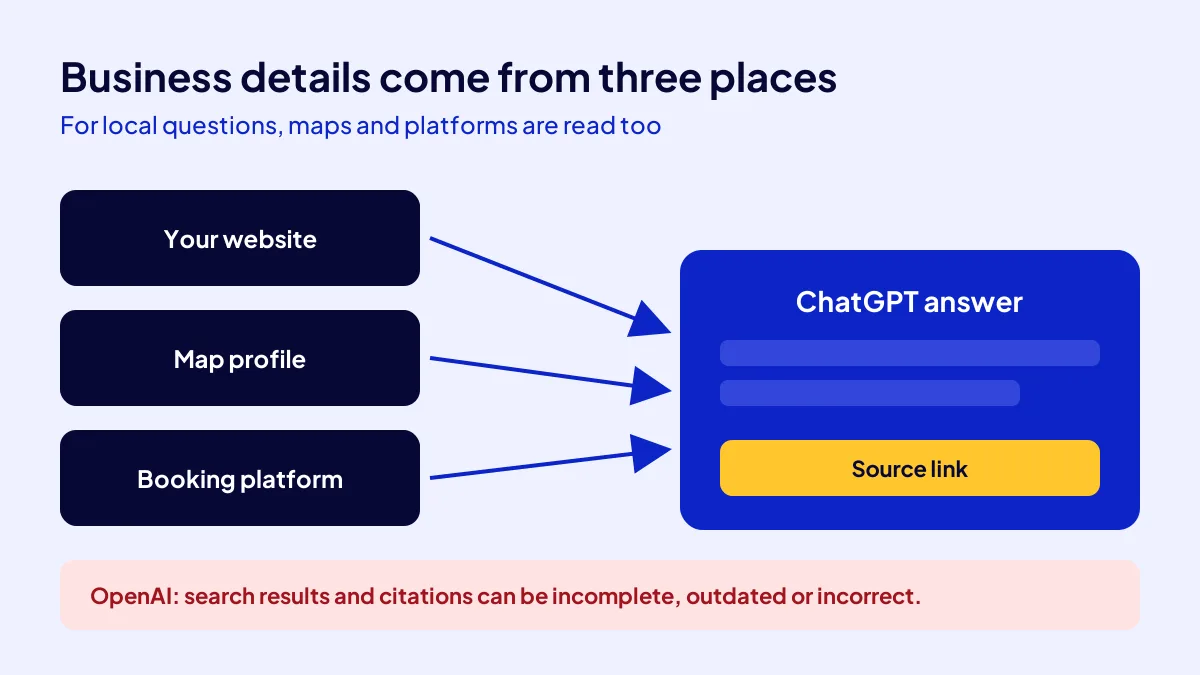
When ChatGPT searches the web, it builds its answer from web pages and can show the pages it used as sources. It puts your website, your map details and other pages that mention you side by side. If they say the same thing, the business becomes clear. If they do not, AI either mixes you up or leaves you out.
Most people do not know this: OpenAI adds a caveat to its own sources
OpenAI’s help page on searching the web with ChatGPT contains an interesting line: search results and citations can be incomplete, outdated or incorrect. So if AI finds an old address or a disconnected phone number for you, it may cite that too. Leaving a trace is not enough. The trace has to be current.
Citation, mention and recommendation are different things
Being cited means the answer links to your page. A mention means your name appears without a link. A recommendation means AI tells the user “go there”. The difference is covered in detail in what being cited by AI means.
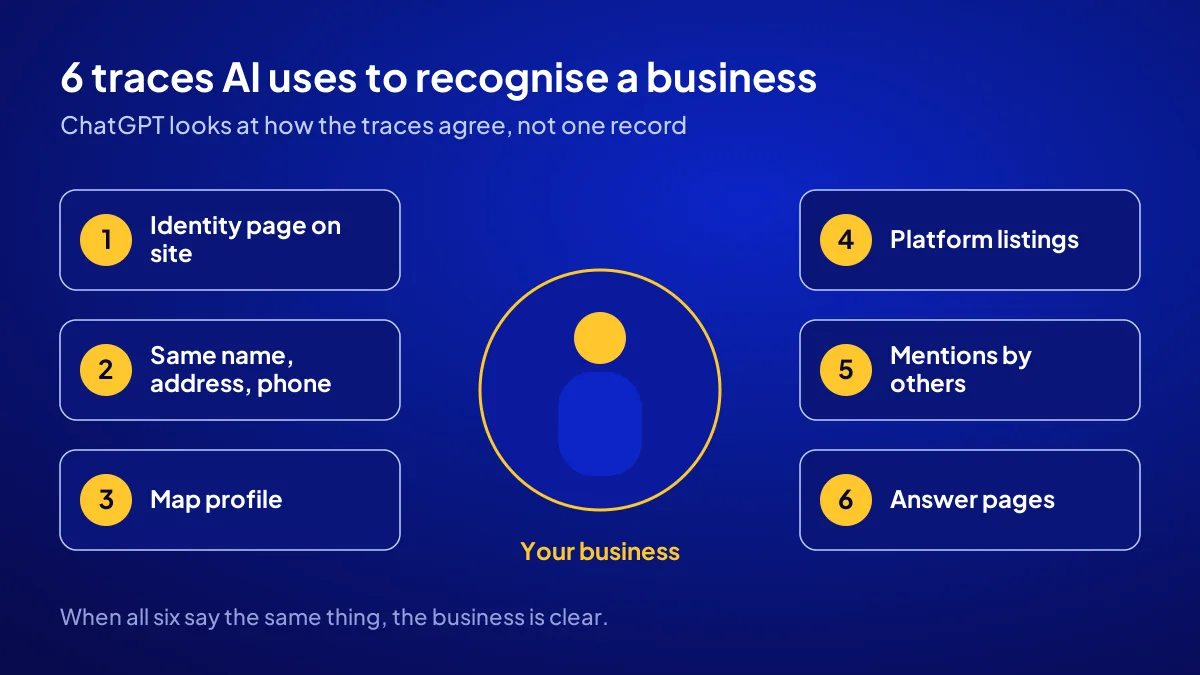
What are the 6 traces a business leaves online?
A business leaves six kinds of trace online and AI reads them together. The first and last are in your hands; the ones in between sit on other sites but are fed by your details.
- The identity page on your site: an about or contact page that says who you are, where you are and what you do.
- The same name, address and phone, letter for letter, everywhere.
- Your Google Business Profile and other map listings.
- Your listings on booking, directory and industry platforms.
- Pages where others mention you: local news, guides, professional association lists.
- Content pages that answer your customer’s question directly.
Your website trace: can AI get through the door?
The trace on your website only works if AI’s crawler can get in. OpenAI uses a crawler called OAI-SearchBot to surface sites in ChatGPT search, and states that sites which block it in robots.txt will not be shown in ChatGPT search answers. A locked door means nobody walks in, however good the window.
Why do map and platform traces carry so much weight?
For local questions, AI may take business details from maps and platforms as much as from your website. According to OpenAI’s help page, ChatGPT can use approximate location for local results, and for restaurants it may show availability from providers such as OpenTable, Resy or Yelp. In other words, information about your business sometimes comes from a platform you never opened.
Listings you never created still count
A directory may list you at your old address. You forget; the internet does not. Searching your business name once a year is the cheapest maintenance there is.
Why is being mentioned by others the hardest trace?
Because you cannot write it yourself. When a local news site, a district guide or a professional body mentions you, AI hears from a second voice that your business exists. It is word of mouth, online: slow to build, hard to erase.
| Trace | Who writes it? | Can you fix it? |
|---|---|---|
| Identity page | You | Yes, right away |
| Name, address, phone | You and platforms | Yes, one by one |
| Map profile | You; reviews by customers | Details yes, reviews no |
| Platform listings | The platform | Mostly by correction request |
| Mentions by others | Journalists, guides, institutions | No, it has to be earned |
| Answer content | You | Yes, one page per question |
Collecting reviews has limits
Under Turkey’s commercial advertising regulation amendment that took effect in 2026, reviews from people whose purchase cannot be verified may not be published. Fake reviews are a risky way to grow your traces.
Should you build these traces on your own?
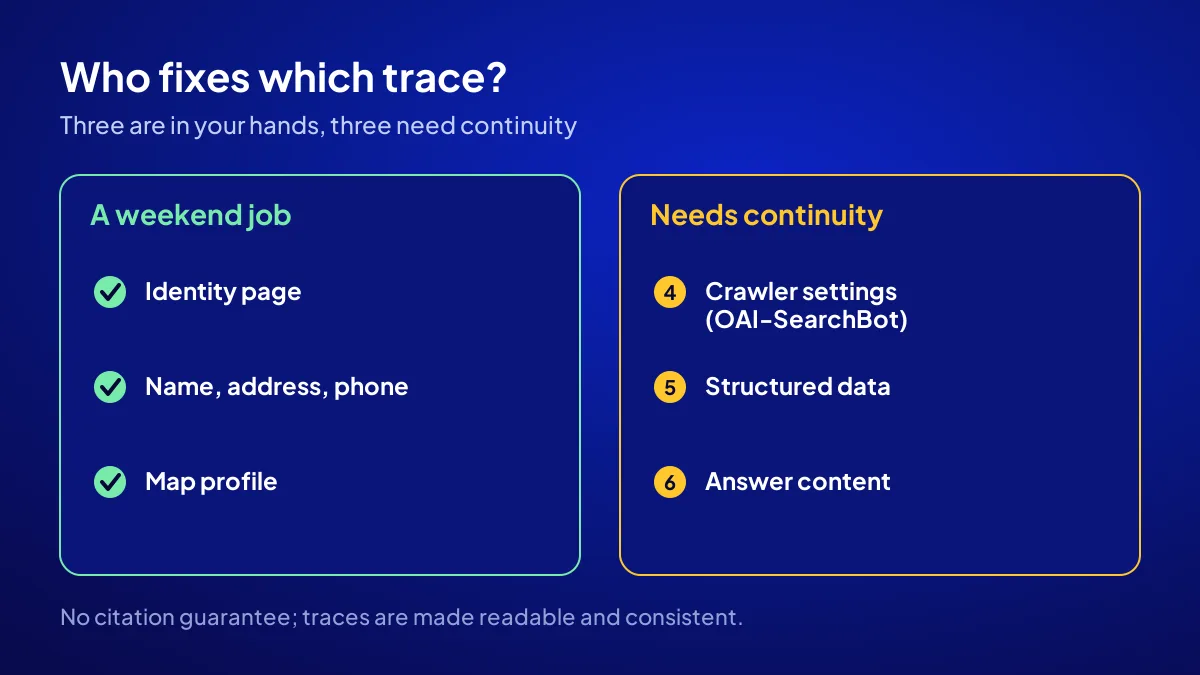
You can fix three of the six over a weekend: the identity page, name-address-phone and the map profile. Crawler settings, structured data and answer content are technical and need continuity. When the till is not ringing, that is a heavy load.
If you have premises, change the order
If you run a physical shop, clinic or studio, the map trace moves up. The order that works from shop to clinic is in six steps in how to get my business place cited by ChatGPT. The full picture is in the how to get my website cited by ChatGPT guide.
For those who want it set up
Adapte’s AI SEO campaign builds these traces in 30 days: crawler settings, entity structure, structured data, brand profiles and 108 question-led articles. The price is a fixed TRY 36,000 + VAT; with 20% VAT that is TRY 43,200, so check the current rate on the invoice. No recommendation or citation is guaranteed; the groundwork is built and measured.
Now you know: AI does not know your business, it knows what is written about it. And fixing what is written is in your hands.
Quick Summary
- ChatGPT recognises your business from six traces, not one record.
- A site that blocks OAI-SearchBot in robots.txt is not shown in ChatGPT search.
- For local questions, map and platform listings matter as much as your site.
- OpenAI says citations can be incomplete or outdated; traces must be current.
- There is no citation guarantee; readable, consistent traces are built.
Short Glossary
Being cited: Being cited is the term used when AI links to the page it took information from in its answer.
OAI-SearchBot: OAI-SearchBot is the crawler OpenAI uses to read sites that may be shown in ChatGPT search.
Business trace: A business trace is the general name used for any online record of a business’s name, address and work.
Next Step
If your traces are scattered, first you need to see where you stand. Apply for the AI SEO campaign and see your business’s current traces on your starting diagnosis card.
Frequently Asked Questions
Source: OpenAI Help Center — Searching the web with ChatGPT
Sık Sorulan Sorular
Because AI does not know you. It knows what is written about you. It cannot see your shop sign; it reads the online version of it. Without online traces, your shop has not opened yet as far as the machine is concerned.
Say you have just opened a boutique coffee shop in Kadıköy, Istanbul. Your Instagram is lively, but your site has no address and your map profile shows an old phone number. To AI, that is two witnesses giving two different addresses. The judge believes neither.
A crawler is software that visits and reads websites. robots.txt is the note on your site’s door saying who may enter. Allowing OAI-SearchBot in that note is a precondition for appearing in ChatGPT search. How the crawler then recognises you is explained in what is an entity in SEO.
The full business name, address, phone, opening hours and what you do, in one sentence. A small piece of code called structured data (schema) repeats the same details in a language machines read.
Category, hours, address, photos and reviews: each is a separate trace. How to fill them is covered in how to get my business profile cited by AI.
Join a local association, take part in a district event, keep your chamber record current. A one-line opening note in a Mavişehir neighbourhood paper is a second witness.
No, nobody can guarantee that. OpenAI also states that placement is not guaranteed. What you can do is make your business traces readable, consistent and current.
It may recognise you from your map profile and platform listings, but there is no page of your own to cite. A site with an identity page is the strongest trace.
If you want to appear in ChatGPT search, OAI-SearchBot must be allowed. OpenAI states that sites blocking this crawler are not shown in its search answers.
Find the source, fix your own records, and request corrections elsewhere.
No. No recommendation guarantee is given. Readability and recognisability groundwork is built and measured with starting and closing diagnosis cards.
AI traffic is tracked separately in GA4, and Bing Webmaster Tools and Search Console are set up. Starting and closing diagnosis cards are compared using the same questions.
Updated: October 2026