
Content guide for ChatGPT answers: Adapte’s FORM-97 writing standard
To appear in ChatGPT answers, content has to pass two doors: ChatGPT’s search crawler must be able to reach the page, and the page must give a quotable answer to the question asked. At Adapte Dijital we build the second door with a writing standard called FORM-97: one question, the answer first, question subheadings, sourced figures, a visible update note and a short summary. Nothing guarantees a place in ChatGPT; we build pages that can be read and quoted.
The same rules apply to your shop’s website. If it only has “about us” and “contact”, the shutters are up but the shelves are empty, and AI has no sentence of yours to quote.
What does ChatGPT need before it can cite a page?
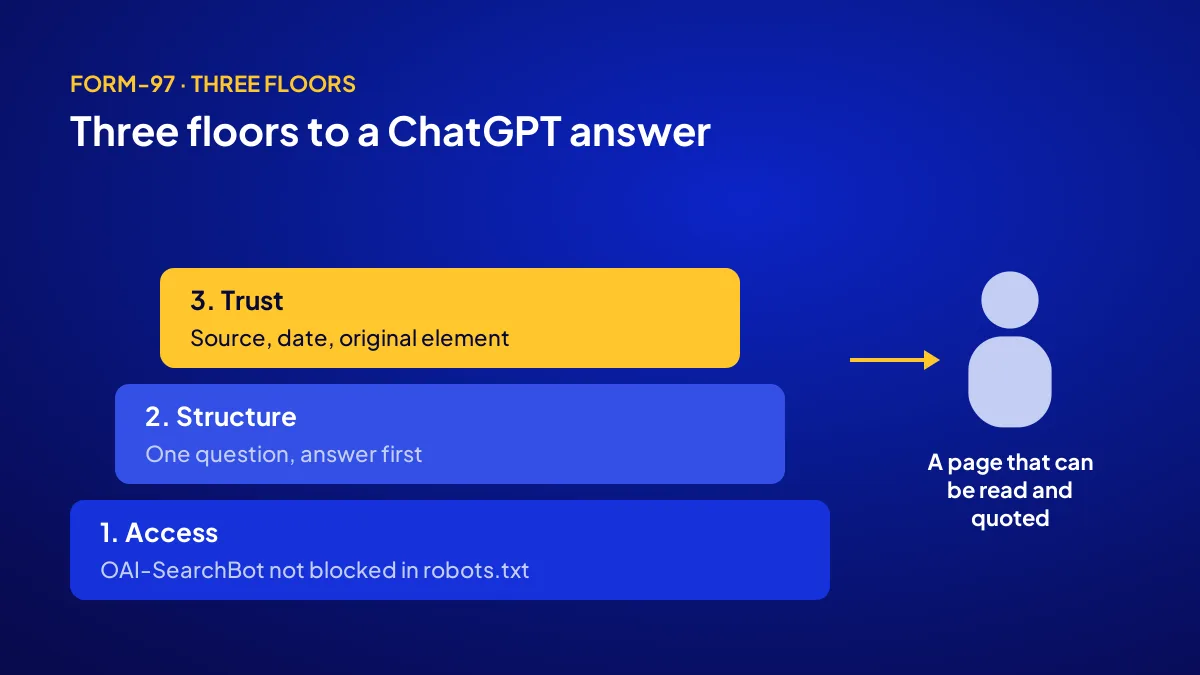
Access first. According to OpenAI’s crawler overview, OAI-SearchBot is used to surface websites in ChatGPT’s search features. Sites that block it in robots.txt are not shown in ChatGPT search answers, though they can still appear as navigational links. OpenAI recommends allowing it, so we check this first.
Three crawlers, three separate settings
OpenAI runs three crawlers. GPTBot is for model training, OAI-SearchBot for ChatGPT search, and ChatGPT-User for page visits a user asks for. The settings are independent; you can keep content out of training and open to search.
What is FORM-97 and what does it standardise?
FORM-97 is the writing standard Adapte Dijital uses to build every article to the same quality line. It puts the skeleton, language rules, link set, visuals and pre-publication scoring into one document, and moved to its eighth version in September 2026. The aim: an article that reads equally clearly to people, search engines and AI.
“Who is searching?” comes first
Our 1K9N method first defines who is searching, then spreads the topic across nine question axes, from “what” to “what next”. Each topic becomes an 18-article set in which every query has a single owner.
Twelve author identities, one standard
Articles are written under twelve author identities. The voice changes; the skeleton and rules do not.
Which skeleton does a FORM-97 article follow?
BU BÖLÜMÜN ÖZETİ
- Each section reads on its own
- Definitions follow a fixed pattern
- FAQ blocks are a craft of their own
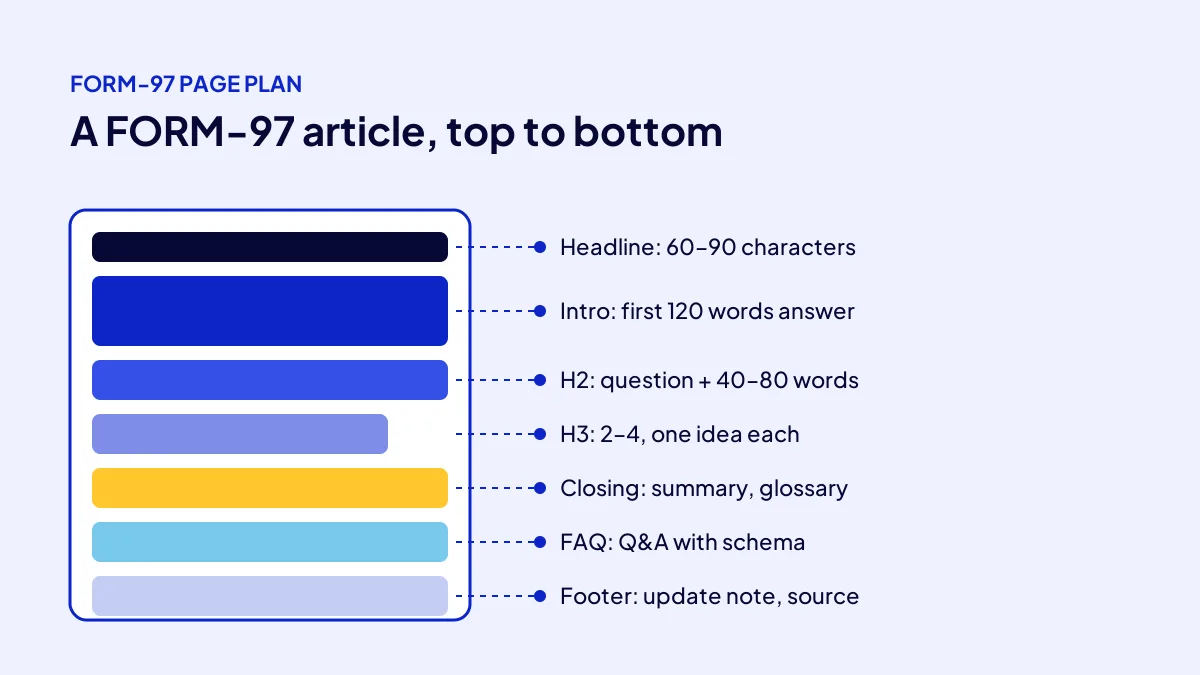
The skeleton has six parts: headline, an introduction that answers, question-style subheadings, single-idea sub-sections, closing blocks and a footer. Each part has a written measure. The table puts an ordinary blog post next to a FORM-97 article.
| Section | Ordinary blog post | FORM-97 article |
|---|---|---|
| Headline | Generic, unrelated to the query | 60–90 characters, query in the first 30, no exclamation mark |
| Introduction | A long warm-up paragraph | First two paragraphs answer the question; the first 120 words quotable alone |
| Subheading | One-word label | A question or clear claim, followed by a 40–80 word direct answer |
| Sub-section | No set number | 2–4 per subheading, one idea each |
| Closing | “Get in touch” | Quick summary, short glossary, one action, FAQ with schema |
| Footer | No date | Visible update note and source line |
Each section reads on its own
Every section makes sense even if the rest were deleted, so an answer engine using one section gets a complete one.
Definitions follow a fixed pattern
Every glossary definition uses the same pattern: “X is the … used for …”. One plain sentence, chosen so the definition can be quoted as it stands.
FAQ blocks are a craft of their own
We do not repeat how we write the FAQ section here. The nine rules are in how to write FAQ blocks AI will quote.
Figures, sources and dates: which lines carry trust?
Every figure sits next to its source. We do not write unsourced statistics, invented percentages or named customer cases; when a scenario is needed, we make it clearly hypothetical. Every article carries a visible update note and at least one official or authoritative source. Main pages are reviewed every 90 days, support articles every 180.
Context is written into the body
We write “in 2026”, “in Istanbul”, “in the hairdressing trade” into the body. A sentence with no time or place can answer the wrong question.
We do not write guarantees
“We will get you to number one” or “ChatGPT will recommend you” appears in none of our articles. The company running each system decides who gets cited. The most common gaps in uncited articles are listed in why my articles are not cited by AI.
What threshold must an article pass before publishing?
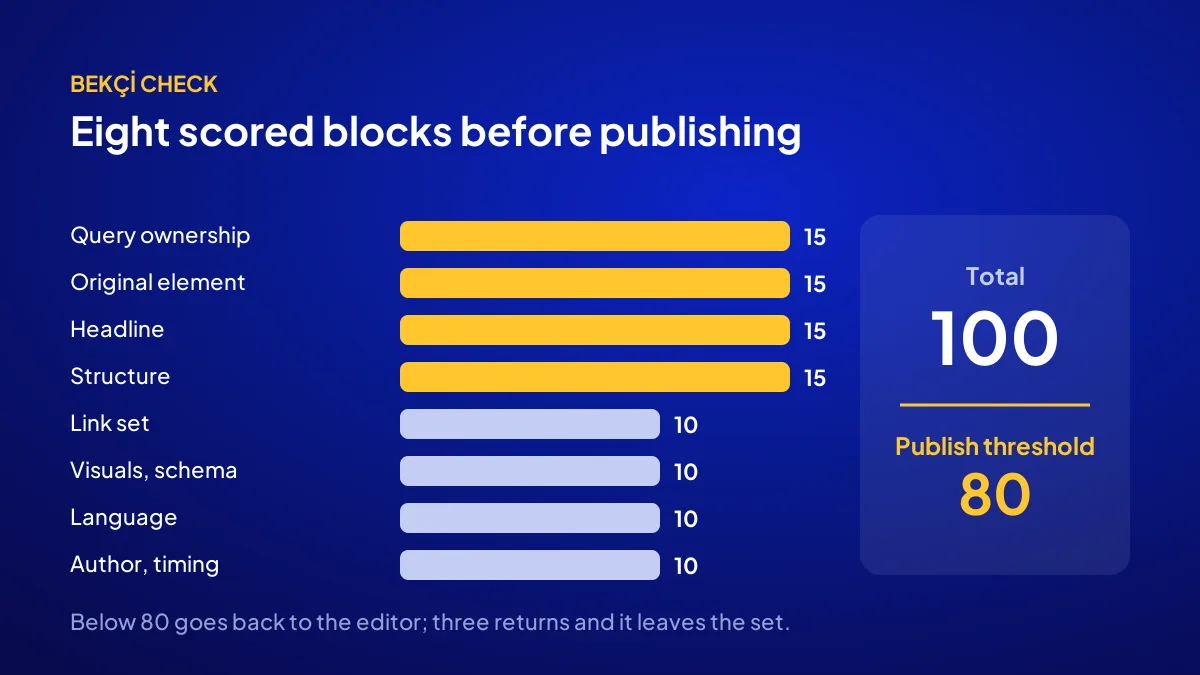
Before publishing, every article goes through a check we call Bekçi (“the watchman”) and is scored out of 100. The threshold is 80. An article below 80 goes back to the editor; one that returns three times leaves the set and its topic moves to the update list. The eight blocks are below.
| Block | Points | What is checked |
|---|---|---|
| Query ownership | 15 | No other page on the site owns the query |
| Original element | 15 | Sourced original data or example fitting the author |
| Headline | 15 | At least 75 on the headline framework |
| Structure | 15 | Full skeleton, no similar skeleton in the set |
| Link set | 10 | Five internal links and one authority source |
| Visuals and schema | 10 | Three visuals, valid structured data |
| Language | 10 | No banned patterns, correct word set |
| Author and timing | 10 | Author box and update note |
No original element, no article
Every article carries at least one original element: a sourced figure, a clearly hypothetical example or an observation from our own data. Repeating what exists elsewhere tells nobody anything new.
How do you bring this standard to your own site?
Six steps are enough to start. The rule is simple: if your customer asks AI a question before walking through your door, the answer should sit on your page, in your words. Begin with the crawler setting, then the questions.
- Check that robots.txt does not block OAI-SearchBot.
- Write nine questions customers ask at the counter, in their own words.
- Open a separate page for each question.
- Make the first paragraph the full answer.
- Put a source next to every figure and an update note at the bottom.
- Close the page with a short summary and FAQs.
A roadmap for your site and premises
The nine site-wide signals are in how to get my website cited by ChatGPT, and the steps for a physical place in how to get my business place cited by ChatGPT.
The ready-made route
If you have no time for this, the AI SEO campaign writes 108 articles across 6 question groups to this standard, each built for a specific question and intent. The fixed price is TRY 36,000 + VAT, TRY 43,200 with 20 percent VAT (check the current rate on the invoice). Delivery in 30 days, 12 businesses per period, no recommendation guarantee.
Quick Summary
- To appear in ChatGPT answers, OAI-SearchBot must first be able to reach the page.
- FORM-97 is Adapte’s writing standard, now in its eighth version (September 2026).
- The first two paragraphs answer the question; subheadings are questions.
- Every figure has a source; every page has a visible update note.
- No article is published below 80 out of 100 on the Bekçi check.
- No place in ChatGPT is guaranteed.
Short Glossary
FORM-97: FORM-97 is the writing standard Adapte Dijital uses to build articles with the same skeleton, language and source rules.
OAI-SearchBot: OAI-SearchBot is the crawler OpenAI uses to surface websites in ChatGPT’s search features.
Bekçi score: The Bekçi score is the check score used to decide, across eight blocks out of 100, whether an article can be published.
Next Step
If you have no pages answering your customers’ questions, that is where we start. Apply for the AI SEO campaign and see where your site stands today with an initial diagnosis card.
Sık Sorulan Sorular
OpenAI says search-side robots.txt changes can take about 24 hours to apply. How long a newly published article takes to be cited is covered in when new content gets cited by AI.
We dropped emojis, bold text in every paragraph and length targets. A support article now runs between 1,100 and 1,600 words. Our view: an article’s value comes from the new information it brings, not its length.
“Looks good” is not a measure. A score holds one standard across twelve pens.
Check that OAI-SearchBot is not blocked. According to OpenAI, sites blocking it are not shown in ChatGPT search answers, though they can appear as navigational links. The GPTBot setting is separate.
Yes. The basics need no agency: one question, the answer first, sources and a visible update note.
Length alone is not the measure. Our support articles stay between 1,100 and 1,600 words; their value comes from the new information they bring.
No. The company running the system decides who is cited. The standard makes the page readable and quotable.
The campaign delivers 108 articles across 6 question groups, each built for a specific question and intent. No recommendation guarantee is given; the foundation is measured with initial and final diagnosis cards.
A fixed TRY 36,000 + VAT, with 10 percent off for coupon holders. Delivery takes 30 days and 12 businesses are taken per period.
Updated: October 2026