
Why is structured data important? Why AI mixes up your business, in 6 examples
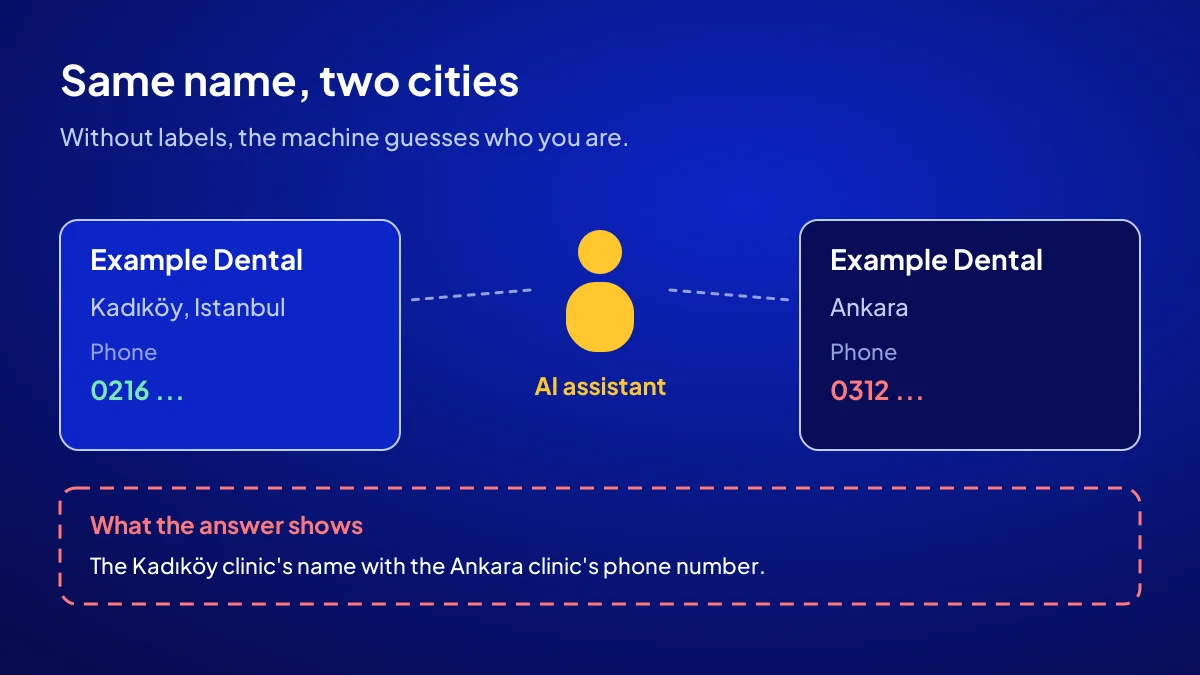
Let’s say you run a dental clinic in Kadıköy, Istanbul, and it shares its name with a clinic in Ankara. Someone asks an AI assistant for “a dental clinic open on Sunday in Kadıköy”. Your name appears in the answer, but next to it sits the Ankara clinic’s phone number. That scene holds the answer to why structured data is important: when a machine has to guess who you are, it sometimes guesses wrong.
Structured data is a label added behind a page that states, in a standard language machines understand, who the business is, where it is, what it does and when it is open. Google writes that it uses this data to understand the page’s content and to gather information about the world, such as people, books and companies. Without the label, the machine infers from the text. Below are the six places where that inference most often goes wrong.
What does a machine have to guess when it reads a page?
BU BÖLÜMÜN ÖZETİ
- Text for people, labels for machines
- JSON-LD: an invisible ID card for the page
- What the label describes is an entity
A person reads “Closed on Mondays, open 09:00–19:00 on other days” and gets it at once. A machine sees a string of words and numbers in the same sentence. It works out from context which number is the time, which is the phone, which name is the business and which is the dentist. Structured data removes that guesswork by naming each piece of information.
Text for people, labels for machines
The text on the page speaks to the reader and should stay that way. The label puts the same information into boxes: a name box, an address box, an hours box. Visitors never see it, and their experience does not change.
JSON-LD: an invisible ID card for the page
The most common format is JSON-LD, which Google recommends because it is easy to implement and maintain. It is a short block added to the page code and does not touch the design. It gathers the business’s whole identity in one place.
What the label describes is an entity
To a machine your business is not a piece of text but an entity with properties: name, address, owner, services. We explain entities in plain language in what is an entity in SEO.
How does confusion start, in six examples?
BU BÖLÜMÜN ÖZETİ
- Identity mix-ups
- Business description mix-ups
- Person and product mix-ups
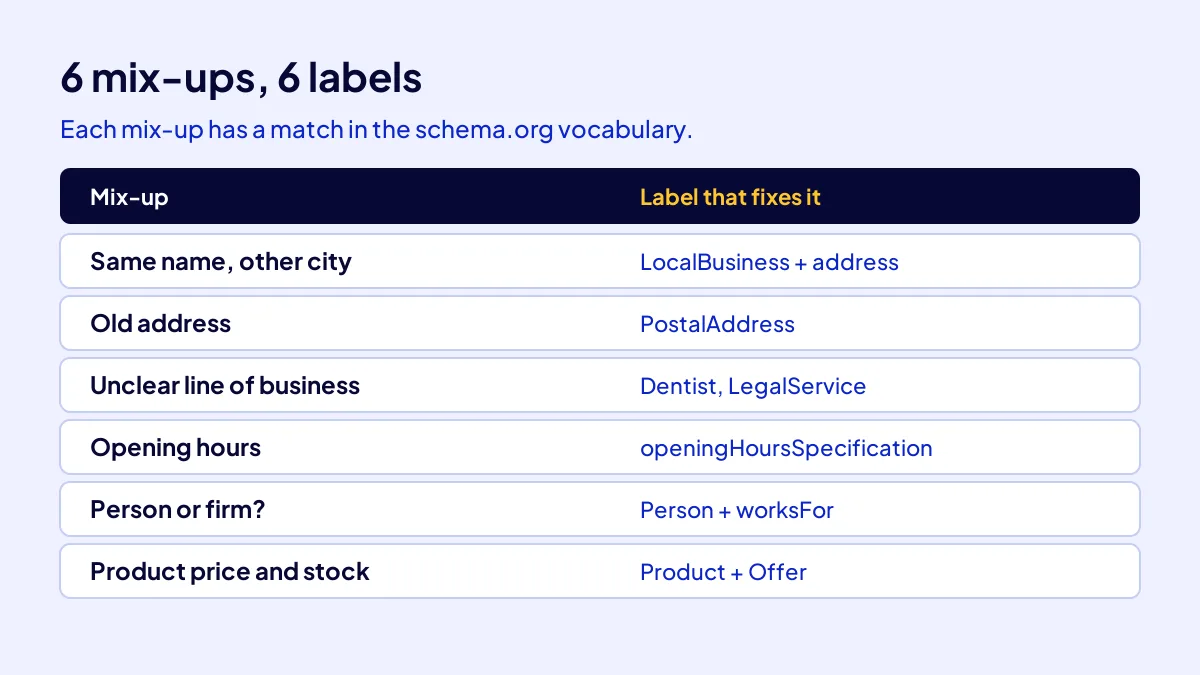
Most mix-ups come from three places: identity, business description and person or product details. For each one there is a ready-made label in the schema.org vocabulary. The table below sets six typical mix-ups beside their result and the label that fixes them.
| Mix-up | What happens | Label that fixes it |
|---|---|---|
| 1. Same name, another city | Another business’s phone is shown as yours | LocalBusiness + address |
| 2. Old address | The shop you left is still shown | PostalAddress, single and current |
| 3. Unclear line of business | Your law firm is taken for a consultancy | Subtype such as Dentist or LegalService |
| 4. Opening hours | You are open on Sunday but listed as closed | openingHoursSpecification |
| 5. Person or organisation? | The dentist’s name is taken for the clinic’s | Person + worksFor |
| 6. Product price and stock | A sold-out product shows “in stock” | Product + Offer |
Identity mix-ups
Examples one and two do the most damage, because the customer goes to the wrong door. When a business moves, the old address keeps circulating online for years. The label tells the machine plainly which address is current.
Business description mix-ups
Examples three and four cause the “not showing up for the right question” problem. If the machine puts you on the wrong shelf, your name does not come to mind for questions about your work. Opening hours are used directly in “is it open now” questions.
Person and product mix-ups
Example five is common in clinics and law firms: the dentist or lawyer is known by their own name, the firm by another. Example six hits online shops where the till stops ringing, because customers arrive for a sold-out product and leave.
What happens if the label contradicts the page?
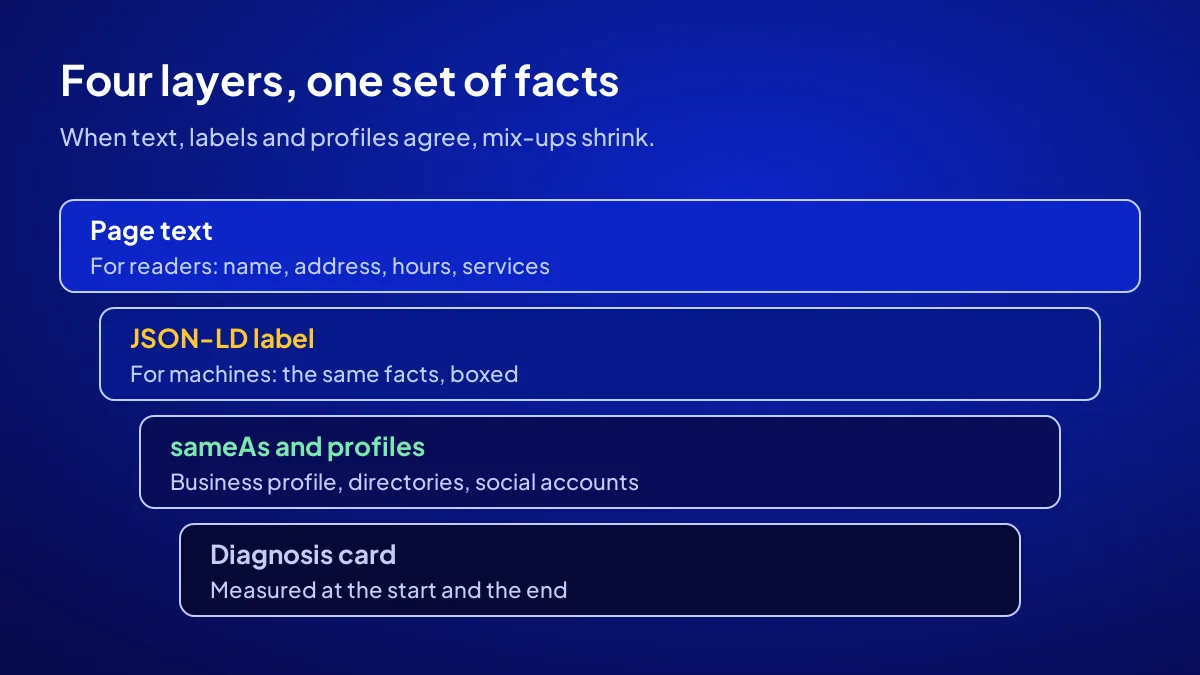
This finding surprises most people: a wrong label can be worse than no label at all. Google’s guidelines ask markup to describe the information visible on the page. If the page says 09:00 and the label says 10:00, the machine is left with two conflicting facts. The label should repeat the page, not make a separate claim.
One time on the page, another in the label
The usual culprit is a label a theme or plugin set up once and nobody touched again. Hours and phone change; the label stays old. A yearly check fixes it.
Labels and profiles should speak the same language
Your Google Business Profile, directory listings and social accounts should give the same name, address and phone. The sameAs label links those profiles to your site. We explain how this consistency works in local searches in who does AI recommend in Istanbul.
What did it do in classic SEO, and what changes in AI search?
In classic SEO, structured data is mostly used for rich results: stars, prices, event dates and other eye-catching lines. In AI search the goal is different: being recognised correctly and named for the right question. The first decorates how you look in search results; the second lays the ground for appearing inside the answer itself.
Rich results and recognition are separate goals
Google says every required property must be present to be eligible for rich results, and eligibility does not guarantee display. Recognition is not about a single result but about correct information in every question. One is the light in the window; the other is getting the sign above the door spelled right.
No guarantee, less uncertainty
Structured data promises nobody a recommendation. What it does is lower the chance that a machine says something wrong about you. To check how your brand looks in AI today, see how does my brand appear in AI.
Which labels are missing on your site, and how do you tell?
Two free tools show you in ten minutes: Google’s Rich Results Test and schema.org’s Schema Markup Validator. Enter a page address and they list its labels. If the list is empty or shows only the theme name, the machine is guessing you from the text.
- Test the home page: is there a label for business name, address and phone?
- Test the contact page: do the hours in the label match the page?
- Test one service or product page: are price and stock current?
Identity first, then services
Order matters. Without an identity label, a service label floats in the air. Say who you are first, then what you sell.
Where does structured data fit in the campaign?
In Adapte’s AI SEO Campaign, structured data is built as one link in a chain, not on its own. The chain starts with an AI visibility diagnosis, then moves through entity setup, structured data, llms.txt and AI crawler settings. After that come 108 articles in 6 question groups, Q&A blocks on existing pages, brand profiles and directory signals.
Price, timing and places
The campaign is a fixed TRY 36,000 + VAT; with 20% VAT that is TRY 43,200, so check the current rate on your invoice. Delivery takes 30 days and 12 businesses are taken per period. There is no guarantee of being recommended; the groundwork is built and measured with start and end diagnosis cards. Details are on the AI SEO Campaign page.
The whole roadmap
You can see how the steps connect from diagnosis to delivery in AI SEO with 108 articles. One principle: leave nothing for the machine to guess, and tell it yourself who you are.
Quick Summary
- Structured data states business information in a standard language machines understand.
- Without labels, machines infer from text and sometimes mix things up.
- Six typical mix-ups: name, address, line of business, hours, person or firm, product and stock.
- Labels must match the page and your profiles.
- Rich results and correct recognition are separate goals; neither is guaranteed.
- In the campaign, structured data is built with diagnosis, entity setup and 108 articles.
Short Glossary
Structured data: Structured data is the markup used to classify a page’s content in a standard format machines understand.
JSON-LD: JSON-LD is the format used to add structured data to a page’s code without touching its design.
sameAs: sameAs is the label used to link the business on your site with its social accounts and profiles as one entity.
Next Step
If the test tool showed an empty list, it is time to explain your identity to the machine. Apply for the AI SEO Campaign and let’s see what is missing together with your diagnosis card.
Frequently Asked Questions
Source: Google Search Central — Introduction to structured data markup
Sık Sorulan Sorular
Some themes and plugins add a basic label themselves, but it is often incomplete or generic. Choosing the right subtype and linking profiles is manual work.
Classic SEO focuses on ranking pages in search results. AI SEO builds the groundwork for a business to be recognised correctly and named in ChatGPT, Gemini, Perplexity and Google AI answers; structured data is a shared part of both.
That cannot be guaranteed. Structured data improves recognisability and lowers the chance of mix-ups, but the decision to recommend belongs to the AI systems.
Most themes and plugins offer fields for a basic business label. Choosing the right subtype, linking profiles and keeping the label consistent with the page take careful setup.
Updated: October 2026