
Who is AI SEO for? Clinics, law firms, manufacturers and online stores first
Who is AI SEO for? Businesses whose customers ask long questions before deciding: patients before booking, buyers before requesting a quote, shoppers before checkout. Those questions now go into ChatGPT, Gemini, Perplexity and Google’s AI answers too. So Adapte’s AI SEO campaign looks at four groups first: clinics, law firms and consultants; manufacturers and B2B; online stores and brands; and businesses with a site that AI never names.
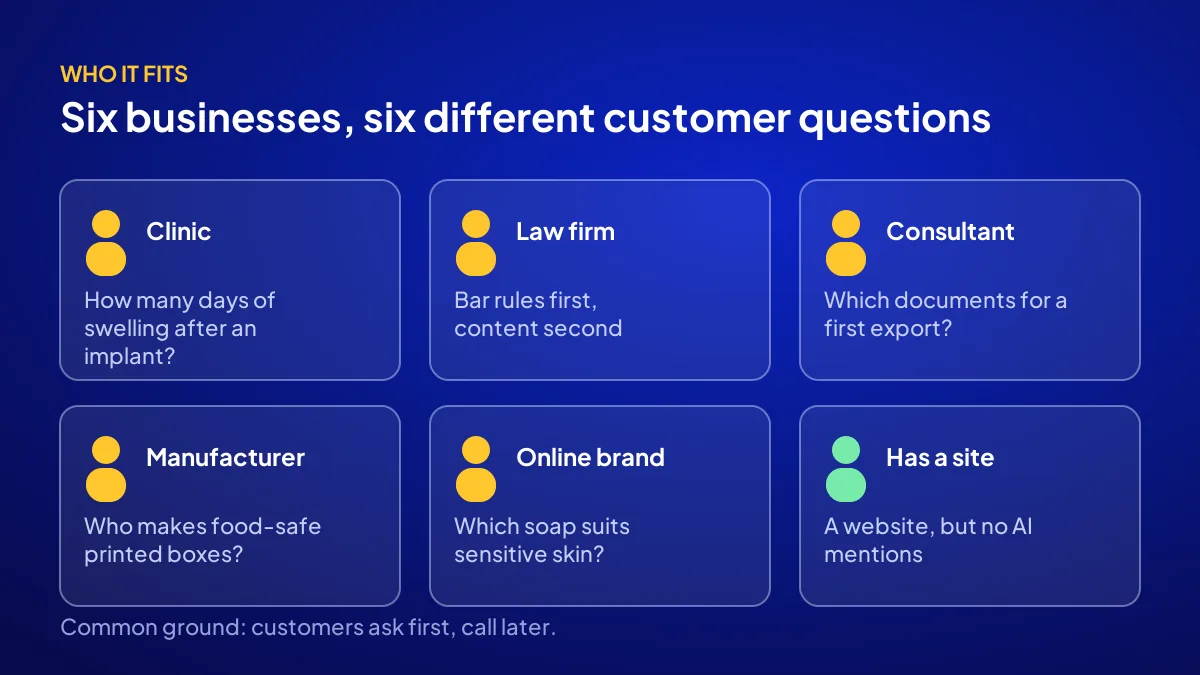
The campaign is a fixed TRY 36,000 + VAT, delivered in 30 days, with 12 businesses per period. There is no recommendation guarantee. What gets built is the groundwork that lets AI read your site and recognise you, measured at start and end. Below are six hypothetical business owners you may recognise.
Why does a business whose customers ask first get ahead?
An AI assistant builds answers from sources it can read, recognise and match to the question. The business whose customers ask long questions loses that match most often. The decision is made before anyone reaches your door, and if your name is missing then, you never make the shortlist.
Longer questions, clearer intent
Our own Search Console shows it. From 14 June to 13 September 2026, the Turkish query “how to open a dental supply store” carries 219 impressions, an average position of 2.5 and 11 clicks. Long, intent-rich questions climb faster than short, generic keywords.
Google’s own line
Google says there are no extra requirements for its AI features: a page must be indexed and eligible to show with a snippet. The work runs through a readable site that answers questions, not magic code.
Clinics: the patient asks before booking
Clinics top the list because in Turkish healthcare, advertising is banned and information is allowed. Content that answers a patient’s question accurately and simply is a clinic’s most legitimate tool, and informational pages are exactly what AI assistants read and quote.
Scene: a dental clinic in Beylikdüzü
Say you run a dental clinic in Beylikdüzü, Istanbul. At night a patient types “how many days of swelling after an implant”. The assistant answers with two sources. Neither is yours.
The line to watch
Patient thank-yous cannot be used as ads. The regulation renewed in November 2025 also asks for a visible last-updated date. Your clinic checks the final text.
Law firms and consultants: rules first, content second
BU BÖLÜMÜN ÖZETİ
- Scene: a two-lawyer firm in Esenyurt
- Scene: a foreign trade consultant in Kadıköy
- What both need: to be recognised
Law firms are on the list but get the most careful approach. The 9 August 2024 amendment to the Union of Turkish Bar Associations’ Advertising Ban Regulation prohibits keywords and redirecting code aimed at ranking higher in search engines. So a law firm’s diagnosis starts with “what may we write”, not “what should we write”.
Scene: a two-lawyer firm in Esenyurt
Say you run a two-lawyer firm in Esenyurt. Nobody calls, because nobody knows the name. You get your bar association’s view first; if the rules do not allow it, we do not start.
Scene: a foreign trade consultant in Kadıköy
Any chamber’s rules come first here too. Say you advise first-time exporters from Kadıköy. A client asks “which documents do I need for my first export”. If that answer is not on your site, your expertise does not exist for AI.
What both need: to be recognised
The core job here is entity hygiene. Name, title, address and specialism are written the same everywhere, so the assistant does not confuse you with someone else.
Manufacturers and B2B: the buyer asks about suppliers
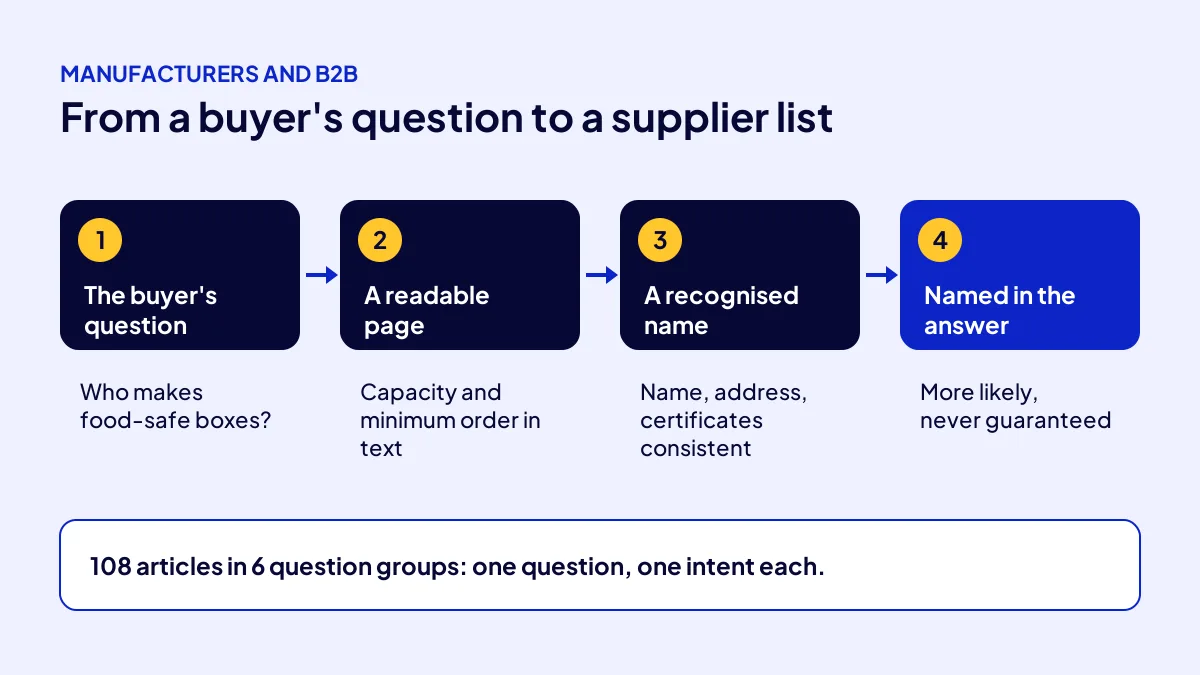
B2B decisions take time, and the first step is now a question. A purchasing specialist building a supplier list can consult an assistant too. The assistant easily reads a manufacturer that states capacity, minimum order and lead time in plain text. If that stays buried in a catalogue, the list gets built without you.
Scene: a box maker in Hadımköy
Say you print cardboard boxes in Hadımköy. A buyer asks “who makes food-safe printed boxes in Istanbul”. Your site has eight pages and a download link. The machines run, but the till turns over on old customers alone.
The surprise: the dullest question wins
In B2B, the question that pays is often the dullest: minimum order, sample lead time, certificates. If competitors skip these, the day you write them is the day you pull ahead.
Online brands and businesses with a site but no AI mentions
BU BÖLÜMÜN ÖZETİ
- Scene: a handmade soap brand in Avcılar
- Scene: a twelve-year-old kitchen equipment dealer
- The shared fix
Both have a site and products, yet AI does not know them. Shoppers ask about products by their features, and older sites rarely answer those questions. In both cases, the first job is to see what the assistant actually reads.
Scene: a handmade soap brand in Avcılar
Say your Avcılar workshop sells olive oil soap online. A shopper asks for “a gentle additive-free soap for sensitive skin”. Your product page has two lines and a photo, no ingredient list. We gather what AI shopping agents expect in AI agents and shopping towards 2027.
Scene: a twelve-year-old kitchen equipment dealer
Say you have raised the shutters on your Esenyurt kitchen equipment shop for twelve years. Yet when someone asks for “commercial dishwasher service in Istanbul”, your name does not come up. Customers are not walking in, because they never see the door.
The shared fix
Q&A blocks, structured data and brand profiles are the missing links. See what assistants check before recommending a brand in how to get recommended by assistants.
Six profiles in one table: who starts where?
Each profile starts somewhere different, because each has a different missing link: information pages, rules, technical detail or the product page. The table sets the first area checked on the diagnosis card next to the point to watch. Find the row closest to you.
| Profile | Sample customer question | First area checked | Watch out for |
|---|---|---|---|
| Clinic | Days of swelling after an implant? | Information pages, update date | Information, not ads |
| Law firm | How long does a rent case take? | Bar rule compliance | Bar view first |
| Consultant | Documents for a first export? | Entity, expertise page | Chamber rules |
| Manufacturer, B2B | Who makes food-safe boxes? | Capacity, minimum order, certificates | Not buried in a catalogue |
| Online brand | Soap for sensitive skin? | Product page, structured data | Marketplace consistency |
| Business with a site | Dishwasher service in Istanbul? | Q&A blocks, brand profiles | Old page freshness |
How to read the table
The first area shows where work starts. Every profile gets the full package.
If you cannot find yourself
If customers walk in without asking first, this campaign is not your priority.
Why only 12 businesses per period, and who is it too early for?
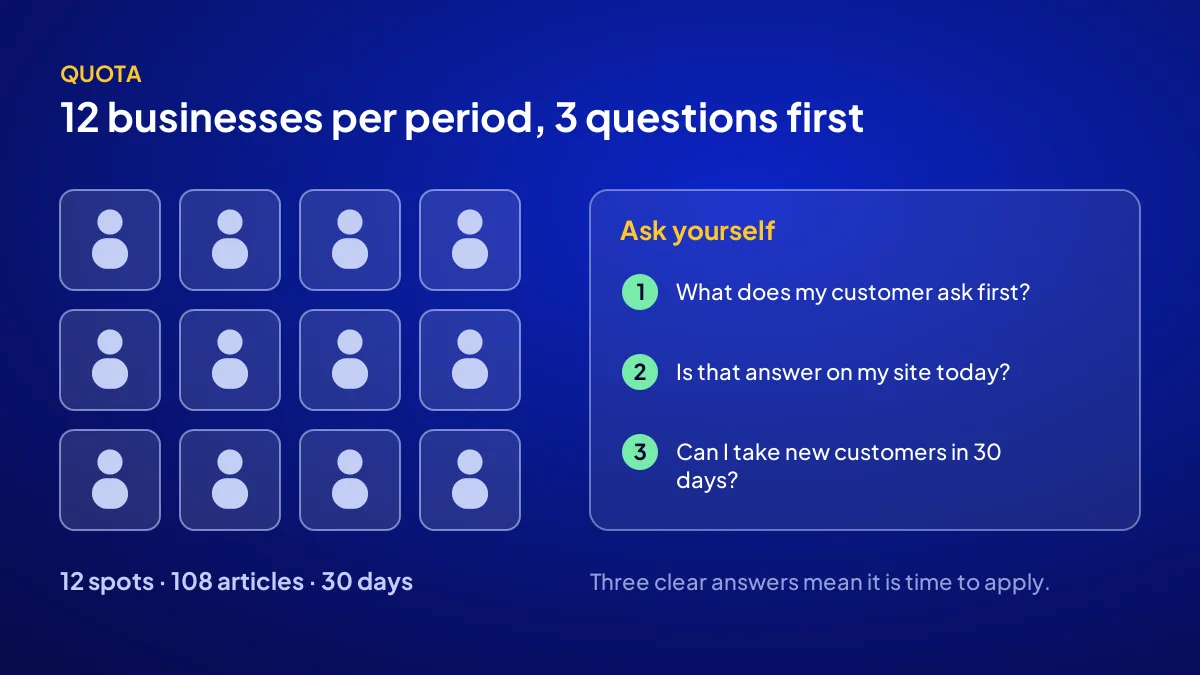
Each business gets 108 articles written to specific questions and intents, plus diagnosis, entity setup and measurement, all within 30 days. This is handwork, not mass production. That is the logic behind the cap of 12 businesses per period, so applying early matters.
Who is it too early for?
- Businesses whose professional rules do not allow content production.
- Businesses without a website, which need their own address first.
- Businesses at full capacity, with no room for new customers.
Three questions before applying
- What does my customer ask before calling me?
- Is that answer on my site today?
- Can I take new customers 30 days from now?
If all three answers are clear, apply on the AI SEO campaign page before the quota fills. For the whole campaign, see AI SEO with 108 articles.
Quick Summary
- The campaign helps most where customers ask before deciding.
- Priority groups: clinics, law firms and consultants, manufacturers and B2B, online brands.
- Clinics may inform, not advertise; law firms get their bar’s view first.
- TRY 36,000 + VAT, delivered in 30 days, 12 businesses per period.
- Sites that AI never names belong here too.
- No recommendation guarantee.
Short Glossary
Entity: An entity is the identity record used so AI can recognise a business as a distinct organisation by its name, address and expertise.
Intent: Intent is the classification used to tell apart the real need behind a question: information, comparison or purchase.
Structured data: Structured data is the code used to mark up product, address or question details in a format machines can read.
Next Step
Saw yourself in a profile? See where your site stands today. Apply for the AI SEO campaign, share your site and your customers’ questions, and get your diagnosis card.
Frequently Asked Questions
Source: Google Search Central — AI features and your website
Sık Sorulan Sorular
Answer pages settle doubts before the appointment. We break down how assistants mention local clinics in who AI recommends in Istanbul.
The 108 articles split into 6 question groups: product, material, sector, process, price formation, certification. Each article serves one question and one intent.
Each business gets 108 articles written to specific questions and intents, delivered with the diagnosis and setup within 30 days. Because this is handwork, the quota is capped at 12 businesses per period.
Yes, but compliance comes first. The Advertising Ban Regulation prohibits keywords aimed at ranking higher in search engines. Work starts only after the bar’s view is taken and a compliant framework is set.
No. The campaign builds the groundwork that lets AI read your site and recognise your business, and measures it with start and end diagnosis cards.
Updated: October 2026