
AI shopping agent: what should your product page look like heading into 2027?
Let’s say you run a small workshop in Bursa making cotton towels, and you sell from your own website. A customer tells an AI shopping agent: “Find me a bath towel under TRY 1,000, 100 percent cotton, shipped within two days.” The agent does not browse your page the way a person does; it looks for price, stock, material, delivery time and return terms as readable information. A product page ready for 2027 states these facts the same way in plain text, in structured data and in the product feed.
The unexpected part: for now, agents choose more than they buy. In March 2026 OpenAI steps back from instant checkout inside ChatGPT and repositions it as a product discovery and comparison tool. So the sale still ends at your own till, but whether you make the customer’s shortlist depends on the information the agent can read.
What does an agent look at on a product page?
BU BÖLÜMÜN ÖZETİ
- The customer’s sentence becomes filters
- Text inside a photo often does not count
- Product identity matters
The agent turns the customer’s sentence into filters and looks for matching information on the page: price, stock, material, size, delivery time and return terms. If one of these is buried inside an image or missing, the product does not make the shortlist. Information that cannot be read is treated as absent.
The customer’s sentence becomes filters
“Under TRY 1,000” is a price filter, “100 percent cotton” a material filter, “shipped in two days” a delivery filter. Answer all three clearly and you are in the race.
Text inside a photo often does not count
A photo of a label reading “100% cotton” is often not enough for an agent. Write the same information as plain text on the page too.
Product identity matters
The brand name and any GTIN stop the agent confusing your product with other sellers’ items. If you make it yourself, put your workshop’s name in the brand field.
What has happened in agentic shopping since 2025?
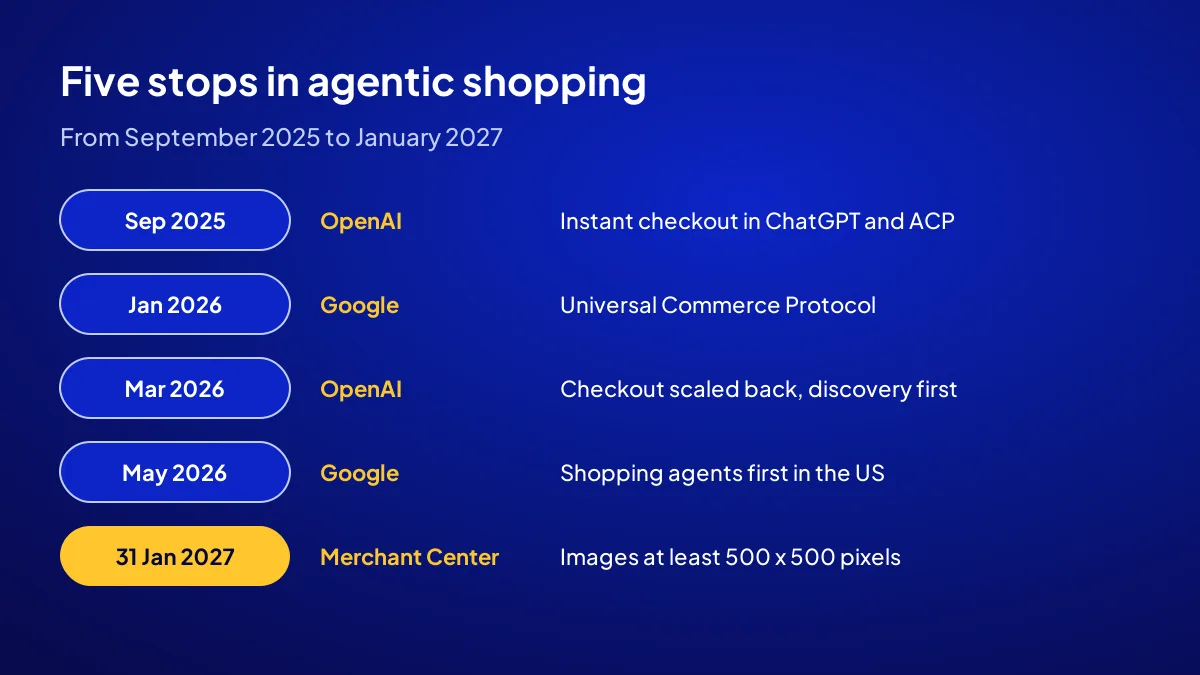
Agentic shopping changes fast within a year. OpenAI announces instant checkout in ChatGPT in September 2025, and Google unveils the Universal Commerce Protocol with Shopify, Etsy, Wayfair, Target and Walmart in January 2026. Both protocols ask sellers for regularly refreshed product data.
| When | Who | What happens |
|---|---|---|
| September 2025 | OpenAI | Instant checkout in ChatGPT and the Agentic Commerce Protocol announced |
| January 2026 | Universal Commerce Protocol; checkout from US retailers inside AI Mode and Gemini | |
| March 2026 | OpenAI | Instant checkout scaled back; discovery and comparison come first |
| May 2026 | Booking and shopping agents open first in the US | |
| 31 January 2027 | Google Merchant Center | Minimum 500 x 500 pixel product image requirement begins |
Why does the agent choose more than it buys?
BU BÖLÜMÜN ÖZETİ
- The shortlist is the new shop window
- Inconsistent data gets you dropped
- A recommendation is a result, not a cause
Because buying is hard and choosing is easy. According to reports, OpenAI admits the first version of instant checkout lacked the flexibility it aimed for; merchant onboarding, accurate product data and multi-item baskets stand out as obstacles. ChatGPT turns into a discovery tool that sends shoppers to the seller’s own checkout.
The shortlist is the new shop window
The agent usually shows a handful of options. If your workshop is not on that list, the customer never visits. When the till is quiet, the reason may be the list, not the price.
Inconsistent data gets you dropped
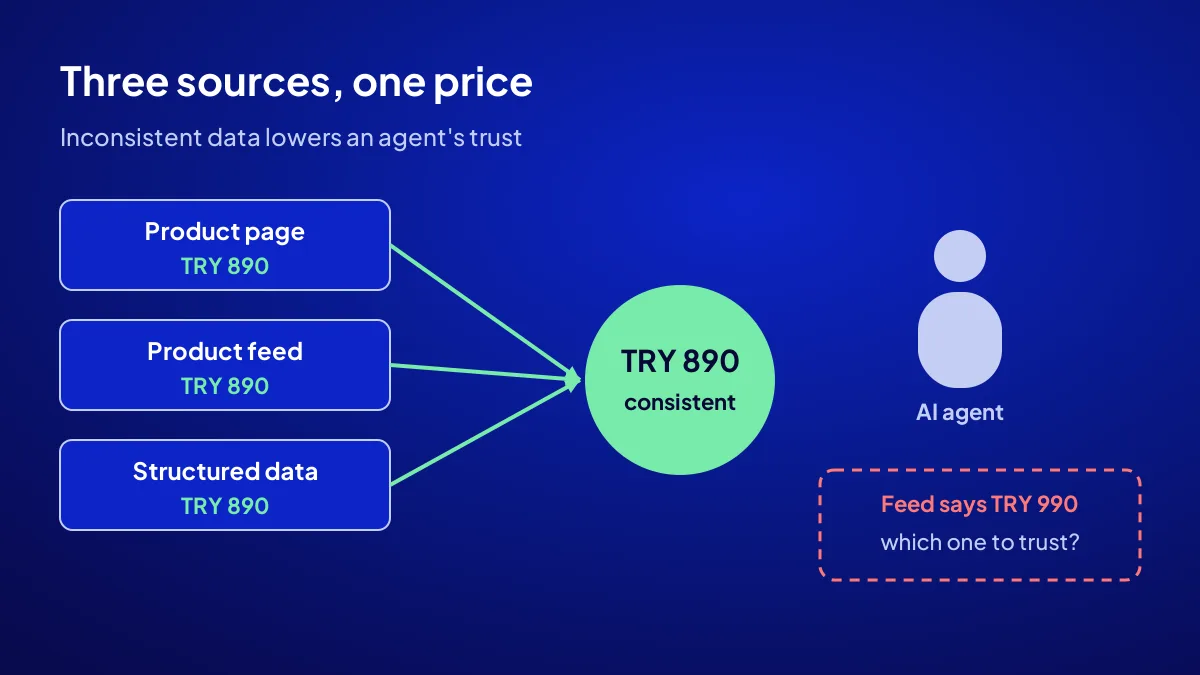
A product showing TRY 890 on the page and TRY 990 in the feed looks unreliable to an agent. How structured data prevents this mix-up is shown with examples in why structured data matters.
A recommendation is a result, not a cause
To see why assistants recommend a brand, look at what they read first; the guide how to get recommended by assistants covers this in detail.
Which 6 facts should a product page state clearly in 2027?
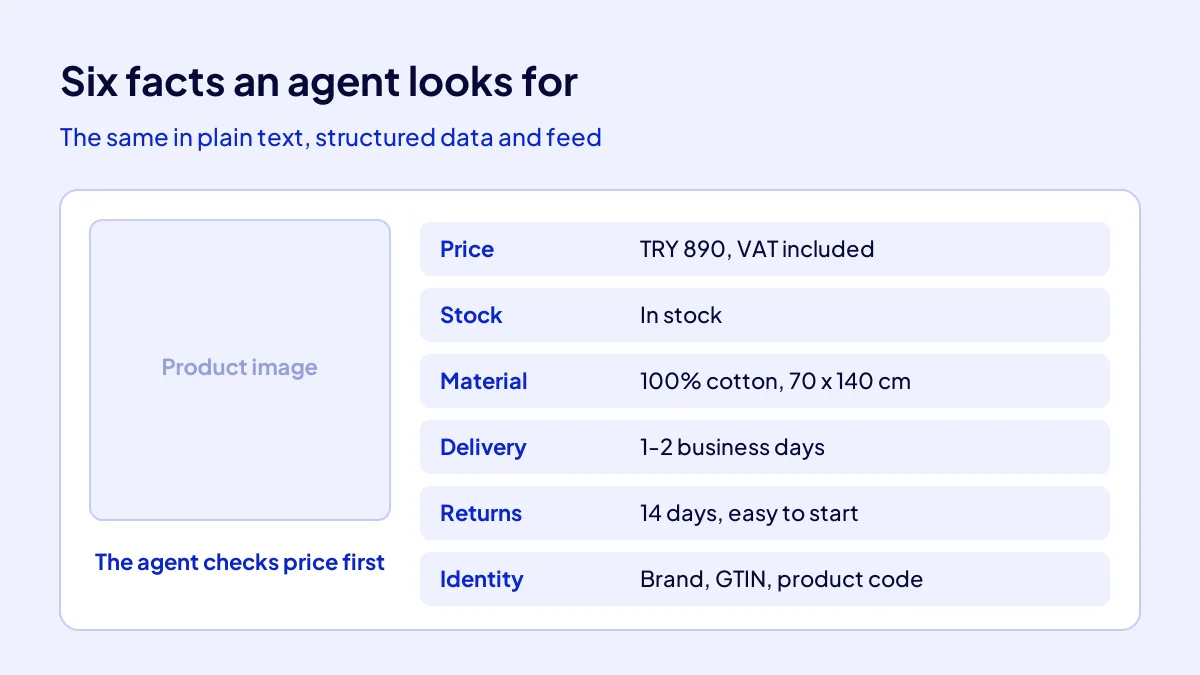
A product page ready for 2027 answers the six questions an agent will ask, in plain text near the top of the page. The same facts appear with the same figures in structured data and in the product feed. The first item is the most critical, because the agent checks price first.
- Current price and currency: one clear figure, such as “TRY 890, VAT included”.
- Stock status: in stock, preorder or sold out.
- Material and size: “100 percent cotton, 70 x 140 cm, 500 g/m²”.
- Delivery time and cost: “1-2 business days, free over TRY 750”.
- Return terms: how many days, who pays, how to start.
- Brand and identity: brand name, GTIN if available, product code.
The product title should carry information
Google Merchant Center’s product data specification sets a maximum of 150 characters for titles and 5,000 for descriptions. “Cotton bath towel 70 x 140 cm, white” catches more of an agent’s filters than “Bath towel”.
Fix image sizes now
Under the same specification, from 31 January 2027 product images must be at least 500 x 500 pixels. Replacing small images now keeps products from being dropped in January.
Why should the page, the feed and structured data say the same thing?
The agent gathers information from several sources and compares them. The page text, its structured data and the product feed sent to channels like Merchant Center should state the same price and stock. When one disagrees, the agent does not know which to trust.
When the price changes, three places change
Many businesses update the site price during a sale and forget the feed. Manage prices in one place and push them to the others automatically.
Where should a small online store start today?
First, check the pages of your 10 best-selling products against the six facts above; adding the missing ones is a weekend’s work. Second, add structured data and make sure the price is identical in all three places. Third, move the questions customers ask onto the page as Q&A blocks.
Getting the groundwork built in one go
For e-commerce and brands, the AI SEO campaign builds structured data, entity structure, Q&A blocks on existing pages and 108 articles across 6 question groups in 30 days. The fee is TRY 36,000 + VAT; with 20 percent VAT that is TRY 43,200, but check the current rate on your invoice. Only 12 businesses are taken per period; details are on the AI SEO campaign page. The logic of the package is explained in AI SEO with 108 articles.
Why is a page written for agents also a better page for people?
Because the questions an agent asks are the questions customers already ask. A page with a clear price, written delivery time and plain return terms also satisfies the customer who calls to ask about delivery. Nobody knows for sure when agents will take payments in Turkey, but a page that is readable today is ready when that day comes.
One warning: no guarantee
No adjustment guarantees an agent will recommend your product; the work makes it readable and comparable.
One principle
Write each fact once, clearly, and the same everywhere. In agentic shopping, the business that makes the shortlist is the one with the cleanest information.
Quick Summary
- An AI shopping agent looks for price, stock, material, delivery, returns and identity on the product page.
- OpenAI scales back instant checkout in March 2026; for now the agent chooses and the sale ends on your site.
- Google’s shopping agents open first in the US; no Turkey timeline is announced.
- From 31 January 2027, Merchant Center images must be at least 500 x 500 pixels.
- The page, the product feed and structured data should show the same price.
- A page fixed for agents also works better for human customers.
Short Glossary
AI agent: An AI agent is software used to find, compare and act on information on a user’s behalf.
Product feed: A product feed is a data file used to send product price, stock and attribute information to platforms on a regular basis.
GTIN: A GTIN is a global trade item number used to identify a product worldwide with a single code.
Next Step
If you want your product pages to be readable by AI agents, apply for the AI SEO campaign and see what is missing with your diagnosis card.
Frequently Asked Questions
Source: Google Merchant Center Help — Product data specification
Sık Sorulan Sorular
As of October 2026, we cannot find an official Turkey timeline for these checkout features, which mainly target US retailers. Preparation does not need to wait.
A product page alone does not answer some questions: “How do I wash cotton towels?”, “Bamboo or cotton?” Articles answering them help the agent recognise you. Which businesses need this work first is covered in who needs AI SEO first.
As of October 2026, OpenAI’s and Google’s agent checkout features are announced mainly for US retailers. We cannot find an official timeline for Turkey. Product discovery and comparison, however, already read your product pages today.
No. The AI SEO campaign does not guarantee recommendations. What it builds is the groundwork that makes your products and business readable and recognisable to AI, and the measurement of it.
Check that price, stock, material, delivery, returns and brand are written in plain text on the pages of your 10 best-selling products. Then make sure this information matches the product feed and structured data.
Updated: October 2026