
Auto Glass Shop: Which Document Comes From Which Authority?
In the auto glass trade, knowing the document list is not enough; you need to know which door each document comes through. The commonest reason a file falls behind is not a missing paper but an authority approached out of turn.
Below we separate the process authority by authority. There are four rings, and each has its own output, its own waiting time and its own precondition. If you intend to work with an insurance agreement, a fifth bundle of papers joins them.
A four-ring map of authorities
| Ring | Authority | Output | Precondition |
|---|---|---|---|
| 1 | Tax office | Commencement notice and tax certificate | Address and activity code |
| 2 | Tradesmen’s or trade chamber | Chamber registration document | Tax certificate |
| 3 | District municipality | Workplace opening and operating licence | Tax certificate, chamber registration, premises papers |
| 4 | The administration on the environment and waste side | Waste declaration and collection arrangement | The nature of the activity |
The real information sits in the last column. The third ring wants the output of the first and second as a precondition, which is why going to the municipality first wastes time.
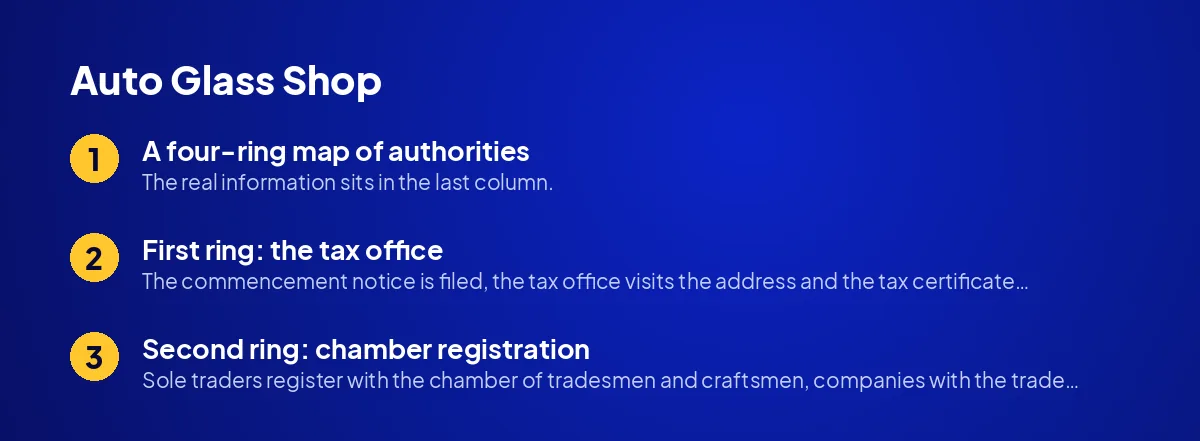
First ring: the tax office
The commencement notice is filed, the tax office visits the address and the tax certificate is issued. Choosing the activity code correctly matters at this stage; selling glass and fitting glass may not be assessed under the same code.
Pick the code with your accountant and discuss the services you may add later as well. Changing a code afterwards is possible but means an extra procedure and a delay; a broad first choice removes the need for it altogether.
Second ring: chamber registration
Sole traders register with the chamber of tradesmen and craftsmen, companies with the trade chamber. This ring runs mechanically and usually closes within days.
The one point to watch is that chamber registration is a precondition for the municipal file. Delaying it delays the chain, so make the chamber application the day your tax certificate appears.
Third ring: the district municipality
The workplace opening and operating licence is obtained in this ring. What decides matters is where the shop lands in the non-sanitary establishment (second or third class) assessment.
A business that only sells glass and one that cuts, shapes and fits it on the vehicle may not be placed in the same class. Set down the operations you intend to carry out and have the district municipality give you the classification in writing.
What the municipal file typically calls for
- Application form and declaration
- Lease or title deed
- Occupancy permit
- Tax certificate and chamber registration document
- Mastership certificate or vocational qualification certificate (MYK), according to district practice
- Fire brigade report, depending on the activity and floor area
No promise of a closed list is made here. Municipalities may call for further papers according to their own practice. When you hand the file in, ask in writing which items are counted as missing; that way you do not walk through the same door twice on the second round.
Fourth ring: the waste side
Broken glass, laminate film and adhesive residues are the unseen burden of this trade. Three windscreens removed in one day build into a serious volume within a week.
Ask the relevant administration in writing which class this waste falls into and how it is to be handed over. Where adhesive and filler residues are involved, the hazardous waste declaration heading can come into play.
The extra papers an insurance agreement brings
A considerable share of turnover in the auto glass trade comes through the insurance channel. Joining an insurer’s network of approved repairers creates a fifth bundle of papers outside the four rings of authorities.
Headings typically raised
- Attaching the licence and chamber registration to the agreement application
- A document showing the competence of the fitting staff
- Business liability insurance and the cover arrangement
- A standard for invoices, work orders and photographic records
The fourth item is the one most often underrated. Working through the insurance channel means every job is photographed and logged; an agreement cannot be sustained without that discipline.
Does offering a mobile service change the file?
Businesses fitting glass at the customer’s own address are increasing. The model does not remove the shop’s paperwork; you still take out the licence against your business address.
What must be settled, though, is the vehicle, the equipment and where the waste will be brought. Broken glass taken off in the field being carried back to the business address and gathered there should be thought of as part of your waste arrangement.
The premises: storage and curing
Glass is fragile and heavy. The storage area needs to suit vertical racking, and the fitting bay needs to be enclosed and kept at a reasonable temperature.
Adhesive curing time depends on temperature. Fitting done in the open and in the cold does not give a dependable result, which makes an enclosed fitting bay a necessity in this trade rather than a preference. The capital and cost bands are laid out on our automotive sector page.
Supply: the original and aftermarket divide
Supply in auto glass runs along two lines: original glass coming through the manufacturer’s network, and aftermarket product from independent makers. The two differ in price, in lead time and in the risk of a complaint after fitting.
If you intend to work through the insurance channel, establish which line is accepted before the agreement is signed. In direct sales to a customer, make sure the make and type of the glass fitted appears on the invoice; that record is the only answer to questions raised later.
There is no single figure for fees and charges
There is no one figure for the licence fee, the signboard tax or the items beside them; every municipality applies its own tariff and updates it once a year. Request the schedule in force from the revenue department of the district municipality before you open the file.
How to ask an authority for written confirmation
- Set out the address, the activity you plan and your list of operations on a single page
- Add the question of establishment class and the papers required to that page
- Have the application logged and ask for the answer in writing
These three steps take an afternoon and head off most of the alteration surprises that emerge later. For the general order authority by authority see the business licence roadmap; if you are considering side products look at our car accessories article, and if the interior trim side interests you see our car upholstery article.
In Short
- The process runs through four rings of authorities, each the precondition of the next
- Going to the municipality first wastes time; tax certificate and chamber registration come before it
- Ask for your establishment class in writing with your list of operations attached
- Broken glass, laminate film and adhesive residue build up a serious volume
- For adhesive residues the hazardous waste declaration heading can arise
- An insurance agreement creates a fifth bundle of papers
- In the insurance channel every job is expected to be photographed and logged
- A mobile service does not remove the shop’s licensing duty
- Settle the original and aftermarket divide before signing an insurance agreement
- Curing depends on temperature; an enclosed fitting bay is obligatory
- Fees follow the municipal tariff and are updated each year
Quick Glossary
Laminate film: the interlayer between the two glass layers of a windscreen that stops it scattering when it breaks. Curing: the time an adhesive needs to reach its bonding strength. Hazardous waste declaration: the notification to the relevant administration of the type and quantity of certain wastes. Approved repairer: a business cleared in advance to which an insurer directs its claims work.
Next Step
Let’s plan your order of authorities and your insurance agreement preparation together: consultation request form.
Frequently Asked Questions
Updated: September 2026
Sık Sorulan Sorular
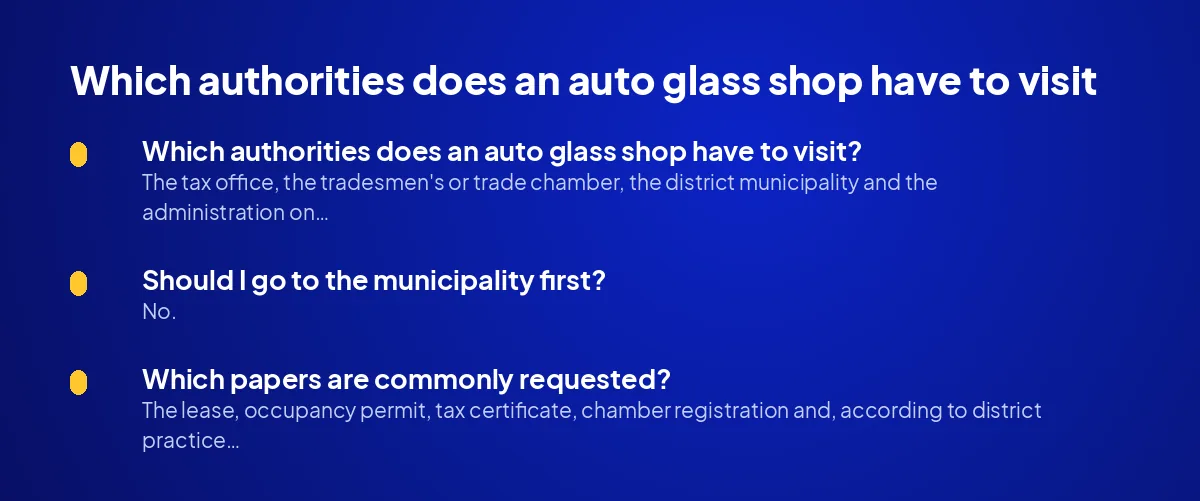
The tax office, the tradesmen’s or trade chamber, the district municipality and the administration on the waste side. That is the order it runs in.
No. The municipal file wants the tax certificate and chamber registration as preconditions.
The lease, occupancy permit, tax certificate, chamber registration and, according to district practice, a mastership or vocational qualification certificate.
The class of the waste and the collection arrangement are set by the relevant administration. Where adhesive residues are present, the declaration heading can arise.
Usually yes. The licence, chamber registration, staff competence and liability insurance are typically asked about.
You do. The licence is taken out against your business address; a mobile service does not lift that duty.
The answer depends on how your district applies the rule and on what you intend to do on the premises. Get it in writing before you open the file.
No single figure applies; the amount comes from your municipality’s tariff and changes annually. The revenue department will give you this year’s.
A few weeks to two months if the rings run in parallel and the premises suit. Alteration work is added to that.