
Agent Commerce Audit: How Do You Know Whether Your Store Is Ready for AI Agents?
An agent commerce audit is a regular check that measures whether a store is readable, accurate and reachable for AI agents. It is not done once and set aside; it is repeated as the store changes and the standards develop. 🔍
This article covers what the audit measures, data and feed checks, policy and legal checks, access and measurement checks and how the audit is carried out. The check headings were compiled according to the state of standards and tools on 12 November 2026. This article is for information only and is not legal advice; consult a lawyer about your own situation.
What does the audit measure?
BU BÖLÜMÜN ÖZETİ
- Readability
- Accuracy
- Access and records
An agent commerce audit looks for answers to three questions. Each corresponds to a separate group of checks, and together they show a store’s readiness in a single table.
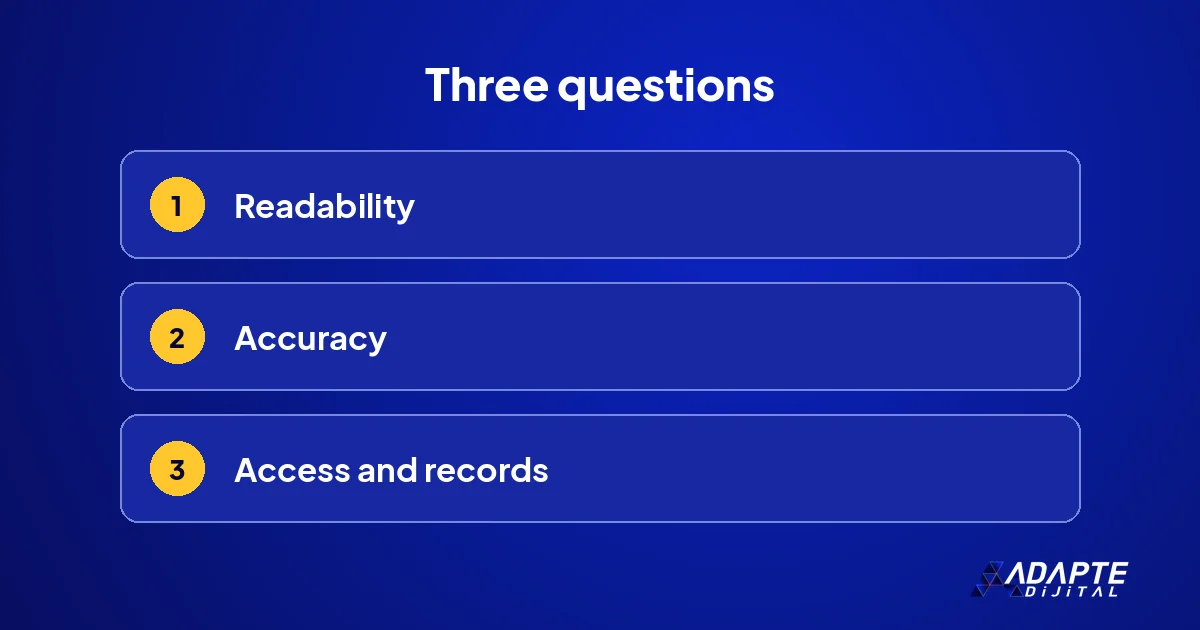
Readability
Can an agent find the store’s products, prices and terms in a machine-readable form? Are product identifiers, attributes, shipping and return information in separate fields, or buried in running text? Information that cannot be read does not exist for an agent. This question is the first step of the audit, because accuracy cannot be checked on data no one can read. 📖
Accuracy
Is the information that is read correct and the same on every channel? Do the feed, the page, structured data, checkout and the marketplace record state the same price, stock and terms? Accuracy comes after readability but weighs more heavily. Contradictory data is worse than missing data, because it undermines trust in everything else the store says.
Access and records
Can agents reach the site, and can the store see visits and orders coming from agents? An agent that is blocked cannot see the store; a store without records cannot know the agent’s influence. Access and records are the invisible but critical leg of the audit. They are often skipped because nothing looks broken from the outside. 🔐
Data and feed checks
BU BÖLÜMÜN ÖZETİ
- Identity and attribute fields
- Feed diagnostics
- Consistency between page and feed
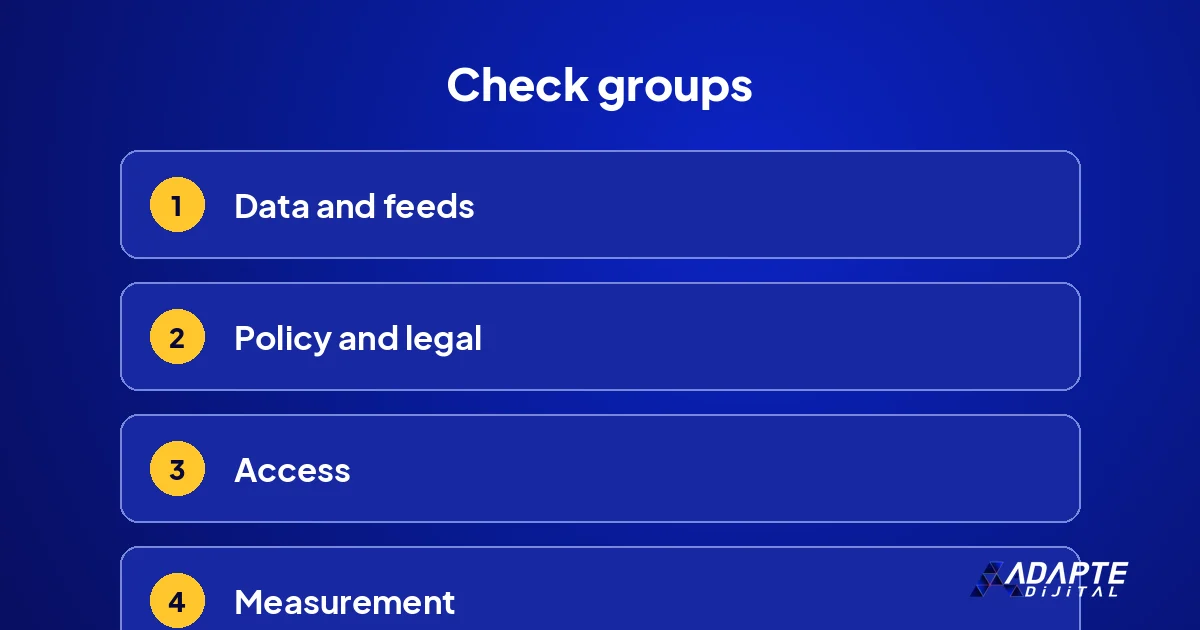
The most extensive part of the audit is the data and feed check. It is carried out under three headings.
Identity and attribute fields
For the selected products, GTIN, brand, manufacturer part number, category, variant structure and core attributes are checked one by one. Empty, wrong or contradictory fields are marked. The share of products with identifiers filled in is the audit’s first numerical indicator, and it is the one most likely to improve quickly once fixes start. 🏷️
Feed diagnostics
The error and warning report in Merchant Center is read: disapproved products, missing attributes and mismatch warnings. The number of products each type of warning affects is noted. The warning that affects the most products goes to the top of the fix list. The dates of warnings are recorded too, because the same warning recurring points to a process problem.
Consistency between page and feed
For the sample products, price, stock and shipping information in the feed is compared with the information on the page and in structured data. The detailed method for this comparison is covered in price and stock accuracy in agent commerce. The consistency rate is the audit’s second numerical indicator. 🔄
Policy and legal checks
BU BÖLÜMÜN ÖZETİ
- Return and delivery data
- The pre-contract information flow
- Seller information
An agent looks at the terms of a purchase as much as at the product. The policy check confirms that these terms are readable and consistent.
Return and delivery data
Do the return window, return costs, exceptions and delivery time appear the same way in product data, structured data and Merchant Center settings? A gap between the policy text and the policy data is a common finding in audits. If there is a gap, the source is identified first, then every place that copies it is corrected. 🔁
The pre-contract information flow
Are the pre-contract information, the distance sales contract and the withdrawal texts up to date, and has anyone considered how they would reach the customer in an agent-assisted purchase? This heading requires legal assessment; the audit measures only technical readiness, and legal advice comes from a lawyer. The audit simply makes sure the question is on the table.
Seller information
Are the store’s name, address, contact details and customer service channels consistent on every channel, and is organisation information marked up with structured data? A seller whose identity is unclear falls behind in an agent’s eyes. This check takes little time but has a large effect, and it is easy to keep right once fixed. 🏢
Access and measurement checks
BU BÖLÜMÜN ÖZETİ
- Robots.txt and the firewall
- Analytics channels
- Server logs
The audit’s last group of checks tests agents’ access to the site and the store’s ability to measure agent influence.
Robots.txt and the firewall
The robots.txt file, firewall and bot protection settings are reviewed. The check confirms that the assistants and agents you want are not blocked by mistake. A door closed by mistake wastes all the data work behind it. Blocking decisions should be deliberate and written down, with a short list of which agents are accepted and which are not. 🚧
Analytics channels
Are the assistant channel in Google Analytics, Search Console’s generative AI report and any custom channel groups working? Can the last three months of data be read? Having measurement tools in place is a precondition for seeing an agent’s influence. How to set these up and read them is covered in measuring agent traffic.
Server logs
Can assistant and agent visits be separated in the server logs, and are agents getting errors? Pages that return errors are listed. A habit of reading logs shows what analytics cannot. This check can be done once a month with a short summary from your host or technical team, which keeps it cheap enough to sustain. 🧾
How is the audit carried out?
BU BÖLÜMÜN ÖZETİ
- Frequency
- Sampling
- Report and fix list
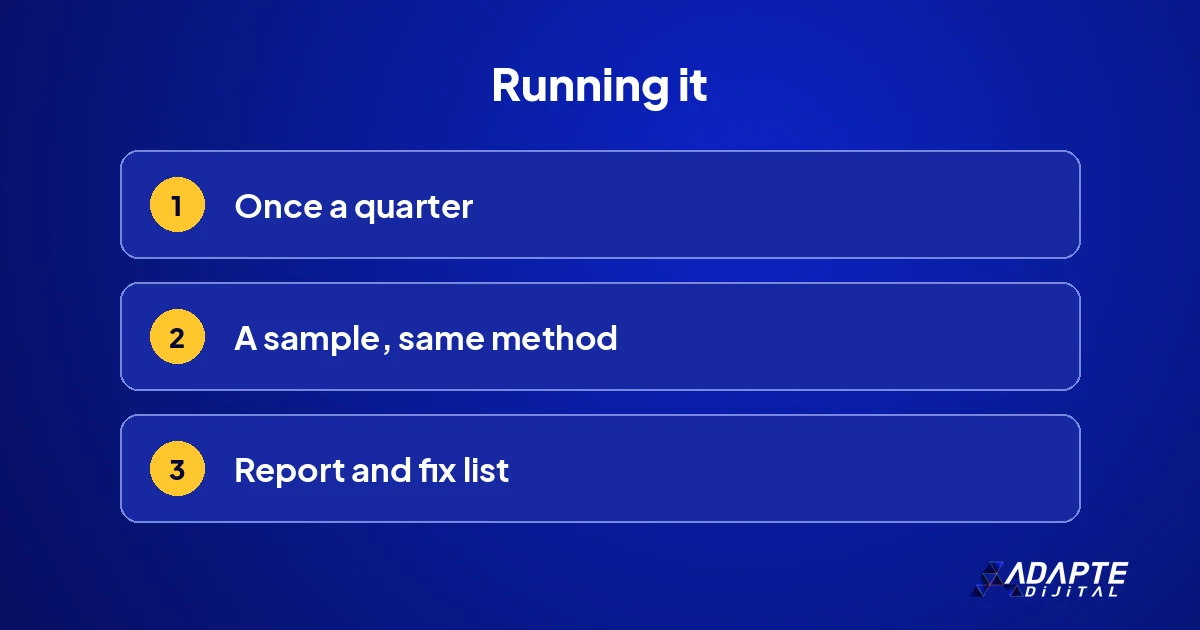
The value of an audit comes from doing it regularly and with the same method.
Frequency
A full audit is done once a quarter; an extra check is added after major changes, such as a platform change, a new integration or before a busy campaign period. Regular audits catch problems while they are small. The schedule is set at the start of the year, so the audit does not slip when the team is busy. 📅
Sampling
Instead of checking the whole catalogue item by item, a sample made up of best sellers and randomly chosen products is used. The sample is chosen the same way in every audit. The same method makes audits comparable with one another. Including both best sellers and newly added products gives a balanced picture of where the catalogue stands.
Report and fix list
The output of the audit is a short report and a fix list in order of priority: numerical indicators, the problems found and who is responsible. The general framework of an e-commerce audit is covered in what an e-commerce audit is. A finding that is not fixed becomes the first line of the next report. 📋
What does Adapte Digital do in an agent commerce audit?
BU BÖLÜMÜN ÖZETİ
- A single delivery package
- What is delivered
- Where to start
We carry out the audit as a delivered job: data, policy, access and measurement are checked, and a report and an ordered fix list are handed over to you.
A single delivery package
Adapte Digital does not charge a monthly management fee. Work starts with a single delivery package whose scope is written down in advance: 36,000 TRY + VAT. If the work grows, the new need is defined as a separate add-on package, priced by what will be delivered rather than by the hours spent. 📦
What is delivered
The output is an audit report with numerical indicators, a fix list in order of priority and a reusable check template for the next audit; legal assessment is done with your lawyer. How visibility in AI answers is audited is explained in AI visibility audit.
Where to start
Which packages are open, and at what price, is shown on our campaign pages, item by item. 🧭
Planning to do this work for other businesses? Our article on agent commerce auditing shows what that door looks like.
Quick Summary
- An agent commerce audit measures readability, accuracy, and access and records.
- Data and feed checks cover identity fields, feed diagnostics and consistency between page and feed.
- Policy checks confirm return, delivery, pre-contract and seller information.
- Access and measurement checks test robots.txt, analytics channels and server logs.
- The audit runs once a quarter with the same method; this article is not legal advice.
Short Glossary
- Audit sample
- The products selected by a set method to be checked in an audit.
- Consistency rate
- The share of sample products for which the feed, the page and structured data give the same information.
- Fix list
- A list of problems found in an audit, ordered by priority and assigned to owners.
Frequently Asked Questions
Next Step
Open the warnings in Merchant Center and write the three warnings that affect the most products onto the fix list for your first audit. Our campaign pages list the delivery packages that cover this work.
Sources: Google Merchant Center Help — Product data specification · Google Search Central — Introducing Search Generative AI performance reports in Search Console · PPC Land — Google Analytics adds AI Assistant channel for ChatGPT, Gemini and Claude
Updated: November 2026
Sık Sorulan Sorular
For a small store it can be completed within a few days. The time depends on the size of the catalogue, the number of channels and the breadth of the sample.
Yes; the check groups in this article offer a starting list. What matters is using the same method in every audit and keeping the results in writing.
The aim of the audit is not a score but an ordered fix list. Indicators such as the identifier rate and the consistency rate show progress between audits.