
Price and Stock Accuracy in Agent Commerce: Why It Matters as Much as the Sale Itself
Price and stock accuracy in agent commerce means that the price and availability a store states in its feed, structured data and pages match reality exactly. An agent passes this information to the customer as a promise. If the promise is not kept, the error stops being a data problem and becomes a sales problem. 💳
This article covers why price and stock accuracy matter so much, the legal dimension in Türkiye, where errors come from, what Google does about it and how accuracy can be protected. The information was compiled on 12 November 2026 from official sources. This article is for information only and is not legal advice; consult a lawyer about your own situation.
Why does it matter so much?
BU BÖLÜMÜN ÖZETİ
- The agent makes a promise
- Errors multiply
- The trust account
A human buyer may notice a price difference on a page and walk away. An agent trusts the data and passes it on to the customer. That difference makes accuracy critical.
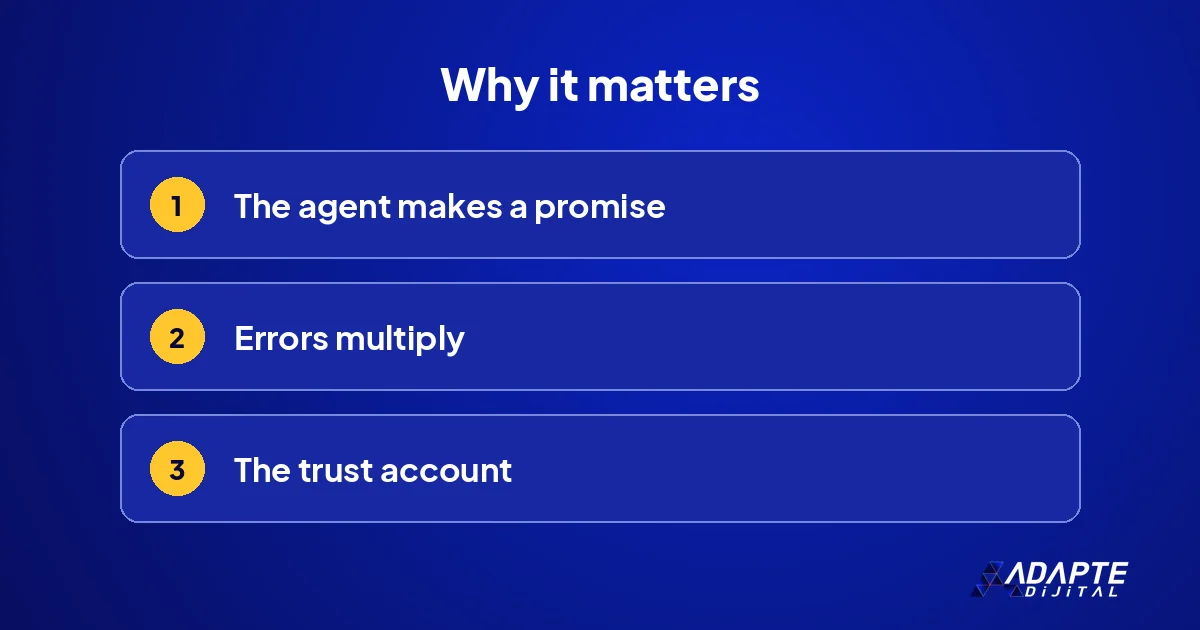
The agent makes a promise
When an agent says “this product is in stock, at this price, with you tomorrow”, it is repeating the store’s data. The customer hears it as the store’s promise, not the agent’s. A broken promise is debited from the store’s trust account. The fields agents read are covered in detail in the product data agents read. 🤝
Errors multiply
A single wrong price that one human buyer might notice can be passed to many customers at once in the agent era. An agent does not question an error; it relays it. Machine speed is also the speed of error. That is why accuracy is as important a competitive factor as speed in agent commerce, and why errors need catching within hours rather than days.
The trust account
In Merchant Center, Google may disapprove products whose price or availability does not match the page; if mismatches pile up, risk arises at account level. Platforms track trust account by account too. Trust lost in one channel may also affect the likelihood of an agent recommending that store, so a feed problem is never only a feed problem. 📉
The legal dimension in Türkiye
BU BÖLÜMÜN ÖZETİ
- The “out of stock” excuse
- Delivery deadlines
- Data as a statement
Price and stock information is not only a marketing matter but part of the legal framework of distance selling.
The “out of stock” excuse
According to the Ministry of Trade’s 2022 announcement, an amendment to the Distance Contracts Regulation established that goods being out of stock does not count as making delivery impossible. Selling a product that is not in stock is therefore not only a customer satisfaction problem. Consult a lawyer for the details of how this applies to your store. ⚖️
Delivery deadlines
The regulation requires the seller, as a rule, to deliver an order within 30 days. If an order is not delivered on time, the consumer can terminate the contract, and the seller must refund the payment within 14 days with statutory interest. Wrong stock information can trigger these obligations directly, which turns a data error into a cost with a deadline.
Data as a statement
Price and stock information in the feed, on the page and in structured data is part of the statement a store makes to the customer. The agent merely carries that statement. The store is responsible for the accuracy of the statement, which is why the source and update frequency of price and stock data should be written down. 📄
Where do errors come from?
BU BÖLÜMÜN ÖZETİ
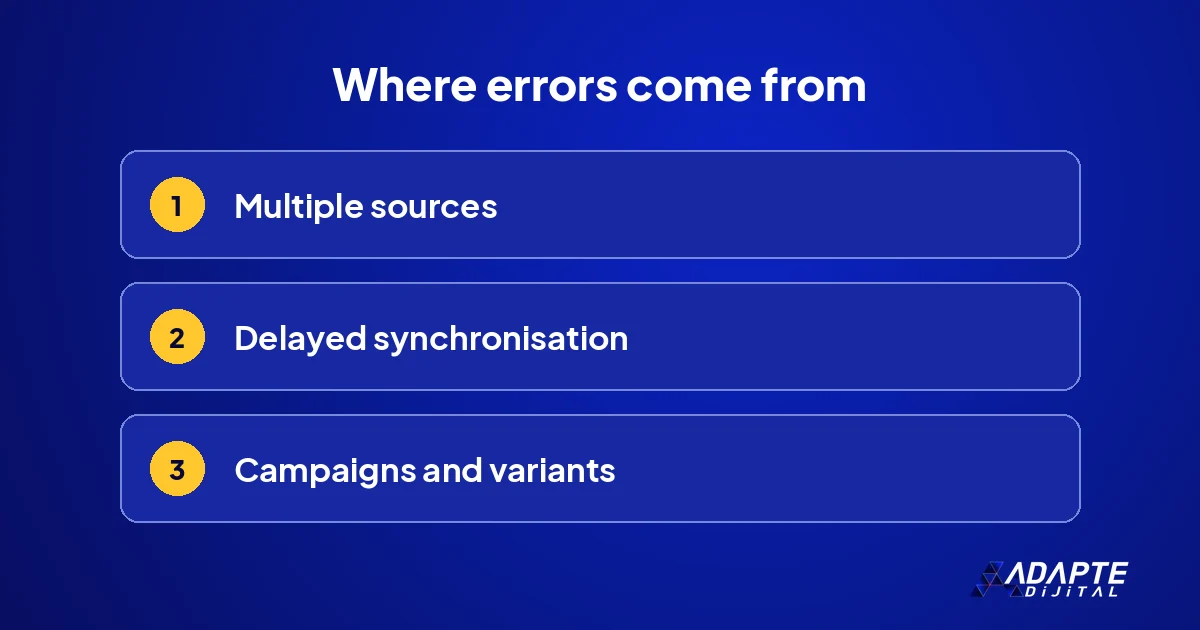
- Multiple sources
- Delayed synchronisation
- Campaigns and variants
Most price and stock errors come not from bad intent but from systems that do not talk to each other.
Multiple sources
If price is updated in an ERP, stock in warehouse software, campaigns in a marketplace panel and the product page in the e-commerce platform, differences between these sources are inevitable. The more sources there are, the more likely contradictions become. Each field should have a single owner, and that owner should be written down where everyone can see it. 🔀
Delayed synchronisation
If the feed is updated once a day, prices and stock that change during the day stay stale until the next update. WooCommerce also recommends replacing daily updates with near-real-time options. For fast-selling products, synchronisation frequency is accuracy itself. The fastest sellers are where the gap between data and shelf grows quickest.
Campaigns and variants
Campaign start and end times, variant-level prices and regional stock are where errors arise most often. A finished campaign still running in the feed, or a single variant’s stock being applied to the whole product, are common. The riskiest moments are known in advance, so checks are concentrated on those moments rather than spread thinly. 🏷️
What does Google do?
BU BÖLÜMÜN ÖZETİ
- Comparing the page and the feed
- Automatic item updates
- A warning about frequent price changes
Google monitors price and stock accuracy on its shopping surfaces by comparing pages with feeds.
Comparing the page and the feed
Google’s crawler visits product pages regularly and compares the feed price with the price on the page or in structured data. A product with a mismatch may be disapproved. The page is the referee of the feed’s accuracy. That is why structured data on the page must be kept accurate as well, since it is one of the places Google checks. 🔍
Automatic item updates
Merchant Center’s automatic item updates can fix small mismatches in price, sale price, availability and condition using information on the page, and Google recommends structured data for this. The feature is a seatbelt, not a substitute for synchronisation. Product data should still be submitted regularly. Ways to keep feeds clean are covered in shopping feed optimization.
A warning about frequent price changes
According to the help page updated in September 2026, automatic updates may not work for products whose price or availability changes more than once a day, and such products may be disapproved. For a store using dynamic pricing, synchronisation frequency therefore becomes even more important, and price changes should be planned with the feed in mind. ⏱️
How is accuracy protected?
BU BÖLÜMÜN ÖZETİ
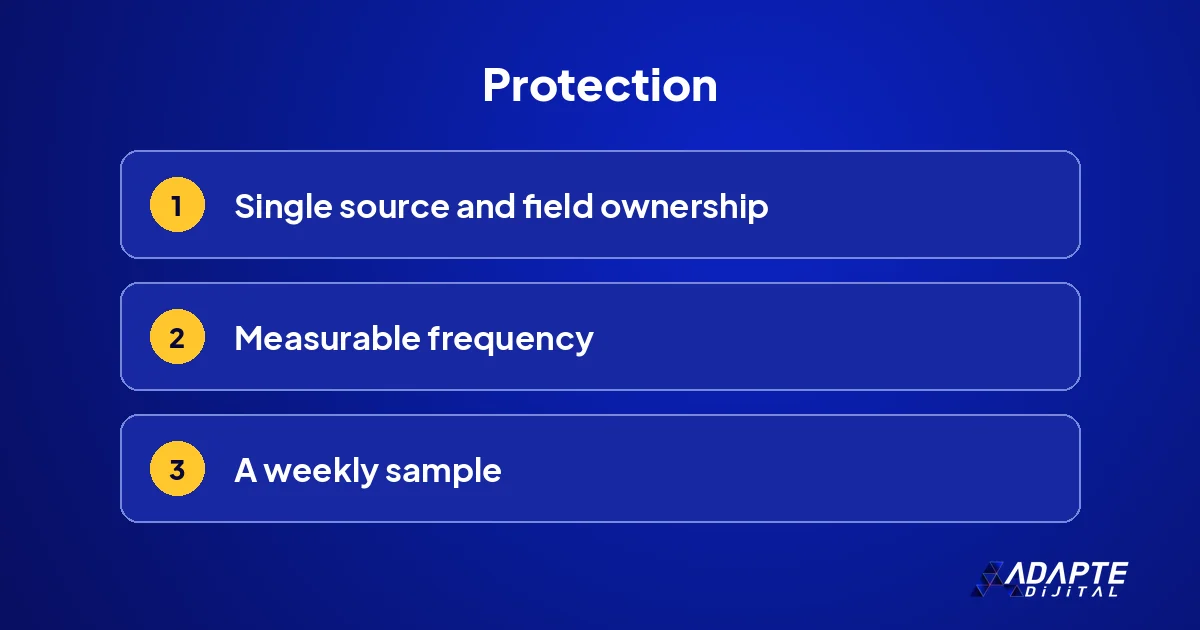
- A single source and field ownership
- Measurable frequency
- A weekly sample
Accuracy is not achieved once and left alone; it is protected through a regular process.
A single source and field ownership
Which system updates price, stock and campaigns is decided in writing, and other systems draw from that source. Field ownership is the constitution of accuracy. Integrations with marketplaces are a common place where ownership breaks down; how these connections are set up is covered in connecting to marketplaces. 📜
Measurable frequency
How often the feed and structured data are updated is measured and adjusted to each product group’s sales speed. Frequency is increased for fast sellers. A frequency that is not measured is merely good intent. Update times are kept in a table and checked weekly, so slippage is noticed before customers notice it.
A weekly sample
Each week, a few best-selling products are chosen and the price and stock in the feed, on the page, at checkout and in the marketplace record are compared side by side. A small sample catches a big problem early. Every difference found goes onto the fix list with its source, and recurring differences point to a process that needs fixing. ✅
What does Adapte Digital do for price and stock accuracy?
BU BÖLÜMÜN ÖZETİ
- A single delivery package
- What is delivered
- Where to start
We do not check accuracy once and walk away; we tie it to a process: field ownership is written down, synchronisation frequency is set and a weekly sample template is handed over.
A single delivery package
Adapte Digital does not charge a monthly management fee. Work starts with a single delivery package whose scope is written down in advance: 36,000 TRY + VAT. If the work grows, the new need is defined as a separate add-on package, priced by what will be delivered rather than by the hours spent. 📦
What is delivered
The output is a field ownership table, a synchronisation frequency proposal, a reading of the Merchant Center mismatch report and a weekly sample checklist. For WooCommerce stores, the wider preparation is described in preparing WooCommerce for agent commerce.
Where to start
Our current packages and capacity are listed on our campaign pages; scope and price are written there before any work starts. 🧭
One way to build a business on this knowledge is set out in our article on product data preparation services.
Quick Summary
- An agent passes price and stock to the customer as a promise; a broken promise lowers the store’s trust.
- Under the 2022 amendment, being out of stock does not count as making delivery impossible.
- Most errors come from multiple sources, delayed synchronisation and campaign transitions.
- Google compares pages with feeds; automatic updates are a seatbelt, not a substitute for synchronisation.
- This article is not legal advice; consult a lawyer about your own situation.
Short Glossary
- Mismatch
- When information in the feed and on the page do not agree.
- Automatic item update
- A Merchant Center feature that can correct fields such as price and availability by checking the page.
- Sample check
- Regularly checking a few selected products in detail instead of every product.
Frequently Asked Questions
Next Step
This week, write the price and stock of your five best-selling products as shown in the feed, on the page, at checkout and in the marketplace record side by side; if there is a difference, find its source. Our campaign pages list the delivery packages that cover this work.
Sources: Google Merchant Center Help — Allow Merchant Center to update product information automatically · Relevant Audience — Merchant Center warns fast price changes may trigger disapprovals · T.C. Ticaret Bakanlığı — İnternet ve telefon vasıtasıyla yapılan satışlara yeni standartlar geldi · WooCommerce — From found to bought: Getting your store ready to sell through AI
Updated: November 2026
Sık Sorulan Sorular
It depends on the details of the case and the nature of the error. Fix it immediately, record the affected orders and consult a lawyer for a legal assessment.
Turning them on acts as a seatbelt for small mismatches, but according to Google they may not work for products whose price changes more than once a day. The real solution is accurate, frequently updated data at the source.
According to each product group’s sales speed. For fast sellers, aim for near-real-time updates; for slow sellers, less frequent updates may be enough.