
The Two-Layer Website: How to Build One Site That Serves Both People and AI Agents

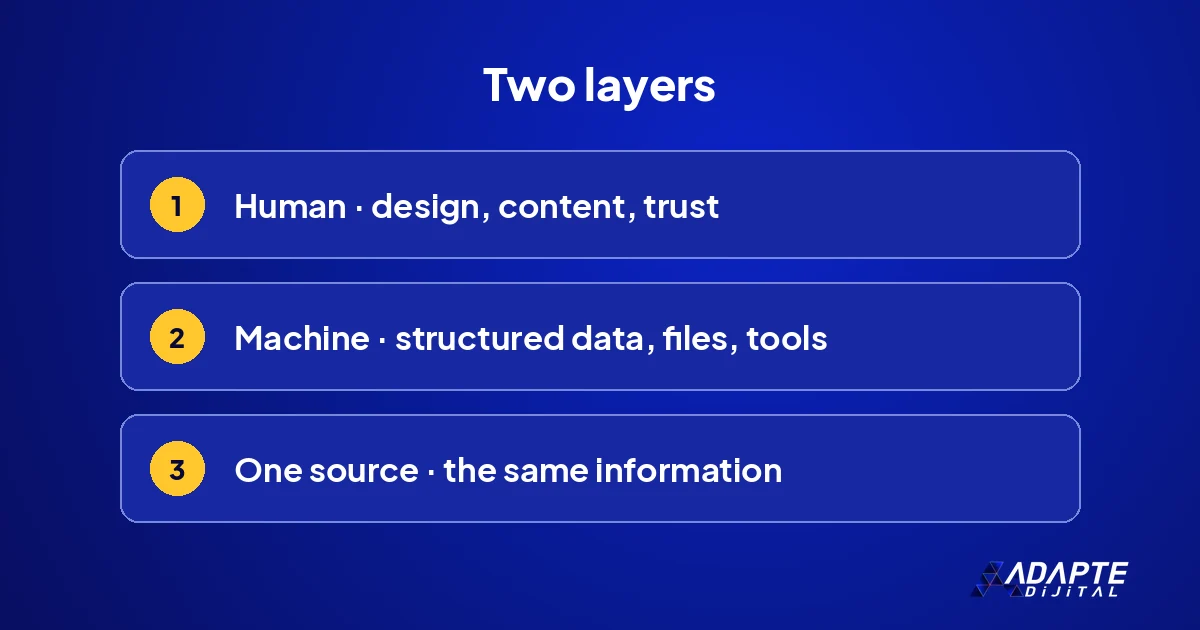
A two-layer website is a structure in which the same site offers human visitors a visual, understandable interface and offers AI agents orderly data and tools. It is not two separate sites but two forms of the same information: one for the eye, one for the machine. 🧱
This article covers what a two-layer website is, what the human and machine layers contain, how to keep the two in sync and what the risks are. The information was compiled with reference to search engines’ rules, the structured data vocabulary and the state of standards on 12 November 2026.
What is a two-layer website?
With agents entering the web, sites face a new question: how do you serve people and machines at the same time? The two-layer website is the answer.
Definition
On a two-layer site, the human layer is made up of design, text, images and interaction; the machine layer of structured data, a clear page structure, sitemaps and the tools offered to agents. Both layers draw on the same content management system. When a price changes, it changes on the page and in the structured data at the same moment, so no contradiction can arise and maintenance happens in one place. 🧩
The human layer
BU BÖLÜMÜN ÖZETİ
- Design and trust
- Speed and accessibility
- Content and story
The human layer is where a site earns trust and persuades. Preparing for agents should not weaken this layer; it should strengthen it.
Design and trust
Brand identity, real photographs, customer reviews and clear contact details win a human visitor’s trust. Even when an agent brings the customer, a person usually makes the decision, so the quality of the human layer affects sales directly. Trust signals should also have a counterpart in the machine layer, so an agent can see what a person sees. 🎨
Speed and accessibility
A fast, accessible site improves the human visitor’s experience, and the same qualities make it easier for agents to read the site. Ways to improve speed are covered in website speed. A slow, complicated page damages both layers at once, which makes performance work doubly valuable.
Content and story
Content that explains why a service is valuable persuades people; the clear facts inside the same content feed an agent’s answer. Story and information are not rivals: a good page carries both. Information should be written plainly in the text and not left only in images, so the story can persuade and the facts can be read. ✍️
The machine layer
BU BÖLÜMÜN ÖZETİ
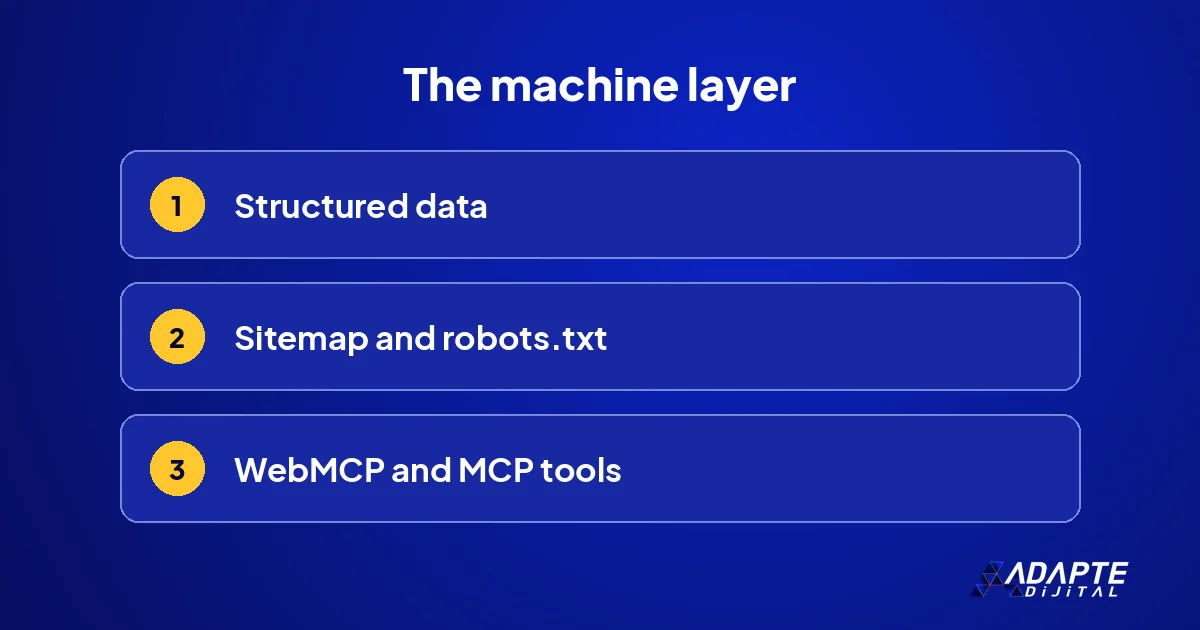
- Structured data
- Machine files
- Tool interfaces
The machine layer lets machines understand exactly what a site offers.
Structured data
Markup with the schema.org vocabulary makes the business, services, products, prices, opening hours and frequently asked questions machine-readable. Structured data must match the information on the page exactly. Giving information only in the markup that does not appear on the page undermines trust. How this markup supports AI systems is covered in schema structured data and AI. 🏷️
Machine files
Files such as the sitemap, robots.txt and the llms.txt some sites are trying tell machines about a site’s structure and rules. llms.txt is still a proposal, and which systems use it is debated; it is covered in what llms.txt is. If the basic files are in order, new proposals can be added at low cost, without becoming a priority.
Tool interfaces
The tools offered so agents can get things done on a site are the newest part of the machine layer: WebMCP on the browser side and MCP on the server side. WordPress is bringing this layer into the platform with the Abilities API and MCP Adapter. Tools can be opened safely when the underlying data layer is solid. Without it, a tool only exposes weak data faster. 🧰
How are the two layers kept in sync?
BU BÖLÜMÜN ÖZETİ
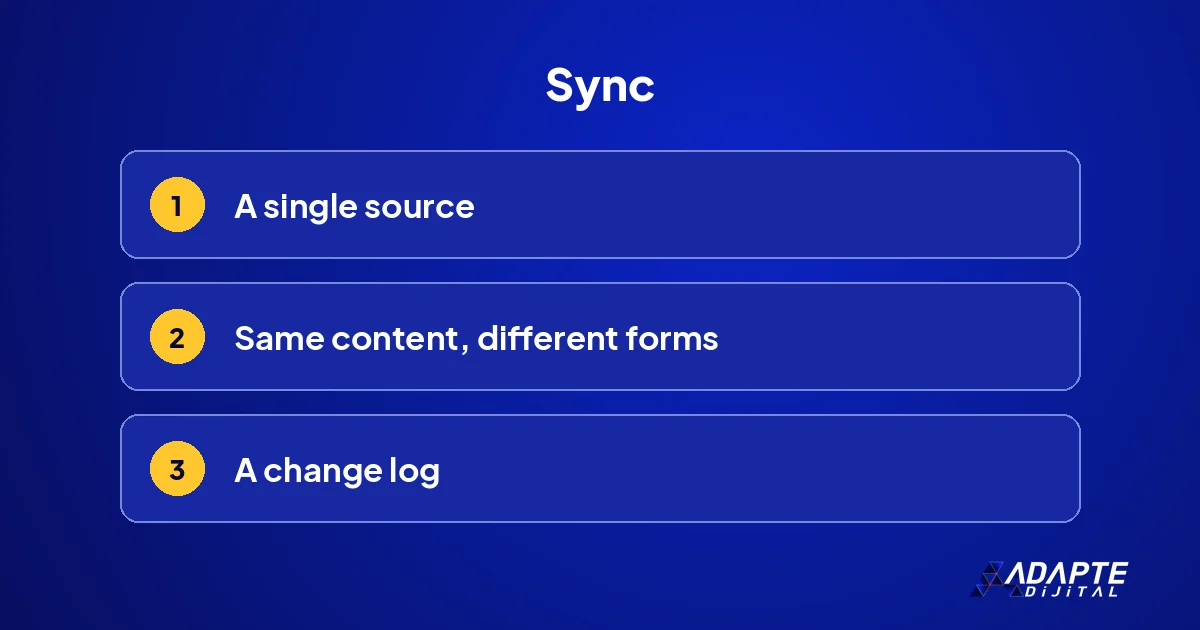
- A single source
- The same content, different forms
- A change log
The real challenge of a two-layer site is not building it but keeping it in sync over time. The biggest enemy of sync is the well-meant manual correction.
A single source
All information is kept in one content management system and distributed to both layers from there. Price, opening hours or service scope are changed in one place. Every field updated separately by hand will one day drift from the other layer. Every field that can be generated automatically should be, so the system rather than a person keeps the layers aligned. 🔄
The same content, different forms
The machine layer does not invent new information; it presents the information in the human layer in an orderly form. This principle protects both consistency and compliance: people and machines are told the same thing. Comparing pages with their structured data using random samples is enough to check it, and the check takes minutes.
A change log
Template, plugin or theme changes can quietly break the machine layer. After every significant change, structured data and tools go through a short check and the result is recorded. A change that is logged is easy to roll back when it breaks something. The log also shows which change caused a problem, which saves hours of searching. 🗂️
What are the risks and limits?
BU BÖLÜMÜN ÖZETİ
- The risk of cloaking
- The maintenance load
- Uncertain standards
If the two-layer structure is not built correctly, it can do more harm than good.
The risk of cloaking
Showing people and search engines different content counts as cloaking in Google’s spam policies. Offering special, different content to agents can come close to that line. The safe way is to present the same content in different forms, which keeps the site honest towards every reader, human or machine. ⚠️
The maintenance load
The machine layer needs maintenance too: structured data must be updated, tools tested and files checked. A layer without planned maintenance gradually turns into a source of wrong information. That is why it is made part of ordinary site maintenance, with a short checklist run after every update rather than a separate project.
Uncertain standards
Some parts, such as tool interfaces, are still in trial and may change. A tool layer built today may need updating in a few months. Lasting investment goes into parts with settled standards, such as structured data and orderly content, while new interfaces are tried carefully on top of them. 🧭
How does Adapte Digital build a two-layer site?
BU BÖLÜMÜN ÖZETİ
- A single delivery package
- What is delivered
- Where to start
We build the two-layer structure on top of your existing site: content is tied to a single source, structured data and machine files are arranged, and a sync check is handed over.
A single delivery package
Adapte Digital does not charge a monthly management fee. Work starts with a single delivery package whose scope is written down in advance: 36,000 TRY + VAT. If the work grows, the new need is defined as a separate add-on package, priced by what will be delivered rather than by the hours spent. 📦
What is delivered
The output is structured data fed from a single source, an arranged sitemap and robots.txt, a sync checklist and a roadmap for the tool layer. How sitemaps support AI systems is covered in an AI-compatible sitemap.
Where to start
The written scope of each package, with current pricing and capacity, is on our campaign pages. 🧭
We cover the earning-gate side of this topic in our article on WebMCP implementation services.
Quick Summary
- A two-layer site serves an interface for people and data and tools for agents from the same source.
- Offering separate, different content to agents creates inconsistency and a risk of cloaking.
- The machine layer is made up of structured data, machine files and tool interfaces.
- Sync requires a single source, the same-content principle and a change log.
- Lasting investment goes into parts with settled standards.
Short Glossary
- Human layer
- The face of a site made up of design, text, images and interaction, aimed at human visitors.
- Machine layer
- The arrangement of structured data, machine files and tools aimed at machines.
- Cloaking
- Misleading search engines by showing them different content from what users see.
Frequently Asked Questions
Next Step
On your three most important pages, check whether price, opening hours and contact details are the same on the page and in the structured data. Our campaign pages list the delivery packages that cover this work.
Sources: Google Search Central — Spam policies for Google web search · Schema.org — Vocabulary for structured data · llms.txt — The /llms.txt file proposal
Updated: November 2026
Sık Sorulan Sorular
Building a separate version for agents can look practical at first. But two separate sets of content drift apart over time and turn into contradictions. Google’s spam policies define showing search engines different content from what users see as cloaking, which makes the idea of a separate version risky. A single source avoids both problems at once.
Service businesses that collect enquiries, shops that sell products and content-rich corporate sites benefit most from a two-layer structure. Even for a small brochure site, the basics of the machine layer, structured data and a clear page structure, can be set up with little effort. The structure scales with the size of the site, so it can grow as the business does. 🏢
No. An existing site can become two-layer by tying content to a single source and adding the machine layer.
llms.txt is still a proposal, and which systems use it is debated. If the basic files and structured data are in order, it can be added at low cost, but it is not a priority.
You can offer agents a useful summary or an orderly data page, but the content must match the information on the human pages. Offering different content creates a risk of cloaking.