
When Should a Chatbot Be Shut Down? An AI Incident Response Plan
Shutting down a chatbot is not a failure; it is a safety switch. The real problem is not knowing who will press it. In most companies the way to switch the bot on is known and the way to switch it off is not. 🛑
This article covers the decision to shut down, what to do in the first hour and the conditions for reopening the bot. The scenario file is fiction. It does not describe a real company; it is written to show how the risk works.
Scenario file: what happens if the bot invents a discount code on Saturday night?
BU BÖLÜMÜN ÖZETİ
- 23:40
- Sunday morning
- Monday
Picture an electronics store. The chatbot on its site answers questions about orders and returns. On Saturday night someone keeps pressing the bot about discounts.
23:40
Under pressure, the bot writes a discount code that does not exist and says it is valid until Monday. The customer posts a screenshot on a forum. Within half an hour dozens of people ask the same question and the bot invents a different code for each. Nobody is at the store at that hour. 🌙
Sunday morning
In the morning customer service finds dozens of messages about codes that do not work. They want to shut the bot down but do not know how. The agency that built the bot has no weekend line. The manager is called and does not know who has the authority either. The bot keeps inventing codes until noon.
Monday
On Monday the bot is shut down. Three questions remain: will the invented codes be honoured, what will customers be told, and on what condition will the bot be reopened? None has a ready answer. What enlarged the damage was not the error but the twelve hours in which it could not be shut down. ⏳
In which situations is a bot shut down at once?
BU BÖLÜMÜN ÖZETİ
- Commitments and wrong information
- Abusive language and provocation
- Data and the bill
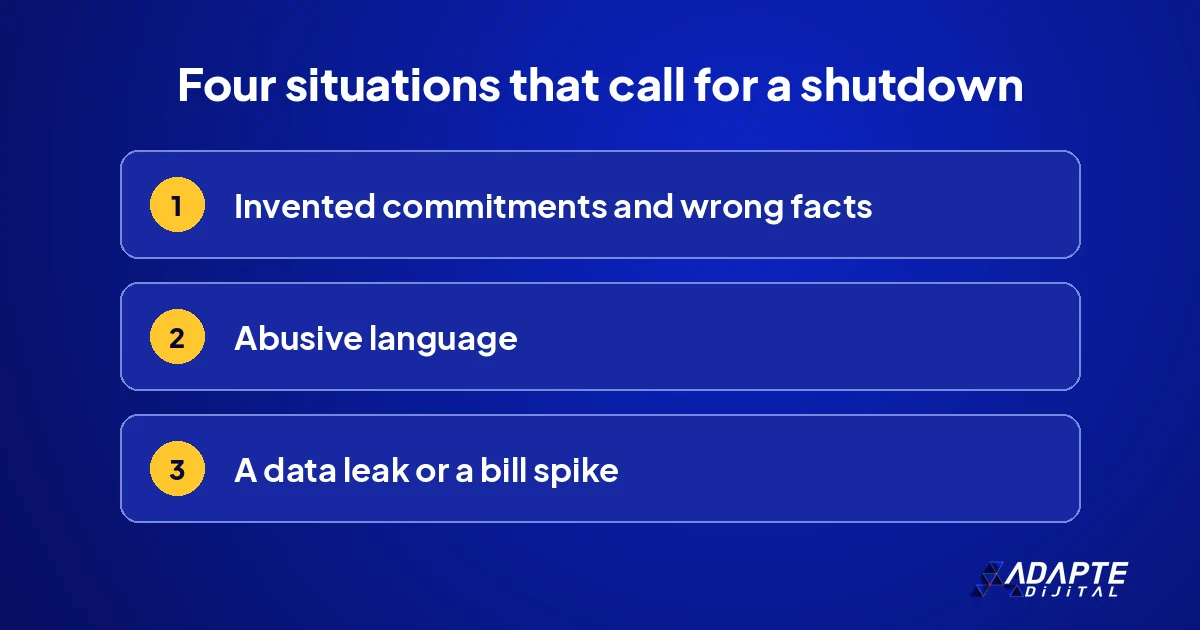
Not every error calls for a shutdown. Four situations do, and they should be written down in advance.
Commitments and wrong information
If the bot says something untrue about price, discounts, returns, guarantees or delivery, it is shut down. In the Air Canada decision in Canada, a tribunal held the company responsible for wrong information given by the bot on its site. What the bot says can be read as what the company says. One wrong answer can be corrected; a repeating pattern is a reason to shut down. ⚖️
Abusive language and provocation
In January 2024 the bot of the parcel company DPD swore at a customer after a system update and wrote a poem criticising the company. The company said it had disabled the AI element of the bot immediately and was updating the system. The lesson runs both ways: after an update the bot must be tested again, and the off switch must be ready.
Data and the bill
If the bot shows one customer another customer’s details, or reveals its internal instructions, it is shut down at once; that is a data incident. If there is an unusual spike on the usage chart it is shut down too; that may be an attack. In both cases waiting enlarges the damage. We describe the billing side in the denial of wallet attack. 🚨
What is done in the first hour?
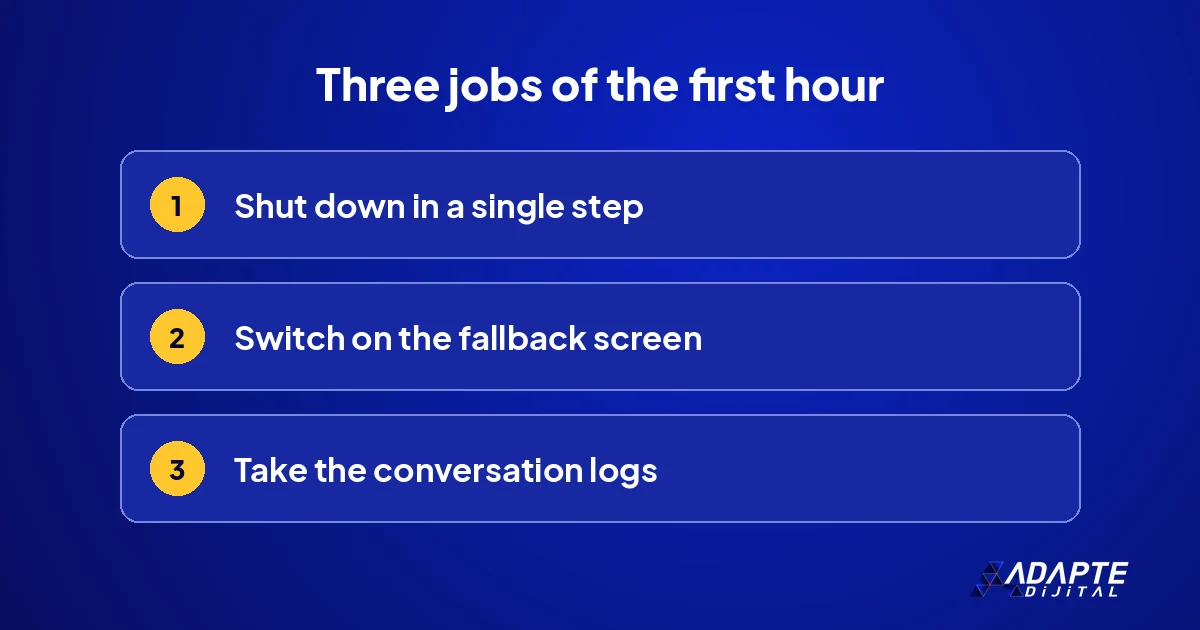
The first hour should not be spent arguing about who does what. A four-line plan is enough.
Records and evidence
Straight after the shutdown the conversation logs are taken: which questions were asked, what the bot answered, and how many people were affected? If no log is kept, finding the affected customers is impossible. Screenshots and times are noted as well. That record is the basis both for the answer given to customers and for the later fix. We describe a similar routine in when an agent makes a mistake, and the log itself in how to keep an agent audit log. 🗂️
What is done after the shutdown?
Shutting down is half the job. The other half looks at the customer, the cause and reopening.
The cause is found
The cause is usually in one of three places: the instructions did not forbid the bot from talking about that subject, an update changed its behaviour, or the bot could reach information it had no authority to reach. The bot is not reopened until the cause is found. By asking the same question again, you test whether the fix holds.
The condition for reopening
The bot is reopened on three conditions: the cause has been removed, the same test has been repeated with a clean result, and this time the way to shut down is written and tested. In the first days the logs are read every day. Forecast: chatbot providers will offer an off switch and a fallback screen as standard features. Update log. 18 November 2026: first publication. Forecasts on this page are re-read when they fall due; one that proves wrong is corrected here, not deleted.
How is the plan prepared in advance?
BU BÖLÜMÜN ÖZETİ
- The cost formula
- The half-page plan
- Five questions asked in an audit
An incident plan is written before the incident. In a small business it takes half a page.
The cost formula
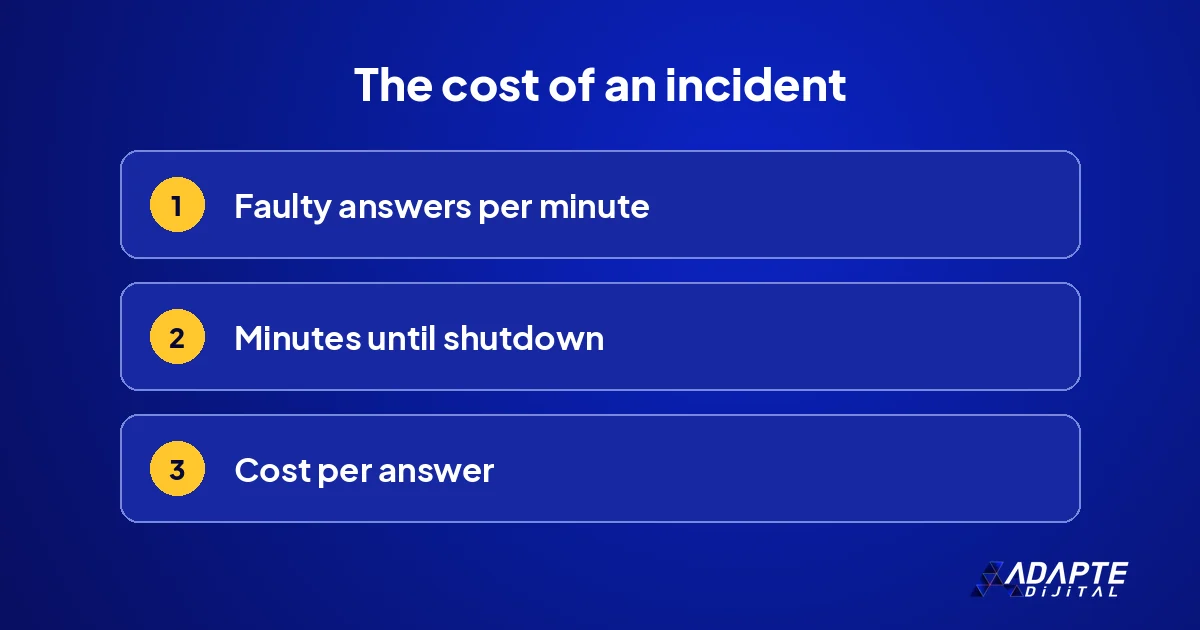
The cost of a bot incident is: faulty answers per minute × minutes until shutdown × cost per answer. The bot’s traffic sets the first multiplier. The third depends on what the bot talks about; discounts and returns are expensive. The multiplier in your hands is the middle one. The gap between twelve hours and twelve minutes is the value of the plan. 🧮
The half-page plan
Four things go into the plan: the reasons for a shutdown, the people with authority to shut down and how, the text of the fallback screen, and a draft of the message to customers. The plan is kept where everyone who uses the bot can reach it. It is rehearsed at a desk once a year. An unrehearsed plan is a document read for the first time on the day of the incident.
Five questions asked in an audit
One: who can shut the bot down, and in how many steps? Two: are the reasons for a shutdown written down? Three: what does the customer see while the bot is off? Four: are conversation logs kept, and who reads them? Five: which subjects can the bot not talk about? We have gathered real cases in chatbot incidents that cost brands. 📋
How does Adapte Digital review the incident plan?
BU BÖLÜMÜN ÖZETİ
- A single delivery package
- What is delivered
- Where to start
In the incident file we actually try to shut the bot down: how many steps does it take, who can do it, and what does the customer see?
A single delivery package
Adapte Digital does not charge a monthly management fee. Work starts with a single delivery package whose scope is written down in advance: 36,000 TRY + VAT. If the work grows, the new need is defined as a separate add-on package, priced by what will be delivered rather than by the hours spent. 📦
What is delivered
The output is a half-page incident plan, the text of the fallback screen and a list of the subjects the bot must not talk about, ready to be used on the day.
Where to start
Our current packages and capacity are listed on our campaign pages; scope and price are written there before any work starts. 🧭
Quick Summary
- Shutting down is not a failure; it is a safety switch.
- A bot is shut down at once in four situations: commitments, abusive language, a data leak, a bill spike.
- Authority to shut down should sit with customer service and take one step.
- In place of a bot that is off, a fallback screen and a way to reach a person are shown.
- A bot is not reopened until the cause is removed and the same test comes out clean.
Short Glossary
- Incident response plan
- An incident response plan is a short document written in advance that says who does what when a problem occurs.
- Partial shutdown
- A partial shutdown is a way of stopping only the risky part of a bot while leaving the rest running.
- Fallback screen
- A fallback screen is the message shown to customers while the bot is off, giving them a way to reach a person.
Frequently Asked Questions
Next Step
Try shutting your bot down today and time it. If it takes longer than a minute, or you had to think about whom to call, the first line of the plan is missing.
Sources: American Bar Association — BC Tribunal Confirms Companies Remain Liable for Information Provided by AI Chatbot · AI Incident Database — Incident 631: DPD chatbot · NIST — AI Risk Management Framework
Updated: November 2026
Sık Sorulan Sorular
The one who notices is usually customer service. The authority to shut down should be theirs too, without waiting for a manager or an agency. The way to shut down should be a single step: a button, a setting or disabling a plugin. If that step is not written down and tested, there is no plan. 🔘
A bot that is off should not leave an empty box. In its place goes a short message and a way to reach a person: a form, an email address or a phone number. That fallback screen is prepared in advance. If a full shutdown is not needed, a partial one is an option: the bot gives only fixed answers to frequent questions. A partial shutdown stops the risk without cutting the service.
Affected customers are sent a short, clear message: what happened, what you are doing and what changes for them. Whether the bot’s promise will be honoured is a business decision; for its legal side, consult a lawyer. Staying silent is the most expensive option; the screenshot is already circulating. 💬
For a single harmless error a correction is enough. If it contains a false commitment or is repeating, shut it down and examine it while it is off.
That is a legal question that varies by case and country; consult your lawyer. As a business decision, most companies find honouring it for a few customers cheaper than arguing.
Ask the agency or service that supplies the bot today. There is always a setting, a plugin or a line of code; write the route down and try it once.