
Denial of Wallet: The Bill for 50,000 Requests Hitting Your AI Server
A denial of wallet attack is a deliberate attempt to inflate the bill of a pay-per-use AI service by sending it heavy traffic. The site does not go down and shows no error. The damage appears on the invoice at the end of the month. 💸
This article describes the attack from the defender’s side only. First comes a fictional scenario, then documented cases, then the cost formula and the defences. The scenario file is fiction. It does not describe a real company; it is written to show how the risk works.
Scenario file: what happens if 50,000 requests arrive in one night?
Picture a mid-sized online store. Its product pages carry an AI box that answers customer questions, and the box can be used without logging in.
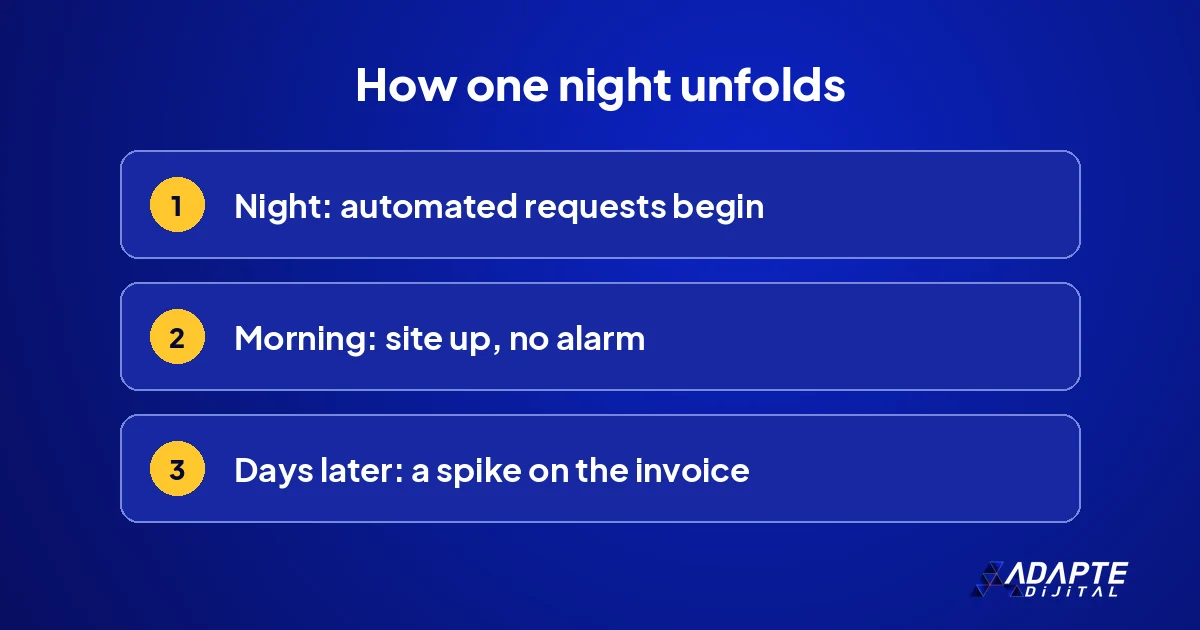
02:10 at night: the traffic starts
A competitor, or simply someone curious, runs a script that sends automated questions to the box. The questions are long and each one asks for a long answer. The site does not slow down, because the server producing the answers is not yours; it belongs to your provider. No alarm rings on the monitoring screen. The alarm was set up to watch whether the site stays online, not what it spends. 🌙
08:30 in the morning: the dashboard opens
In the morning the team finds everything in place. Orders have come in and the site is up. Nobody looks at the provider dashboard, because people log into it once a month, on invoice day. A few days later a warning email arrives and someone looks at the spending chart for the first time. The spike on the chart belongs to that night. By the time it is noticed, the money has already been spent.
What exactly is a denial of wallet attack?
The name is new, but the logic is old: consuming a service whose resources are yours and whose use is someone else’s.
The OWASP definition
OWASP named the tenth item of its 2025 list for large language model applications ‘unbounded consumption’. By its definition, the risk arises when an application lets users make excessive and uncontrolled model calls. The consequences it lists include denial of service, economic loss and degraded service. Denial of wallet is one of the named scenarios under that item.
How it differs from a classic attack
A classic denial of service attack needs large traffic to make a site unreachable. In denial of wallet the target is not availability but pay-per-use pricing. That is why large traffic may not be needed; a small number of expensive requests can be enough. Because the site keeps working, the attack can go unnoticed for a long time. 🎯
Has it actually happened?
Yes. In most documented cases the route is not a site box but a stolen key; the result is the same: someone else uses, you pay.
The attack Sysdig documented
In May 2024 the security company Sysdig published an attack in which stolen cloud credentials were used to reach AI models. The attackers used the models in the account for their own purposes and sold the access on to others. The company also gave the method a name. The victim was paying the bill for a service it did not use. 📄
The lesson from these cases
There are three lessons. First, the attack grows within minutes; a monthly check is not enough. Second, when a key is stolen, no protection on your site comes into play. Third, most victims learn about it from the invoice. A business that does not watch spending in real time is the last to hear about the attack. We explain why smaller businesses became targets in how cyberattacks shifted toward smaller businesses, and we collect more cases in AI bill shock incidents. 🧭
How is the cost worked out?
We do not write the number for you, because prices change by provider and model. The formula does not change.
The cost formula
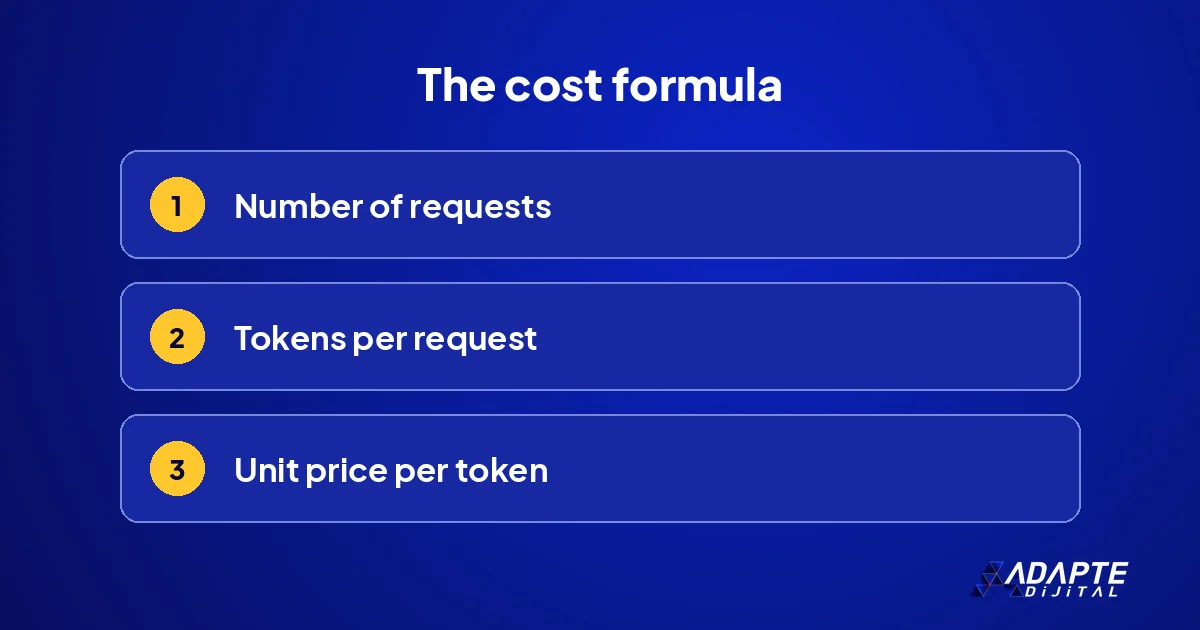
The cost of the attack is the product of three multipliers: number of requests × tokens per request × unit price per token. The attacker sets the number of requests. Tokens per request are set by how long a question your box accepts and how long an answer it gives. The unit price is written on the pricing page of the model you chose. We explain what a token is in what is a token in AI. 🧮
The multiplier in your hands
Two of the three multipliers are in your hands. You can limit question length, cap answer length and choose a cheaper model for simple questions. You can also limit the number of requests per person and per address. If you have done none of these, you have handed every multiplier in the formula to the attacker.
Which defence stops what?
BU BÖLÜMÜN ÖZETİ
- Cap and limit
- Identity and monitoring
- Five questions asked in an audit
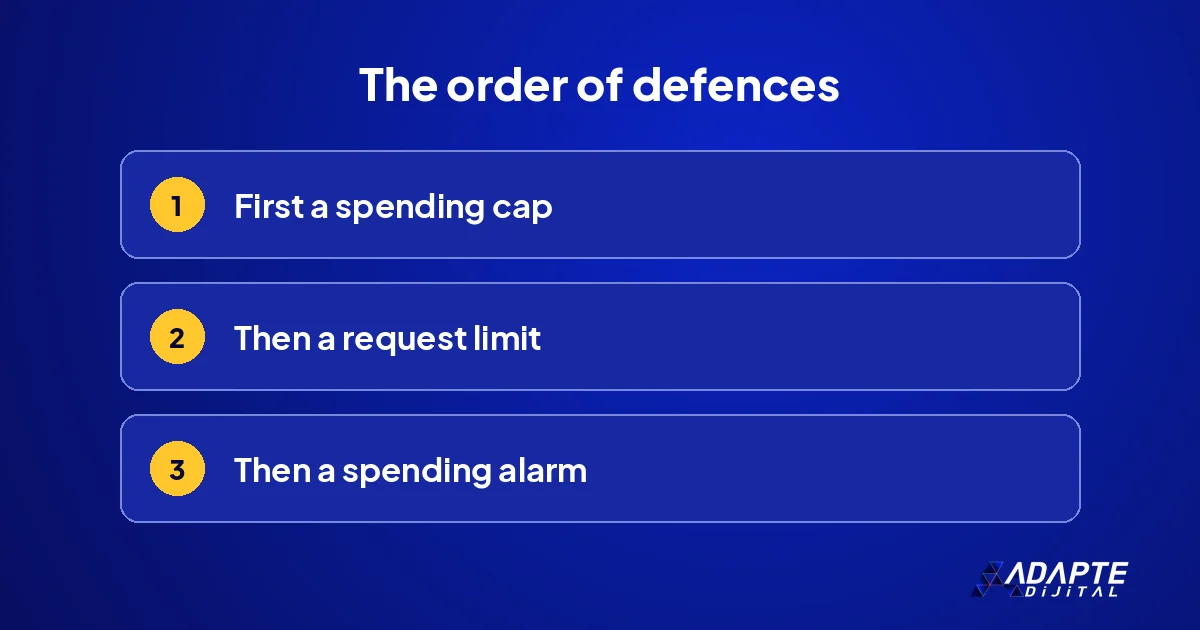
Most defences are not a product you buy but a setting you switch on. Order matters: cap first, then limit, then monitoring.
Cap and limit
The first job is to check whether your provider dashboard has a spending limit and a warning threshold; most do. The second is to put a request limit per person and per address on the box. OWASP also recommends limiting input size, throttling resource-heavy operations and setting timeouts. A cap turns the worst night into a known amount. ⛔
Identity and monitoring
A box open only to logged-in users is far harder to abuse than one open to everyone. If the box must stay public, shorten the question length and watch the hourly usage chart. OWASP recommends continuous logging and monitoring to catch unusual consumption. The alarm should be tied to spending, not only to whether the site is up. Keys are their own subject, which we cover in where AI risk hides in a company.
Five questions asked in an audit
One: does the box work without a login? Two: is there a request limit per person? Three: what is the daily spending cap? Four: does the box close by itself when the cap is passed? Five: who watches the dashboard, and how often? Forecast: as AI boxes spread, this attack will become ordinary and hosting services will make a spending cap the default setting. Update log. 18 November 2026: first publication. Forecasts on this page are re-read when they fall due; one that proves wrong is corrected here, not deleted.
How does Adapte Digital review this risk?
BU BÖLÜMÜN ÖZETİ
- A single delivery package
- What is reviewed
- Where to start
The attack file is the most concrete part of the audit: endpoints are listed, limits are tested and missing settings are written down.
A single delivery package
Adapte Digital does not charge a monthly management fee. Work starts with a single delivery package whose scope is written down in advance: 36,000 TRY + VAT. If the work grows, the new need is defined as a separate add-on package, priced by what will be delivered rather than by the hours spent. 📦
What is reviewed
The AI boxes on the site, the places where keys are stored and the limits in the provider dashboard are checked one by one, and each gap is recorded with the setting that closes it.
Where to start
Which packages are open, and at what price, is shown on our campaign pages, item by item. 🧭
Quick Summary
- A denial of wallet attack does not take the site down; it grows the bill.
- OWASP defines the risk as unbounded consumption in its 2025 list.
- Sysdig documented use worth tens of thousands of dollars a day through stolen credentials.
- Cost: number of requests × tokens per request × unit price per token.
- Order of defences: spending cap, request limit, an alarm tied to spending.
Short Glossary
- Unbounded consumption
- Unbounded consumption is the security term for an AI application letting users make an uncontrolled number of model calls.
- Request limit
- A request limit is a setting that restricts how many requests one person or address can send in a given time.
- Spending cap
- A spending cap is a limit that sets the highest amount an account can spend in a given period.
Frequently Asked Questions
Next Step
Check one thing today: is a spending limit switched on in your provider dashboard? If it is not, switch it on before reading the rest of this article.
Sources: OWASP Gen AI Security Project — LLM10:2025 Unbounded Consumption · Sysdig — LLMjacking: Stolen Cloud Credentials Used in New AI Attack · Sysdig — 2024 Global Threat Year-in-Review
Updated: November 2026
Sık Sorulan Sorular
What was missing was not an advanced security product. Three simple settings were missing: a request limit per person, a daily spending cap, and a rule that closes the box when the cap is passed. There was also no owner; the dashboard was a place everyone could reach and nobody watched. This is an attack on neglected settings. 🔧
The cost of an ordinary page request is tiny. With an AI call, cost grows with the length of the question and the answer. By asking long questions, the attacker sets the cost. If the box is open to everyone and asks for no login, nothing stands between the one who sends the request and the one who pays the bill.
By Sysdig’s estimate, the use in the first case could cost the victim more than 46,000 dollars a day if it went unnoticed. The company’s 2024 year-end report says that with newer models this can pass 100,000 dollars a day, and describes one victim left owing 30,000 dollars after three hours. These figures belong to large cloud accounts; a small business has a lower ceiling, but the proportion is the same.
One test is enough to find your own figure. Ask your box the longest question it accepts and check in the dashboard how many tokens that call used. Multiply that by 50,000 and by the unit price of your model. The result is the upper limit of one night without protection. A business that does this sum once knows where to set its cap.
It can. Much of this starts with automated scanning; a script does not check who owns the box. On a small site, having no cap makes the damage proportionally larger.
Do not count on it. Providers decide case by case and it is not defined as a right. What you can count on is a cap set in advance.
Partly. It can reduce the traffic-driven part; it does not stop use through a stolen key. That route needs key management and spending monitoring.